How to read a watch: three questions before the brand name
Read purpose, power and function separately, then bring them together in one clear description.+
Introductory visual literacy with reference-specific examples. Catalogue descriptions do not establish the condition, authenticity or suitability of an individual watch.
Reading time
4 minutes
Guide reviewed
2026-10-04
Begin with purpose, not prestige
Before reading a logo, look at what the watch makes easy. Can you identify the minute hand immediately? Is there an obvious scale for measuring an interval? Does the case appear compact, broad, long or thick? These questions turn a photograph into something to investigate. Labels such as dress, dive and pilot describe overlapping design traditions; they do not tell you everything about the mechanism or establish a ranking of quality.
The Rolex Submariner reference 124060 is a useful concrete example. Its broad hands, luminous markers and rotating minute scale make time and elapsed-time readings prominent. First describe those visible choices; only then consult the maker’s specifications. A familiar underwater silhouette does not establish the present water resistance of an individual watch, and a photograph cannot tell you how its bracelet feels on your wrist.
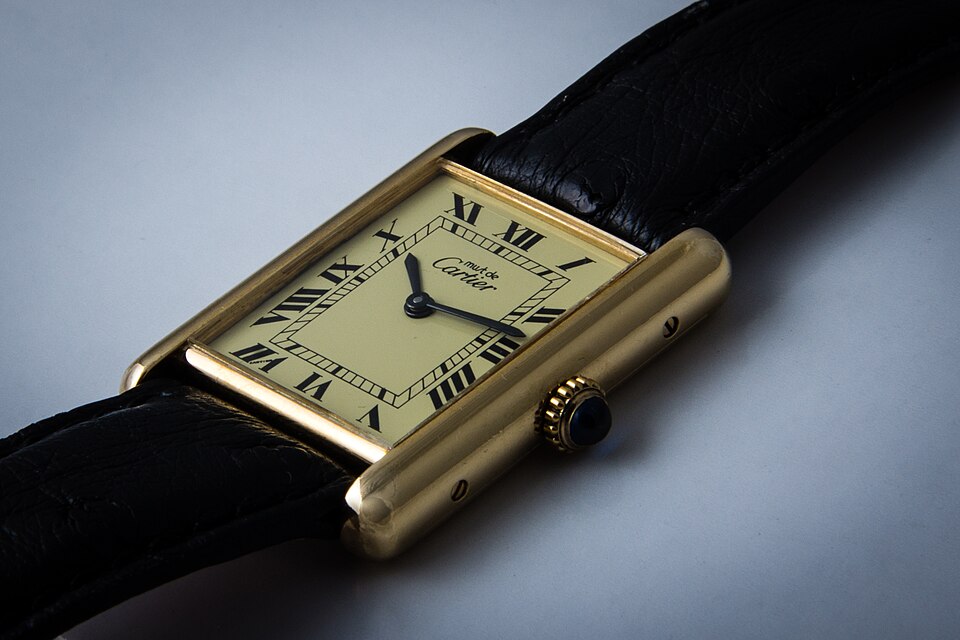
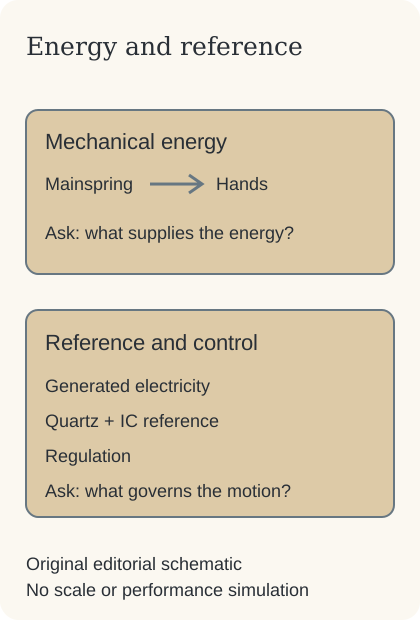
Mechanical watches store energy in a mainspring. Manual winding replenishes it through the crown; automatic winding adds a weight that moves with the watch. Both remain mechanical. Quartz describes an electronic timing reference, while analogue describes a display with hands. The two words answer different questions. Cartier’s user guide identifies the Tank Must WSTA0041 as quartz: its traditional-looking hands do not make it a mechanical watch.
Keep a second distinction in mind: the energy supply is not the same thing as the regulating system. A light-powered watch can still be quartz. A watch’s power reserve describes its available running time under stated conditions, not its daily accuracy. If an unfamiliar specification combines several terms, separate them into energy, regulation and display before deciding that the description is contradictory.
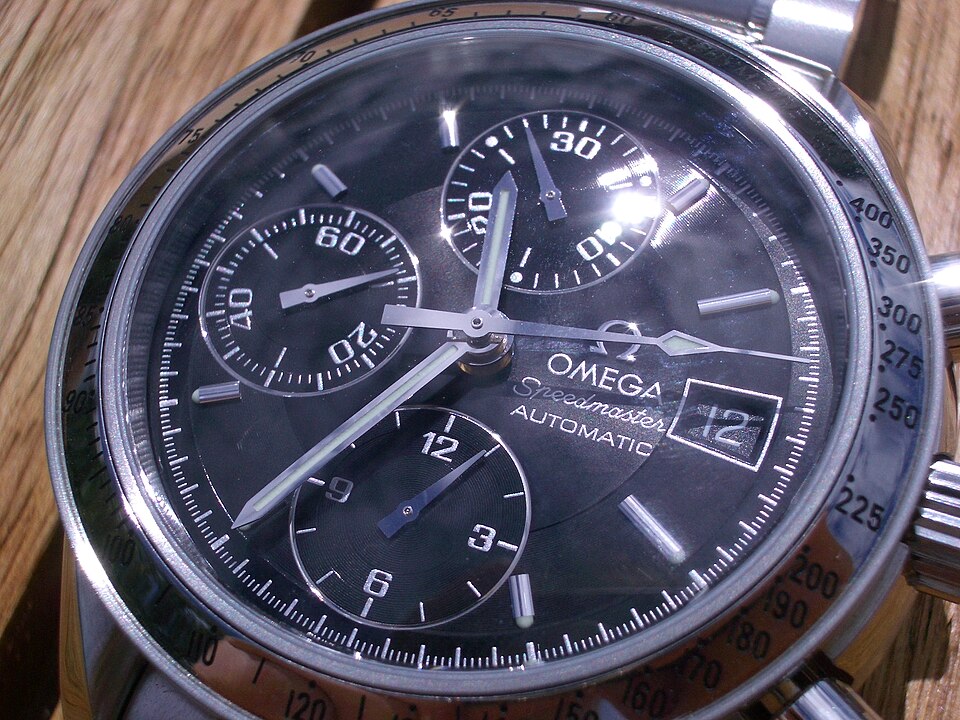
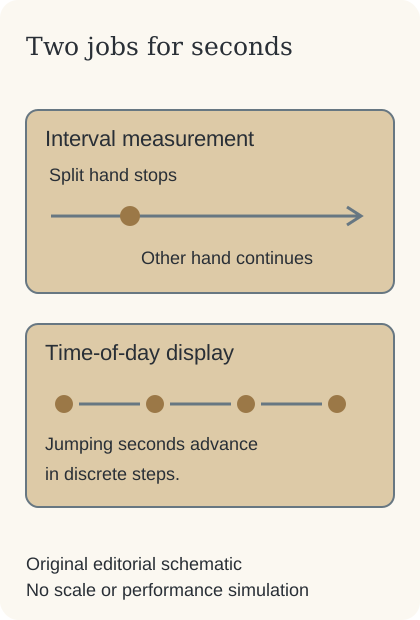
A complication provides something beyond straightforward time indication. A chronograph measures an interval; a calendar supplies date information; a travel display follows another time zone. A chronometer label concerns tested timekeeping performance. A watch may be both a chronograph and a chronometer, but neither term implies the other. The useful question is what each hand, window or scale actually communicates.
Do not assume a long central seconds hand always shows ordinary running seconds, or that every small dial is a chronograph counter. Nor does an exposed mechanism necessarily add a function: opening the dial changes what you can see. Read the model description and its diagram before touching controls. Identifying a pusher visually is different from knowing which operation it safely performs.
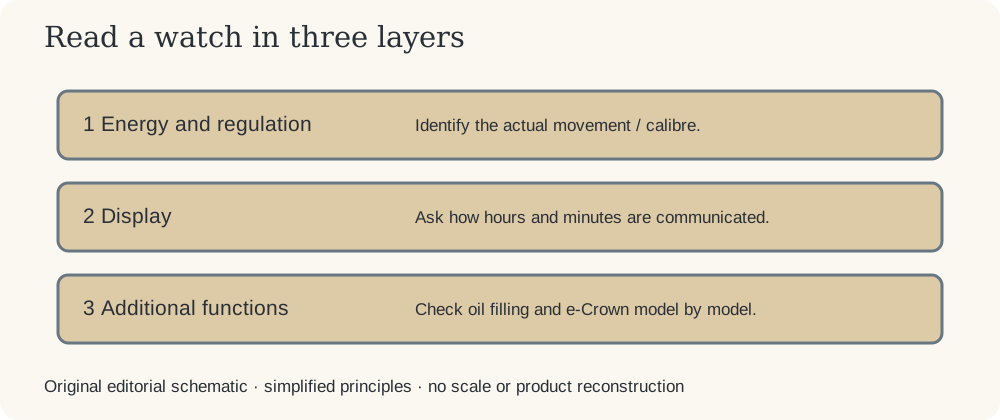
Try three separate sentences. First describe the appearance: a rectangular case, two hands and a restrained dial, for example. Next record the documented movement type and exact reference. Finally list the stated functions. This simple method keeps observations separate from specifications and prevents a nickname from doing the work of an identification.
Compare the quartz Tank Must WSTA0041 with the self-winding Submariner 124060. Both use hands, but their energy systems and reading priorities differ. The Submariner’s bezel adds an elapsed-time reference without turning the watch into a chronograph. A comparison can explain these differences without deciding that one watch is inherently more serious. It can also mark what remains unknown: condition, fit and service history need evidence beyond a catalogue.
Calibre means the movement design or designation. The crown is a control used for setting and, on many mechanical watches, winding. A pusher is a separate control pressed to operate a function. An aperture is an opening in the dial through which information appears. The crystal is the transparent cover; lugs are the projecting attachments that help hold a strap or bracelet.
Use these words to describe relationships rather than to decorate a sentence. “A date aperture at three o’clock” locates a display. “The crown is on the right” locates a control. Neither statement proves how the calendar is adjusted. Learning the nouns should make your next question more precise, not make an uncertain identification sound certain.
Choose an official image of a watch and write down three things you can see, three things its specifications establish, and one thing you cannot know from either. Then ask: does a watch with hands have to be mechanical? Does a rotating timing bezel make it a chronograph? Does a longer reserve prove better accuracy? The answers are no, no and no; each confuses separate categories.
Finish with one honest sentence: “This is a [movement type] watch, reference [identifier], showing [functions], with [one observed design detail].” Leave a blank where the evidence is missing. This is a reading exercise; there is no need to wind, open, immerse or test a watch to complete it.
Continue to Mechanical, quartz and Spring Drive for the energy chain, then Chronograph and chronometer for timing vocabulary. Use Dive watches and water resistance when a bezel or depth rating catches your eye. Finally, read Watchmaking beyond the logo to separate the maker, collection, reference and calibre. Return to the same photograph afterwards: the aim is to notice more, not simply memorise more names.
Original educational explanation. Section sources support technical and historical statements; comparisons, reading paths and paper exercises are editorial teaching devices. These pages are not operating manuals, authentication reports or purchase recommendations. Source review dates are inherited from the supplied research packet; the review export does not claim fresh verification.
Primary sources linked below support the historical and technical account. Observational questions and explanatory comparisons are original editorial interpretation.
Primary sources linked below support the historical and technical account. Observational questions and explanatory comparisons are original editorial interpretation.
02Watch concepts
Mechanical, quartz and Spring Drive
A movement is the timekeeping engine. Understanding its energy source and regulator makes its behaviour much easier to explain.+
Educational overview. Specifications and operating instructions vary by exact reference and production period.
A useful comparison starts with four questions
Ask what supplies the energy, what establishes the timing reference, how the time is displayed, and what the exact calibre promises. Manual and automatic describe winding; they are not competing kinds of oscillator. Likewise, light power describes an electrical supply and does not stop the movement being quartz. Spring Drive retains a spring-powered train but uses electronic reference and braking. A single badge rarely answers all four questions.
Use the movement lab above to follow those separate paths. Then turn to the individual instructions for winding, charging and setting. A movement family is useful for understanding principles; an owner’s routine depends on the reference, including whether the seconds hand stops during setting, how its calendar should be adjusted, and which reserve indication it provides.
An accuracy figure needs a time interval and a test context. Grand Seiko’s mechanical comparison distinguishes a tested mean daily rate from normal usage accuracy. Its 9F quartz table states an annual accuracy specification. Comparing the bare numbers while dropping “per day” or “per year” produces an answer to a question no manufacturer actually asked.
For an arithmetic illustration, a hypothetical constant gain of 3 seconds a day would accumulate to 21 seconds over seven days. That calculation does not predict a real watch: rate may vary with conditions. Nor should an annual tolerance simply be divided into a guaranteed daily result. Check the stated conditions and reference before drawing a performance comparison.
Power reserve asks how long the movement can continue under specified conditions after winding or charging. Accuracy asks how well its time agrees with a reference. A long reserve and a small timing deviation measure different achievements. A spring-powered watch left for the weekend may stop; a light-powered watch kept in a dark drawer may need a charging plan. Neither event alone identifies a defect.
Start with the current instructions, rather than a generic number for the movement family. Reserve, power saving and charge warnings differ between calibres. Citizen, for example, describes an insufficient-charge indication in which the seconds hand advances in two-second intervals. An unusual step pattern can carry an operational message; it should not automatically be read as evidence of a different movement type.
This is an original owner-observation exercise, not a laboratory test. Compare with the same reliable time reference at roughly the same time each day. Record the watch’s offset, elapsed time, whether it was reset, approximate wearing hours and how it rested overnight. Keep identifying numbers private. Several ordinary observations are more informative than one hurried glance.
Use signed offsets: plus means the watch is ahead, minus means behind. If a watch is 4 seconds ahead on Monday and 13 seconds ahead at the same time on Thursday, with no reset, its offset changed by 9 seconds in three days: an observed average gain of 3 seconds a day over that interval. The result describes that interval and your reading method. It does not locate a fault, certify the movement or reveal its performance in unobserved positions.
For a high-accuracy quartz watch, daily reading uncertainty may be larger than the change you are trying to observe. Keep the observation period and uncertainty in view. If there is a persistent marked change from familiar behaviour, share the record with a service provider. Do not open the case or adjust regulating components as part of this exercise.
Original editorial exercise and owner questions; no diagnostic or certification claim.
A smooth hand is a display clue
Grand Seiko explains that its 9F seconds hand receives two rapid pulses per second which appear as one step to the eye. Its Spring Drive system produces a continuous glide through electronic braking. Those are documented implementations, not a universal visual identification key. A photograph or a short video may hide the very timing detail the viewer thinks it proves.
Finish by matching the mechanism to a routine, rather than declaring one family the winner. Consider winding or charging, intended use, the setting experience and realistic care. Follow the connected guides for the difference between a chronometer test and everyday observation, and for agreeing a service brief. Understanding a movement should make ownership calmer and more precise.
In a conventional mechanical movement, a wound mainspring stores energy. Gears convey that energy, the escapement releases it in controlled increments, and the balance and spring establish the rhythm. Hand-wound watches ask the wearer to replenish the spring through the crown. Automatic watches add an oscillating weight that can wind it through movement of the wrist. Neither system creates energy from nothing.
The practical question is not which label sounds more sophisticated, but how the mechanism fits a routine. Someone rotating several watches will experience winding and setting differently from someone wearing one watch daily. A display back can make the energy path more visible, but visibility is not itself a performance certificate.
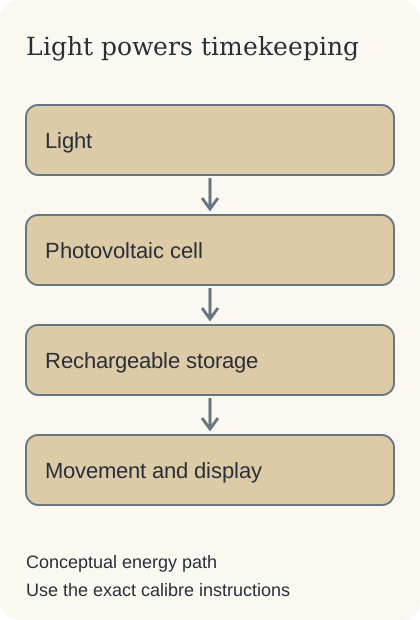
A quartz oscillator provides an electronic timing reference. Hands do not prove that a watch is mechanical: analogue quartz watches use an electrically driven motor and a gear train. Citizen’s Eco-Drive is an instructive charging example. Light is converted to electricity and surplus energy is stored in a rechargeable cell. “Solar” therefore describes the energy supply, rather than a competing form of time indication.
A light-powered watch still needs appropriate charging conditions. Its reserve in darkness, charging time and power-saving behaviour depend on the calibre. “No routine battery replacement” should not be stretched into a claim that every component lasts indefinitely or the watch never needs attention.
Grand Seiko’s Spring Drive is powered by a mainspring, but regulates the motion through a quartz reference, an integrated circuit and electromagnetic braking. The unwinding spring also generates the small electrical supply for that regulating system. The result is the characteristic continuously gliding seconds hand. It is best explained on its own terms rather than squeezed into the ordinary battery-quartz versus traditional-mechanical distinction.
Grand Seiko introduced its 9R Spring Drive in 2004. Individual calibres differ, so precision, reserve and winding information should always be checked at reference level. A movement family explains a principle; it does not guarantee that every watch carrying the name has identical specifications.
Primary sources linked below support the historical and technical account. Observational questions and explanatory comparisons are original editorial interpretation.
Primary sources linked below support the historical and technical account. Observational questions and explanatory comparisons are original editorial interpretation.
Primary sources linked below support the historical and technical account. Observational questions and explanatory comparisons are original editorial interpretation.
A chronograph supplements ordinary time indication with a timer that can be started, stopped and reset. On many analogue models, the long central seconds hand belongs to the chronograph, while a smaller subdial carries continuously running seconds. Reading a photograph without identifying these roles can make a perfectly functioning watch seem stopped. The number and arrangement of counters vary; do not assume every counter records the same interval.
A flyback lets the running chronograph return to zero and begin another interval in a single operation. It is useful for successive measurements. A split-seconds, or rattrapante, uses an additional chronograph hand to record an intermediate reading while the main elapsed-time measurement continues. These solve different problems: restarting a measurement is not the same as holding an intermediate time.
Patek Philippe’s technical explanations provide concrete examples of flyback architecture and a history of split-seconds wrist chronographs. The name on the dial alone does not tell you the safe operating sequence. Ordinary chronographs should not be treated as flybacks; consult the model’s instructions before pressing reset during timing.
A chronometer label relates to precision testing. COSC tests mechanical and quartz instruments under programmes appropriate to their construction; its mechanical certification uses defined positions and temperatures. A laboratory result is meaningful evidence about a stated test, not a promise that an owner will see the same deviation every day in every circumstance.
Ask which organisation tested the watch, whether the programme concerns the movement or the completed watch, and what limits apply to that particular certification. Do not turn the familiar mechanical daily-rate figures into a universal rule for quartz or every modern testing scheme. Equally, an uncertified watch is not automatically inaccurate: absence of a particular certificate is different from a measured failure. These distinctions make technical comparisons more useful than reading “chrono” as a general synonym for quality.
Primary sources linked below support the historical and technical account. Observational questions and explanatory comparisons are original editorial interpretation.
Primary sources linked below support the historical and technical account. Observational questions and explanatory comparisons are original editorial interpretation.
Primary sources linked below support the historical and technical account. Observational questions and explanatory comparisons are original editorial interpretation.
Primary sources linked below support the historical and technical account. Observational questions and explanatory comparisons are original editorial interpretation.
04Watch concepts
Date, annual calendar and perpetual calendar
Understand what the mechanism remembers, what the dial displays and when the owner still has to intervene.+
Calendar principles and reference-specific examples, checked 4 October 2026. No universal setting sequence is supplied; the exact watch manual governs adjustment.
Reading time
4 minutes
Guide reviewed
2026-10-04
Start with the month-end problem
A basic mechanical date display usually follows a 31-day cycle. After a 30-day month, it needs help to reach the first of the next month; February also needs correction. An annual calendar handles the difference between 30 and 31 days but leaves the February-to-March transition to its owner. These descriptions assume that the watch has stayed running and remains correctly set. A stopped watch does not continue remembering the passing days by itself.
Patek Philippe introduced its Annual Calendar in 1996. Its 5205 provides a useful display example, with day, date and month arranged in three apertures. Those windows tell you what information is visible, not how much calendar logic lies underneath. A complete calendar can show day, date and month without automatically managing their irregular lengths. Read the mechanism’s description instead of counting indicators.
A conventional perpetual calendar incorporates the four-year leap-year pattern. The Gregorian rule is slightly more demanding: years divisible by four are leap years, except century years that are not divisible by 400. Thus 2000 and 2400 qualify, while 2100 does not. A mechanism programmed only for the four-year cycle needs help at that exception. “Perpetual” is a watchmaking category, not a promise that every such watch handles every future date.
IWC’s Big Pilot’s Watch Perpetual Calendar IW503605 offers a clear example. Its 2021 technical release describes connected indications adjusted from one crown and identifies 2100 as a correction point. The four-digit year display does not remove that limitation. Showing a year and calculating every rule associated with that year are different engineering tasks; a generous display range should never be mistaken for an unlimited calendar programme.
Before correcting a calendar, identify the exact reference and calibre, find the matching instructions, and check the permitted adjustment times and directions. There is no safe universal shortcut based on the words annual or perpetual. If the indications disagree or the correct procedure is unclear, stop and ask the manufacturer or a qualified watchmaker rather than experimenting with the correctors.
Designs can change substantially while retaining familiar-looking dials. IWC’s 2026 ProSet, using calibre 82665, explicitly adds synchronised forward and backward crown adjustment. That is a property of this construction, not permission to reverse an older IWC calendar. The contrast shows why a current brand overview cannot replace the manual belonging to the watch in front of you.
The same result can come from different mechanisms
Mechanical calendar programmes encode information through the shapes and relationships of parts. One approach starts from a long month and advances past dates that should not appear. MB&F describes a different approach in the Legacy Machine Perpetual, developed with Stephen McDonnell: begin with a 28-day baseline, then add the extra days required. Both approaches aim to keep the displayed date aligned with the calendar, but they need not share the same construction or setting behavior.
Display design is another independent choice. Patek Philippe’s 5236 groups day, date and month into one broad in-line aperture. It can look more visually compact than a calendar with several subdials while still carrying a perpetual mechanism. A calm dial is not evidence of a simple movement; a crowded dial is not proof of a more capable calendar.
Date means the numbered day of the month; weekday identifies Monday through Sunday. A leap-year indicator tells you the mechanism’s position in its four-year programme. A corrector is a control for changing an indication, not an invitation to press it whenever convenient. “Instantaneous” describes the manner of a display change; it does not, by itself, identify an annual or perpetual calendar.
A moon-phase display follows a different cycle: the Moon’s changing illuminated appearance. It is not simply a date display with a picture. A maker’s theoretical moon-phase error interval assumes appropriate running and setting; it is not the watch’s power reserve, service interval or guarantee of centuries without intervention. Keep civil-calendar logic, astronomical indication and maintenance on separate lines of your notes.
On paper, imagine correctly set, continuously running examples of a simple date, an annual calendar and a conventional four-year perpetual. What happens after 30 April? The simple date needs correction; the other two should recognise the short month. What happens at the end of an ordinary February? The annual needs correction, while the perpetual should handle the change. What is special about February 2100? The century exception exceeds the ordinary four-year programme.
Now look at a calendar photograph and ask what evidence would distinguish those three mechanisms. The answer is a reliable reference-level description or manual, not the number of windows. Do not create these scenarios by advancing an unfamiliar real watch: the paper comparison teaches the principle without imposing an operating sequence.
Read the Patek Philippe and IWC profiles for contrasting calendar traditions, then Servicing and restoration for the difference between maintaining a mechanism and preserving an object. If a calendar is combined with travel time, use the GMT reading-room study next. Ask which time display drives the date; the answer belongs to the particular calibre, not to the GMT label alone.
Original educational explanation. Section sources support technical and historical statements; comparisons, reading paths and paper exercises are editorial teaching devices. These pages are not operating manuals, authentication reports or purchase recommendations. Source review dates are inherited from the supplied research packet; the review export does not claim fresh verification.
Official indexed passage read; direct page retrieval failed. Used only to distinguish day/date/month display from automatic month-length management. No annual-calendar leap-year wording or operating instructions are imported.
Primary sources linked below support the historical and technical account. Observational questions and explanatory comparisons are original editorial interpretation.
Primary sources linked below support the historical and technical account. Observational questions and explanatory comparisons are original editorial interpretation.
Primary sources linked below support the historical and technical account. Observational questions and explanatory comparisons are original editorial interpretation.
05Watch concepts
Dive watches and water resistance
Read the timing instrument, the manufacturer’s rating and the present condition as three connected questions.+
Educational watch literacy, not diving instruction or permission to expose a specific watch to water. Manufacturer instructions, current condition and appropriate professional assessment take priority.
Reading time
4 minutes
Guide reviewed
2026-10-04
What makes the category useful
A diving watch combines resistance to water entry with features intended to make underwater timing usable. The Federation of the Swiss Watch Industry distinguishes ISO 22810, covering water-resistant watches, from ISO 6425, covering diver’s watches. The latter involves more than a depth number: legibility, a dive-time indication and resistance to relevant stresses matter too. An underwater appearance alone does not establish that a watch meets a named standard.
Separate three questions when reading a description. What has the manufacturer claimed for this reference? Which test or standard supports that claim? What evidence exists about this individual watch’s present condition? A specification answers the first question; it cannot, by itself, answer the third. Nor should you describe a model as independently certified unless the documentation actually identifies such certification.
On a typical elapsed-time bezel, the starting marker is aligned with the minute hand. As the hand moves, its position against the bezel shows minutes since the start. Imagine starting at 10:10 and looking again at 10:25: the indicated interval is 15 minutes. This is a different reading from the ordinary time shown against the fixed dial, even though the same minute hand participates in both.
A 60-minute scale repeats after an hour; it does not independently count elapsed hours. A conventional unidirectional elapsed-time bezel turns so that an accidental movement normally makes the displayed interval larger, not smaller. That conservative direction reduces one type of reading error; it is not a complete safety system. The bezel does not measure remaining gas, depth, exertion or decompression obligations. Treat it as an elapsed-time scale, never as a substitute for dive training, planning and appropriate equipment.
The number marked in metres or bar describes a water-resistance specification associated with testing. It should not be converted into a universal permission table for every activity or every watch. The manufacturer’s instructions, the precise model, crown and pusher requirements, and the watch’s condition remain important. A historic rating on a vintage dial does not establish how its seals perform today.
Water-resistance checks belong with an appropriately equipped professional. A test provides evidence about the condition tested, rather than an everlasting guarantee. If the service history is unknown or something appears damaged, resolve that uncertainty before water exposure. The strap and its attachment also deserve attention: keeping water out of the case and keeping the watch on the wrist are separate practical requirements.
Rolex’s modern Submariner guide describes the secured screw-down crown and warns against unscrewing it underwater. The guide also distinguishes the standard Submariner from the Date version. This is useful evidence about those models, not proof that every watch with a screw-down crown has the same rating or operating rules.
Seiko’s diver-specific 4R35/4R36 manual asks the owner to check winding, crown security, bezel function and band attachment before diving, and prohibits operating the crown or buttons underwater. A watch with a related movement name may belong to a different category, so match the whole manual to the watch. Follow its aftercare directions only when the watch is in the condition those directions assume; do not immerse an uncertain vintage or damaged example as a cleaning experiment.
Water resistance concerns resistance to water entry under stated conditions. A pressure test checks that capability through a defined procedure. A gasket is a sealing component. The bezel is the ring around the dial; on a dive watch it may carry the elapsed-minute scale. Luminous markings help a reading in darkness, but their mere presence says nothing about certification.
Elapsed time means the interval since a chosen start. It is not remaining time unless a separate calculation establishes a limit. A 24-hour travel bezel serves a different reading system from a 60-minute dive bezel. Before discussing colour, finish or heritage, identify the scale’s units and purpose. Similar-looking rings can ask the wearer to perform very different tasks.
Draw a simple dial and put a starting marker at the ten-minute position. Move your imagined minute hand to twenty-five minutes: the elapsed reading is 15. Shift the starting marker five minutes backwards around the dial: the reading becomes 20. This explains the intended conservative effect without handling a watch, entering water or treating a schematic as dive instruction.
Now consider an old diver with a clear depth marking but no known service record. Can the marking alone establish that it is ready for swimming? No. And if a modern watch has a large depth rating but its manual forbids underwater pusher use, does the number override the warning? Again, no. Capability and permitted operation must be read together.
Read the Rolex and Blancpain profiles for different historical approaches to underwater watches. Continue to Case materials and finishing for the distinction between scratch resistance, corrosion resistance and impact vulnerability. Finish with Servicing and restoration when the subject is an actual older watch. These readings add context; a condition assessment and the correct manual still come before a water-use decision.
Original educational explanation. Section sources support technical and historical statements; comparisons, reading paths and paper exercises are editorial teaching devices. These pages are not operating manuals, authentication reports or purchase recommendations. Source review dates are inherited from the supplied research packet; the review export does not claim fresh verification.
Primary sources linked below support the historical and technical account. Observational questions and explanatory comparisons are original editorial interpretation.
Primary sources linked below support the historical and technical account. Observational questions and explanatory comparisons are original editorial interpretation.
Primary sources linked below support the historical and technical account. Observational questions and explanatory comparisons are original editorial interpretation.
06Watch concepts
Tourbillons and chiming watches: two kinds of complexity
Separate a rotating regulating assembly from the mechanisms that translate time into sound.+
Introduces common tourbillon and striking principles. Chiming sequences and operating restrictions are reference-specific. No measured performance or sound-quality superiority is claimed.
Reading time
4 minutes
Guide reviewed
2026-10-04
What a tourbillon actually changes
Abraham-Louis Breguet received the French tourbillon patent on 26 June 1801. The idea placed the balance and escapement in a rotating carriage, allowing some position-related rate errors to be distributed over its rotation. The historical problem was especially relevant to watches held for long periods in particular orientations. A tourbillon changes the arrangement of the regulating assembly; it does not make gravity disappear.
It is worth separating the patent from a finished commercial watch. Breguet’s archive describes experimental work and later commercialisation, illustrating that a dated invention is one step in a longer manufacturing story. Today an exposed cage can reveal remarkable construction and finishing. Its visibility alone proves neither a particular daily rate nor superiority over an ordinary well-adjusted watch. Accuracy needs evidence about the complete instrument and the conditions under which it was tested.
A minute repeater sounds the displayed time on demand. In a common quarter-based system, low notes count hours, paired notes count completed quarters, and high notes count the remaining minutes. At 3:47, listen for three hour notes, three quarter pairs and two final minute notes. The quarter pairs represent 45 minutes; the final two bring the total to 47. This is a reading convention, not the pattern of every chiming watch.
Tiny hammers strike sounding elements called gongs. The mechanism must read the time and deliver the correct sequence, while the acoustic construction makes those strikes audible and distinct. When listening to an official recording, ask whether you can separate the groups and follow the rhythm. Recording equipment and playback volume prevent a reliable loudness ranking between watches heard in different videos.
A repeater responds to a request; a sonnerie sounds automatically as time passes. In the conventional scheme described by Patek Philippe, a grande sonnerie repeats hours with the quarters, while a petite sonnerie sounds the quarters without repeating the hour count each time; it still strikes the full hour when that hour arrives. Silent modes and combinations vary. The name identifies a function, not every detail of its control system.
An alarm serves another purpose: it draws attention to a chosen time. Jaeger-LeCoultre’s Master Control Memovox Timer Q410257J can express that choice as a target time or a number of hours until the alarm. That is different from a repeater reporting the current time. Start by asking what causes the sound: the wearer’s request, the passing hour, or a preset reminder.
Breguet’s Classique Tourbillon Extra-Plat 5367 places its tourbillon near five o’clock, balanced visually by an offset hour chapter. Use it to distinguish the visible rotating assembly from the hands that actually provide the time reading. The opening is informative, but it is not an extra calendar or timer. A complicated construction can coexist with a deliberately sparse display.
Patek Philippe’s 6301P combines grande sonnerie, petite sonnerie and a minute repeater. Here the interesting question is how several sound functions inhabit one watch. Compare that problem with the 5367’s rotating regulator, rather than reducing both to a single measure of complexity. Part count, acoustic character, ease of reading and measured timekeeping performance answer different questions and should be assessed separately.
Carriage or cage: the rotating structure supporting the tourbillon assembly. Balance: the oscillating part that works with its spring as a mechanical timing element. Gong: a sounding element struck by a hammer. Repeater: an on-demand time-striking function. Sonnerie: an automatic striking function. Quarter: a completed fifteen-minute division of the hour in the common repeater system.
These definitions are a starting point for observation, not instructions for a slide, selector or crown. Never infer a safe operating sequence from a video of a different reference. If permitted actions during striking are unclear, leave the controls alone until the exact manual or a qualified specialist resolves the question.
On paper, decode this imagined quarter-based sequence: four low notes, two quarter pairs, then seven high notes. Four hours plus thirty minutes plus seven minutes gives 4:37. At 6:00 there would be six hour notes and no completed quarters or additional minutes. These examples explain the counting system; an actual watch may use different tones or a different striking architecture.
Now test three statements. “Every visible balance is a tourbillon” is false: the rotating carriage is the distinguishing arrangement. “A repeater is an alarm” is false: their triggers and messages differ. “A tourbillon guarantees a better daily rate” is unsupported without comparative measurements. A satisfying explanation should say what the mechanism does and what evidence would be needed for a stronger claim.
Begin with Escapements and regulation to understand the balance and the release of energy, then read Breguet for the tourbillon’s historical setting. Use the Patek Philippe profile for the relationship between calendars and sound. The extended Jaeger-LeCoultre study provides another view of functional invention. Keep the categories separate as you explore; a watch can combine them without making them synonymous.
Original educational explanation. Section sources support technical and historical statements; comparisons, reading paths and paper exercises are editorial teaching devices. These pages are not operating manuals, authentication reports or purchase recommendations. Source review dates are inherited from the supplied research packet; the review export does not claim fresh verification.
Primary sources linked below support the historical and technical account. Observational questions and explanatory comparisons are original editorial interpretation.
Primary sources linked below support the historical and technical account. Observational questions and explanatory comparisons are original editorial interpretation.
Primary sources linked below support the historical and technical account. Observational questions and explanatory comparisons are original editorial interpretation.
07Watch concepts
1969: three routes to the automatic chronograph
The history is richer than a single unqualified claim to being first.+
Educational overview. Specifications and operating instructions vary by exact reference and production period.
“First” can refer to a public announcement, a functioning prototype, manufacture at scale, or watches that customers could actually buy. These are different milestones. The automatic chronograph is a particularly clear example of why a serious reference should state its criterion instead of repeating the strongest sentence in a brand’s publicity.
During 1969, Zenith, the Chronomatic partnership associated with Heuer and other makers, and Seiko all brought significant automatic chronograph programmes into view. Their architectures and launch narratives should be compared rather than collapsed into one contest with an obvious finish line.
Zenith dates its El Primero announcement to 10 January 1969 and emphasises an integrated, high-frequency automatic chronograph. A rate of 36,000 vibrations per hour is central to its technical story. Heuer’s official history instead records March 1969 presentations in Geneva and New York for Calibre 11 models in the Autavia, Carrera and Monaco collections.
These accounts answer different questions. One is especially useful for the timing of an announcement and the character of a calibre; the other documents the presentation of a family of commercial watches. Reading them side by side is more informative than deciding that one brand’s slogan erases the other programme.
Seiko’s Calibre 6139 was also commercialised in 1969, with a column wheel and vertical clutch. Leaving it out would turn an international technical story into a Swiss-only narrative. Seiko’s own material specifies the technical scope of its claims, which is a good habit to retain when writing about any early invention.
The lesson extends beyond chronographs. Ask what was patented, what was demonstrated, what was produced and when it reached customers. For a museum label, exhibition timeline or introductory article, “one of the pioneering automatic chronographs of 1969” is often more accurate and more useful than a headline that promises a universal verdict.
Primary sources linked below support the historical and technical account. Observational questions and explanatory comparisons are original editorial interpretation.
Primary sources linked below support the historical and technical account. Observational questions and explanatory comparisons are original editorial interpretation.
Primary sources linked below support the historical and technical account. Observational questions and explanatory comparisons are original editorial interpretation.
08Watch concepts
Watchmaking beyond the logo
Follow the maker, movement, collaborators and records instead of asking one name to explain the entire watch.+
An evidence-reading guide. Examples concern named models and documented production relationships; they are not authentication, valuation, legal-origin determinations or claims of investment potential.
Reading time
4 minutes
Guide reviewed
2026-10-04
A watch is a collaborative object
A finished watch brings together movement parts, a dial, hands, a case, a crystal and a means of attachment, with work in design, manufacturing, assembly, finishing and testing. The Swiss industry grew through specialist networks as well as integrated factories. The Federation of the Swiss Watch Industry describes the historical établisseur as an assembler using supplied components, and the manufacture as a more vertically integrated organisation, with integration varying in degree.
These are descriptions of how work is organised. They are not automatic verdicts about quality. When a maker uses the phrase in-house, ask what it covers: development, component production, assembly, decoration or regulation. A disclosed collaboration can be more informative than a broad slogan. Conversely, a list of suppliers cannot tell you by itself whether the completed watch has been carefully made and tested.
Use four levels of identity. The house is the broader maker; the collection is a family of watches; the reference narrows the configuration; the calibre identifies the movement. A serial number serves a different role by identifying an individual case or movement. Do not substitute one level for another when looking for specifications, instructions or records.
A useful example is Rolex, Submariner, reference 124060, calibre 3230. That sequence is more precise than simply writing “Submariner movement”. A collection may include date and no-date versions or change across production periods. Likewise, a historic collection name on a modern revival establishes a connection, not technical identity. Keep the reference, period and documented configuration beside every comparison.
Primary sources answer different questions. A dated technical release documents what a maker announced. A patent identifies a protected invention and its date, which may precede production. A later house history is a curated account of earlier events. None should silently be converted into proof of uninterrupted manufacture, unchanged ownership, or a universal first claim without checking the exact wording and scope.
Records also have boundaries. Patek Philippe describes an Extract from the Archives as a partial transcript of its records and distinguishes it from the Certificate of Origin supplied with a new watch. An archival description is valuable evidence, but it should not be asked to establish the present condition of every component. Preserve the document’s actual name and purpose rather than loosely calling all paperwork an authenticity certificate.
A movement can carry more than one maker’s contribution
Tudor’s official Black Bay Chrono 39 technical release identifies calibre MT5813 as derived from Breitling’s B01, with a regulating organ developed by Tudor and distinctive finishes. Breitling, in turn, describes the B20 in the Superocean Heritage reference AB2030121B1A1 as based on Tudor’s MT5612. These are useful documented relationships, not evidence that the watches are interchangeable or that every model in either collection uses those movements.
Write the relationship precisely: based on, developed with, supplied by or assembled by are different claims. If the source does not disclose which parts or processes changed, leave that gap visible. Shared architecture can coexist with different functions, dimensions, regulation or finishing; identifying the common starting point is the beginning of a comparison, not its conclusion.
Look for the named people as well as the factories
MB&F’s Legacy Machine Perpetual explicitly credits independent watchmaker Stephen McDonnell. That credit helps explain a particular calendar construction and the expertise behind it. It also shows why collaboration and originality need not be opposites. The informative question is who contributed which work, not whether a watch can be described with a single self-contained origin story.
A practical research sheet can have five lines: design and development; component production; assembly; finishing; testing and service. Add a source beside each confirmed statement and leave unconfirmed lines open. This is an editorial method, not a demand that every manufacturer publish a complete supply chain. It helps you notice where the available evidence ends before filling the silence with assumptions.
Glossary and self-check: test the claim, not the reputation
Provenance means a documented history or origin; its scope may concern an object, a movement design or a particular component. Reference and calibre are not synonyms. An archive extract is a record-derived document. Manufacture describes production organisation, while a certification refers to a defined assessment. None of these words automatically supplies the meaning of all the others.
Try this claim: “It shares a movement family with another watch, so every part, specification and service procedure must match.” The conclusion does not follow. Now try: “The dial carries a prestigious name, so the movement’s origin needs no checking.” Again, the conclusion replaces evidence with reputation. For either watch, find the exact reference and a maker’s technical account, then record both the known relationship and the unanswered questions.
Start with How to read a watch for a neutral description of the object. Follow the Tudor, Breitling and MB&F entries to examine different production stories. Read Servicing and restoration when questions concern an individual watch’s life rather than its original design. End by comparing your notes with the source documents: a short description with clear limits is more useful than a confident but unsupported pedigree.
Original educational explanation. Section sources support technical and historical statements; comparisons, reading paths and paper exercises are editorial teaching devices. These pages are not operating manuals, authentication reports or purchase recommendations. Source review dates are inherited from the supplied research packet; the review export does not claim fresh verification.
Source-backed indexed official PDF passage inspected; direct PDF open returned a tool fetch error. Only the visible passage on movement provenance is used.
Primary sources linked below support the historical and technical account. Observational questions and explanatory comparisons are original editorial interpretation.
Primary sources linked below support the historical and technical account. Observational questions and explanatory comparisons are original editorial interpretation.
09Watch houses
Rolex: the wristwatch as a dependable instrument
From the Oyster case to travelling hour hands, Rolex history is a sequence of practical problems made visible in familiar designs.+
Historical and educational profile. Model families developed over time; technical details refer to the stated generation or example.
Reading time
5 minutes
Profile reviewed
2026-10-04
1905–1919: making the wristwatch credible
Rolex began with a commercial proposition rather than a diving watch. In London in 1905, Hans Wilsdorf established a timepiece-distribution business and pursued the idea that a small wristwatch could be a reliable everyday instrument. He used Swiss movements from Bienne; the Rolex name followed in 1908. That sequence matters: the organisation and its ambition preceded the familiar name on the dial.
Precision was an early means of demonstrating the proposition. Rolex records a Bienne chronometric certificate in 1910 and a Kew class A certificate in 1914. Wilsdorf moved the business to Geneva in 1919, with Montres Rolex S.A. registered there the following year. These milestones concern measured timekeeping and corporate development, setting the stage for a second challenge: protecting that performance outside the testing room.
1926–1931: a protected movement, then automatic winding
The Oyster of 1926 approached protection as a system. Its original bezel, back and winding crown screwed against the middle case, closing routes through which moisture and dirt could enter. Rolex’s earlier Submarine of 1922 had enclosed a watch within an additional case, which had to be opened for winding and setting. Comparing the two makes the improvement tangible: sealing needed to coexist with convenient access to the controls.
In 1931 Rolex patented its Perpetual rotor mechanism. Wrist motion could now help replenish the mainspring through a rotating weight. Oyster and Perpetual therefore describe different engineering ideas: one concerns the case, the other the energy supply. Their combination explains much of the brand’s subsequent vocabulary. Automatic winding still depends on motion and a finite reserve; the word “Perpetual” here does not describe a calendar or an inexhaustible power source.
1945–1956: everyday information becomes a design signature
The Datejust arrived in 1945 with a date window and the Jubilee bracelet created for it. Its significance is easy to overlook beside more dramatic professional watches: a calendar could be integrated into an automatic wrist chronometer without making the dial difficult to read. Date indication became part of the everyday visual language of the watch.
The Day-Date followed in 1956, adding the weekday written in full and appearing in gold or platinum with the President bracelet. The distinction is functional as well as stylistic. Neither name means that the watch calculates the changing lengths of all months. They illustrate how information, case treatment and bracelet design can establish separate identities within a recognisable family.
1953 onward: the professional watch is a specific answer
Rolex dates both the Explorer and Submariner to 1953. The Explorer grew from the company’s expedition associations; the Submariner addressed underwater use with a rotating elapsed-time bezel. The Sea-Dweller of 1967 added a helium escape valve for a different problem: releasing helium during decompression after saturation-diving exposure. Its valve is not a general-purpose upgrade needed for every encounter with water.
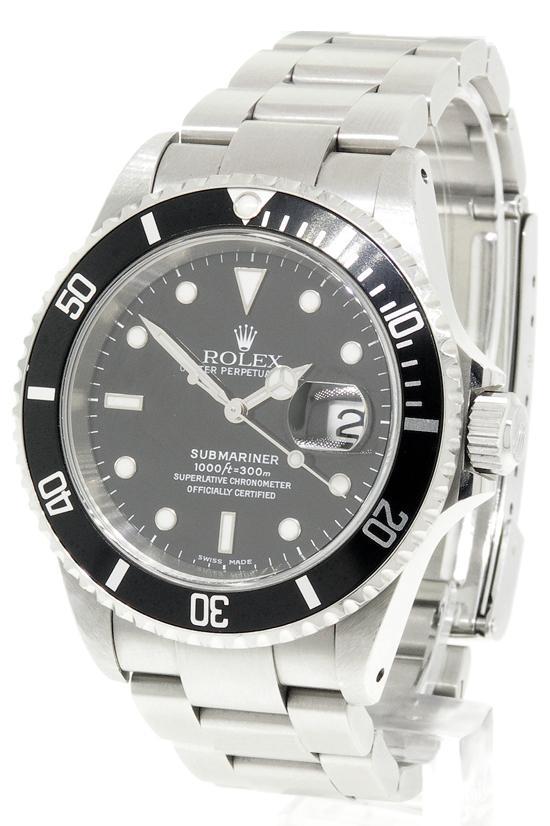
The modern Submariner’s 60-minute bezel demonstrates how an exterior component can perform a calculation. Align its zero marker with the minute hand and subsequent hand positions show elapsed minutes. Counterclockwise-only rotation makes an accidental displacement increase the indicated elapsed time. A GMT bezel, despite a similar circular appearance, has a different scale and purpose. Reading the markings reveals more than recognising the silhouette.
Rolex Submariner-Date, identified on the source page as reference 16610.
Compare the bezel scale and the date aperture as different kinds of information. This later family example does not establish specifications for the 1953 launch watch.
Photo: Rolex-Submariner.jpg by FrankWilliams / Wikimedia Commons. Public-domain dedication by the photographer. Original image; no local edits.
The GMT-Master appeared in 1955 as long-distance flying made simultaneous time-zone awareness increasingly useful. Its association with Pan American World Airways placed the watch in a concrete working environment. A hand completing one revolution in 24 hours could be read against a matching bezel scale, while conventional hands supplied the familiar twelve-hour display. The divided bezel colours also gave the scale a day-and-night structure.
Rolex’s chronology dates the GMT-Master II to 1982. Its important change was an independently adjustable local hour hand, which could move in hour steps without disturbing the minute and 24-hour hands. This made arrival in another time zone less disruptive to the reference time. The extra “II” consequently identifies a meaningful operating difference, not simply a new bezel colour. A travel watch should be understood through what changes when its owner moves.
The Cosmograph launched in 1963 and acquired the Daytona name through its motor-racing associations. A chronograph adds an elapsed-time mechanism to ordinary timekeeping. On this watch the outer tachymetric scale can turn the duration of travel over a known distance into an average speed; it does not sense speed directly. The pushers and counters should therefore be read as a separate measuring instrument sharing the case.
The movement history changes the meaning of an apparently continuous design. Automatic calibre 4030 arrived in 1988; Rolex’s own calibre 4130 followed in 2000. Those dates prevent a modern Daytona from standing in for every earlier example. Winding arrangements and movement architecture evolved even while the three-counter racing-watch identity remained recognisable.
The present Submariner family offers a useful technical comparison. Calibre 3230 powers the time-only model and 3235 the date version; both use the Chronergy escapement and have an approximately 70-hour reserve. Studying these named movements is more informative than assigning one specification to every historical Submariner. The bracelet’s Glidelock adjustment also shows that wearability is an engineering concern alongside the movement.
Precision claims require the same attention to scope. Rolex explains its modern Superlative Chronometer process as two stages: movement chronometer testing, followed by testing of the cased watch under its own protocol. Its stated finished-watch rate tolerance is −2/+2 seconds per day. This is a defined testing claim, distinct from the chronograph function and from a depth rating. Follow those distinctions and the familiar Rolex dial becomes a compact account of construction, function and verification.
Manufacturer histories describe the house’s own account. Source review dates are inherited from the supplied research packet; the review export does not claim fresh verification.
Section-level source links support dates, model histories and technical descriptions. These are primary manufacturer accounts; the explanations and comparisons are original editorial interpretation.
Section-level source links support dates, model histories and technical descriptions. These are primary manufacturer accounts; the explanations and comparisons are original editorial interpretation.
Section-level source links support dates, model histories and technical descriptions. These are primary manufacturer accounts; the explanations and comparisons are original editorial interpretation.
Section-level source links support dates, model histories and technical descriptions. These are primary manufacturer accounts; the explanations and comparisons are original editorial interpretation.
Section-level source links support dates, model histories and technical descriptions. These are primary manufacturer accounts; the explanations and comparisons are original editorial interpretation.
Section-level source links support dates, model histories and technical descriptions. These are primary manufacturer accounts; the explanations and comparisons are original editorial interpretation.
Section-level source links support dates, model histories and technical descriptions. These are primary manufacturer accounts; the explanations and comparisons are original editorial interpretation.
Section-level source links support dates, model histories and technical descriptions. These are primary manufacturer accounts; the explanations and comparisons are original editorial interpretation.
Section-level source links support dates, model histories and technical descriptions. These are primary manufacturer accounts; the explanations and comparisons are original editorial interpretation.
Section-level source links support dates, model histories and technical descriptions. These are primary manufacturer accounts; the explanations and comparisons are original editorial interpretation.
Section-level source links support dates, model histories and technical descriptions. These are primary manufacturer accounts; the explanations and comparisons are original editorial interpretation.
Primary sources linked below support the historical and technical account. Observational questions and explanatory comparisons are original editorial interpretation.
Primary sources linked below support the historical and technical account. Observational questions and explanatory comparisons are original editorial interpretation.
Primary sources linked below support the historical and technical account. Observational questions and explanatory comparisons are original editorial interpretation.
Primary sources linked below support the historical and technical account. Observational questions and explanatory comparisons are original editorial interpretation.
10Watch houses
Patek Philippe: calendars, chronographs and the shape of tradition
Keyless winding, disciplined design and complicated mechanisms connect nearly two centuries of Patek Philippe history.+
Historical and educational profile. Model families developed over time; technical details refer to the stated generation or example.
Reading time
6 minutes
Profile reviewed
2026-10-04
1839–1851: two partnerships and an everyday invention
The company began in Geneva in 1839 as Patek, Czapek & Co., founded by Antoine Norbert de Patek and watchmaker Franciszek Czapek. Its eventual name records a later partnership. At the Paris Industrial Exposition in 1844, Patek encountered Jean Adrien Philippe’s keyless winding system; Philippe joined him in Geneva in 1845. The firm adopted the Patek, Philippe & Cie name in 1851.
Keyless winding is a useful starting point because its benefit is immediate: the owner need not carry a separate winding key. A seemingly ordinary interaction with the crown contains an important chapter of watchmaking development. This origin also complicates the idea of Patek Philippe as a house concerned only with elaborate displays. Making an essential daily action easier belonged to its programme before many of its celebrated complications.
During the Great Depression, brothers Charles and Jean Stern acquired the company in 1932. Their business, Cadrans Stern Frères, had supplied dials to Patek Philippe. The connection makes the watch face an especially revealing place to study the house: a dial must translate a mechanism into something the wearer can understand, whether it carries two hands or several calendars.
The Calatrava collection also dates to 1932. Patek Philippe associates its round, restrained design with Bauhaus thinking and functional clarity. The name should be distinguished from the Calatrava Cross emblem, formally registered in 1887. A symbol can appear across the manufacture’s work without making every watch a Calatrava. Look at the placement of the hands, the weight of the markers and the space around them before reducing this family to a synonym for simplicity.
1968 and 1976: two alternatives to the round dress watch
The Golden Ellipse of 1968 brought a softly shaped case between a circle and a rectangle, with proportions inspired by the golden ratio. Its sparse display makes small decisions unusually visible: slender hands, index lengths and the relationship between dial and case carry much of the design. Modern examples use the thin automatic calibre 240, whose off-centre mini-rotor provides a different architecture from a full-width winding weight above the movement.
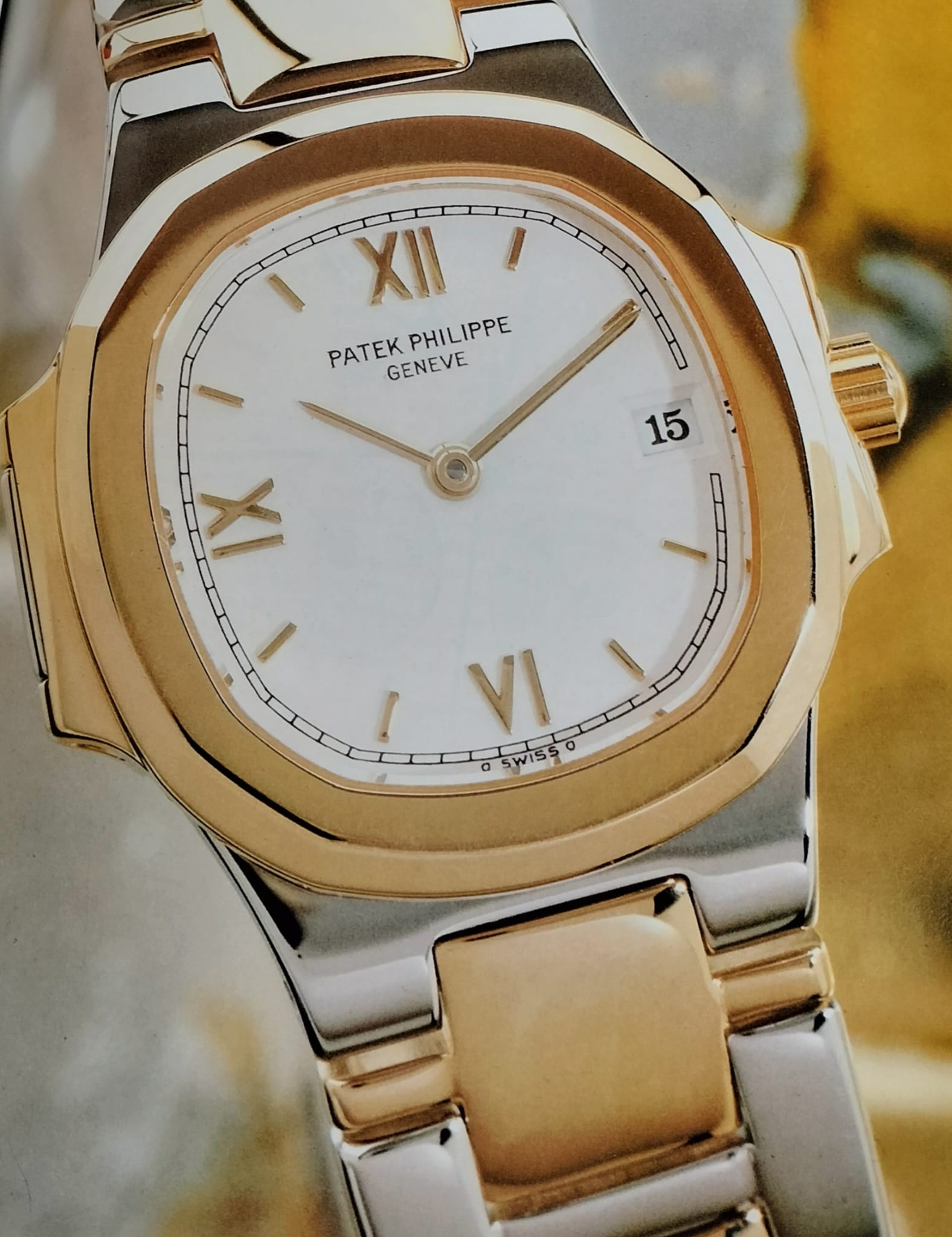
The Nautilus, launched in 1976, pursued another direction. A porthole-inspired case, rounded octagonal bezel and horizontally patterned dial gave it a sporting identity. Alternating polished and satin surfaces make its geometry change with the light. Later calendar and chronograph versions show that a model family can retain its outline while changing its mechanical content. The Golden Ellipse and Nautilus are therefore useful companions in study: distinctive form is not confined to one style or level of complication.
A two-tone Patek Philippe Nautilus; the photographer identifies this example as quartz. This later variant is distinct from the original 1976 mechanical Nautilus.
Notice the continuous case-and-bracelet outline. The movement type is attributed to the photographer, rather than authenticated from this still image.
Calendars: teaching a mechanism the irregular year
Patek Philippe’s calendar history includes a wristwatch completed in 1925 using a movement made in 1898. That gap is instructive: the date of a movement’s creation and the date of the finished watch can tell different stories. Moving a complicated mechanism to the wrist was its own design problem.
The Annual Calendar introduced in 1996 offers a particularly clear lesson in mechanical logic. An ordinary date display cycles through 31 numbers; an annual calendar also distinguishes 30-day from 31-day months. February still requires a correction. A perpetual calendar goes further by incorporating the usual four-year leap-year cycle. Most such mechanisms nevertheless need intervention at exceptional non-leap century years, including 2100.
Complexity also changes how information is arranged. Compare the arched apertures of Reference 5205 with the single broad day-date-month opening of Reference 5236. Both demand attention to reading order, but the mechanisms do not provide the same calendar programme. Attractive symmetry alone cannot tell the viewer whether a calendar is annual or perpetual.
Chronographs: architecture as well as elapsed seconds
Patek Philippe records a specially commissioned split-seconds wrist chronograph in 1923 and series-produced wrist chronographs from 1927. A split-seconds mechanism supplies two superimposed timing hands: one can pause for an intermediate reading while the other continues. Reuniting them enables another comparison without ending the overall measurement. This is different from a flyback, which rapidly resets and restarts a timing sequence.
A later milestone arrived in 2009 when the manually wound CH 29-535 PS debuted in Reference 7071. The manufacture’s proprietary calibre became a basis for further versions, including the perpetual-calendar chronograph introduced in Reference 5270 in 2011. These relationships make movement names worth learning. They reveal a developing mechanical platform beneath watches whose dial layouts, cases and intended audiences may differ considerably.
A minute repeater converts the displayed time into an on-demand sequence of sounds. In the conventional Patek Philippe arrangement, low notes count hours, paired notes count completed quarters, and high notes count the remaining minutes. Hammers strike gongs around the movement. The challenge is not merely producing enough components: the sequence must be distinct, paced intelligibly and acoustically convincing inside a small case.
Patek Philippe introduced longer cathedral gongs in 2000 and the double-sided Grandmaster Chime in 2014, whose functions include five chiming modes. A sonnerie adds another distinction by striking automatically at scheduled intervals. Listening therefore exposes differences that a photograph cannot communicate. A complicated dial is only one possible expression of a complicated watch.
2005 onward: new materials within a traditional craft
The Advanced Research programme began in 2005 and makes technological change explicit. Its early Annual Calendar examples included Reference 5250 in 2005 and Reference 5350 in 2006; the latter introduced the Spiromax balance spring in silicon-based Silinvar. Here the focus is the regulator and its materials rather than an additional indication on the dial. The outwardly traditional watch can contain substantial experimentation.
The Patek Philippe Seal, created in 2009, likewise extends the discussion beyond appearance. Its requirements encompass the complete mechanical watch, including functionality, accuracy, exterior components and finishing. Under this lens, a polished bevel is one part of an overall construction standard. Decoration, reliable operation and legible display deserve separate examination rather than being treated as interchangeable signs of quality.
The house produces manual, automatic and quartz movements, so its name alone does not specify a power system. Its archival records can identify movement and case numbers, dial details, manufacture date and sale date. Keeping those dates distinct gives an individual watch a more precise history. Compare the record, the actual mechanism and the visible configuration; then return to the basic question shared by Calatrava, Nautilus and complicated watches alike: how clearly does this particular object express what it does?
Manufacturer histories describe the house’s own account. Source review dates are inherited from the supplied research packet; the review export does not claim fresh verification.
Section-level source links support dates, model histories and technical descriptions. These are primary manufacturer accounts; the explanations and comparisons are original editorial interpretation.
Section-level source links support dates, model histories and technical descriptions. These are primary manufacturer accounts; the explanations and comparisons are original editorial interpretation.
Section-level source links support dates, model histories and technical descriptions. These are primary manufacturer accounts; the explanations and comparisons are original editorial interpretation.
Section-level source links support dates, model histories and technical descriptions. These are primary manufacturer accounts; the explanations and comparisons are original editorial interpretation.
Section-level source links support dates, model histories and technical descriptions. These are primary manufacturer accounts; the explanations and comparisons are original editorial interpretation.
Section-level source links support dates, model histories and technical descriptions. These are primary manufacturer accounts; the explanations and comparisons are original editorial interpretation.
Section-level source links support dates, model histories and technical descriptions. These are primary manufacturer accounts; the explanations and comparisons are original editorial interpretation.
Section-level source links support dates, model histories and technical descriptions. These are primary manufacturer accounts; the explanations and comparisons are original editorial interpretation.
Section-level source links support dates, model histories and technical descriptions. These are primary manufacturer accounts; the explanations and comparisons are original editorial interpretation.
Section-level source links support dates, model histories and technical descriptions. These are primary manufacturer accounts; the explanations and comparisons are original editorial interpretation.
Section-level source links support dates, model histories and technical descriptions. These are primary manufacturer accounts; the explanations and comparisons are original editorial interpretation.
Primary sources linked below support the historical and technical account. Observational questions and explanatory comparisons are original editorial interpretation.
Primary sources linked below support the historical and technical account. Observational questions and explanatory comparisons are original editorial interpretation.
Primary sources linked below support the historical and technical account. Observational questions and explanatory comparisons are original editorial interpretation.
11Watch houses
Audemars Piguet: complications, design and the expanding Royal Oak
From a network of Vallée de Joux specialists to an unusually adaptable sports-watch design, Audemars Piguet connects complicated mechanisms with the architecture of the case and bracelet.+
Educational overview. Specifications and operating instructions vary by exact reference and production period.
Reading time
5 minutes
Profile reviewed
2026-10-04
A workshop before a famous silhouette
Audemars Piguet locates its beginnings in Le Brassus in 1875. Its own historical research makes a useful distinction: Jules Louis Audemars and Edward Auguste Piguet signed their surviving partnership agreement in December 1881, and a production register begins in 1882. The founders later chose 1875 as the starting date. A foundation story can contain several genuine milestones without requiring them to be the same event.
Their surroundings matter. The Vallée de Joux supported an interconnected community of specialists making parts, finishing mechanisms and assembling complicated watches. Early watchmaking was often organised through these relationships. Understanding that network gives more substance to the word manufacture than imagining that every historical component emerged from one self-contained building.
This background also helps explain why a story centred only on the Royal Oak is incomplete. Calendars, striking mechanisms and carefully finished movements belong to the house’s earlier history. The 1972 watch gave those capabilities a different external language; it did not create its maker’s interest in watchmaking.
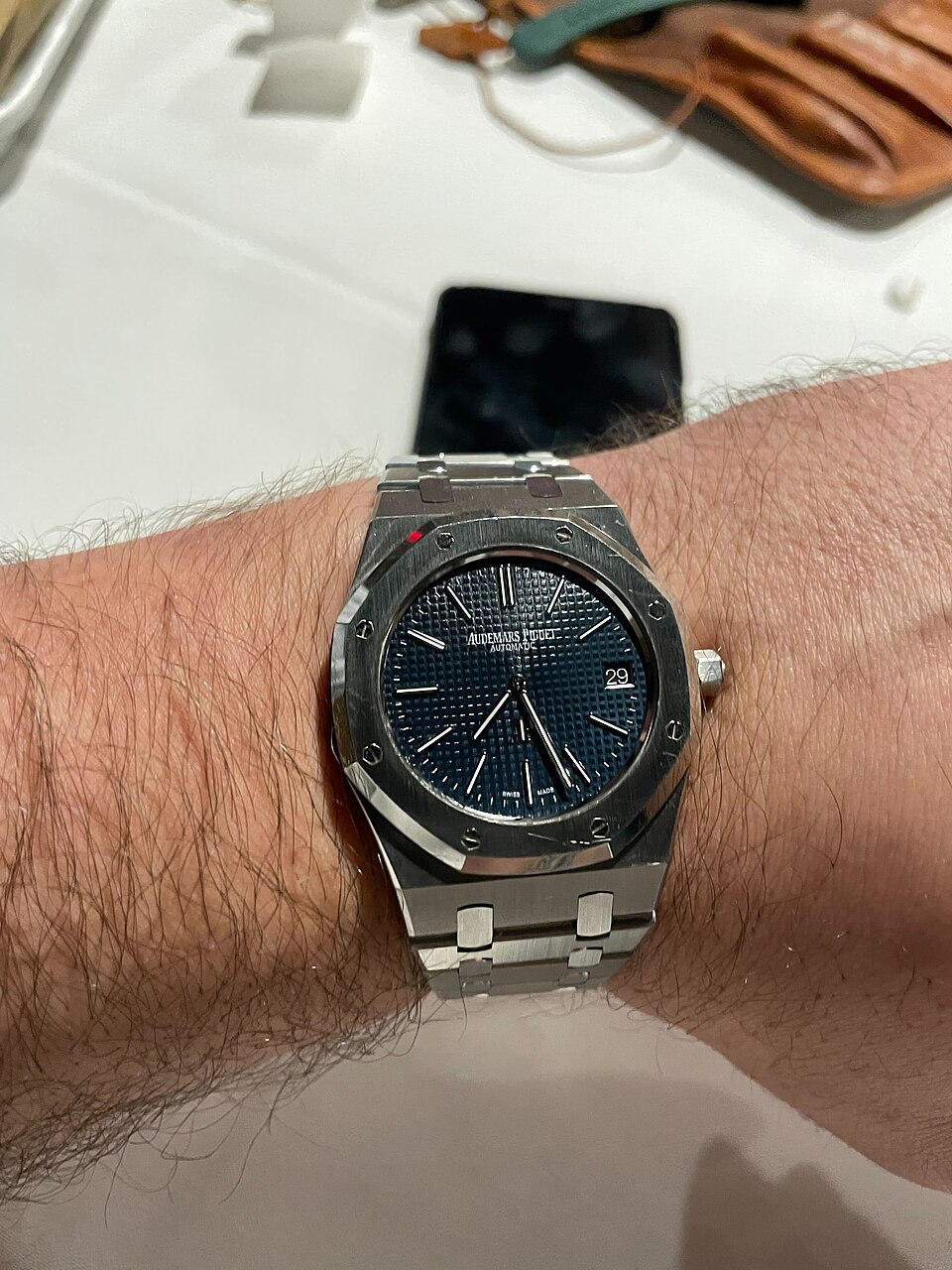
The Royal Oak reference 5402 appeared at the Basel Fair in 1972, following development of Gérald Genta’s design. Its 39 mm steel case, octagonal bezel, patterned dial and tapering bracelet formed a continuous composition. Calibre 2121 supplied automatic winding and a date. The watch’s visual identity depended on the relationship among these elements as much as on any one recognisable detail.
The original monocoque construction joined case middle and back into a main structure. Looking at the archive’s component photographs reveals how the first bracelet links participate in the case architecture. “Integrated bracelet” is therefore worth examining as a physical connection rather than using it only as a style label.
A useful viewing exercise is to follow the edge of the bezel into the bracelet. Broad brushed surfaces and bright borders send light in different directions. That contrast can make steel visually complex without precious stones or an elaborate dial. This is an observation about the design, not a test of a watch’s accuracy or durability.
A blue-dial Audemars Piguet Royal Oak on the wrist, identified on the source page as reference 15202. This later example is distinct from the original 1972 reference 5402.
Look at the case-to-bracelet transition and the screw-set bezel. The exact reference identification follows the source description rather than independent authentication.
The first Royal Oak was one model, but its lasting influence came partly from adaptation. Jacqueline Dimier developed the 29 mm reference 8638 introduced in 1976. The 35 mm reference 4100 followed in 1977. These watches required decisions about proportion and wearability, rather than simply reducing a drawing by a fixed percentage.
As the family grew, different materials, dial treatments and quartz mechanisms entered the picture. Those variations are important evidence: the Royal Oak has never meant one unchanging size or a single movement philosophy. A small quartz example and a mechanical “Jumbo” can share design ancestry while offering different experiences.
Compare where the bezel sits relative to the dial opening, the width of the bracelet at the case and the amount of visible wrist around the watch. This gives a more revealing account of size than diameter alone. Dimier’s contribution also makes the history a continuing design practice, rather than a single moment attributed to a single designer.
In 1978, reference 5548 introduced the automatic perpetual-calendar Calibre 2120/2800. Its 3.95 mm movement combined a thin automatic base with additional calendar work beneath the dial. It represented a different response to the period’s electronic-watch competition: compact mechanical complexity that could be worn in an elegant case.
AP Chronicles identifies the underlying contributions of LeCoultre and Dubois-Dépraz in its movement record. Naming specialist participants helps readers understand what development, assembly and finishing can involve. Collaboration is part of the history to describe accurately, rather than a fact to conceal or a reason to dismiss the finished watch.
The mechanism reached the Royal Oak in 1984 through reference 5554. A familiar exterior now carried a longer mechanical memory, distinguishing the unequal months and leap-year cycle. The addition changed how the dial was organised and how the owner interacted with the watch. A moon display, date and month subdials are visible clues, but the mechanism’s programming is what makes a calendar perpetual.
Emmanuel Gueit designed the Royal Oak Offshore, introduced in 1993 with a 42 mm case and chronograph. The exposed dark gasket, rubber-clad controls and more substantial forms made its relationship to the earlier watch apparent while changing its character. This was an expansion of the family’s vocabulary, rather than a replacement for the original proportions.
The contrast is educational. On a time-and-date Royal Oak, the dial can emphasise surface pattern and open space. A chronograph needs additional timing information and controls. A larger case also changes the mass seen above the wrist. Comparing those design demands is more useful than judging every descendant by how closely it copies the 5402.
Start by identifying the reference, approximate period and movement. Then read the exterior in layers: bezel, dial opening, case flank, bracelet transition and clasp. An openworked movement invites another kind of looking. Follow which metal has been removed, which structures remain to support moving parts, and how those structures frame the indications.
Finishing and construction deserve separate descriptions. A bright bevel describes a surface; a calendar or chronograph describes a function. Neither tells the whole story. Reference-specific documentation is especially valuable because a family can retain an immediately recognisable outline while changing substantially beneath it.
Finally, compare a simple Royal Oak with a complicated example and a non-Royal Oak calendar watch. The exercise returns the house to its broader history: exterior design, thinness and complicated watchmaking are related threads, each capable of leading the reader somewhere different.
Manufacturer histories describe the house’s own account. Source review dates are inherited from the supplied research packet; the review export does not claim fresh verification.
House archives and technical explanations support the dated history. The comparisons and looking exercises are original editorial interpretation. Brand-supplied images are not licensed by these source citations.
House archives and technical explanations support the dated history. The comparisons and looking exercises are original editorial interpretation. Brand-supplied images are not licensed by these source citations.
House archives and technical explanations support the dated history. The comparisons and looking exercises are original editorial interpretation. Brand-supplied images are not licensed by these source citations.
House archives and technical explanations support the dated history. The comparisons and looking exercises are original editorial interpretation. Brand-supplied images are not licensed by these source citations.
House archives and technical explanations support the dated history. The comparisons and looking exercises are original editorial interpretation. Brand-supplied images are not licensed by these source citations.
House archives and technical explanations support the dated history. The comparisons and looking exercises are original editorial interpretation. Brand-supplied images are not licensed by these source citations.
Primary sources linked below support the historical and technical account. Observational questions and explanatory comparisons are original editorial interpretation.
12Watch houses
Vacheron Constantin: continuity, invention and unexpected shapes
A Genevan history that connects industrial tools, slender movements, off-centre dials and watches treated as miniature works of art.+
Historical and educational profile. Technical details apply to the stated model or generation, not every watch bearing the family name.
Reading time
5 minutes
Profile reviewed
2026-10-04
1755–1839: a workshop becomes a lasting partnership
Jean-Marc Vacheron established his Genevan workshop in 1755. The second name arrived in 1819, when François Constantin joined Jacques Barthélémi Vacheron, the founder’s grandson. Vacheron Constantin describes its history as uninterrupted manufacture: that is a claim about continuing activity, not unchanged ownership, premises or products. Keeping those distinctions separate makes the long chronology more useful than simply counting birthdays.
There is a practical surprise in this cultivated history. In 1839 Georges Auguste Leschot adapted the pantograph to watchmaking, helping reproduce movement components at controlled scales. Precision manufacturing and hand finishing could support each other. Consistent geometry made good work repeatable; decoration and adjustment gave individual components their final quality.
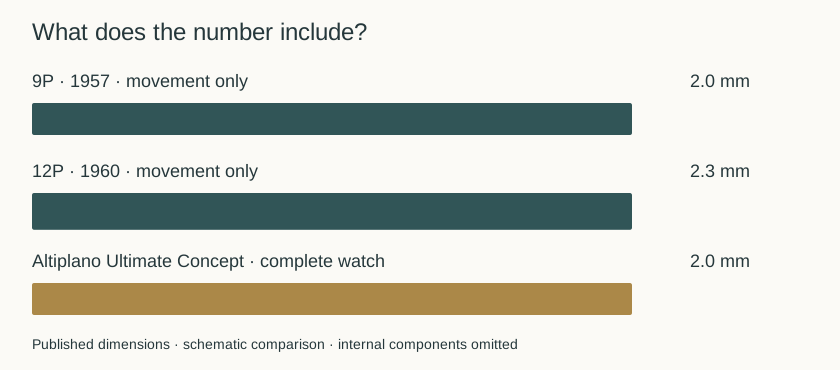
The house’s 1955 bicentenary brought calibre 1003, a hand-wound movement just 1.64 mm thick. Its significance lies in the arrangement of a complete mechanism within a very shallow space. Reducing thickness constrains the height of wheels, the stiffness of supporting parts and the clearance between moving components. A slender watch is therefore not automatically a simple watch to construct.
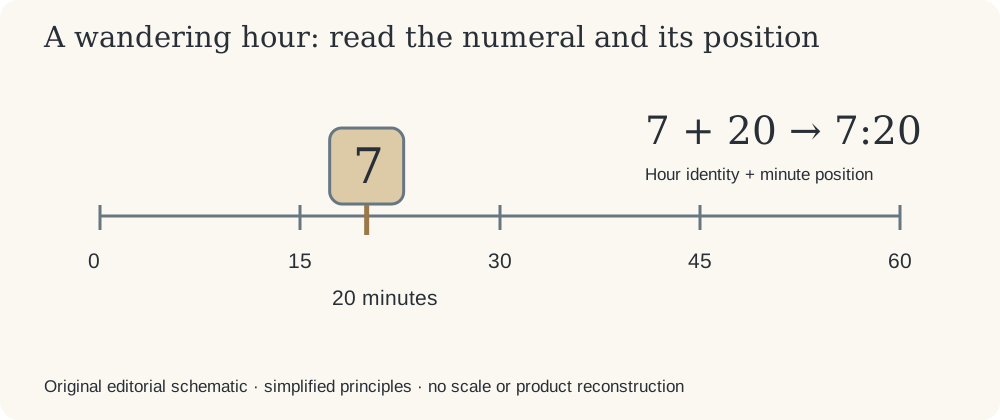
Vacheron’s timeline also records the 1996 Saltarello, pairing a jumping hour with retrograde minutes. Here the minute hand travels along an arc and returns to its starting point rather than circling continuously. These examples reveal two different ambitions: reducing a movement’s volume and changing how its information reaches the wearer.
The American 1921 makes asymmetry immediately visible. Its cushion-shaped case, rotated time display and corner crown interrupt the expectation that twelve must sit at the top of the wrist. Vacheron’s current account connects the angled dial with reading time while driving, with less movement of the wrist. It is best presented as the house’s explanation of the design, rather than embellished with an invented commissioning story.
The enjoyable test is simply to turn your forearm and see when the dial becomes upright to your eyes. This is a lesson in viewing angle as much as styling. A modern Historiques interpretation carries that idea forward without becoming an original watch made in 1921.
222 and Overseas: related territory, distinct histories
The 222 was introduced in 1977 for the manufacture’s 222nd anniversary. Jorg Hysek designed it, an important attribution in a field where almost any angular seventies bracelet watch can be casually assigned to Gérald Genta. Its integrated bracelet and sharply defined case made a more sporting expression of the house’s design vocabulary.
The Historiques 222 returned in yellow gold in 2022 and in steel in 2025. These are contemporary reinterpretations, so specifications should be checked independently from a vintage example. Overseas, introduced in 1996, occupies its own continuing sports-watch family. Similar intended lifestyles do not make the 222 and Overseas the same model, nor does a shared logo guarantee interchangeable bracelets or components.
Patrimony foregrounds restrained lines and the visual economy of mid-century dress watches. Traditionnelle makes a more overt connection to classical Genevan watchmaking. Historiques revisits particular designs; Overseas supplies the contemporary sporting branch. Each is a useful route into the catalogue, but none is a movement specification or a universal promise of a particular complication.
Compare one time-only reference with a calendar or tourbillon from the same family. Look at case thickness, dial hierarchy, winding method and the information you would actually use. The exercise prevents the collection name from doing all the thinking. It also reveals why a spare two-hand dial can be as deliberate a design decision as a crowded display.
The Métiers d’Art approach places decorative crafts such as engraving, enamelling, guilloché and gem setting alongside movement construction. These are distinct processes. Engraving removes material to create relief or texture; enamel builds a glass-like coloured surface through firing; guilloché produces controlled repeating patterns. Identifying the process is more revealing than calling every decorated dial hand painted.
For a close look, follow where one material meets another and how the decoration works around the time display. The design must leave the watch readable while giving the craft enough room to be seen. That balance links these expressive pieces to the house’s quieter watches: both depend on deciding what the eye should notice first.
Collecting: separate identity, condition and documentation
An appealing vintage Vacheron needs more than a plausible date. Ask which reference and calibre it contains, what has been replaced, and whether the dial, case and movement belong together. Service records and clear photographs answer different questions from a presentation box. A highly polished case may also communicate its original geometry differently from an example retaining its edges.
Vacheron offers heritage documentation, including a Certificate of Authenticity that requires physical examination by its specialists. Do not treat every archival paper as interchangeable with that process. Before commissioning restoration, agree what will be preserved and what may be replaced. These are questions about the object and its future care, not predictions about financial return.
Manufacturer histories describe the house’s own account. Source review dates are inherited from the supplied research packet; the review export does not claim fresh verification.
Section links support the historical and technical account. House histories remain manufacturer accounts; collecting questions and explanatory comparisons are original editorial interpretation.
Section links support the historical and technical account. House histories remain manufacturer accounts; collecting questions and explanatory comparisons are original editorial interpretation.
Section links support the historical and technical account. House histories remain manufacturer accounts; collecting questions and explanatory comparisons are original editorial interpretation.
Section links support the historical and technical account. House histories remain manufacturer accounts; collecting questions and explanatory comparisons are original editorial interpretation.
Section links support the historical and technical account. House histories remain manufacturer accounts; collecting questions and explanatory comparisons are original editorial interpretation.
Section links support the historical and technical account. House histories remain manufacturer accounts; collecting questions and explanatory comparisons are original editorial interpretation.
Section links support the historical and technical account. House histories remain manufacturer accounts; collecting questions and explanatory comparisons are original editorial interpretation.
Section links support the historical and technical account. House histories remain manufacturer accounts; collecting questions and explanatory comparisons are original editorial interpretation.
Primary sources linked below support the historical and technical account. Observational questions and explanatory comparisons are original editorial interpretation.
Primary sources linked below support the historical and technical account. Observational questions and explanatory comparisons are original editorial interpretation.
13Watch houses
Jaeger-LeCoultre: mechanisms, miniaturisation and the Reverso
A manufacture’s story becomes clearer when the problem solved by each invention is made visible.+
Educational overview. Specifications and operating instructions vary by exact reference and production period.
Jaeger-LeCoultre traces its origins to Antoine LeCoultre’s workshop in the Vallée de Joux in 1833. Its history includes the small Calibre 101 and the Atmos clock, developed from Jean-Léon Reutter’s invention. These examples pull in different directions: one explores miniaturisation, while the other draws operating energy from environmental temperature changes.
They are useful reminders that horology extends beyond a conventional round wristwatch. Size, energy consumption and the arrangement of components are design problems in their own right.
The house’s account connects the Reverso to a request for a watch that could withstand the knocks of polo. René-Alfred Chauvot patented the reversible case concept on 4 March 1931. César de Trey and Jacques-David LeCoultre were involved in bringing it to market, and Wenger helped refine the case.
Early Reversos used Tavannes movements while LeCoultre developed its rectangular Calibre 410, introduced in 1933. That detail makes the story more interesting, not less: a recognisable design emerged through collaboration and staged technical development rather than appearing fully formed from a single workshop.
A Reverso invites attention to the relationship between case, carrier and reverse face. The protective solution also created another surface for personalisation and later watchmaking expression. Compare the functional role of the original solid back with the uses to which the reversible format can be put.
Do not assume that an elegant modern Reverso inherits permission for vigorous sport from its origin story. The exact model’s operating and care instructions are the relevant guide to present use.
Primary sources linked below support the historical and technical account. Observational questions and explanatory comparisons are original editorial interpretation.
Primary sources linked below support the historical and technical account. Observational questions and explanatory comparisons are original editorial interpretation.
14Watch houses
A. Lange & Söhne: rebuilding a Saxon watchmaking language
An 1845 origin, a 1990 re-establishment and a 1994 debut belong in the same story of disciplined mechanics and unconventional displays.+
Historical and educational profile. Technical details apply to the stated model or generation, not every watch bearing the family name.
Reading time
5 minutes
Profile reviewed
2026-10-04
1845, 1948 and 1990: three dates, three different meanings
Ferdinand Adolph Lange established his Glashütte enterprise in 1845. The business was expropriated in 1948, breaking the direct corporate continuity that a simple “since 1845” caption can suggest. Walter Lange re-established the name on 7 December 1990 after German reunification. The modern manufacture is therefore a revival with historical roots, not an unchanged nineteenth-century company.
Its first new collection appeared on 24 October 1994 at Dresden’s Royal Palace: Lange 1, Arkade, Saxonia and Tourbillon “Pour le Mérite”. Four different designs announced the return together. This was an ambitious statement about what the revived house could make, rather than a single commemorative watch carrying a recovered name.
The Lange 1’s outsize date has an unexpected architectural relative: the Five-Minute Clock above the stage at Dresden’s Semper Opera House. Its prominent numerals inspired a wristwatch display that could be read without forcing the whole dial into symmetry. Hours and minutes sit to one side; date, subsidiary seconds and power-reserve information occupy distinct positions elsewhere.
The pleasure of the connection is its change of scale. A display designed for an audience across a room becomes a way to organise information centimetres from the eye. It is inspiration, not a miniature copy of the theatre mechanism. The watch’s imbalance is carefully composed: separate indications remain distinct instead of competing around a shared central axis.
The three-quarter plate: structure before ornament
A large plate covering much of the movement is a recognisable Lange feature. It supports the wheel-train arbors together, helping maintain their relative positions. The house reintroduced this three-quarter-plate arrangement after its revival. Its untreated German silver is an alloy of copper, nickel and zinc; the name does not mean that it contains precious silver.
The material develops a warm patina, while striping, screwed chatons and thermally blued screws give the mechanism its distinctive appearance. Look first at what each element supports, then at how it is finished. A plate is a structural part; a stripe is a surface treatment. Understanding both makes the caseback more rewarding than treating it as a collection of decorative colours.
Lange states that each of its manufacture movements is assembled twice. The phrase describes a sequence of workshop operations, not a complication that appears on the dial. Assembly, checking, disassembly and final finishing demand time even when a watch displays only hours and minutes. A spare face can conceal a demanding production process.
This also explains why finishing deserves its own vocabulary. An engraved balance cock is different from a polished bevel, and a functional bearing is different from the precious-metal setting surrounding it. Study one detail at a time. The aim is not to count visible flourishes, but to understand how construction and careful treatment of surfaces coexist in a completed movement.
The Datograph arrived in 1999 with Lange’s first chronograph movement, calibre L951.1. Its combination of column-wheel control, flyback operation, an outsize date and a precisely jumping minute counter established a distinct technical identity. The minute counter advances decisively at the appropriate moment, helping the reader distinguish a completed minute from a hand approaching a mark.
Flyback means the chronograph can reset and restart while running; it does not describe a second hand that follows another elapsed-time hand, as in a split-seconds chronograph. Later Datograph Up/Down versions add their own specifications, including a power-reserve indication. The original launch date is an entry point, not permission to assign one calibre or case size to every Datograph.
2009 onward: digital time without a quartz circuit
The Zeitwerk, introduced in 2009, displays hours and minutes through jumping numerals while remaining mechanical. Digital describes the presentation of information here, not the source of power or the regulating technology. Moving numeral discs requires carefully managed energy, particularly when several displays must change together at the hour.
A constant-force mechanism helps govern that switching and supplies more consistent energy to the regulating system. The later calibre L043.6 offers a 72-hour reserve and a separate hour-adjustment pusher. Those specifications belong to that generation. The larger lesson is wonderfully clear: a mechanical watch need not have conventional hour and minute hands, and an unconventional display need not abandon the mainspring and balance.
The Lange 1 illustrates why movement identification matters. Its familiar face survived a substantial change in 2015, when calibre L121.1 replaced the earlier L901.0. The newer construction includes an instantaneously advancing date. A photograph of the front may therefore conceal differences that affect how the watch behaves and how a collector understands its place in the modern history.
When considering an example, record its full reference, calibre, condition and service evidence. Try the thickness and lug shape on the wrist rather than judging only the nominal diameter. Ask for correct setting instructions and a realistic servicing plan. A documented, understood watch is a better collecting foundation than an attractive dial accompanied by an imprecise revival story.
Manufacturer histories describe the house’s own account. Source review dates are inherited from the supplied research packet; the review export does not claim fresh verification.
Section links support the historical and technical account. House histories remain manufacturer accounts; collecting questions and explanatory comparisons are original editorial interpretation.
Section links support the historical and technical account. House histories remain manufacturer accounts; collecting questions and explanatory comparisons are original editorial interpretation.
Section links support the historical and technical account. House histories remain manufacturer accounts; collecting questions and explanatory comparisons are original editorial interpretation.
Section links support the historical and technical account. House histories remain manufacturer accounts; collecting questions and explanatory comparisons are original editorial interpretation.
Section links support the historical and technical account. House histories remain manufacturer accounts; collecting questions and explanatory comparisons are original editorial interpretation.
Section links support the historical and technical account. House histories remain manufacturer accounts; collecting questions and explanatory comparisons are original editorial interpretation.
Section links support the historical and technical account. House histories remain manufacturer accounts; collecting questions and explanatory comparisons are original editorial interpretation.
Section links support the historical and technical account. House histories remain manufacturer accounts; collecting questions and explanatory comparisons are original editorial interpretation.
Primary sources linked below support the historical and technical account. Observational questions and explanatory comparisons are original editorial interpretation.
Primary sources linked below support the historical and technical account. Observational questions and explanatory comparisons are original editorial interpretation.
15Watch houses
Cartier: how shape became a watchmaking language
The Santos, Tank and Crash offer three ways to study a wristwatch: as a useful instrument, an exercise in proportion and a deliberately expressive object.+
Educational overview. Specifications and operating instructions vary by exact reference and production period.
Reading time
5 minutes
Profile reviewed
2026-10-04
Read the shape before the specifications
Cartier’s watch history is especially rewarding when approached through design. The shape of the case determines the space available for the dial, the relationship between numerals and hands, and the way a strap or bracelet meets the wrist. A watch can communicate a strong identity before the viewer knows what powers it.
The house records timepieces in its registers from 1853, including pocket watches and wearable jewellery forms. That variety gives useful context for the wristwatches that followed. Cartier’s interest in telling the time developed alongside an interest in how an object is worn, seen and incorporated into everyday life.
For a first comparison, place a square Santos beside a rectangular Tank. Ask where the case begins and the attachment ends. Notice the balance between straight lines and softened corners. These observations are original ways of reading the objects; they do not require treating every example as mechanically identical.
Cartier connects the Santos design to Louis Cartier and the aviator Alberto Santos-Dumont in 1904. The practical story is straightforward: a wrist-mounted display made time easier to consult during flight than a pocket watch. This is an important early wristwatch history, without needing the broader and misleading claim that wristwatches did not exist beforehand.
The square outline, exposed bezel screws and curved transition towards the attachment make the design recognisable. Screws do more than secure parts visually: they give the surrounding frame a repeated rhythm. The rounded corners prevent the square from reading as a simple rigid box.
Cartier’s historical collection includes a Santos-Dumont wristwatch dated 1912. It also records the later Santos de Cartier design created in 1978, represented by a 1981 steel-and-gold automatic example. These are different chapters. The original aviation connection should not be used to suggest that every later Santos has the same case, bracelet or mechanism.
The Tank and the relationship between case and strap
Louis Cartier created the Tank in 1917. Its two long side elements, known as brancards, frame the dial and make the transition towards the strap central to the composition. Looking at the whole outline is more informative than describing it only as a rectangular watch. The edges, dial and attachment work together.
The house’s collection includes an early Tank dated 1920. That museum object is a useful reminder to distinguish the creation of a design from the date of a particular surviving watch. An archive photograph may illustrate a later example even when it accompanies a story about the family’s origin.
To compare Tank variants, start with width and length, then consider thickness, curvature and dial proportions. A narrow elongated case occupies the wrist differently from a shorter, broader one. Roman numerals, a railway-style minute track and a cabochon crown can provide continuity, while the overall balance changes. “Small” and “large” are collection labels, not universal measurements across every generation.
A Les Must de Cartier Tank photographed by Guy Sie. This family example is not a 1917 original or a Tank Louis Cartier.
Notice the vertical case sides, Roman numerals and strap continuity. Production date, exact reference and metal fineness are not established by this photograph.
Photo: Cartier Tank.jpg by Guy Sie / Wikimedia Commons. CC BY-SA 2.0. Wikimedia Commons 960px web rendition; no local edits. ShareAlike applies to adapted images.
Cartier’s collection also documents a tonneau wristwatch from 1915 and a London Crash from 1967. The first offers a rounded barrel-like alternative; the second distorts the expected outline far more dramatically. Both help explain why shaped watches deserve their own vocabulary, rather than being treated as departures from a supposedly normal round watch.
The Crash’s origin is often wrapped in an accident story. Cartier’s collection page presents that account as a tradition, so it should remain qualified. The surviving object and its 1967 date provide firmer ground for discussion than an embellished narrative about the precise circumstances of inspiration.
Compare how numerals respond to each case. A designer may preserve a regular central dial, stretch the arrangement or let markings echo the outer boundary. The result affects both expression and legibility. This is one of the pleasures of studying shaped watches: familiar time indications become an exercise in spatial organisation.
A shaped case does not automatically imply a shaped movement. Cartier’s hand-wound 1917 MC is an instructive example because its tonneau form was developed for narrower cases, including Tank Louis Cartier and Crash models. The relationship between a movement’s outline and the space surrounding it is an engineering question as well as a visual one.
Skeleton work offers another connection. Cartier’s account traces the modern Santos skeleton vocabulary to the 2009 Santos 100 Skeleton. In Calibre 9611 MC, bridges take the form of Roman numerals, bringing structural support and the reading of time into the same composition. Removing material therefore becomes part of the design of the display.
The 2021 Tank Must SolarBeat illustrates a different response. Perforations in the Roman numerals allow light to reach photovoltaic cells beneath the dial. The interest lies in how the charging system is accommodated within an established appearance. It should be described as a particular technical implementation, not as a feature of every Tank or every quartz Cartier.
Cartier’s Model A mystery clocks first appeared in 1912. Their hands seem visually detached from a conventional movement, turning the reading of time into a small puzzle. The historical collection includes a 1918 example combining rock crystal and ornamental materials with the apparently floating display.
This offers a useful comparison with skeleton watches. One invites attention to visible supports and mechanical structure; the other makes the transmission of motion difficult to see. In each case, the display is carefully staged. A technical object can invite curiosity through what it reveals and through what it conceals.
When studying a Cartier watch, record the collection, exact reference, dimensions and movement type separately. Then describe the case outline, numeral arrangement and attachment. This keeps an observation about style from turning into an unsupported claim about technical specification.
Try the comparison with photographs at the same scale, and include a side view when available. Front views alone cannot show curvature or thickness. A quartz version, a hand-wound version and a skeleton interpretation may each serve the design differently. Understanding those decisions makes Cartier a useful starting point for watch appreciation, even before the discussion reaches a list of complications.
Manufacturer histories describe the house’s own account. Source review dates are inherited from the supplied research packet; the review export does not claim fresh verification.
House archives and technical explanations support the dated history. The comparisons and looking exercises are original editorial interpretation. Brand-supplied images are not licensed by these source citations.
House archives and technical explanations support the dated history. The comparisons and looking exercises are original editorial interpretation. Brand-supplied images are not licensed by these source citations.
House archives and technical explanations support the dated history. The comparisons and looking exercises are original editorial interpretation. Brand-supplied images are not licensed by these source citations.
House archives and technical explanations support the dated history. The comparisons and looking exercises are original editorial interpretation. Brand-supplied images are not licensed by these source citations.
House archives and technical explanations support the dated history. The comparisons and looking exercises are original editorial interpretation. Brand-supplied images are not licensed by these source citations.
Primary sources linked below support the historical and technical account. Observational questions and explanatory comparisons are original editorial interpretation.
Primary sources linked below support the historical and technical account. Observational questions and explanatory comparisons are original editorial interpretation.
16Watch houses
Omega: industrial precision, working watches and the Moon
From a movement that named the company to spaceflight chronographs and modern certification, Omega’s history is a sequence of practical problems made visible on the wrist.+
Educational historical overview. Movement specifications, certification criteria and operating instructions apply to the identified calibre or reference and its production period.
Reading time
5 minutes
Profile reviewed
2026-10-04
1848–1903: a company named after its movement
Omega’s story begins with Louis Brandt’s workshop in 1848, but the name familiar on today’s dials came later. In 1894, his sons Louis-Paul and César introduced the 19-ligne Omega calibre. Its significance lay in bringing an ambitious movement together with production on an industrial scale. In 1903, the company adopted the movement’s name. These are three different milestones: the business’s origin, a technical product launch and the establishment of its enduring identity.
That sequence provides a useful lens for the whole history. Omega was not built around a single case shape or complication. Its identity repeatedly connects precision with reproducible manufacturing. A movement name can therefore be as revealing as a collection name: it points to the machinery, production methods and engineering objectives beneath the dial.
1932–1952: timing events and building everyday collections
Omega’s Olympic timekeeping role began in 1932 with 30 stopwatches. That work belonged to a larger measurement system: officials, start signals and finish decisions mattered alongside the instrument. Modern photo-finish equipment makes the same point in a different technological language. Timing a sporting result is a coordinated operation, not simply a watch possessing an impressive rate specification.
The post-war collections gave precision a more personal setting. Seamaster appeared in 1948, before the purpose-built Seamaster 300 diver of 1957. Constellation followed in 1952; Omega’s archive identifies the CK 2648 as an automatic, chronometer-certified watch using calibres 352 or 354. These families show two distinct priorities: protection for active use and formally tested timekeeping. They also explain why an early Seamaster can look much more restrained than the diving watches now associated with the name.
1957: three professions, three different instruments
The 1957 professional trio brought those practical ambitions into sharper focus. Speedmaster served racing drivers, Seamaster 300 addressed underwater work, and Railmaster was designed for railway personnel and others exposed to magnetic fields. The shared launch year matters because it makes their differences easier to see. Each watch answered a different environmental or measurement problem rather than expressing one generic idea of a sports watch.
The original Railmaster used an inner protective case to shield its movement against fields up to 1,000 gauss. Speedmaster instead made elapsed-time measurement central to its identity, with a tachymeter scale around the dial. Compare the three by asking what the wearer needed to know and what might disturb the watch. The visible design becomes more intelligible when connected to that job.
1962–1969: personal choice, qualification and lunar use
The route to the Moon was not a single event. On 3 October 1962, Wally Schirra wore a personally purchased Speedmaster CK 2998 during the Mercury programme’s Sigma 7 mission. The model itself had appeared in 1959. Omega dates NASA’s formal flight qualification to 1 March 1965. Personal use came before institutional approval, and neither date is the date of the lunar landing.
During Apollo 11 in July 1969, Buzz Aldrin wore his Speedmaster on the lunar surface. Omega’s account explains that Neil Armstrong left his own watch in the lunar module as a backup for its malfunctioning timer. Armstrong’s flown chronograph subsequently entered the Smithsonian collection through NASA in 1973. The museum object anchors a famous story in a particular instrument with a documented user and transfer history. This is why reference, mission and provenance are more informative than treating every Speedmaster as interchangeable.
A chronograph keeps ordinary time while allowing a separate elapsed-time measurement. Begin by distinguishing the running-seconds display from the central chronograph hand and its accumulating counters. The tachymeter then translates a measured interval into a rate. For example, covering one kilometre in 30 seconds corresponds to 120 kilometres per hour; covering one mile in the same interval corresponds to 120 miles per hour. The scale needs a known distance and a suitable timing interval.
Historical styling is a separate layer. Omega’s 2017 tribute to the original Broad Arrow Speedmaster uses calibre 1861, while the 2024 First Omega in Space revival uses calibre 3861. Both deliberately refer to earlier watches, but their movement descriptions identify different contemporary constructions. Read the reference and calibre together, then enjoy the visual quotation on its own terms.
An Omega Speedmaster Automatic with a date window, photographed by Hobo. This image illustrates a different Speedmaster variant from the hand-wound Moonwatch discussed in the history.
Compare the three subdials with the separate date window. The exact reference and movement calibre remain unverified; this is a variant comparison, not a NASA or Apollo illustration.
Photo: OmegaSpeedMaster.JPG by Hobo (source summary; uploader account Richardmilgate) / Wikimedia Commons. Public-domain dedication by the photographer. Wikimedia Commons 960px web rendition; no local edits.
1999–2007: Co-Axial changes the internal conversation
In 1999, Omega introduced calibre 2500 with the Co-Axial escapement invented by George Daniels. The escapement controls the release of mainspring energy and supplies impulses that sustain the balance’s oscillation. Co-Axial’s importance concerns how those impulses are delivered and how friction is managed. It is a change to the regulating mechanism, rather than a new dial function like a calendar or chronograph.
The next important step came in 2007 with calibre 8500, designed around the Co-Axial architecture. This progression distinguishes adopting an invention from creating a movement platform around it. It also reconnects the modern house with its nineteenth-century concern for industrial production. The useful achievement to study is how a demanding mechanism becomes repeatable in series manufacture, not merely whether it appears in a rare demonstration piece.
2015 onward: from movement architecture to measured performance
The Globemaster introduced Omega’s Master Chronometer era in 2015. Here the question changes again: an escapement describes construction, whereas certification describes tested performance. METAS’s programme considers the complete watch’s chronometric behaviour, water resistance, power reserve and magnetic resistance. Its requirements include exposure to 1.5 tesla, equivalent to 15,000 gauss, and a chronometer-qualified movement.
The testing system also has an institutional structure. The applicant tests movements and watches, while METAS independently monitors the process, analyses results and performs sample checks. The designation is open to qualifying Swiss Made watches from other brands as well. Read an Omega through these separate layers: collection and historical purpose, calibre and mechanical architecture, then certification and its defined tests. That approach makes room for the romance of the Moonwatch while revealing a much broader history of manufacturing and measurement.
Manufacturer histories describe the house’s own account. Source review dates are inherited from the supplied research packet; the review export does not claim fresh verification.
Official manufacturer histories and technical documentation support the dated account; Omega’s spaceflight discussion also uses a Smithsonian collection record, and certification is checked against METAS. Comparisons and reading exercises are original editorial interpretation.
Official manufacturer histories and technical documentation support the dated account; Omega’s spaceflight discussion also uses a Smithsonian collection record, and certification is checked against METAS. Comparisons and reading exercises are original editorial interpretation.
Official manufacturer histories and technical documentation support the dated account; Omega’s spaceflight discussion also uses a Smithsonian collection record, and certification is checked against METAS. Comparisons and reading exercises are original editorial interpretation.
Official manufacturer histories and technical documentation support the dated account; Omega’s spaceflight discussion also uses a Smithsonian collection record, and certification is checked against METAS. Comparisons and reading exercises are original editorial interpretation.
Official manufacturer histories and technical documentation support the dated account; Omega’s spaceflight discussion also uses a Smithsonian collection record, and certification is checked against METAS. Comparisons and reading exercises are original editorial interpretation.
Official manufacturer histories and technical documentation support the dated account; Omega’s spaceflight discussion also uses a Smithsonian collection record, and certification is checked against METAS. Comparisons and reading exercises are original editorial interpretation.
Official manufacturer histories and technical documentation support the dated account; Omega’s spaceflight discussion also uses a Smithsonian collection record, and certification is checked against METAS. Comparisons and reading exercises are original editorial interpretation.
Official manufacturer histories and technical documentation support the dated account; Omega’s spaceflight discussion also uses a Smithsonian collection record, and certification is checked against METAS. Comparisons and reading exercises are original editorial interpretation.
Official manufacturer histories and technical documentation support the dated account; Omega’s spaceflight discussion also uses a Smithsonian collection record, and certification is checked against METAS. Comparisons and reading exercises are original editorial interpretation.
Official manufacturer histories and technical documentation support the dated account; Omega’s spaceflight discussion also uses a Smithsonian collection record, and certification is checked against METAS. Comparisons and reading exercises are original editorial interpretation.
Official manufacturer histories and technical documentation support the dated account; Omega’s spaceflight discussion also uses a Smithsonian collection record, and certification is checked against METAS. Comparisons and reading exercises are original editorial interpretation.
Official manufacturer histories and technical documentation support the dated account; Omega’s spaceflight discussion also uses a Smithsonian collection record, and certification is checked against METAS. Comparisons and reading exercises are original editorial interpretation.
Official manufacturer histories and technical documentation support the dated account; Omega’s spaceflight discussion also uses a Smithsonian collection record, and certification is checked against METAS. Comparisons and reading exercises are original editorial interpretation.
Official manufacturer histories and technical documentation support the dated account; Omega’s spaceflight discussion also uses a Smithsonian collection record, and certification is checked against METAS. Comparisons and reading exercises are original editorial interpretation.
Primary sources linked below support the historical and technical account. Observational questions and explanatory comparisons are original editorial interpretation.
Primary sources linked below support the historical and technical account. Observational questions and explanatory comparisons are original editorial interpretation.
17Watch houses
Grand Seiko: three technologies, one idea of the everyday watch
Mechanical, quartz and Spring Drive form a continuous pursuit of precision, while distinctive surfaces and hands turn engineering into a recognisable visual language.+
Educational historical overview. Movement specifications, certification criteria and operating instructions apply to the identified calibre or reference and its production period.
Reading time
5 minutes
Profile reviewed
2026-10-04
1960–1969: establishing a standard of its own
Grand Seiko began in 1960 with calibre 3180 and an ambition to make a precise, practical Japanese wristwatch competitive internationally. Its early progress was concrete: the 1964 Self-Dater added a calendar and improved water resistance, while the Grand Seiko Standard established in 1966 formalised the house’s mechanical accuracy requirements. The initial standard specified a mean daily rate between minus three and plus six seconds, tightened to minus three and plus five in 1969.
The late 1960s also expanded the technical vocabulary. The automatic 61GS and hand-wound 45GS arrived in 1968 with 36,000 vibrations per hour, or ten beats each second. Those watches linked the pursuit of stable timekeeping with higher balance frequency. The 1969 V.F.A. models, whose initials mean Very Fine Adjusted, carried the ambition further through intensive adjustment. Precision was already a programme of testing and refinement, not simply a word printed on a dial.
The 44GS, produced by Daini Seikosha in 1967, became the pivotal expression of Grand Seiko Style. Broad planes, sharply defined facets and controlled reflections gave the watch an identity that could be recognised without reading its name. Zaratsu-polished case surfaces were intended to reflect their surroundings cleanly, while faceted hands and markers created alternating brightness and shadow across the display.
This is best understood by moving a watch under a light rather than viewing one static photograph. A hand can change from bright to almost black as its angle changes, while another facet remains visible. The design uses geometry to create contrast. The original 44GS supplies an important reference point, but Grand Seiko’s own historical account describes the style as adaptable. Later cases can preserve the treatment of light without reproducing every dimension or contour of the 1967 model.
The 95GS of 1988 introduced quartz to Grand Seiko, with an annual accuracy specification of ten seconds. The 9F83 followed in 1993. This chronology challenges the idea that the brand’s serious watchmaking exists only in its mechanical models. Quartz was a deliberate route toward the same goals of precise indication and daily usefulness.
The important comparison separates energy, regulation and display. A conventional quartz watch uses battery power, an electronically monitored quartz oscillator and a motor-driven gear train. Its seconds hand may advance once per second, but the oscillator is working at a much higher frequency. With 9F, Grand Seiko concentrated on transmitting electronic precision to a clear, stable display.
Inside 9F: small mechanisms with visible consequences
The 9F Twin Pulse Control Motor delivers two rapid impulses for each apparent one-second advance. That provides the torque needed for the brand’s substantial hands while conserving battery power. A backlash-adjustment mechanism uses a small spring to limit the seconds hand’s tremble after each step. The goal is not just an accurate oscillator but an indication that settles cleanly where the wearer can read it.
Temperature compensation addresses another problem: quartz frequency shifts as temperature changes. Grand Seiko matches the oscillator’s characteristics to its integrated circuit and checks temperature 540 times a day. On date-equipped versions, a spring-loaded mechanism changes the calendar rapidly. These are distinct solutions to rate stability, hand behaviour and calendar operation. Taken together, they explain why a seemingly simple three-hand quartz watch can contain substantial engineering beyond the basic electronic timekeeping circuit.
1998 onward: mechanical watchmaking returns and develops
The 9S55 arrived in 1998 as Grand Seiko’s first new mechanical movement in twenty years. A revised testing standard accompanied it, using 17 days, six positions and three temperatures. The movement and its assessment therefore developed together. High-frequency mechanics returned with calibre 9S85 in 2009, continuing the interest in faster-beating balances visible in the 1960s.
Calibre 9SA5, introduced in 2020, combines a 5 Hz balance with an approximately 80-hour reserve. Its Dual Impulse Escapement delivers energy directly to the balance in one direction and indirectly through the lever in the other. Twin barrels support the energy supply. The interesting advance is the combination of frequency and endurance: increasing the number of beats creates demands on energy use, so a long reserve requires more than simply choosing a faster oscillator.
2004: Spring Drive separates winding from regulation
Grand Seiko introduced Spring Drive calibre 9R65 in 2004, with automatic winding and a 72-hour power reserve. A mainspring drives the hands, but a conventional balance and escapement do not regulate their speed. Instead, the gear train turns a glide wheel that generates electricity for a quartz oscillator and integrated circuit. The circuit compares the wheel’s motion with the reference signal and applies electromagnetic braking when necessary.
This architecture explains the smoothly gliding seconds hand. It also resolves a common classification problem: automatic winding describes how energy is stored; quartz regulation describes how the rate is controlled. The two can coexist. Spring Drive is therefore neither ordinary battery-powered quartz nor a purely mechanical oscillator system. Its appeal lies in this particular allocation of jobs, with stored spring energy moving the display and electronic comparison controlling the flow.
From Snowflake to Evolution 9: studying actual watches
The SBGA211 Snowflake makes a useful case study. Its textured dial refers to wind-shaped snow in the Hotaka mountains, while the case and bracelet use Grand Seiko’s High-Intensity Titanium. Inside is the 9R65 Spring Drive movement. Those details explain three different experiences: the shifting dial texture, relatively light feel and continuous seconds-hand motion. A nature-inspired surface is most interesting when considered alongside the watch’s physical construction.
Grand Seiko established its separate brand identity in 2017, placing its own name prominently at twelve o’clock. The Evolution 9 design developed around the 2020 generation, and the SLGH005 White Birch illustrates its connection to the earlier Grand Seiko Style. Comparing it with the Snowflake is particularly instructive: both invite close attention to texture, yet their movements answer the problem of regulation differently. The brand becomes richer when each watch is read as a combination of design, material and a specific timekeeping system.
Manufacturer histories describe the house’s own account. Source review dates are inherited from the supplied research packet; the review export does not claim fresh verification.
Official Grand Seiko histories, movement documentation and model records support the dated account. Comparisons between display, materials and movement systems are original editorial interpretation.
Official Grand Seiko histories, movement documentation and model records support the dated account. Comparisons between display, materials and movement systems are original editorial interpretation.
Official Grand Seiko histories, movement documentation and model records support the dated account. Comparisons between display, materials and movement systems are original editorial interpretation.
Official Grand Seiko histories, movement documentation and model records support the dated account. Comparisons between display, materials and movement systems are original editorial interpretation.
Official Grand Seiko histories, movement documentation and model records support the dated account. Comparisons between display, materials and movement systems are original editorial interpretation.
Official Grand Seiko histories, movement documentation and model records support the dated account. Comparisons between display, materials and movement systems are original editorial interpretation.
Official Grand Seiko histories, movement documentation and model records support the dated account. Comparisons between display, materials and movement systems are original editorial interpretation.
Official Grand Seiko histories, movement documentation and model records support the dated account. Comparisons between display, materials and movement systems are original editorial interpretation.
Official Grand Seiko histories, movement documentation and model records support the dated account. Comparisons between display, materials and movement systems are original editorial interpretation.
Primary sources linked below support the historical and technical account. Observational questions and explanatory comparisons are original editorial interpretation.
Primary sources linked below support the historical and technical account. Observational questions and explanatory comparisons are original editorial interpretation.
18Watch houses
Zenith: the factory, the fast beat and the saved tools
Precision at Zenith connects industrial organisation, observatory trials and a chronograph whose survival depended on preserving the means to make it.+
Historical and educational profile. Technical details apply to the named reference, calibre or generation; a family name is not a universal specification.
Reading time
5 minutes
Profile reviewed
2026-10-04
1865: precision begins with the workshop
Georges Favre-Jacot established his watchmaking enterprise in Le Locle in 1865. His ambition involved bringing different watchmaking trades into a coordinated manufacturing site. Before studying a movement, it is worth picturing that organisation: components have to arrive with consistent dimensions, in the correct sequence, ready for assembly and adjustment. A successful watch is also the result of a successful production system.
Zenith’s account links the company’s eventual name to its celebrated Zenith calibre, recognised at the Paris exhibition of 1900. The story is more useful as a connection between product and identity than as a claim that the factory invented industrial watchmaking single-handedly. Manufacture describes how work is organised; it does not eliminate the skill of individual craftspeople.
The calibre 135 supplies an essential counterweight to the famous chronograph. Produced from 1949 to 1962, it existed as a commercial movement and as the 135-O prepared for observatory competitions. Zenith credits the competition version with five consecutive first prizes in the wristwatch category at Neuchâtel from 1950 through 1954. Those results belong to specially prepared movements and their regulators, not automatically to every watch carrying the brand.
A chronometer concerns tested timekeeping performance; a chronograph measures an interval. The distinction explains why a simple-looking watch can have an important precision history. The modern G.F.J., introduced in 2025, revisits the 135’s architecture through a re-engineered movement. It should not be mistaken for an untouched competition calibre from the nineteen-fifties.
Zenith announced El Primero on 10 January 1969. Its integrated automatic chronograph combined self-winding with an interval timer, rather than treating those functions as mutually exclusive. Integrated means that the chronograph is designed into the movement’s overall construction. The column wheel coordinates the chronograph’s operations; the clutch connects or separates the timing mechanism from its driving train.
The familiar frequency of 36,000 vibrations an hour equals ten beats each second, or five complete oscillations. That creates a basis for tenth-second interval timing, not a guarantee that a watch gains or loses only one tenth of a second per day. Other automatic-chronograph projects also reached the public in 1969. Announcements, production readiness and retail availability are different milestones, so a single unqualified “first” obscures more than it explains.
Charles Vermot: saving the ability to make a movement
According to Zenith’s account, management decided in 1975 to stop producing El Primero as the industry shifted towards quartz. Watchmaker Charles Vermot preserved the plans and production tools in a concealed part of the manufacture’s attic. They later helped the company resume making the movement. The memorable object in this story is therefore not a finished watch but a collection of equipment that might otherwise have disappeared.
Treat the account as the house’s retrospective history, without adding imaginary conversations or a dramatic last-minute rescue. Its broader lesson is practical: drawings alone do not capture every fixture, tool and learned production method. Keeping those resources together can preserve an industrial capability that would be costly and difficult to reconstruct.
Chronomaster: learn the display before timing anything
The Chronomaster Original carries forward the round-case language and overlapping coloured counters of the 1969 A386. In the modern calibre 3600 version, the central chronograph hand makes a complete turn in ten seconds. Its circuit therefore cannot be read like the usual sixty-second sweep. The graduations, counter labels and the actual motion of the hand must be understood together.
This makes a useful learning exercise: time a short interval, stop the chronograph, and identify where whole seconds and their fractions are shown. Then compare the result with an older El Primero display. Shared ancestry does not imply identical indications. The cited modern model adds stop-seconds and a stated sixty-hour power reserve; those specifications should not be projected backwards across every generation.
1969 also brought the Defy A3642, whose angular case and fourteen-sided bezel offered a different visual proposition from a round chronograph. The 2022 Revival A3642 revisited that design, including the open-link ladder bracelet associated with the original. The result is a useful reminder that Zenith’s design history is not confined to three overlapping counters.
Study the case from the side as well as from above. Facets, bevels and the relationship between bezel and bracelet create the impression of strength before the mechanism is visible. That impression is design, not a substitute for a water-resistance specification. An original A3642 and its modern revival also require separate checks of movement, materials, dimensions and service condition.
Care: preserve function and understand the intervention
Choose the operating instructions for the exact calibre before using the crown, date corrector or chronograph. Zenith separates its online manuals by generation, a sensible warning against assuming that a familiar-looking watch operates exactly like another. If the reference is uncertain, establish its identity before experimenting with the controls.
A complete Zenith service includes disassembly, cleaning, lubrication, adjustment and functional tests, with gaskets replaced and water resistance checked to the watch’s specifications. For an older example, ask what replacement of hands, dial or exterior components would involve before approving restoration. A service record explains work performed; a handsome case alone does not establish internal condition. Continue with the chronograph, chronometer and servicing guides to connect the history with everyday observation.
Manufacturer histories describe the house’s own account. Source review dates are inherited from the supplied research packet; the review export does not claim fresh verification.
Used for dated events, not to adjudicate competing first-automatic-chronograph claims. Vermot episode is labelled 1976 here; his dedicated page dates the shutdown decision to 1975.
Official heritage, technical and care sources support the sections. Manufacturer recollections are identified; explanatory comparisons and study prompts are original editorial interpretation.
Official heritage, technical and care sources support the sections. Manufacturer recollections are identified; explanatory comparisons and study prompts are original editorial interpretation.
Official heritage, technical and care sources support the sections. Manufacturer recollections are identified; explanatory comparisons and study prompts are original editorial interpretation.
Official heritage, technical and care sources support the sections. Manufacturer recollections are identified; explanatory comparisons and study prompts are original editorial interpretation.
Primary sources linked below support the historical and technical account. Observational questions and explanatory comparisons are original editorial interpretation.
19Watch houses
TAG Heuer: measuring an interval, shaping a sporting watch
From stopwatches and dashboard instruments to Carrera and Monaco, the house’s history becomes clearer when the timing function leads the story.+
Historical and educational profile. Technical details apply to the named reference, calibre or generation; a family name is not a universal specification.
Reading time
5 minutes
Profile reviewed
2026-10-04
1860–1887: a practical complication takes shape
Édouard Heuer opened his workshop in Saint-Imier in 1860, initially making pocket watches. The later association with racing grew from a wider interest in practical time measurement. A wrist chronograph needs to keep ordinary time while allowing a separate indication to start, stop and return to zero. Making that interaction dependable is a mechanical problem as well as a matter of attractive dial design.
Heuer’s 1887 patent improved the oscillating pinion. This coupling uses a movable shaft carrying gears to engage or disengage the chronograph’s drive. It is a useful small component to study: the wearer presses a button, but the mechanism must translate that gesture into controlled contact between moving parts. The achievement is more specific than the vague claim that Heuer invented the chronograph.
The Mikrograph of 1916 brought hundredth-second timing to Heuer’s mechanical stopwatch vocabulary. Its context included sport and industrial measurement, where observers wanted to compare brief events. This was an interval-measuring instrument, not a claim that an ordinary wristwatch would remain accurate to a hundredth of a second over an entire day.
Distinguish three things when reading such claims: the smallest division displayed, the rate of the mechanism, and the uncertainty introduced by starting or stopping it. A finely graduated scale cannot remove human reaction time. That distinction also helps explain the later importance of electronic timing systems. Heuer’s heritage includes the apparatus around an event, not just the watch photographed on a participant’s wrist.
Autavia began as the name of a dashboard timer in 1933, combining automobile and aviation. In 1962 it became a wrist chronograph with a rotating bezel. Different bezel scales offered different tasks: elapsed minutes, another hour reference, or specialised timing work. A bezel is therefore worth reading as an instrument rather than treating it as a decorative border.
The Carrera followed in 1963, taking its name from the Carrera Panamericana road race. Jack Heuer favoured a clear dial and a restrained arrangement of counters, markers and scales. Its more open composition contrasts productively with the Autavia’s conspicuous outer ring. Compare the two by asking which information is easiest to find, then check the exact reference. Neither collection name fixes the movement, case shape or complications for every generation.
The automatic Calibre 11 project brought together Heuer, Breitling, Büren and Dubois-Dépraz, with Hamilton entering the story through its acquisition of Büren. An automatic base movement with a micro-rotor, a small winding weight set within the movement, was combined with a chronograph module. That modular arrangement differs from a chronograph conceived as an integrated movement, without making either approach inherently good or bad.
The consortium presented its watches on 3 March 1969. Heuer used the movement in Autavia, Carrera and the new Monaco. The left-side crown became a conspicuous sign of the unusual construction and a marketing cue for self-winding. Keep the claim bounded: this was one of the competing automatic-chronograph developments of 1969. The historical Calibre 11 architecture should also not be inferred solely from the same name on a much later watch.
Monaco and Le Mans: separate the film from the folklore
Steve McQueen wore a blue Heuer Monaco in the film Le Mans, released in 1971. TAG Heuer’s model archive identifies the watch as reference 1133B and reproduces Jack Heuer’s recollection of supplying timing equipment to the production. This places the famous wristwatch within a larger set of sporting props rather than an isolated celebrity endorsement.
The same archive is refreshingly specific about the limits of that recollection: Jack was not present when McQueen chose the watch and depended on other people’s accounts. There is no need to repeat uncertain dialogue to appreciate the result. The square case, circular minute track and contrasting registers produce an immediately recognisable design; the film gave that design a lasting visual association.
Techniques d’Avant-Garde acquired Heuer in 1985; the Formula 1 collection arrived in 1986. Its colourful quartz watches mark a different chapter from the hand-wound racing chronographs of the nineteen-sixties. Quartz was part of the company’s development, not a gap to erase from its history. In 2015, the Connected watch added a digital branch alongside conventional watchmaking.
This breadth makes reference-level reading essential. A collection name may connect several technologies and several generations of design. Ask separately how a watch is powered, how it regulates time, what it displays and what support it will need. A mechanical chronograph, a quartz watch and a connected device can share sporting imagery while asking very different things of their owner.
Care: sporting associations do not replace instructions
For a modern TAG Heuer, the manufacturer warns that water resistance can change as seals age or components suffer impacts. Its guidance says to close the crown correctly, avoid operating pushers underwater and have regularly water-exposed watches checked by an authorised service centre. Use the exact model’s instructions rather than transferring the specifications of an Aquaracer to a Carrera or a vintage Monaco.
With older chronographs, establish the calibre and service history before testing unfamiliar controls. Ask a repairer to explain proposed cosmetic changes as well as movement work, especially where legible original markings matter to the watch’s character. The next useful reading is the difference between chronographs and chronometers, followed by the servicing guide: one explains the function; the other helps frame informed questions about preserving it.
Manufacturer histories describe the house’s own account. Source review dates are inherited from the supplied research packet; the review export does not claim fresh verification.
Official heritage, technical and care sources support the sections. Manufacturer recollections are identified; explanatory comparisons and study prompts are original editorial interpretation.
Official heritage, technical and care sources support the sections. Manufacturer recollections are identified; explanatory comparisons and study prompts are original editorial interpretation.
Official heritage, technical and care sources support the sections. Manufacturer recollections are identified; explanatory comparisons and study prompts are original editorial interpretation.
Primary sources linked below support the historical and technical account. Observational questions and explanatory comparisons are original editorial interpretation.
Primary sources linked below support the historical and technical account. Observational questions and explanatory comparisons are original editorial interpretation.
20Watch houses
Blancpain: from the dive instrument to the calendar dial
Fifty Fathoms and Villeret tell complementary stories about legibility, practical controls and the modern revival of mechanical watchmaking.+
Historical and educational profile. The 1735 origin and early dive-watch accounts are attributed to Blancpain. No claim of uninterrupted production or exclusive first modern diver is made. Bathyscaphe dating follows the current house account with older uncertainty acknowledged.
Reading time
5 minutes
Profile reviewed
2026-10-04
1735 and the modern revival belong in the same introduction
Blancpain traces its name to Jehan-Jacques Blancpain’s registration as a watchmaker in Villeret’s village records in 1735. That is the house’s stated origin, not sufficient evidence by itself for an unbroken production line. Its chronology records a change of leadership after Frédéric-Emile Blancpain’s death in 1932, with Betty Fiechter succeeding him, and entry into the SSIH group in 1961.
The modern revival has its own dates. Jacques Piguet acquired Blancpain in 1982; the house places Jean-Claude Biver’s arrival in 1983. Blancpain and Frédéric Piguet were sold to SMH, later Swatch Group, in 1992. Their formal manufacturing merger followed in 2010. These transitions explain the present house more accurately than a single uninterrupted-sounding slogan.
Blancpain dates the Fifty Fathoms launch to 1953. The significant idea was a combination: a protected case, an automatically wound movement, a dark dial with luminous indications and a bezel for tracking elapsed minutes. Each feature addressed a different problem, from seeing the display to limiting how often the crown needed to be handled.
Calling it a foundational modern dive watch is more useful than trying to settle every competing “first” in one sentence. Earlier water-resistant watches and other contemporary diving designs belong to the wider history. When looking at a Fifty Fathoms, identify the practical job of each part. A bezel measures elapsed time; it does not measure depth, remaining air or decompression requirements.
An early bezel did not work exactly like every modern one
In Blancpain’s published account of Jean-Jacques Fiechter’s recollections, the original bezel had to be pushed before it could turn. The locking arrangement guarded against accidental movement. The same account describes a double-sealed crown and a caseback-sealing arrangement intended to keep its sealing ring correctly positioned. Water protection was a set of interacting details rather than a magical property of the case metal.
That distinction matters when writing captions for old watches. A modern unidirectional bezel is not automatically an accurate description of an early locking design. Identify the generation before explaining how to operate it. It is a small correction that makes a historical object more interesting: safety-related engineering evolved, even where the basic silhouette remained familiar.
The MIL-SPEC moisture indicator is one of the house’s most revealing details. Blancpain dates its appearance to 1957 and describes it as a way to warn that moisture had entered the watch. In shared professional equipment, the next wearer needed information about what might have happened during the previous use. A visually striking patch on a vintage dial could therefore have a very practical purpose.
A moisture indicator is not a depth gauge, and its presence today does not certify the condition of an old watch’s seals. Modern commemorative versions also need to be distinguished from historical service-issued examples. Similar graphics can carry different histories; documentation must establish the identity of the particular object.
Bathyscaphe: making the diving idea easier to wear daily
The Bathyscaphe translated the diving-watch concept into a smaller, more everyday form. Blancpain’s current anniversary history dates its introduction to 1956 and says the name had already been registered in 1953. An older house account gives the less precise “approximately 1956 or 1957”. That difference is worth retaining in research notes rather than pretending every retrospective source always agreed.
The important design distinction is consistent across those accounts: Fiechter wanted an alternative to the large, purpose-led Fifty Fathoms. Today the Bathyscaphe name covers its own range of dimensions, materials and complications. A family connection does not mean that every version is equally small, or that a contemporary example reproduces one particular 1950s reference.
Villeret: complicated information with discreet controls
Blancpain’s Villeret vocabulary offers another entry into the house: a stepped bezel, measured proportions and traditional calendar displays. The modern complete-calendar moon-phase design is traced by the manufacture to 1983. A complete calendar shows date, weekday and month, but should not be confused with a perpetual calendar that mechanically accounts for the leap-year cycle.
On specified modern Villeret calendar models, correctors beneath the lugs allow fingertip adjustment while keeping the case sides visually clean. Blancpain also describes protected calendar mechanisms on particular references. Do not extend that promise to every old calendar watch: setting instructions are reference-specific. The hidden controls make a good viewing exercise, showing how an elegant exterior can depend on practical engineering behind it.
A light story in Blancpain’s Fiechter account concerns a diver puzzled by the new date window: its little number occasionally changed. Presented as the house’s reported recollection, it is a charming reminder that a feature now taken for granted could once seem unnecessary on specialised equipment. It also makes the difference between a calendar and a dive-timing function immediately clear.
For collecting, establish the reference before debating whether a date belongs on the dial. Ask about replacement hands, bezel parts, dial treatment and documented servicing. Have water resistance assessed for the individual watch before deciding how to use it. A famous diving ancestry is historical information, not a present-day guarantee about an aged seal.
Manufacturer histories describe the house’s own account. Source review dates are inherited from the supplied research packet; the review export does not claim fresh verification.
Jeffrey S. Kingston’s house-published account of Jean-Jacques Fiechter’s recollections. Used for bezel engineering and attributed date-window anecdote only. Its No Radiations discussion is not adopted.
Section links support the historical and technical account. House histories remain manufacturer accounts; collecting questions and explanatory comparisons are original editorial interpretation.
Section links support the historical and technical account. House histories remain manufacturer accounts; collecting questions and explanatory comparisons are original editorial interpretation.
Section links support the historical and technical account. House histories remain manufacturer accounts; collecting questions and explanatory comparisons are original editorial interpretation.
Section links support the historical and technical account. House histories remain manufacturer accounts; collecting questions and explanatory comparisons are original editorial interpretation.
Primary sources linked below support the historical and technical account. Observational questions and explanatory comparisons are original editorial interpretation.
Primary sources linked below support the historical and technical account. Observational questions and explanatory comparisons are original editorial interpretation.
21Watch houses
Breitling: the watch as a calculating instrument
Independent pushers, circular slide rules, a slow-moving dive timer and electronic instruments reveal a house with more than one kind of tool watch.+
Historical and educational profile. Technical details apply to the stated model or generation, not every watch bearing the family name.
Reading time
5 minutes
Profile reviewed
2026-10-04
1884–1934: the chronograph acquires familiar controls
Léon Breitling opened his Saint-Imier workshop in 1884. The house’s early identity centred on measuring elapsed time, rather than on the aviation image now often associated with its name. Its chronology connects Gaston Breitling with the 1915 wrist-chronograph pusher separated from the crown, and Willy Breitling with a second, reset-only pusher patented in 1933 and put into production the following year.
The significance is easiest to understand at the wrist: ordinary time setting, starting and stopping an interval, and returning the timer to zero become distinct operations. This helped establish the familiar two-pusher chronograph layout. It does not make every two-pusher watch a Breitling invention in its entirety, nor does the word chronograph say anything by itself about chronometer certification.
The Navitimer: a calculation scale around a chronograph
Breitling dates the Navitimer’s development to 1952 in connection with the Aircraft Owners and Pilots Association. Its house history distinguishes the AOPA-distributed watch from the later public release. The circular slide rule adapted an idea used on the earlier Chronomat, enabling calculations through the alignment of logarithmic scales rather than through an electronic processor.
This is the source of the Navitimer’s dense, purposeful dial. The slide rule and chronograph are separate tools sharing the watch: one compares scales, the other measures an interval. Try a straightforward multiplication before attempting a flight calculation. Learning the scales also clarifies what the watch cannot do by itself: it requires the user to supply the quantities and interpret the units.
According to Breitling’s account, astronaut Scott Carpenter contacted the company to request changes to the Navitimer for his mission. The most revealing was a 24-hour time display, useful when repeated orbital sunrises no longer map neatly onto an ordinary day. He wore the resulting Cosmonaute on Mercury-Atlas 7 on 24 May 1962.
The story is striking enough without inflating it into “the first watch in space”, a broader and inaccurate claim. The technical point is the dial: the hour hand makes one circuit in a full day rather than twelve hours. A modern Cosmonaute reinterpretation continues that reading habit, but it is a different object from Carpenter’s mission watch, with its own movement and construction.
The Superocean family began in 1957. Among its most intriguing later branches was the “Slow Motion” chronograph, whose central timing hand took an hour to make one revolution. Minutes, the useful unit for the intended underwater task, occupied the main scale instead of being relegated to a small counter.
The drawback was equally instructive: a slowly moving hand could make it hard to see whether timing was active. Breitling added a dial indicator to show the chronograph’s state. This is a small lesson in interface design. Improving one kind of legibility can create another problem that needs its own solution. Do not assume a contemporary Superocean has this historical mechanism simply because it shares the family name.
Breitling joined Heuer-Leonidas, Hamilton-Buren and Dubois-Dépraz in the automatic-chronograph project commonly called Project 99. The partners presented calibre 11 on 3 March 1969. Its architecture combined automatic winding and a chronograph through specialised contributions, rather than one company doing every step independently. The crown on the left and pushers on the right made the layout immediately recognisable.
This belongs in the wider 1969 story alongside competing developments, where announcement, production and market availability are different milestones. Calling it one of that year’s pioneering automatic-chronograph programmes preserves its importance without collapsing the debate into a promotional “first”. The partnership is itself a significant part of the engineering story.
Ernest Schneider took over Breitling in 1979, beginning a new ownership chapter after the founding family. The 1984 Chronomat followed the work on a chronograph for Italy’s Frecce Tricolori aerobatic team. Its prominent bezel rider tabs and rounded-link bracelet created a recognisable new identity. This Chronomat should not be confused with the earlier slide-rule watch simply because the name returned.
Schneider’s era also embraced quartz, rather than presenting mechanical watches as the only legitimate instruments. The Aerospace appeared in 1985 with analogue and digital indications. Breitling’s subsequent B01 manufacture movement, introduced in 2009, belongs to another mechanical-development milestone. These are parallel technical choices across a changing business, not one unchanged movement tradition stretching back to 1884.
Breitling’s long-lived names reward careful identification. Early Navitimer dials can have different winged signatures, including association-specific versions, while later generations changed movements, dimensions and display details. Begin with a full reference and clear photographs, then compare them with period documentation. A familiar silhouette alone cannot settle whether parts belong together or whether a dial has been restored.
For a modern purchase, compare the tasks you want the watch to perform: a circular slide rule, a chronograph, an analogue-digital display and a diving bezel invite different interactions. Ask for reference-specific operating instructions and service information. Wearability, legibility and documented condition provide a practical basis for a collection without relying on forecasts about resale prices.
Manufacturer histories describe the house’s own account. Source review dates are inherited from the supplied research packet; the review export does not claim fresh verification.
Section links support the historical and technical account. House histories remain manufacturer accounts; collecting questions and explanatory comparisons are original editorial interpretation.
House account distinguishes 1952 development, AOPA distribution and later public release; conflicting retrospective early-production dates are not flattened into one universal launch date.
Section links support the historical and technical account. House histories remain manufacturer accounts; collecting questions and explanatory comparisons are original editorial interpretation.
Section links support the historical and technical account. House histories remain manufacturer accounts; collecting questions and explanatory comparisons are original editorial interpretation.
Used for family origin and slow-motion operation. Inconsistent catalogue captions for ref. 2005 sub-variants are not used to assign a precise launch year.
Section links support the historical and technical account. House histories remain manufacturer accounts; collecting questions and explanatory comparisons are original editorial interpretation.
Section links support the historical and technical account. House histories remain manufacturer accounts; collecting questions and explanatory comparisons are original editorial interpretation.
Section links support the historical and technical account. House histories remain manufacturer accounts; collecting questions and explanatory comparisons are original editorial interpretation.
Primary sources linked below support the historical and technical account. Observational questions and explanatory comparisons are original editorial interpretation.
22Watch houses
IWC Schaffhausen: industrial thinking in a wristwatch
An American founder, Rhine-powered production and unusually practical mechanisms connect IWC’s pilot, travel, sports and calendar watches.+
Historical and educational profile. Technical details apply to the stated model or generation, not every watch bearing the family name.
Reading time
5 minutes
Profile reviewed
2026-10-04
1868: an American plan in German-speaking Switzerland
Florentine Ariosto Jones founded the International Watch Company in Schaffhausen in 1868. The American watchmaker’s proposal combined mechanised production methods with Swiss watchmaking skills. Schaffhausen offered factory space, an established local horological tradition and power from the Rhine, geographically separate from the better-known French-speaking watchmaking centres.
That setting is a useful antidote to imagining all Swiss watches emerging from the same sort of mountain workshop. IWC’s story concerns organisation and manufacturing as well as individual inventions. The name on a later Pilot’s Watch belongs to a company already making pocket-watch movements decades before aviation became its best-known visual association. Founding history and model-family history should therefore be read on separate timelines.
IWC dates its Special Pilot’s Watch to 1936 and the Mark 11 to 1948. Its catalogue identifies calibre 89, developed under technical director Albert Pellaton, with the latter. These are different stages of an instrument-watch history, not earlier names for every present-day Big Pilot. The much larger 1940 Big Pilot used another movement and a different physical format.
For a useful first look, set aside the romantic aircraft imagery and examine contrast, hand shapes, orientation marks and the clarity of the minute track. Those are the means by which a watch communicates under awkward viewing conditions. Modern pilot styling may echo historical solutions without reproducing the original military specification, dimensions or intended method of wearing.
1939: the Portugieser’s size began with its movement
IWC’s account of the Portugieser starts with a request from Portuguese customers for large wristwatches with high timekeeping performance. The 1939 solution put the pocket-watch calibre 74 into a wristwatch case. Its broad dial was therefore connected to the chosen mechanism, rather than simply anticipating a later fashion for oversized watches.
This is a useful family to study through proportion. The space between numerals, the minute track, the subsidiary seconds and the edge of the dial establishes a particular visual rhythm. Subsequent chronographs and calendars add functions to that vocabulary. A marine-chronometer-inspired ambition does not turn every Portugieser into a certified marine chronometer; certification and historical inspiration remain separate questions.
Albert Pellaton’s automatic winding system converts the rotor’s motion into a rocking action through an eccentric, heart-shaped cam. Two pawls take turns advancing the winding wheel, allowing motion in either direction to contribute energy. IWC dates the system’s patent to 1950. The important idea is the route by which wrist movement reaches the mainspring, not simply the presence of a visible rotor.
Later versions use ceramic for selected highly stressed components. That is an evolution of the mechanism, not a material description that should be applied retroactively to every vintage Pellaton movement. Compare an original calibre with a modern example and ask which parts changed and why. Automatic winding still replenishes a finite reserve; it cannot make a stationary watch run forever.
1955 and 1976: two beginnings within the Ingenieur story
The Ingenieur arrived in 1955 with automatic winding and a soft-iron inner case to help protect the movement from magnetic fields. Its initial purpose was technical and its appearance relatively restrained. Gérald Genta’s Ingenieur SL, reference 1832, followed in 1976, giving the family the integrated-bracelet sports-watch language now closely associated with it.
The distinction prevents two common mistakes: dating the whole Ingenieur line to the seventies, or attributing the original 1955 watch to Genta. A family can retain a technical theme while changing its design dramatically. When assessing a current or vintage example, establish its actual magnetic-protection construction and specifications rather than borrowing the claims of another generation with the same name.
Kurt Klaus’s perpetual-calendar mechanism debuted in the Da Vinci Chronograph Perpetual Calendar in 1985. Its synchronised indications could be advanced through the crown, reducing the need to set each display separately. This is a useful example of complexity being invested in the movement so that the owner’s interaction becomes simpler.
A perpetual calendar mechanically handles different month lengths and the usual leap-year cycle; it is not a promise that the watch will never need correction or servicing. Calendar rules have exceptions, and a stopped watch still needs attention. Modern IWC calendar references have different movements and operating details, so learn the instructions for the exact watch. The historical achievement is the coordination of information, not permission to turn controls indiscriminately.
Aquatimer, introduced in 1967, and Portofino, created in 1984, show why IWC cannot be reduced to a single cockpit aesthetic. The former develops an underwater-instrument theme; the latter provides a more restrained dress-watch direction. IWC also participated in the Beta 21 quartz programme, an important reminder that its technical history includes electronic as well as mechanical solutions.
For collecting, choose a reference that fits the intended use, then establish the movement, operating condition and service history. Do not assume that all IWC movements share one architecture or that every family has identical water resistance. The most rewarding comparison often sits inside a collection: two similar faces can hide quite different answers to winding, timing or calendar problems.
Manufacturer histories describe the house’s own account. Source review dates are inherited from the supplied research packet; the review export does not claim fresh verification.
Section links support the historical and technical account. House histories remain manufacturer accounts; collecting questions and explanatory comparisons are original editorial interpretation.
Section links support the historical and technical account. House histories remain manufacturer accounts; collecting questions and explanatory comparisons are original editorial interpretation.
Section links support the historical and technical account. House histories remain manufacturer accounts; collecting questions and explanatory comparisons are original editorial interpretation.
Section links support the historical and technical account. House histories remain manufacturer accounts; collecting questions and explanatory comparisons are original editorial interpretation.
Section links support the historical and technical account. House histories remain manufacturer accounts; collecting questions and explanatory comparisons are original editorial interpretation.
Section links support the historical and technical account. House histories remain manufacturer accounts; collecting questions and explanatory comparisons are original editorial interpretation.
Section links support the historical and technical account. House histories remain manufacturer accounts; collecting questions and explanatory comparisons are original editorial interpretation.
Section links support the historical and technical account. House histories remain manufacturer accounts; collecting questions and explanatory comparisons are original editorial interpretation.
IWC: Time machinesprimary · 2026-10-03 · Earlier edition source retained
Primary sources linked below support the historical and technical account. Observational questions and explanatory comparisons are original editorial interpretation.
Primary sources linked below support the historical and technical account. Observational questions and explanatory comparisons are original editorial interpretation.
23Watch houses
Tudor: practical watches, distinctive decisions
From polar equipment and naval trials to Snowflake hands and modern certification, Tudor rewards a closer look at the details that make a watch useful.+
Historical and educational profile. Model specifications and certification apply only to the reference or generation identified.
Reading time
5 minutes
Profile reviewed
2026-10-04
1926 and 1946: two beginnings worth separating
Tudor has two useful starting dates. In 1926, the watchmaking house Veuve de Philippe Hüther registered The Tudor for Hans Wilsdorf. In 1946, Wilsdorf established Montres Tudor S.A. The first date concerns a trademark; the second marks the formation of the company. Neither should be made to stand for every later stage of its manufacture.
Its connection with Rolex was explicit in early advertising and support arrangements. Yet the archive also contains rectangular and barrel-shaped watches, models for women and men, and changing rose-and-shield signatures. Starting with those objects gives Tudor a richer identity than treating every historical model as a preliminary version of a modern dive watch.
The Oyster Prince arrived in 1952, combining the Oyster case with automatic winding. Watches accompanied the British North Greenland Expedition that began that year. The appealing part of this story is its scale: a compact object on a wrist became one small piece of equipment within a much larger scientific undertaking. The expedition watches were Oyster Princes; a later Ranger tribute should not be mistaken for the model actually carried.
Tudor also promoted toughness through work rather than only sport. Its account of a 1953 advertising campaign describes a watch worn by a coal miner through 252 hours of excavation. Read this as a documented manufacturer advertising story, not a modern independent endurance certification or a recommendation to expose a vintage watch to the same treatment.
The Oyster Prince Submariner entered Tudor’s range in 1954. The company records French naval evaluation of references 7922 and 7923 in 1956, an interesting pairing because one was automatic and the other manually wound. Military use was a context for evaluating equipment, rather than a separate type of movement.
In 1969, reference 7016 introduced square markers and the angular hands collectors later called Snowflake. Tudor explains the shapes through the space they provided for luminous material. Look at the hour hand next to the minute hand: their different outlines help the eye separate two overlapping indications. That visual lesson remains useful even when the surrounding case, movement and dial have changed.
Black Bay, Pelagos and Ranger: three ways to be useful
Black Bay, launched in 2012, gathers historical dive-watch cues into a contemporary family. The original burgundy-bezel model gained a Manufacture Calibre in 2016. The collection name now covers different executions, so it is a starting point for comparison, not a complete technical description.
Pelagos shows a more overtly equipment-led approach. Reference M25600TN-0001, for example, combines a titanium-and-steel case, a luminous bezel scale, a bracelet extension system and a stated 500-metre water-resistance rating. Ranger takes another direction with painted markers, distinctive arrow-shaped hands and an expedition-watch identity. Compare their bezel, dial hierarchy and fit before judging them by diameter alone. A bezel that measures elapsed time does a different job from a clean, fixed surround, even if both watches tell the same hour.
Tudor introduced its first Manufacture Calibre in 2015. The published description emphasises a 70-hour power reserve, a silicon balance spring and a variable-inertia oscillator supported by a bridge. These terms address different questions: how long the watch runs, how its regulating spring behaves, and how the balance is adjusted and held in place.
The useful habit is to read the calibre number alongside the reference number. MT5602 and MT5612, for instance, do not have identical displays: the latter includes a date. Movement specifications also evolve. A power-reserve figure from one generation should not be copied onto every watch sharing its family name, and the word manufacture alone does not explain a mechanism’s construction.
Tudor’s METAS explanation describes Master Chronometer testing of the complete watch, with a daily precision range of zero to plus five seconds under the specified test conditions. The programme also examines performance around magnetic exposure of 15,000 gauss, water resistance and power reserve. A COSC-certified movement is one prerequisite, so these labels describe related stages of assessment rather than interchangeable words.
For a practical reading exercise, locate the certification attached to the exact reference, then separate rate, reserve and water resistance in your notes. None is a substitute for the others. A watch may run for several days without being equally accurate throughout every imaginable situation. Certification provides a defined set of tests, not a promise that damage or neglected servicing cannot affect performance.
Care: preserve the object as well as its performance
Tudor’s service process begins with examination and an estimate, then addresses the movement, worn components, lubrication and adjustment. Its published procedure includes replacement seals and water-resistance checks. Refinishing the case and bracelet is optional. This distinction matters when an owner wants reliable operation while keeping visible signs of age.
Before agreeing to work, ask what will be replaced and whether polishing is included. Keep the reference, service history and instructions together, and use the correct crown procedure for that watch. For further study, connect this profile with the guides to servicing and restoration, dive watches and water resistance, and chronometer standards. They explain why a handsome case, a timing certificate and a sound seal each answer a different question.
Manufacturer histories describe the house’s own account. Source review dates are inherited from the supplied research packet; the review export does not claim fresh verification.
Official histories, technical descriptions and service guidance were checked on 4 October 2026. Expedition and advertising accounts are identified as manufacturer accounts; explanatory comparisons are original editorial interpretation.
Official histories, technical descriptions and service guidance were checked on 4 October 2026. Expedition and advertising accounts are identified as manufacturer accounts; explanatory comparisons are original editorial interpretation.
Official histories, technical descriptions and service guidance were checked on 4 October 2026. Expedition and advertising accounts are identified as manufacturer accounts; explanatory comparisons are original editorial interpretation.
Official histories, technical descriptions and service guidance were checked on 4 October 2026. Expedition and advertising accounts are identified as manufacturer accounts; explanatory comparisons are original editorial interpretation.
Official histories, technical descriptions and service guidance were checked on 4 October 2026. Expedition and advertising accounts are identified as manufacturer accounts; explanatory comparisons are original editorial interpretation.
Official histories, technical descriptions and service guidance were checked on 4 October 2026. Expedition and advertising accounts are identified as manufacturer accounts; explanatory comparisons are original editorial interpretation.
Official histories, technical descriptions and service guidance were checked on 4 October 2026. Expedition and advertising accounts are identified as manufacturer accounts; explanatory comparisons are original editorial interpretation.
Official histories, technical descriptions and service guidance were checked on 4 October 2026. Expedition and advertising accounts are identified as manufacturer accounts; explanatory comparisons are original editorial interpretation.
Official histories, technical descriptions and service guidance were checked on 4 October 2026. Expedition and advertising accounts are identified as manufacturer accounts; explanatory comparisons are original editorial interpretation.
Primary sources linked below support the historical and technical account. Observational questions and explanatory comparisons are original editorial interpretation.
Primary sources linked below support the historical and technical account. Observational questions and explanatory comparisons are original editorial interpretation.
24Watch houses
Panerai: light, water and a powerful silhouette
A Florentine instrument-making story becomes a study in legibility, crown protection and long-running movements, with a restored sailing yacht offering an unexpected parallel.+
Historical and educational profile. Collection names do not imply common movements, luminous materials or water-resistance ratings. Technical examples are reference-specific.
Reading time
5 minutes
Profile reviewed
2026-10-04
Florentine beginnings and a much later public debut
Giovanni Panerai opened a watch shop in Florence in 1860. The business’s later work included precision instruments for the Italian Navy. Its history therefore extends beyond wristwatches into the practical problem of making instruments readable and usable in difficult environments.
The modern civilian-watch chapter began in 1993 with Luminor, Luminor Marina and Mare Nostrum models. Keeping these dates separate matters: a long-established instrument supplier and a consumer watch collection are different stages of the same story. When reading a modern watch, distinguish the historical object that inspired it from the date of the actual reference. Similar shapes can cross generations while their construction, materials and intended use change substantially.
Radiomir began as a name associated with a radium-based luminous material, documented in a 1916 patent addendum. It later became a familiar watch-family name. That origin does not mean a modern Radiomir contains the historical luminous compound. Names can preserve a technical memory long after materials have changed.
The sandwich dial offers a particularly clear lesson in construction. In the configuration described by Panerai’s P.2002/10 manual, a lower luminous plate sits beneath an upper plate cut through with markers. Light appears through the openings, giving the display depth as well as contrast. Look at the edges of the markers instead of only their colour. This reveals how the dial is made; it also prevents the assumption that every broadly similar Panerai dial uses precisely the same construction.
Panerai’s historical exhibition dates the patent for its crown-protecting bridge to 1956 and connects it with the GPF 2/56 watch. The bridge’s purpose was functional: its locking arrangement helped seal the crown against water ingress. The large projecting shape subsequently became one of the easiest ways to recognise a Panerai across a room.
A helpful viewing exercise is to follow the case from the dial’s cushion-shaped outline toward the crown. The protective structure changes the whole silhouette, while the lever gives the wearer another control to understand. Its presence alone does not establish a water-resistance rating. That depends on the complete case, seals and tested specification of the particular watch, including its present condition.
Radiomir provides a route into the earlier cushion-case vocabulary. Luminor brings the crown bridge to the foreground. Luminor Due, introduced in 2016, revisits that visual identity through slimmer proportions. The shared outline should not obscure the practical differences: the published specification for Due PAM01423, for example, states five bar of water resistance.
Submersible makes elapsed-time measurement more explicit through its rotating bezel. The PAM01289 specification lists a unidirectional graduated bezel and a 30-bar rating. Those two references illustrate why brand-wide assumptions are unhelpful. Look separately at diameter, thickness, strap attachment, bezel function and water resistance. A recognisable family resemblance is a design achievement; it is not evidence that two watches have identical capabilities or feel the same on a wrist.
Panerai’s movement account marks the 2005 launch of P.2002 as a significant starting point in its modern calibre development. One documented derivative, P.2002/10, is hand-wound and uses three barrels for an eight-day reserve, with a GMT indication and a linear reserve display. These are specific technical choices, not automatic consequences of having a large case.
The reserve indicator makes stored running time visible; it is not an accuracy meter. Likewise, a second-time-zone hand adds information without saying how the watch should be adjusted. Read the manual for the exact calibre before setting it. Comparing winding method, available indications and reserve is often more illuminating than deciding that every movement made within a brand must follow one formula.
Panerai’s maritime interests produced an unusually tangible project: the restoration of Eilean, a Bermudian ketch created by William Fife III in 1936. In its 2018 Homo Faber account, the house says the yacht was found abandoned in Antigua in 2007 and brought to Italy. Craftspeople at the Francesco del Carlo yard in Viareggio then invested more than 40,000 hours in the work.
The same account describes recovering sixty percent of the teak hull cladding, restoring the rudder and reconditioning instruments. The useful connection to watches is the question of what survives: preservation, repair and replacement can all be part of restoration. The project makes that distinction visible at boat scale. Comparing a restored hull with a polished watch case offers a memorable way to think about condition and continued use.
Panerai advises closing all relevant controls before water use and rinsing a suitable watch after exposure to seawater. Leather needs separate consideration: the house recommends avoiding water and strong humidity for leather straps. A case’s rating does not make every attached material equally suitable for swimming.
Its service guidance calls for periodic water-resistance checks and recommends annual checking before underwater sporting use. Ask about seals, crown operation and the correct strap-changing procedure for your reference. For an older piece, agree which surfaces and parts should be preserved before restoration begins. Continue with the guides to water resistance, case materials and servicing to connect the house’s striking appearance with the less visible work that keeps a watch usable.
Manufacturer histories describe the house’s own account. Source review dates are inherited from the supplied research packet; the review export does not claim fresh verification.
Official chronology, technical pages, a model manual and care guidance were checked on 4 October 2026. The Eilean story is attributed to Panerai’s published account; design comparisons are original editorial interpretation.
Official chronology, technical pages, a model manual and care guidance were checked on 4 October 2026. The Eilean story is attributed to Panerai’s published account; design comparisons are original editorial interpretation.
Official chronology, technical pages, a model manual and care guidance were checked on 4 October 2026. The Eilean story is attributed to Panerai’s published account; design comparisons are original editorial interpretation.
Official chronology, technical pages, a model manual and care guidance were checked on 4 October 2026. The Eilean story is attributed to Panerai’s published account; design comparisons are original editorial interpretation.
Official chronology, technical pages, a model manual and care guidance were checked on 4 October 2026. The Eilean story is attributed to Panerai’s published account; design comparisons are original editorial interpretation.
Official chronology, technical pages, a model manual and care guidance were checked on 4 October 2026. The Eilean story is attributed to Panerai’s published account; design comparisons are original editorial interpretation.
Official chronology, technical pages, a model manual and care guidance were checked on 4 October 2026. The Eilean story is attributed to Panerai’s published account; design comparisons are original editorial interpretation.
Official chronology, technical pages, a model manual and care guidance were checked on 4 October 2026. The Eilean story is attributed to Panerai’s published account; design comparisons are original editorial interpretation.
Official chronology, technical pages, a model manual and care guidance were checked on 4 October 2026. The Eilean story is attributed to Panerai’s published account; design comparisons are original editorial interpretation.
Primary sources linked below support the historical and technical account. Observational questions and explanatory comparisons are original editorial interpretation.
25Watch houses
Breguet: ideas that outlived their inventor
A Paris workshop changed the language of watches, from slender hands and audible time to the tourbillon and an unusually early wrist-worn commission.+
Historical and educational profile. Technical details apply to the stated model or generation, not every watch bearing the family name.
Reading time
5 minutes
Profile reviewed
2026-10-04
1775 onward: distinguish the inventor from the modern house
Abraham-Louis Breguet opened his Paris workshop in 1775. His name now denotes both an individual inventor and a watchmaking house that continued after his death. The distinction matters when a modern movement is described as Breguet: it belongs to a continuing commercial and technical history, rather than having been designed by the eighteenth-century founder.
The company passed to workshop manager Edward Brown in 1870, then to Chaumet in 1970. A Swiss workshop opened in the Vallée de Joux in 1976; Investcorp acquired the house in 1987 and Swatch Group in 1999. That sequence explains how a name rooted in Paris became associated with contemporary Swiss manufacture without erasing its earlier chapters.
Breguet’s house archive dates his gong-spring development and distinctive hollow-tipped hands to 1783. A gong arranged around the movement offered a slimmer alternative to the bell used in earlier repeating watches. The purpose was functional: let the owner hear the time when the dial could not readily be seen. The exact striking sequence depends on the repeater, so a quarter repeater and a minute repeater should not be treated as identical.
The hands addressed another everyday problem, separating the indication from a crowded decorative surface. Their open circular tips remain recognisable far beyond Breguet-branded watches. A familiar hand shape is therefore a design vocabulary, not evidence that an entire watch was made by this house.
The souscription watch offers a different view of the inventor: a designer concerned with production and access, not only intricate commissions. Breguet’s chronology places its development in 1796 and the advertising brochure in 1797. Customers paid a quarter of the price when ordering. A large enamel dial and a single hand accompanied a comparatively straightforward movement.
The delightful surprise is that a watchmaker remembered for elaborate complications deliberately removed a hand. The resulting dial asks the viewer to read time differently, while the deposit helped organise production. Calling this a modern subscription service would be misleading; it was an order-and-deposit arrangement for a physical watch. Simplicity here was a positive technical and commercial choice.
Breguet received his tourbillon patent on 26 June 1801. The regulating and escapement components rotate in a carriage, distributing certain position-dependent rate errors instead of leaving them to accumulate in one orientation. The historical setting was the pocket watch, which could spend long periods upright. The device does not switch off gravity or make adjustment unnecessary.
A patent date is also not a retail-launch date. Breguet’s archive says commercial sales began in 1805 after experimental pieces. That gap makes the story more interesting: a persuasive mechanical idea still had to become a workable, repeatable object. In a modern wristwatch, admire the construction while asking separately how the completed watch is regulated and tested.
1810–1812: a wristwatch described in an order book
Caroline Murat, Queen of Naples, commissioned a wrist-worn watch in 1810; Breguet records payment in 1811 and delivery in 1812. The house describes an oblong repeating watch with a thermometer, attached to a wristlet woven from hair and gold thread. Those concrete details are more illuminating than an unqualified claim to the world’s first wristwatch, a category whose boundaries are disputed.
This was a particular commission, not the beginning of mass-market wristwatch production. The modern Reine de Naples family draws inspiration from that connection, but should not be treated as a dimensionally exact reconstruction of the historical object. The account also challenges a familiar shortcut in watch history: wrist-worn timekeeping did not begin only with twentieth-century military demand.
1954 onward: the aviation branch has another purpose
Type XX adds a tool-watch chapter to a name often associated with guilloché dials. Breguet dates its production milestone to 1954. Its defining flyback function lets a running chronograph return to zero and begin timing a new interval with a single operation. That is different from a conventional sequence of stopping, resetting and restarting.
Breguet’s 2023 generation continues that operating idea with newly developed movements. A military-style dial or historical name does not make a current watch an issued instrument from the 1950s. For collecting, establish the precise reference, service history and movement generation. For understanding, watch what the lower pusher actually does: the function explains the design more clearly than the aviation association alone.
An informed first look: decoration, mechanism and maintenance
A Breguet inspection can begin with three independent questions. How is the dial surface made? Which functions does the movement perform? What care does that particular reference require? The answers need not rise together in complexity. Decorative patterning, a tourbillon and a repeating mechanism describe different areas of work, and none automatically tells you the others are present.
The Classique 7637, for example, makes time audible with a minute repeater, connecting a modern wristwatch to the founder’s interest in gongs. Before buying any complicated example, obtain a reference-specific service assessment and demonstration of correct operation. Documented condition and a realistic plan for upkeep are more useful than assuming the oldest-looking design is the most historically faithful.
Manufacturer histories describe the house’s own account. Source review dates are inherited from the supplied research packet; the review export does not claim fresh verification.
Section links support the historical and technical account. House histories remain manufacturer accounts; collecting questions and explanatory comparisons are original editorial interpretation.
Section links support the historical and technical account. House histories remain manufacturer accounts; collecting questions and explanatory comparisons are original editorial interpretation.
Section links support the historical and technical account. House histories remain manufacturer accounts; collecting questions and explanatory comparisons are original editorial interpretation.
Section links support the historical and technical account. House histories remain manufacturer accounts; collecting questions and explanatory comparisons are original editorial interpretation.
Section links support the historical and technical account. House histories remain manufacturer accounts; collecting questions and explanatory comparisons are original editorial interpretation.
Section links support the historical and technical account. House histories remain manufacturer accounts; collecting questions and explanatory comparisons are original editorial interpretation.
Section links support the historical and technical account. House histories remain manufacturer accounts; collecting questions and explanatory comparisons are original editorial interpretation.
Section links support the historical and technical account. House histories remain manufacturer accounts; collecting questions and explanatory comparisons are original editorial interpretation.
Primary sources linked below support the historical and technical account. Observational questions and explanatory comparisons are original editorial interpretation.
Primary sources linked below support the historical and technical account. Observational questions and explanatory comparisons are original editorial interpretation.
26Watch houses
Ulysse Nardin: from navigation to the Freak
A maker shaped by practical precision became a laboratory for unfamiliar ways of displaying and regulating time.+
An interpretive historical profile, reviewed 3 October 2026. Model-specific construction and handling vary; cited manufacturer histories are primary accounts, not independent performance tests. No claim of market value or investment return.
Ulysse Nardin established his workshop in Le Locle in 1846. The location is a useful corrective to the imagery: this maritime watchmaking story began in the Swiss mountains, not beside a shipyard. The company became associated with marine chronometers, instruments whose dependable rate helped navigators establish longitude. A chronometer preserved a reference time; comparison with local astronomical observations helped turn a difference in time into a difference in position.
The important quality was predictable behaviour over a voyage. A known daily gain or loss could be allowed for; an erratic instrument was much less useful. That distinction explains why precision competitions and observatory testing mattered to historical makers. It also helps separate a ship’s boxed navigation instrument from a modern wristwatch styled with Roman numerals, a power-reserve display and a nautical name. Shared visual ancestry does not make their mechanisms or certification identical.
Rolf Schnyder’s acquisition of the company in 1983 opened a different chapter. Working with Ludwig Oechslin, Ulysse Nardin made astronomical wristwatches whose ambition went beyond adding conventional complications to familiar dials. The Trilogy of Time comprised the Astrolabium Galileo Galilei of 1985, Planetarium Copernicus of 1988 and Tellurium Johannes Kepler of 1992. Their names identify distinct ways of modelling the heavens rather than three interchangeable moon-phase watches.
The useful story is the partnership itself: an entrepreneur made room for a watchmaker’s unusually expansive technical interests. Mechanical astronomy asks wheels and ratios to represent cycles much longer than a second or an hour. Such watches are miniature explanatory models as well as timekeepers. Reading one requires learning its particular display; the reward is a sense of time as a set of relationships between Earth, Sun and Moon.
Evidence for this section: The astronomical complications. Primary accounts are attributed; the association is not an independent performance test.
The Freak made the mechanism the display
The 2001 Freak changed what the viewer was looking at. Instead of placing ordinary hands above a mostly concealed movement, it used a rotating assembly to indicate the minutes. The original concept dispensed with a conventional dial, hands and crown. Its significance lies in this integration of working mechanism and information: the machinery is not merely visible decoration but part of the act of reading the time.
The Freak also gave silicon a conspicuous early role in high-end mechanical watchmaking. Ulysse Nardin’s account describes two silicon wheels in Oechslin’s Dual Direct Escapement, developed as an answer to the energy demands of the unusual construction. The escapement meters energy to the oscillator; reducing the mass of moving components can matter greatly there. Silicon should not be confused with silicone rubber. Here it is a precisely manufactured engineering material, and its usefulness depends on the geometry and application, not on novelty alone.
Evidence for this section: Freak 2001. Primary accounts are attributed; the association is not an independent performance test.
Innovation is a family of solutions
The company subsequently developed diamond-coated silicon under the DIAMonSIL name and invested in specialist component making through Sigatec. These developments belong to an ongoing attempt to manage friction, wear and energy rather than a single invention that finished the job. At the other end of the workshop’s vocabulary, the acquisition of enamel specialist Donzé Cadrans in 2011 reinforced traditional decorative craft. Silicon and fired enamel are not contradictory identities: each solves a different design problem.
Later Freaks also demonstrate why a family name is not a specification. The historical Freak X Carb, reference 2303-270.1/CARB, uses the self-winding UN-230 and a conventional crown. Its central bridge supplies the minute indication while a wheel indicates the hours. Those details should not be projected onto every Freak. Before comparing two examples, identify their exact references, winding systems, setting controls and escapements.
Begin with the display. Ask what rotates, what oscillates, and which component actually carries the indication. A balance oscillates back and forth; a display assembly may turn much more slowly. Watching both motions prevents the common mistake of treating every rotating mechanism as the same sort of tourbillon.
Then read the operation manual before touching the setting mechanism. An unconventional watch rewards curiosity but does not invite improvised handling. Compare a Freak with a more classical Marine-family watch to see two answers to the same underlying question: should a watch communicate confidence through familiar order, or teach its wearer a new visual language? Ulysse Nardin is particularly revealing because both approaches belong to its history.
Editorial observation and questions for further study; no new historical attribution or measured performance claim is asserted in this section.
Primary source in the supplied bibliography. The section links above identify its relevant subject; manufacturer narratives and specifications remain attributed accounts, not independent specimen tests.
Primary source in the supplied bibliography. The section links above identify its relevant subject; manufacturer narratives and specifications remain attributed accounts, not independent specimen tests.
Primary source in the supplied bibliography. The section links above identify its relevant subject; manufacturer narratives and specifications remain attributed accounts, not independent specimen tests.
Primary source in the supplied bibliography. The section links above identify its relevant subject; manufacturer narratives and specifications remain attributed accounts, not independent specimen tests.
Primary source in the supplied bibliography. The section links above identify its relevant subject; manufacturer narratives and specifications remain attributed accounts, not independent specimen tests.
27Watch houses
Richard Mille: the watch as an engineering structure
Lightness, visible architecture and demanding case materials form a coherent design language, but each reference needs to be understood on its own terms.+
An interpretive historical profile, reviewed 3 October 2026. Model-specific construction and handling vary; cited manufacturer histories are primary accounts, not independent performance tests. No claim of market value or investment return.
Richard Mille entered the market in 2001 with the RM 001 Tourbillon. Its historical importance does not require a centuries-old company narrative: the proposition was recognisably modern from the beginning. The brand’s own model archive describes the RM 001 as a pre-series laboratory developed with Renaud & Papi, leading into the RM 002 and later references. The visible framework became as central to the identity as a conventional dial might be elsewhere.
This is a useful way into the watches. Look for a baseplate, the structure on which the movement is organised, and bridges that locate and support moving components. Openworking removes or omits material so that more of the mechanism can be seen, but the remaining structure still has to hold its geometry. An industrial appearance does not imply rough finishing or simple manufacture; nor does visibility alone prove a performance advantage.
The RM 027, associated with Rafael Nadal in 2010, made low mass and use during tennis central to the story. Richard Mille’s official account says Nadal tested and wore the watch in matches. The significance is not that every complicated watch should be used this way, but that the intended activity became part of the engineering brief. Movement, case and strap must be considered together when discussing the weight a wearer actually feels.
The later RM 27-01 provides a particularly concrete example. Its movement baseplate is suspended within the case using four braided steel cables, each 0.35 millimetres in diameter. The official specification gives a movement weight of 3.5 grams; that figure is not the weight of the complete watch. The cable arrangement illustrates a deliberate structural solution to supporting a delicate mechanism. It should not be turned into a general promise that other references tolerate identical impacts.
Carbon TPT and Quartz TPT are closely associated with the brand’s collaboration with North Thin Ply Technology. These are engineered composites: thin layers of reinforcement are combined with a binding material, arranged and processed to form a usable structure. The exposed layering creates a recognisable appearance, but appearance is only one consequence of the manufacturing method. The arrangement of layers and the way the finished block is machined also matter.
The word carbon is therefore not a complete description of a case. A forged composite, a layered composite and a decorative carbon-fibre component can differ in manufacture and behaviour. Likewise, Quartz TPT names a structural material; it does not mean the watch contains a quartz-regulated electronic movement. Reading material terminology carefully prevents a surprisingly easy confusion between the case and the timekeeping system.
Evidence for this section: Research and development · Watchcase. Primary accounts are attributed; the association is not an independent performance test.
The transparent case is a machining problem
The RM 056 of 2012 brought a sapphire case to a split-seconds chronograph and tourbillon. Synthetic sapphire is crystalline aluminium oxide, familiar as a watch crystal but much harder to turn into a complex, curved case. Richard Mille’s technical account describes crystal growth, precision machining and extensive polishing. Transparency makes the result visually immediate while concealing much of the difficulty of making it.
Hardness and toughness are different properties. A surface can resist scratching yet remain vulnerable to fracture under an unfortunate impact. A sapphire case is not an invitation to disregard handling advice. More broadly, a case must accommodate seals, screws, the movement and the strap while maintaining its intended form. Richard Mille’s curved cases show why exterior architecture belongs to engineering rather than sitting outside it as a cosmetic wrapper.
Evidence for this section: Sapphire · Watchcase. Primary accounts are attributed; the association is not an independent performance test.
How to compare the watches intelligently
Start with the reference number, not a photograph of the silhouette. Some models are automatic, others manually wound; some are chronographs, some have tourbillons, and others use different combinations of functions. An automatic winding system replenishes the mainspring from wrist motion. A tourbillon carries regulating components in a rotating cage. Neither term tells you, by itself, how a watch will feel, read or perform on your wrist.
Next separate manufacturer-stated tests from independent certification, and movement-only measurements from complete-watch measurements. Ask how the case material affects repair options, what servicing requires and whether the operating controls are comfortable. These practical questions do not diminish the spectacle. They reveal the actual object behind it. Richard Mille is most interesting when considered as a collection of specific engineering choices rather than as a shorthand for celebrity, price or supposed indestructibility.
Editorial observation and questions for further study; no new historical attribution or measured performance claim is asserted in this section.
Primary source in the supplied bibliography. The section links above identify its relevant subject; manufacturer narratives and specifications remain attributed accounts, not independent specimen tests.
Primary source in the supplied bibliography. The section links above identify its relevant subject; manufacturer narratives and specifications remain attributed accounts, not independent specimen tests.
Primary source in the supplied bibliography. The section links above identify its relevant subject; manufacturer narratives and specifications remain attributed accounts, not independent specimen tests.
Primary source in the supplied bibliography. The section links above identify its relevant subject; manufacturer narratives and specifications remain attributed accounts, not independent specimen tests.
Primary source in the supplied bibliography. The section links above identify its relevant subject; manufacturer narratives and specifications remain attributed accounts, not independent specimen tests.
Primary source in the supplied bibliography. The section links above identify its relevant subject; manufacturer narratives and specifications remain attributed accounts, not independent specimen tests.
Primary source in the supplied bibliography. The section links above identify its relevant subject; manufacturer narratives and specifications remain attributed accounts, not independent specimen tests.
28Watch houses
MB&F: collaboration made visible
Maximilian Büsser and Friends treats a watch as a three-dimensional mechanical idea, with the people behind it deliberately kept in view.+
An interpretive historical profile, reviewed 3 October 2026. Model-specific construction and handling vary; cited manufacturer histories are primary accounts, not independent performance tests. No claim of market value or investment return.
MB&F began in 2005, and the initials expand to Maximilian Büsser and Friends. The wording is important: collaboration is part of the identity, not an inconvenient footnote beneath a manufacture claim. Designers, movement constructors, finishers and other specialists contribute different kinds of expertise. Studying those credits offers a more useful understanding of watchmaking than assuming that excellence requires every operation to happen beneath one roof.
The first Horological Machine, HM1, appeared in 2007. Its separated displays, central tourbillon and conspicuous three-dimensional architecture established a direction rather than a conventional model template. MB&F describes four mainspring barrels connected in a combination of series and parallel. A barrel stores the energy that drives a mechanical watch. Multiple barrels are an architectural choice; their number alone does not tell you how long the watch runs or how evenly it supplies energy.
Evidence for this section: MB&F milestones · Horological Machine No. 1. Primary accounts are attributed; the association is not an independent performance test.
Horological Machines change the viewing angle
The Horological Machine name gives the designers permission to start with an imagined object instead of a familiar round dial. HM4 Thunderbolt, launched in 2010, makes that approach especially clear. Two projecting pods contain the time and power-reserve displays, with a transparent central section exposing the mechanism. Its aviation character grew from Büsser’s enthusiasm for model aircraft, according to MB&F’s own account.
The interesting result is a change in the relationship between watch and viewer. Instead of reading a flat diagram from above, the wearer encounters a small structure with several viewpoints. That structure needs a purpose-built arrangement to bring power to its displays. It is worth distinguishing inspiration from historical function: an aircraft-like case is an artistic and engineering interpretation, not proof that the watch is a certified cockpit instrument.
Evidence for this section: HM4 series official technical history. Primary accounts are attributed; the association is not an independent performance test.
Legacy Machine 1: a different imagined past
Legacy Machine No. 1, introduced in 2011, took a round case and nineteenth-century watchmaking as its starting points. Jean-François Mojon and Kari Voutilainen are credited with its movement development. A large balance wheel sits above the dial plane beneath an arched bridge, making the regulator the visual centre. The balance is the oscillating wheel whose back-and-forth motion helps establish the watch’s rhythm; it is not a miniature rotor for automatic winding.
Two time displays can be set independently, rather than being confined to whole-hour differences, and a standing power-reserve indicator makes stored energy visible in another plane. Traditional finishing on the back supplies a deliberate counterpoint to the theatrical front. The underlying thought experiment was Büsser imagining what he might create in an earlier age. LM1 therefore reads as an invented historical possibility, not a reproduction of a surviving antique.
Evidence for this section: Legacy Machine No. 1. Primary accounts are attributed; the association is not an independent performance test.
A perpetual calendar reconsidered
The 2015 Legacy Machine Perpetual, developed with Stephen McDonnell, shows that an unconventional appearance can accompany a substantial mechanical rethink. A perpetual calendar represents unequal month lengths and the usual four-year leap-year cycle. Many traditional arrangements work around a nominal 31-day month and mechanically skip unnecessary dates. MB&F’s account describes a different approach: start from 28 days, the common minimum, and add the days the particular month requires.
The brand calls the mechanism a mechanical processor. That term describes an arrangement of mechanical parts, not an electronic computer hidden in the movement. Safety measures disable the calendar adjusters while the calendar changes. The design is a meaningful response to handling vulnerabilities, but it does not remove the need to follow the manual or maintain the watch. A perpetual calendar also remains a model of a calendar system; the label should never be read as a claim that no future correction can be required under any circumstances.
Examine an MB&F in stages. First identify the time display and how easily it can be read from the intended viewing angle. Then distinguish the energy source, the regulating organ and the decorative framework. Finally turn it over and look at the bridges, bevels and changes of finish. A spectacular shape can draw attention, but the quality of the small transitions is often what sustains it.
The wider project includes mechanical art and collaborations beyond wristwatches, reflected in the M.A.D.Gallery opened in Geneva in 2011. That context helps explain why the machines are best approached as functional mechanical sculpture. It does not make comfort, servicing or legibility irrelevant. Those practical concerns create a productive tension with imagination. MB&F’s contribution is to keep asking how far a timekeeper can depart from convention while remaining an intelligible, working object.
Evidence for this section: MB&F milestones. Primary accounts are attributed; the association is not an independent performance test.
Primary source in the supplied bibliography. The section links above identify its relevant subject; manufacturer narratives and specifications remain attributed accounts, not independent specimen tests.
Primary source in the supplied bibliography. The section links above identify its relevant subject; manufacturer narratives and specifications remain attributed accounts, not independent specimen tests.
Primary source in the supplied bibliography. The section links above identify its relevant subject; manufacturer narratives and specifications remain attributed accounts, not independent specimen tests.
Primary source in the supplied bibliography. The section links above identify its relevant subject; manufacturer narratives and specifications remain attributed accounts, not independent specimen tests.
Primary source in the supplied bibliography. The section links above identify its relevant subject; manufacturer narratives and specifications remain attributed accounts, not independent specimen tests.
29Watch concepts
Escapements and Regulation
Inside a mechanical watch, energy must be released and rhythm must be sustained. Understanding those two jobs makes movement specifications far more revealing.+
An explanatory guide to balance-and-hairspring mechanical watches, checked on 3 October 2026. Brand documents are used for named mechanisms, not as proof that every movement shares the claimed advantages. The Omega guide describes a specific historical calibre. This is not a repair procedure; diagnostic thresholds and tool settings are calibre-specific.
The mainspring stores energy; it does not, by itself, know the time. Its force travels through the gear train towards the escapement. Without controlled release, that train would run down rapidly. At the other end of the system, the balance wheel and its fine hairspring form an oscillator: a mechanism that repeatedly swings away from, and returns towards, an equilibrium position.
The escapement joins these two worlds. It lets the train advance in small steps governed by the oscillator, while delivering impulses that replace energy lost during oscillation. Calling the escapement the watch's heartbeat is evocative, but incomplete. The balance-and-spring assembly establishes the rhythm; the escapement sustains it and translates it into the movement of the train.
In a conventional Swiss lever escapement, an escape wheel works with a lever carrying two pallet stones. A tooth is held on one pallet's locking surface. As the balance returns, its impulse jewel engages the fork and moves the lever enough to release the wheel. The wheel advances, delivering an impulse through the pallet and lever to the balance. Another tooth then locks against the opposite pallet. On the return swing, the sequence repeats in the other direction.
Locking prevents uncontrolled release; impulse keeps the oscillator moving. For much of its arc, the balance is detached from the lever, rather than being continuously driven by the gear train. The geometry and lubrication at these tiny contacts matter because an escapement must deliver energy without disturbing the oscillator more than necessary.
Frequency counts complete oscillations per second and is expressed in hertz. One complete oscillation contains two beats, also called vibrations or alternations. A 4 Hz movement therefore makes eight beats per second: 28,800 per hour. A 5 Hz movement makes 36,000. These numbers describe the oscillator's intended rhythm, not the number of seconds the watch will gain or lose.
Higher frequency can support resistance to some disturbances, but it also creates engineering demands for energy delivery and durability. Grand Seiko's discussion of its high-beat movements describes changes to winding efficiency, materials, and surface treatments alongside the higher beat rate. The sensible comparison is between complete movements and their measured performance, rather than assuming that the highest frequency must win.
Regulation means bringing the rate towards the desired value. A traditional index regulator alters the hairspring's effective working length through the position of its curb pins. In the simplified relationship, a shorter effective spring produces a faster rhythm and a longer one a slower rhythm. This is a fine adjustment of a functioning oscillator, not a cure for dirt, wear, damaged pivots, or a distorted spring.
A free-sprung balance takes another route: its spring has no conventional index for rate adjustment, and the watchmaker changes the balance's moment of inertia using screws or movable masses. Patek Philippe's Gyromax is a documented example of adjustable inertia. Moving mass effectively farther from the axis increases inertia and slows the oscillation; bringing it inward does the reverse. “Free-sprung” does not mean unadjustable, frictionless, or automatically superior in every finished watch.
Isochronism is the ideal that an oscillator takes the same time to complete a cycle despite changes in the width of its swing. That width is its amplitude. Real mechanical systems only approximate the ideal, which is why the remaining mainspring energy, position, temperature, and condition of the movement matter. Hairspring geometry and materials are tools for reducing those disturbances, not decorative specifications.
Positional adjustment is a broader task than merely shifting the average rate. A watch that gains in one position and loses in another may have an attractive average while retaining a large spread. A tourbillon addresses certain positional effects by rotating the regulating assembly. Breguet explains its original purpose in relation to pocket watches held vertically. Its presence alone does not establish better everyday wrist accuracy; that still requires evidence from the whole watch.
Different escapements pursue different ways of transferring energy. Omega's Co-Axial system, for example, changes the impulse geometry to reduce sliding contact and associated friction. Omega's technical guide for calibre 2628B describes very short sliding contacts rather than a magical absence of friction. The distinction is important: a benefit at the escapement does not remove lubrication requirements elsewhere, eliminate servicing, or guarantee a particular lifetime rate.
Likewise, using silicon for a spring or escapement component changes material properties; it does not turn a mechanical watch into a quartz watch. Ask which component is made from which material, what problem the design addresses, and what performance the complete calibre actually promises.
A timegrapher listens to the escapement and usually reports rate, amplitude, and beat error. Rate estimates gain or loss per day. Amplitude is the angle from the balance's rest position to its turning point. Beat error, expressed in milliseconds, describes asymmetry in the timing of the alternating beats. It is not another name for daily rate.
These readings depend on the measurement setup. Acoustic amplitude calculations need the appropriate lift-angle setting, and some escapements require a suitable measurement mode. There is no universal healthy-amplitude number for every calibre and position. Useful assessment compares several positions and winding states with the maker's specifications. For the owner, a consistent multi-day timekeeping record is more informative than one impressive screenshot, and persistent changes warrant diagnosis before adjustment.
Primary source in the supplied bibliography. The section links above identify its relevant subject; manufacturer narratives and specifications remain attributed accounts, not independent specimen tests.
Primary source in the supplied bibliography. The section links above identify its relevant subject; manufacturer narratives and specifications remain attributed accounts, not independent specimen tests.
Primary source in the supplied bibliography. The section links above identify its relevant subject; manufacturer narratives and specifications remain attributed accounts, not independent specimen tests.
Primary source in the supplied bibliography. The section links above identify its relevant subject; manufacturer narratives and specifications remain attributed accounts, not independent specimen tests.
Primary source in the supplied bibliography. The section links above identify its relevant subject; manufacturer narratives and specifications remain attributed accounts, not independent specimen tests.
Primary source in the supplied bibliography. The section links above identify its relevant subject; manufacturer narratives and specifications remain attributed accounts, not independent specimen tests.
Primary source in the supplied bibliography. The section links above identify its relevant subject; manufacturer narratives and specifications remain attributed accounts, not independent specimen tests.
Primary source in the supplied bibliography. The section links above identify its relevant subject; manufacturer narratives and specifications remain attributed accounts, not independent specimen tests.
Primary source in the supplied bibliography. The section links above identify its relevant subject; manufacturer narratives and specifications remain attributed accounts, not independent specimen tests.
30Watch concepts
Servicing and Restoration
A watch can be made reliable without being made to look new. Understanding the difference between maintenance, repair and restoration helps preserve both its function and its history.+
General educational guidance, not a diagnosis or repair instruction. Service recommendations cited are manufacturer- and caliber-specific examples checked in October 2026. The appropriate intervention, parts policy, water-resistance testing and warranty depend on the individual watch and service provider.
Turn a service estimate into clear choices
Imagine an estimate listing a movement overhaul, a replacement handset and case refinishing. Those are three decisions, even when a provider offers them in one package. Ask which items address the reported fault, which are required by that provider’s service policy, and which change the appearance. If an intervention cannot be separated, understand that before authorising the work.
Write the objective in ordinary language: dependable daily use, conservation of a family object, or a particular cosmetic result. Then ask the provider to describe the proposed changes and any limits. “Please retain the current dial and hands where function permits, and contact me before any replacement” is clearer than “keep it original.” It is a question to agree with the workshop, not a promise that a particular part can safely remain.
Original editorial exercise and owner questions; no diagnostic or certification claim.
Compare the result with the brief
Keep a dated copy of the agreed scope and the pre-service photographs. On return, compare the completed invoice with that scope: what was cleaned, repaired, replaced or refinished, what tests were performed, and what the service warranty covers. Ask about any difference in plain language. A record of the work is more useful than an unqualified statement that the watch is “as new.”
Treat water-use advice and cosmetic approval as separate conversations. A timing result cannot establish the current state of a case’s seals; an attractive finish cannot establish movement condition. Retain the service record privately with the watch’s instructions. This owner checklist develops the earlier guide’s questions; it is not a diagnosis, a legal service contract or a claim about the policies of every workshop.
Original editorial exercise and owner questions; no diagnostic or certification claim.
Servicing is planned maintenance: examining a watch, cleaning its mechanism, renewing lubrication where required and checking its operation. Repair addresses a fault, such as a damaged winding component or a failed seal. Restoration is a more interpretive undertaking, often involving an older watch whose worn, altered or missing elements require specialist decisions. The terms overlap, but they should never conceal the scope of the work.
A useful starting question is what the owner wants to preserve. A daily companion may need dependable operation and an agreed level of water resistance. A historically significant watch may call for greater restraint, with original surfaces and components taking priority over a factory-fresh appearance. Neither objective should be left implicit.
A mechanical overhaul generally begins with assessment and an estimate. The movement is removed and dismantled; components are inspected, cleaned and repaired or replaced as necessary. Reassembly includes carefully specified lubrication and adjustment. This is substantially different from regulating a watch, which adjusts how much time it gains or loses without necessarily addressing wear or contamination inside it.
Rolex's published procedure follows this sequence and separates movement work from case and bracelet work. It also includes renewed seals and pressure testing. Patek Philippe describes additional checks covering winding, power reserve, accuracy and simulated wear. These examples illustrate the breadth of a full service, rather than a checklist every workshop or watch must follow identically. A quartz battery replacement is likewise a particular intervention, not proof that every aspect of the watch has received an overhaul.
There is no universal service interval for wristwatches. The movement, lubricants, age, exposure and manufacturer's instructions all matter. Rolex currently recommends approximately ten years, depending on model and real-life use; Grand Seiko's instructions for its 9SA4 movement recommend an overhaul approximately every three to four years. Those recommendations belong to their respective watches and should not be transferred indiscriminately to others.
A marked change in performance, damaged controls or a significant impact merits assessment rather than waiting for a scheduled anniversary. Persistent condensation under the crystal is particularly important: Grand Seiko's care instructions advise immediate consultation. Water resistance also deserves its own conversation. Aging gaskets or damage can compromise a case even while its movement continues keeping time.
Originality does not mean that every component must remain untouched forever. Replacing a worn working part can be essential to safe operation. Yet a new dial, handset or bezel can change a watch's appearance and remove evidence of its earlier life. A genuine manufacturer replacement is still a replacement; authenticity of the part and originality to that particular watch are separate questions.
Patek Philippe describes its restoration atelier's objective as retaining original movement and case components wherever possible, with specialist manufacture of unavailable parts when needed. The British Horological Institute's code similarly emphasizes respect for an object's original character. The practical lesson is to distinguish required functional work from optional cosmetic work before authorizing either. Ask what will change, why it is necessary, and how the intervention will be recorded.
Cleaning removes dirt; abrasive refinishing removes material to alter the surface. Done sensitively, refinishing can restore the intended relationship between polished areas, brushed planes and crisp boundaries. Done aggressively or repeatedly, it can soften lug profiles, reduce bevels and weaken shallow markings. An article in the American Watchmakers-Clockmakers Institute's Horological Times stresses identifying original finishes and protecting corners from rounding during polishing.
Declining polishing can therefore be a deliberate conservation choice, while choosing expert refinishing can be reasonable for a modern watch whose owner prefers that appearance. Neither decision should be automatic. The material, coating, existing damage and remaining geometry limit what can responsibly be achieved. 'Light polish' is too vague on its own: specify the areas, intended finish and features that must remain intact.
Record the reference and identifying numbers privately, photograph the condition, and describe symptoms and service history. Agree whether dial or hand replacement, reluming (renewing luminous material) and case refinishing require separate permission. Ask about parts availability, the estimate process, likely timescale, transport arrangements and the treatment of removed components. Ask explicitly whether replaced parts can be returned; their return should never be assumed.
Choose a provider with demonstrable experience of the relevant movement and case construction. A manufacturer's network may offer proprietary parts and factory procedures; a qualified independent specialist may suit a particular older mechanism or conservation brief. The decisive issue is capability matched to the watch and the agreed objective, including any applicable warranty conditions.
On collection, check the agreed functions and review the invoice, replaced components, test results and service warranty. Establish the watch's current water-use guidance rather than assuming an old dial inscription describes its present condition. Keep photographs and paperwork together. A well-documented intervention explains what survives, what changed and what the next watchmaker should know; it makes ongoing stewardship more informed.
Primary source in the supplied bibliography. The section links above identify its relevant subject; manufacturer narratives and specifications remain attributed accounts, not independent specimen tests.
Primary source in the supplied bibliography. The section links above identify its relevant subject; manufacturer narratives and specifications remain attributed accounts, not independent specimen tests.
Primary source in the supplied bibliography. The section links above identify its relevant subject; manufacturer narratives and specifications remain attributed accounts, not independent specimen tests.
Primary source in the supplied bibliography. The section links above identify its relevant subject; manufacturer narratives and specifications remain attributed accounts, not independent specimen tests.
Primary source in the supplied bibliography. The section links above identify its relevant subject; manufacturer narratives and specifications remain attributed accounts, not independent specimen tests.
Primary source in the supplied bibliography. The section links above identify its relevant subject; manufacturer narratives and specifications remain attributed accounts, not independent specimen tests.
Primary source in the supplied bibliography. The section links above identify its relevant subject; manufacturer narratives and specifications remain attributed accounts, not independent specimen tests.
Primary source in the supplied bibliography. The section links above identify its relevant subject; manufacturer narratives and specifications remain attributed accounts, not independent specimen tests.
31Watch concepts
Case Materials and Finishing
A watch case is both protective structure and sculpted surface. Its alloy, treatment and finishing determine how it feels, catches light, acquires marks and can eventually be repaired.+
A comparative introduction, not a universal ranking of materials. Brand trade names and advertised properties describe the cited implementations, not every alloy or treatment in a category. Sources checked in October 2026; care and refinishing must follow the particular reference's manufacturer guidance.
Hardness, toughness and corrosion resistance describe different properties. Hardness concerns resistance to localized deformation, commonly measured by indentation tests such as Vickers. Toughness concerns resistance to fracture. Corrosion resistance concerns chemical attack. A material can perform strongly in one respect without leading in the others. This is why a very scratch-resistant ceramic and a dentable metal can respond so differently to the same accident.
The finished watch introduces further variables: case thickness, geometry, surface treatment and the construction of its crown, bezel and bracelet. A material name is therefore a useful beginning, not a complete prediction of durability or comfort. Nor does the case material alone establish water resistance.
Stainless steel offers a practical combination of corrosion resistance, strength and finishing possibilities. 'Stainless' does not mean incapable of corrosion, and one stainless alloy is not interchangeable with every other. Rolex identifies its Oystersteel with the 904L family and emphasizes corrosion resistance. This should not be read as a promise that its polished surfaces cannot scratch or that an alloy designation alone ranks the quality of a finished case.
Titanium offers lower weight than steel for comparable case volume, but the word covers different grades and proprietary formulations. Rolex's RLX titanium is a grade 5 alloy; Grand Seiko separately describes Brilliant Hard Titanium as an engineered material with increased hardness and a brighter appearance. Those are specific implementations. Broad claims that all titanium is unusually soft, uniformly dark or necessarily difficult to finish overlook the alloy and treatment actually used.
Gold watch cases generally use alloys rather than pure gold. An 18-carat alloy contains 75 percent gold by mass; its other metals influence color and physical behavior. Yellow, rose and white gold are therefore not simply different surface paints. Likewise, a fineness designation does not tell the whole story of hardness or scratch resistance. IWC's material comparison distinguishes precious-metal cases from steel and ceramics on several properties rather than presenting one universal durability ranking.
Platinum contributes a notably substantial feel, although the weight of a complete watch still depends on its dimensions and construction. Gold and platinum can acquire small marks during normal wear. A higher price or precious-metal content should not be mistaken for greater resistance to everyday abrasion.
Bronze makes surface change part of the design. Tudor uses an aluminum-bronze alloy and describes the resulting patina as dependent on the wearer's environment. Different bronze formulations need not age identically. Buyers should understand the intended evolution and follow the maker's care instructions rather than assuming that every change in color requires aggressive removal.
Watchmaking ceramics are engineered materials, not ordinary pottery repurposed as a case. Powders are processed and fired into dense components, with composition and production affecting their properties. Their hardness can offer excellent resistance to everyday scratches, and color may belong to the ceramic itself rather than a thin decorative layer.
Scratch resistance nevertheless has limits. Rado warns that sufficiently hard materials can scratch its high-tech ceramic and that a dropped watch may break. IWC's comparison also separates ceramics' high scratch resistance from their lower breaking strength relative to several metals. A chipped ceramic component presents a different repair problem from a scratched steel surface. Ask about the specific component's service options rather than assuming that all damage can be polished away.
A case description may combine a substrate, the underlying material, with a treatment applied to its surface. PVD refers to a group of physical vapor deposition processes, rather than one universal substance. The performance of a coated case depends on the coating, its support and the way it is applied. A dark surface alone does not identify what is underneath it.
Sinn provides a useful distinction: its TEGIMENT process hardens the material's surface without adding a coating, while its Black Hard Coating is a separate PVD treatment used over that hardened foundation. IWC's Ceratanium uses a different approach, transforming the surface of a titanium alloy through heat treatment. These technologies should not be collapsed into a single category of 'black titanium.' Their refinishing requirements also differ.
A polished surface produces clear reflections; a brushed or hairline finish creates a controlled directional grain; a blasted finish produces a diffuse texture. Contrasting treatments make the same material read differently across a case. A narrow polished bevel, or sloped edge, can define a lug more strongly than a large expanse of shine. The transition between finishes is part of the design, not an incidental border.
Grand Seiko describes Zaratsu polishing as specialist work that develops smooth, minimally distorted surfaces while preserving ridge lines. Its pairing with hairline finishing shows why case finishing is about shape and light together. Refinishing should respect that geometry. Removing a scratch while rounding an edge or blurring a transition may improve one small area while changing the watch's overall character.
Compare watches on the wrist and under ordinary light. Consider weight, surface contrast, acceptable aging and realistic repair options alongside the specification sheet. Ask which parts share the advertised material and whether any have separate coatings. The most suitable case is the one whose feel, appearance and care requirements fit its intended use, with its compromises understood.
Editorial observation and questions for further study; no new historical attribution or measured performance claim is asserted in this section.
Primary source in the supplied bibliography. The section links above identify its relevant subject; manufacturer narratives and specifications remain attributed accounts, not independent specimen tests.
Primary source in the supplied bibliography. The section links above identify its relevant subject; manufacturer narratives and specifications remain attributed accounts, not independent specimen tests.
Primary source in the supplied bibliography. The section links above identify its relevant subject; manufacturer narratives and specifications remain attributed accounts, not independent specimen tests.
Primary source in the supplied bibliography. The section links above identify its relevant subject; manufacturer narratives and specifications remain attributed accounts, not independent specimen tests.
Primary source in the supplied bibliography. The section links above identify its relevant subject; manufacturer narratives and specifications remain attributed accounts, not independent specimen tests.
Primary source in the supplied bibliography. The section links above identify its relevant subject; manufacturer narratives and specifications remain attributed accounts, not independent specimen tests.
Primary source in the supplied bibliography. The section links above identify its relevant subject; manufacturer narratives and specifications remain attributed accounts, not independent specimen tests.
Primary source in the supplied bibliography. The section links above identify its relevant subject; manufacturer narratives and specifications remain attributed accounts, not independent specimen tests.
Primary source in the supplied bibliography. The section links above identify its relevant subject; manufacturer narratives and specifications remain attributed accounts, not independent specimen tests.
Primary source in the supplied bibliography. The section links above identify its relevant subject; manufacturer narratives and specifications remain attributed accounts, not independent specimen tests.
32Watch concepts
Reading Chronometer Standards
A chronometer label is meaningful evidence, provided you know what was tested, who tested it, and which result the number describes.+
Checked against official sources on 3 October 2026. This guide concentrates on mechanical wristwatch certification. METAS N001 v1.2 category limits take precedence over simplified 0/+5 summaries; COSC's completed-watch Excellence tier is distinct from its established movement certification. Model-specific promises and later protocol revisions should be checked separately.
A watch can be beautifully finished, expensive, or exceptionally complicated without being a certified chronometer. Chronometry concerns timekeeping performance. A chronograph, by contrast, is a mechanism for measuring elapsed time. The same watch may be both, but its stopwatch function does not confer chronometer status. When reading a specification, start with three questions: which certification, which version of its requirements, and which parts of the watch underwent testing?
Those questions matter because a movement tested before casing is not the same test object as a finished watch. Nor is an independent certification interchangeable with a manufacturer's own additional performance promise. Each can be useful; each needs its proper context.
COSC, the Official Swiss Chronometer Testing Authority, bases its established mechanical wristwatch certification on ISO 3159. The familiar programme tests movements over 15 days in five positions and at three temperatures: 8°C, 23°C, and 38°C. These are generally uncased movements, rather than the finished objects a buyer straps on. For the larger movement category, the often-quoted average daily rate is −4 to +6 seconds. Smaller movements have different category limits, so the familiar figure should not be applied indiscriminately.
Average rate is only one of seven criteria. The programme also examines variations between readings, horizontal and vertical performance, temperature response, and the return to an earlier rate. Passing therefore demonstrates more than one flattering timing result. Quartz chronometers use a different COSC protocol; applying these mechanical tolerances to quartz watches would miss the point of their separate testing.
A watch that is 20 seconds ahead is not necessarily gaining 20 seconds a day. That is its current offset from a reference. Rate describes how that offset changes. If it is 20 seconds ahead today and 23 seconds ahead at the same time tomorrow, it gained three seconds over that day. If it stays 20 seconds ahead, its daily rate over that interval is zero.
An average-rate limit also does not mean every brief measurement in every orientation must show that same range. Certification protocols distinguish averages, individual readings, and permitted variations. A short timegrapher reading and several days of actual wear answer related but different questions.
Evidence for this section: COSC: Frequently asked questions. Primary accounts are attributed; the association is not an independent performance test.
COSC now has a completed-watch tier
By October 2026, COSC's official material distinguishes its established certification from Excellence Chronometer Certified. The additional tier follows movement certification with testing of the finished watch. Its published protocol includes simulated wear in six semi-dynamic positions, a −2 to +4 seconds-per-day criterion after that sequence, magnetic-field testing at 200 gauss, and verification of the declared power reserve.
The magnetic checks have their own acceptance criteria, including continued operation during exposure and a stated post-exposure rate tolerance. It would be misleading to assume that every phase uses the headline −2/+4 range. Equally, an older COSC-certified watch does not automatically acquire the newer designation. Read the exact label attached to the particular reference.
METAS Master Chronometer certification evaluates the finished mechanical watch and includes movement-level requirements. Its scope extends beyond rate to magnetic resistance, power reserve, and water resistance. METAS describes the watch tests as examining performance under changes in position, temperature, magnetisation, and remaining energy. The programme requires a Swiss-made watch and an ISO 3159-qualified movement tested by an appropriately accredited laboratory; the written requirement does not name COSC as the only possible laboratory.
The detailed METAS N001 version 1.2 matters more than shorthand advertising. For round movement fitting diameters, category 1a is above 26 mm and permits an average daily rate of 0 to +5 seconds; category 1b is above 20 mm through 26 mm and permits 0 to +6; category 2 is 20 mm or less and permits 0 to +7. The standard also defines corresponding fitting-surface categories. A brand may promise tighter limits. METAS’s public FAQ simplifies this to 0/+5; the category-specific requirements are the precise reference. Its 15,000-gauss magnetic tests and other rate-variation checks have separate criteria.
Every submitted movement and watch is tested by the applicant or its authorised laboratory. METAS certifies and supervises the process through audits, analysis, and sample checks. Independent oversight does not mean METAS personnel personally perform every production measurement.
Rolex's Superlative Chronometer designation illustrates a layered approach: COSC testing of the movement is followed by Rolex's own finished-watch testing. Rolex publishes a −2/+2 seconds-per-day precision criterion after casing. That narrower numerical window is useful information, but comparing only window widths leaves out test duration, conditions, and the other properties examined. A specification is a protocol, not merely a contest between the smallest numbers.
Keep the reference, calibre, stated certification, and any individual test results together. COSC notes that brands decide whether to pass its documents to buyers; an absent paper certificate alone does not establish that a watch was never certified. Ask the manufacturer when the record is unclear.
Certification records performance demonstrated during a defined test. It cannot freeze a mechanical object in that condition forever. For a useful ownership record, compare against one dependable reference over several days and note the winding and wearing pattern. A persistent change is worth discussing with a qualified watchmaker. The label gives that conversation a starting point, not a substitute for examining the watch as it is now.
Evidence for this section: COSC: Frequently asked questions. Primary accounts are attributed; the association is not an independent performance test.
Primary source in the supplied bibliography. The section links above identify its relevant subject; manufacturer narratives and specifications remain attributed accounts, not independent specimen tests.
Primary source in the supplied bibliography. The section links above identify its relevant subject; manufacturer narratives and specifications remain attributed accounts, not independent specimen tests.
Primary source in the supplied bibliography. The section links above identify its relevant subject; manufacturer narratives and specifications remain attributed accounts, not independent specimen tests.
Primary source in the supplied bibliography. The section links above identify its relevant subject; manufacturer narratives and specifications remain attributed accounts, not independent specimen tests.
Primary source in the supplied bibliography. The section links above identify its relevant subject; manufacturer narratives and specifications remain attributed accounts, not independent specimen tests.
Primary source in the supplied bibliography. The section links above identify its relevant subject; manufacturer narratives and specifications remain attributed accounts, not independent specimen tests.
Primary source in the supplied bibliography. The section links above identify its relevant subject; manufacturer narratives and specifications remain attributed accounts, not independent specimen tests.
Primary source in the supplied bibliography. The section links above identify its relevant subject; manufacturer narratives and specifications remain attributed accounts, not independent specimen tests.
33Watch concepts
One watch. Two places.
A manual travel-time desk explains the 24-hour hand, date rollover and the different jobs of a local-hour adjustment and a rotating bezel.+
Researched educational interpretation. No hands-on test, authentication, appraisal or personal endorsement is claimed. All models are illustrative teaching tools, not product photographs, identification tests, calibrated optics or precision instruments.
A travel watch is useful because one moment can carry different local clock readings. Rolex dates the GMT-Master to 1955 and GMT-Master II to 1982. In its account, the later model allows the local hour hand to be adjusted independently in one-hour steps without stopping the watch.
Keep the historical claim specific: these are dates for those Rolex collections, not proof that time zones or every dual-time watch began with them. The important development is a more convenient relationship between the local display and a retained reference. The reference might be home, work or another location the wearer chooses.
Imagine arriving somewhere while family members remain elsewhere. You need two answers at once: “What time is it here?” and “What time is it for them?” The timekeeping challenge is not to make time pass differently, but to label the same moment in two useful ways.
A second displayed time is not necessarily the current time in Greenwich; it can be a chosen reference.
Begin with the two places you want to follow, then understand how the watch represents them.
On a documented GMT-Master II example, the distinctive reference hand makes one circuit in 24 hours and is read against a 24-hour scale. The ordinary hour hand makes two circuits in that same day. Reading both hands against the same twelve numerals produces confusion.
The desk uses a clear outer 24-hour scale and shorter inner local-hour hand. A time of 18:00 sits at 18 on the outer ring, not at the ordinary six-hour interpretation alone. The minute hand supplies the minutes in the selected whole-hour-offset demonstration. The drawings illustrate reading, not the dimensions of a Rolex.
Set the reference to 18:30. Follow the long reference hand between 18 and 19 on the outer scale; then check the minute reading. Say “eighteen thirty” before translating it into “six thirty in the evening”. You have retained the AM/PM information.
A hand’s length, colour or triangle is a visual cue; its scale and documented function establish its meaning.
When inspecting any multi-time watch, identify which scale belongs to each indication.
The reference date in this desk is deliberately called Day 0. Choose a reference time and add a hypothetical whole-hour difference. At 23:30 with +3 hours, the local result is 02:30 on Day +1. At 01:15 with −4 hours, the result is 21:15 on Day −1.
Seiko’s 4R34 instructions explain why AM/PM matters to the date display: an incorrectly set twelve-hour cycle can cause a date change around noon rather than midnight. The on-screen date badges are arithmetic labels, not a simulated calendar mechanism or universal date-setting sequence.
Try 23:30 at +3 and then 01:15 at −4. Notice that the minute value is retained but the relative day changes. This is the detail a quick glance at only a twelve-hour hand can hide. Our model is not a flight itinerary and applies no city database or daylight-saving rules.
Two clocks can show different calendar days at the same instant without either being wrong.
When setting a real watch, verify its AM/PM cycle and follow its own restrictions for date adjustment.
Citizen describes two common GMT configurations. A traveller-type arrangement adjusts the main hour hand independently; a caller-type arrangement adjusts the 24-hour reference hand. Both can show a second region. The difference is which display you can conveniently change while retaining the other.
Neither label is a universal certificate of quality. Think instead about the task. Changing the local hour after arrival is different from staying in one place and checking various reference locations. The exact calibre may also have particular date-setting rules and adjustment increments.
The desk has a reference-time input and a local-offset control, so you can see what it means to preserve one reading while changing another. It is a teaching convenience, not a reproduction of a specific crown mechanism. Never infer a watch’s setting sequence from this interface.
“True GMT” is not a substitute for stating which hand adjusts independently and how.
Ask for the exact movement instructions; compare a function with your use case rather than with a nickname.
Seiko documents using a rotating 24-hour bezel to read another region against the reference hand. The hand can retain its reference while the scale moves. Rotating the bezel does not, by itself, change the watch’s stored local or reference time.
The additional bezel-offset slider in this desk gives a third hypothetical reading, calculated from the reference time. The local time and its date remain untouched. On a real dial, the new bezel reading may replace the easy reading of the original reference; a separate fixed 24-hour scale can be useful. Layouts vary.
Set reference time to 10:00, local offset to +3 and bezel reading offset to −5. The desk shows 10:00 reference, 13:00 local and 05:00 on the temporary reading. Return the bezel control to zero and see that the original reference was never changed.
A rotating bezel is not necessarily an additional independently driven hand or movement.
Reset a temporary scale deliberately so the next reading uses the reference you expect.
Citizen’s world-time guidance notes that a city scale does not automatically calculate daylight-saving changes. A watch dial and a continuously updated civil-time database are different tools. Countries can also use offsets that do not fit a simple whole-hour teaching model.
This desk intentionally offers whole-hour differences only and names no current cities. That keeps the arithmetic honest. It demonstrates reading principles, not complete global coverage or live time-zone accuracy. A precise watch still needs the right reference information and the correct model-specific settings.
Before a real trip, confirm the destination’s current offset and your exact watch’s capabilities. Write down which display is home, which is local and what the date follows. A world map printed on a dial is attractive, but clear assumptions make a travel display useful.
A city name on a scale does not guarantee its offset remains correct in every season or year.
Understand the watch’s information limits as carefully as its mechanical features.
GMT-Master 1955; GMT-Master II 1982; independent local-hour adjustment in GMT-Master II. Paraphrased research only; no photograph or logo licence implied.
24-hour reference hand and independent local-hour adjustment on this documented watch. Paraphrased research only; no photograph or logo licence implied.
AM/PM and date relationship; 24-hour hand usage. Exact crown procedure is model-specific. Paraphrased research only; no photograph or logo licence implied.
World-time city scale example and daylight-saving limitation; not a current time-zone database. Paraphrased research only; no photograph or logo licence implied.
34Watch houses
Jaeger-LeCoultre: What can the other side of a watch do?
Begin with a watch you can turn over. Stay for a story of tools, tiny movements, a partnership across borders and a clock that draws its energy from the room.+
Complete existing researched manufacturer-history pilot, signatures and dossier. A researched reference review. Official documentation and manufacturer photographs checked on 3 October 2026. No hands-on testing, ownership experience or independent performance measurement. Company claims remain attributed. Image rights must be reviewed separately.
Hours, minutes, small seconds; second time zone and 24-hour indication
Water resistance
3 bar · manufacturer rating
Dial pair
Light opaline front; blue sunray reverse
Strap package
Official descriptions differ; confirm the offered configuration
Before the watch, the tool
The company dates its beginning to Antoine LeCoultre’s workshop in the Vallée de Joux in 1833. That starting point matters: this is a story about making the means of making watches. LeCoultre’s interests in tools and component production belong beside the finished objects, rather than behind them as a footnote. A beautifully drawn dial tells only a small part of what a manufacture knows how to do.
The valley provides a setting, not a complete explanation. Skill still had to be organised, tools developed and work repeated with enough consistency to be useful. Our map marks Le Sentier approximately; it is not a reconstruction of the original workshop footprint. Read the opening date as the house’s account of its industrial origins, rather than the date on which the modern combined name appeared. Those are different events, almost a century apart.
Jaeger-LeCoultre identifies the Millionometre, developed in 1844, as an instrument capable of measuring a micron. It also preserves the history of LeCoultre’s earlier pinion-cutting machine. Together, these tools make a useful pair: one concerns how a part is produced; the other concerns how a tiny dimension can be checked. The photograph shows a historical instrument presented by the manufacturer, not a modern laboratory test performed for this article.
Precision here is a manufacturing question before it is a claim about seconds gained or lost on the wrist. Measuring a component does not, by itself, certify a complete watch’s timekeeping. That distinction is worth carrying into every later chapter. When a maker describes an innovation, ask which problem it addresses: dimensional consistency, energy consumption, durability, legibility or rate. These achievements can support each other without being interchangeable.
The manufacturer’s historical account places an important organisational change in 1866: Antoine and his son Elie brought watchmaking skills together within a manufacture. The significance is not simply that more people occupied one building. A movement depends on relationships between parts, so bringing skills together can change how a fault is discovered, discussed and corrected. Organisation becomes part of the technical story.
This also helps explain why a company history should extend beyond recognisable collections. A supplier’s competence may be present in a watch whose dial carries another name. Conversely, a familiar name on a dial does not tell us who made every component at every moment in its history. Here we use the documented workshop and manufacturing milestones as anchors. Claims about a particular supplied movement would require its own archival evidence and reference identification.
In the house’s chronology, the Paris-based Edmond Jaeger’s challenge to Swiss makers in 1903 led to collaboration with Jacques-David LeCoultre. The combined Jaeger-LeCoultre name followed in 1937. The two dates distinguish a working relationship from the later identity under which we now encounter it. It would be misleading to apply the modern name uncritically to every earlier event.
Thinness was one of the partnership’s technical concerns. The manufacturer dates Calibre 145 to 1907 and records a movement thickness of 1.38 millimetres. That is a movement measurement, not a case thickness. The distinction is particularly useful when looking at today’s Master Ultra Thin watches. A thin calibre leaves a designer possibilities, but the final watch also needs a dial, hands, case and crystal. Our map connects the discussion to Paris and the Vallée de Joux; its points describe places in the story, not a documented journey.
The Duoplan of 1925 tackled small-scale watchmaking through a movement arranged on two levels. In the manufacturer’s account, this allowed the proportions of important components to be retained within a compact watch. The name is a clue to construction, not merely a decorative collection title. The Duoplan Empire photographed here is a later historical example presented in the house’s Collectibles programme; it is not labelled as the first 1925 watch.
The house’s chronology also places Calibre 101 in 1929. Miniaturisation gives a different perspective on technical ambition: an achievement can be about making room, rather than adding another visible indication. For the reader, Duoplan and 101 are invitations to ask how architecture changes the use of space. They should not be collapsed into a single calibre or treated as evidence that every small watch shares the same internal solution.
Jaeger-LeCoultre recounts a challenge brought by César de Trey after encountering polo players in India: protect the exposed watch crystal. De Trey partnered with Jacques-David LeCoultre and, through connections with Jaeger SA, entrusted the reversible case to designer René-Alfred Chauvot. A French patent application was filed on 4 March 1931. This is the manufacturer’s retrospective account, rather than a newly discovered eyewitness testimony.
The case project, the movement and the later company name have separate histories. The same account identifies early Tavannes movements and LeCoultre’s Calibre 410 in 1933. De Trey and LeCoultre also established Spécialités Horlogères in 1931 to commercialise the watches. This makes the Reverso a useful lesson in collaboration. Turning the watch head away from danger also creates another visible surface. Over time that surface could carry decoration or another dial. The modern Duoface below is one interpretation of the idea, not a specification sheet for the original 1931 watch.
A company story need not move through one product at a time. Jean-Léon Reutter’s 1928 Atmos prototype belongs to a parallel thread. The manufacturer describes subsequent collaboration with Jacques-David LeCoultre and an Atmos I in 1932; the energy system developed further during the decade. A room clock poses a different brief from a compact wristwatch. It can occupy space, remain stationary and exploit its surroundings.
The Polaris thread offers another contrast. The house links the name to the 1968 Memovox Polaris and describes a modern collection introduced in 2018. Today’s Polaris Date is not thereby an alarm watch, nor is it the same generation as that historical model. These connections are useful precisely when their limits remain visible. A shared name can preserve a design conversation while the case, movement and functions change. The signature cabinet below identifies the photographed 2026 reference separately.
The manufacturer dates the Reverso Duoface concept to 1994 and the Duetto to 1997. Their distinction is useful: two dials can serve different time zones, or offer two designs for the same time. Counting dials is not enough to identify a watch’s function. The existing interactive study lets you compare these ideas without pretending that a teaching diagram is a measured movement.
The contemporary enamel work shown here takes the reverse in another direction. The 2026 Hokusai Waterfalls series places miniature paintings on the closed back. Alongside the Atmos, Duoplan, Master Ultra Thin and Polaris, this is a reminder of the range hidden by any single icon. Continuity does not mean that every modern watch repeats the first design. It can mean that a recurring question—how to use limited space—keeps receiving materially different answers.
Start here because the case asks you to do something: turn it to read another dial. This steel reference pairs a light front with a blue reverse and a second time-zone display. The choice makes the wider Reverso idea legible without requiring a complicated calendar or a tourbillon. Its rectangular footprint should be assessed as a rectangle, rather than compared directly with the diameter of a round watch. The linked dossier separates documented specifications, visual observations and unanswered ownership questions. It also records a strap-description discrepancy between official sources, so a prospective buyer can ask about the exact offered configuration.
Choose this watch as a contrast in composition. The photographed copper-toned, grained dial belongs to Q1368460: a 39 mm steel Moon model, with the date and moon-phase display sharing the lower portion of the dial. The press specification gives a 9.3 mm case and automatic Calibre 925. These figures are not those of the adjacent Master Ultra Thin Date in the same announcement. The Moon selection connects the house’s interest in thin construction with a visibly different way of arranging information. Its appeal here is editorial: compare the space around the hands and indications with the more architectural front of the Reverso. No fit, winding or accuracy test was performed.
The Polaris Date supplies a third design language: a dark blue gradient dial, strong luminous indications and an inner rotating bezel. The 2026 press specification identifies this photographed reference as Q9128981, with a 40 mm steel case, automatic Calibre 899 and a stated 70-hour power reserve. Those data belong to this generation. Its relationship to the 1968 Memovox Polaris is historical, not a claim that it contains an alarm. Put its dial beside the Moon and the Duoface: the useful comparison is how each organises attention. We have not evaluated underwater performance, low-light legibility, bezel feel or the supplied strap in person.
The Atmos Infinite Halo makes its unusual energy source easier to discuss because the clock is presented inside a transparent enclosure. The manufacturer identifies the 2025 edition as Q540532J. A temperature-sensitive capsule responds to changes in the surrounding air, and the mechanism uses that response to wind the spring. The energy comes from the environment; this is not a demonstration of perpetual motion.
Jaeger-LeCoultre states that a change of one degree Celsius can provide approximately two days of operation. That is a manufacturer’s operating claim, not a result measured by Lumière. It is also not a promise that every room, installation or historical Atmos will behave identically. The earlier Atmos story involves Reutter’s prototype and subsequent changes to the energy system. The contemporary photograph should therefore not be used as an illustration of the exact 1928 construction.
The interesting design question is how a very small energy supply can become useful. A clock with modest demands can make a different bargain with its environment from a wristwatch exposed to motion and changing positions. Looking at the rear capsule and the suspended mechanism makes that bargain tangible. It also explains why this object belongs in a house history rather than a list of wristwatch specifications: the maker is solving a different problem, at a different scale, with a different relationship to the person who owns it.
The reverse need not tell a second time. In the 2026 Reverso Tribute Enamel Hokusai Waterfalls series, it becomes a small painted surface. The photograph here identifies Q39331T9, associated with The Falls at Aoigaoka in the Eastern Capital. It is a closed-back enamel interpretation, not the blue second dial of Q3908410. The surprising part is the change of purpose: a surface associated with protecting a watch becomes a place to look closely. Compare it with the workbench photograph of the series. The printed image, paint, tiny panels and tools make scale part of the story. This is a documented craft example, not a humorous legend or an invented collector encounter.
Record the complete reference, case material, dial, movement and supplied strap configuration. A collection name alone is not enough. An archive photograph, even one published by the maker, cannot authenticate the watch offered to you.
Editorial reading guidance; no historical attribution is asserted.
Separate condition from appearance
Ask for current photographs of both faces, case edges, cradle and clasp, plus a service history. Press lighting does not establish the condition of an individual watch. We have not handled, timed, opened or pressure-tested a specimen.
Editorial reading guidance; no historical attribution is asserted.
Read care for the exact watch
Consult the manufacturer’s instructions and a qualified service provider before operating an unfamiliar case or setting mechanism. Water resistance changes as seals age; a stated rating is not a current pressure-test result. The polo origin is not an invitation to wear any Reverso for impact sports.
Editorial reading guidance; no historical attribution is asserted.
One reference, two views
Q3908410 is the steel Reverso Tribute Duoface Small Seconds considered here. Both official pages identify the reference and the same core case and movement specification. This precision is necessary because Reverso names cover many sizes, materials and functions. A photograph of a Monoface or an older Duoface cannot fill a missing view of this reference. The two photographs used in this dossier are explicitly identified as Q3908410 in the manufacturer’s press assets.
The front photograph presents a light dial and small seconds, while the reverse photograph shows the blue dial and its 24-hour indication. These are manufacturer-supplied views under controlled lighting. They support discussion of arrangement and contrast; they do not establish how the watch looks under every light or on a particular wrist.
The documented case measures 42.9 millimetres long, 25.5 wide and 9.23 thick. Treat the first two values as different dimensions of a rectangular footprint. Neither is a round-watch diameter, and a numerical comparison alone will not settle comfort. The steel case, supporting cradle and moving watch head have to be experienced together to answer that question.
In the photographs, the horizontal bands above and below the dial frame a vertical composition. Turning the case changes the visible face while preserving the surrounding architecture. That is an observation about the supplied images, not a verdict on finishing quality. Useful questions for an in-person inspection include how the edges sit against the wrist, whether the strap bends comfortably and whether the watch remains stable during ordinary movement. No wrist size or wearability score is invented here.
The reference uses manually wound Calibre 854 with a stated 42-hour power reserve. Its two time displays are powered by one movement. The second time zone and 24-hour indication are the functional reason to choose this Duoface interpretation. They should not be confused with Duetto, where the two faces provide different presentations of the same time.
A second view can support a different reading task: one face can be associated with the time you use locally and the other with a place you want to keep in mind. That is a possible use, not a claim about a factory setting. The teaching model linked below uses chosen example times. It is not a live time-zone service, and it does not reproduce the setting sequence of Calibre 854. For actual operation, consult the exact watch’s instructions.
As a researched design reading, the attraction is the relationship between action and information. Turning the case produces a meaningful change in what can be read. The transformation is more than a colour change: it introduces a different time display. The house’s historical account begins with protection; this reference demonstrates how the same case idea can support another purpose.
The trade-off is that both faces cannot be read at the same instant from the same side of the wrist. Whether that separation feels deliberate, enjoyable or inconvenient is a personal judgement requiring use. We cannot report the force needed to move this specimen’s case, the tactile quality of its winding, its observed daily rate or its resistance to wear. Photographs and specifications do not answer those questions. A prospective owner should separate this architectural appeal from any seller’s claims about condition or performance.
The official product page and the May 2026 press announcement agree on the reference’s central dimensions, calibre, power reserve and water-resistance rating. Their strap descriptions are less consistent. The press announcement describes black calfskin and grey canvas in its introductory account, while the product page contains black-strap wording alongside a structured grey-calfskin entry. We therefore leave the supplied strap package unresolved.
Ask the seller or manufacturer to identify exactly which straps, clasp and accessories accompany the watch being offered, and retain that answer with the reference and dated quotation. This is a documentation discrepancy, not evidence that a particular watch is incorrect. No current price, stock status, production total or delivery promise is inferred from these pages.
The listed 3-bar rating is a manufacturer specification, not proof that an individual watch remains water resistant today. Jaeger-LeCoultre’s service guidance explains that seals and water resistance require attention over time. Request service records and appropriate checks for the actual watch, particularly when its history is uncertain. Do not extrapolate from the original polo story to modern sporting use.
For a pre-owned example, obtain clear current views of both dials, the cradle, case edges and clasp, together with the full reference and available service paperwork. An inspection by a competent watchmaker can address questions that a listing cannot. This dossier is a starting point for a better conversation: it identifies the documented object, explains why its construction matters and leaves physical condition, authenticity, fit and measured performance to evidence from the specimen itself.
Primary manufacturer source; claims are attributed, not independently measured.
35Watch houses
F.P. Journe: old questions, new mechanical answers
Restoration, controlled energy and unusual displays connect a Geneva house to the experiments of earlier clockmakers.+
Historical and educational profile. Specifications belong to the named reference, calibre or generation. This is a selective study, not an exhaustive catalogue, authentication, valuation or buying recommendation.
Reading time
5 minutes
Profile reviewed
2026-10-04
A collection grows out of restoration
F.P. Journe’s wristwatch collection appeared in 1999, but its intellectual starting point lies in older clocks and pocket watches. François-Paul Journe worked in antique restoration in Paris before developing watches under his own name. The signature Invenit et Fecit means “invented and made”: it describes the author’s conception of the work rather than a separate timing certificate.
His retrospective contains a revealing early episode. Unable to buy the tourbillons he admired, he spent five years making a pocket watch of his own. The story, as he tells it, puts patient construction before commercial success. It also offers a useful way into the brand: ask which old mechanical problem a watch revisits before counting its complications.
Tourbillon Souverain: separate position from power
The Tourbillon Souverain links two mechanisms with different jobs. A tourbillon carries the regulating assembly in a rotating cage, changing its orientation. A remontoir d’égalité supplies that assembly through a small auxiliary spring that is repeatedly replenished. One addresses positional effects; the other moderates changes in the driving force reaching the escapement.
The archived calibre 1403 adds a seconds display that advances in individual steps. Its technical description shows the auxiliary spring being rewound once per second. A jumping seconds hand therefore does not prove that a watch is quartz. Nor does adding a remontoir prove perfect rate under every condition. The point is to identify the energy path and the display separately, then examine what the particular movement actually does.
The house dates the public introduction of its Chronomètre à Résonance to 2000. Two balance systems are intended to influence one another through resonance, a synchronising behaviour familiar from earlier paired pendulums. This is a different proposition from simply giving one movement two time-zone hands. The regulator arrangement, rather than the number of displays alone, is central to the watch.
The 2020 redesign supplies both going trains from one mainspring through a differential, with a one-second remontoir in each branch. In plain language, stored energy is divided and then buffered before reaching the two escapements. The differential distributing power is not itself the resonance phenomenon. These are the maker’s documented design principles, not a claim that every example has been independently tested by Nour.
In its fourth journal, F.P. Journe recalls the founder working as a restorer on a Breguet double-pendulum regulator associated with the Conservatoire National des Arts et Métiers in Paris. The house presents this encounter as part of the background to his resonance research. It is a distinctive story because the inspiration was a mechanism to understand, rather than a historic shape to reproduce.
Consider the change of setting. A clock installed in a room and a watch carried on a wrist face different disturbances, dimensions and energy constraints. Translating an idea between them is a design problem of its own. Read the account alongside Breguet’s history and the regulation guide; the continuity lies in the question being investigated, not in an assertion that the mechanisms are identical.
Introduced in 2001, Octa approached daily use through automatic winding, substantial running reserve and a common movement envelope that could accommodate different functions. The archived Automatique Lune page describes calibre 1300.3 with unidirectional winding, a date and a moon-phase indication. It also records a practical design response: some clients found the earlier offset layout difficult to read, encouraging a central time display.
A rotor replenishes the mainspring as it moves; it does not guarantee a full wind after any amount of activity. The same source distinguishes a stated 120-hour chronometric period from additional hours during which the movement may continue running with lower amplitude. That distinction is unusually instructive: duration of motion and the intended timekeeping performance window are different specifications.
The Chronomètre Bleu presents central hours and minutes with small seconds positioned low on the left. Its 39 mm tantalum case and blue dial establish an immediately different colour relationship from a conventional gold dress watch. Inside, the manually wound calibre 1304 uses two mainspring barrels in parallel; its baseplate and bridges are made from 18-carat rose gold.
Parallel barrels share the task of driving the mechanism. Their presence should not automatically be translated into twice the running time, because the arrangement and dimensions determine the result. Turn the watch over in an official view and compare the broad bridge surfaces with the less symmetrical dial. Decoration, material and mechanical layout are three related things to observe, each deserving its own description.
The élégante, introduced in 2014, widens the story beyond purely mechanical regulation. Its electromechanical system allows the hands to stop after roughly thirty-five minutes without motion while timekeeping continues electronically. When the watch moves again, the hands return to the correct time by a short route. The visible pause is an energy-saving strategy, not evidence that the watch has forgotten the time.
Compare this with Octa’s long mechanical reserve and the Tourbillon Souverain’s regular replenishment of an auxiliary spring. Each tackles energy differently. Finish with the movement guide and ask three questions of any Journe reference: what stores its energy, what regulates its rate, and how does it communicate the result? Use the exact model’s instructions before treating a crown or pusher as familiar.
Manufacturer histories describe the house’s own account. Source review dates are inherited from the supplied research packet; the review export does not claim fresh verification.
Manufacturer retrospective. Used for restoration background, the five-year pocket-watch project and the 1999 collection launch; no current production totals or universal first claims.
French technical description of the archived calibre 1403. Page gives production 2003–2018 and a 2004 presentation; the profile avoids collapsing those milestones and does not apply specifications to the later vertical tourbillon.
Dated 28 April 2020 release. Supports 2000 public introduction, single barrel, differential and paired one-second remontoirs. Manufacturer exclusivity and precision superlatives are not adopted; no independent test is implied.
Manufacturer retrospective links Journe’s restoration work at the CNAM with a Breguet double-pendulum regulator. It is attributed as the house account, not independent museum verification. Auction-price anecdotes omitted.
Model marked produced 2007–2018. Supports the 2001 Octa line and distinguishes 120-hour chronometric operating window from longer total running time. Those figures are not generalised to every Octa.
Reference CB technical data; supports tantalum, blue dial, manual winding, two parallel barrels and gold plates/bridges. No resale, rarity or independent accuracy claim.
Dated 24 October 2014. Supports approximately 35 minutes to standby and automatic hand repositioning. Promotional battery-life and gender-exclusivity claims are not repeated.
36Watch houses
Bulgari: Roman shapes, flexible gold and thin mechanisms
A snake bracelet, a lettered bezel and a shallow mechanical calibre reveal three different ways to design a watch.+
Historical and educational profile. Specifications belong to the named reference, calibre or generation. This is a selective study, not an exhaustive catalogue, authentication, valuation or buying recommendation.
Reading time
5 minutes
Profile reviewed
2026-10-04
1884: begin with the Roman house
Sotirio Bulgari opened his Via Sistina shop in Rome in 1884, bringing the skills of a Greek silversmith into a business selling silver ornaments, precious objects and antiques. That is the house’s foundation date, not the launch of a modern Swiss wristwatch factory. Distinguishing those histories makes its later watchmaking more interesting: the organisation approaches time through jewellery, surfaces and cultural references as well as mechanisms.
The useful visual question is how an object occupies the body. A bracelet can wrap, a bezel can frame, and a case can become an architectural shape. Bulgari’s watch history repeatedly moves between those possibilities. Its Roman identity describes a design vocabulary; the manufacture and specification of any particular watch still need to be established separately.
Bulgari dates Serpenti’s appearance as a jewellery-watch to 1948. The early concept paired a watch head with a coiling Tubogas bracelet, making time part of an object that wound around the wrist. Later interpretations made the animal more literal through scales, coloured surfaces and articulated forms. Serpenti is therefore a family of transformations, not one unchanged case and movement.
Look first at the transition from bracelet to head. Where does the indication of time become visible, and how strongly is the snake suggested? This is a different design problem from enlarging a conventional dial. The bracelet’s movement, the position of the watch head and the orientation of the numerals all affect the encounter. A jewellery-led composition still has functional choices to explain.
Tubogas: an industrial resemblance, a jewellery technique
The Tubogas story is especially revealing because its visual ancestry is industrial rather than purely ornamental. Bulgari’s historical essay relates the name and form to flexible tubing, while noting that comparable jewellery techniques predate the house’s use of them. It does not supply a single certain inventor or birth date, and neither should a short watch history.
The construction uses long metal ribbons whose shaped edges interlock around a temporary core. Once the core is removed, the structure holds together without soldering its successive coils into a rigid tube. In simple terms, the joints preserve movement while the repeated metal surfaces create a continuous appearance. This explains why the bracelet can look substantial and still flex. It does not mean every modern Serpenti bracelet uses that construction.
The Bvlgari Bvlgari watch of 1977 made the repeated name part of the bezel’s design. The house relates its curved inscriptions to ancient Roman coins and its cylindrical case to classical columns. These are specific design references, rather than evidence that an ancient object already contained the modern watch’s entire form.
There is a useful looking exercise here: imagine the same case with the lettering removed. The broad ring would still frame the dial, but its rhythm and visual weight would change. The watch demonstrates how typography can behave like ornament or architecture. It also cautions against using a collection name as a movement specification. A long-lived family can contain different sizes, materials and power systems while retaining its recognisable graphic idea.
Bulgari’s history places the modern Octo launch in 2012. Its combination of circular and angular elements asks the eye to read several outlines at once. Rather than treating an octagon as a flat badge, the design builds a sequence of surfaces and steps. The impression changes when the case is viewed obliquely, because planes that disappear from above become visible from the side.
This makes Octo a productive comparison with the Royal Oak and other shaped watches already in the library. Shared geometry does not establish shared engineering or authorship. Describe the bezel, middle case, dial opening and bracelet separately. An integrated-looking silhouette is a relationship between those parts; it is not a technical specification that can replace the dimensions of an individual reference.
The 2017 Octo Finissimo Automatic catalogue gives two measurements worth keeping apart: 2.23 mm for calibre BVL 138 and 5.15 mm for the titanium watch. A movement sits inside a larger assembly that also needs a case, crystal, dial and clearances. Quoting the thinner number as the thickness of the complete watch would misdescribe the achievement.
Reference 102713 uses a platinum micro-rotor for automatic winding. A micro-rotor occupies a recess within the movement’s footprint rather than sweeping over it as a large rotor does, helping limit height. Its smaller dimensions make the winding system’s design important; density is one useful property of platinum here. Thinness is consequently an arrangement problem as well as a component-making problem. It is not a promise that every version has the same water resistance.
Bulgari dates its Monete watches to 1966, linking ancient coins with modern goldsmithing and time displays. Here the historical object becomes part of the composition itself, rather than merely supplying a motif. That is a different relationship to the past from the coin-inspired lettering of Bvlgari Bvlgari, and worth recognising before grouping both under a vague idea of heritage.
Read Bulgari through these separate experiments: Serpenti changes how a watch encircles the wrist; Bvlgari Bvlgari changes how a name frames a dial; Octo Finissimo changes how much mechanism fits vertically. Continue with case materials, watchmaking beyond the logo and Cartier’s shaped watches. The comparison is about design decisions and construction, with exact-reference checks whenever a claim becomes technical.
Manufacturer histories describe the house’s own account. Source review dates are inherited from the supplied research packet; the review export does not claim fresh verification.
Contemporaneous catalogue supports BVL 138 and 2017 Octo Finissimo Automatic dimensions. Historical record headlines are not repeated as current facts.
French product specifications for the named titanium reference: 2.23 mm BVL 138, platinum micro-rotor, 5.15 mm case, 60-hour reserve and 30 m rating. Not extrapolated to other Finissimo references.
Manufacturer dates Monete watches to 1966 and describes coins integrated into watch design. No claim of a particular coin’s provenance or lawful export is made.
37Watch houses
Chopard: moving diamonds and the manufacture behind them
A history of jewellery watches, motor-racing chronographs and refined movements becomes clearer when each collection is read on its own terms.+
Historical and educational profile. Specifications belong to the named reference, calibre or generation. This is a selective study, not an exhaustive catalogue, authentication, valuation or buying recommendation.
Reading time
5 minutes
Profile reviewed
2026-10-04
1860 and 1963: two chapters, not one founding
Louis-Ulysse Chopard established his watchmaking business in Sonvilier in 1860, with pocket watches and precision timekeeping at its centre. The company moved to Geneva in 1937. In 1963, Karl Scheufele III acquired it, bringing an existing jewellery-watch business into a new relationship with the Swiss house. The Chopard and Scheufele histories meet here; they do not begin on the same date.
That combination helps explain the later breadth of the catalogue. A dancing-diamond watch and a restrained L.U.C are not competing versions of a single aesthetic. They draw on different capacities within the same organisation. Start by identifying the collection’s purpose, then examine the movement, case and decorative work that serve it.
The house’s account of Happy Diamonds begins in 1976 with an observation of sparkling water. Designers sought to translate the changing flashes of a waterfall into diamonds that could move. Instead of fixing each stone permanently to one point on the dial or bezel, the concept allows mobile gem settings to travel within a protected space between sapphire surfaces.
Their motion comes from the wearer’s gestures and changes of orientation. It is separate from the mechanism keeping time. This distinction is useful: visible movement in a watch need not be a complication or a sign of the escapement working. Happy Diamonds makes light and chance part of the viewing experience, while the ordinary time display continues its own more regular task.
Happy Sport: a workshop wager becomes a house story
Caroline Scheufele’s Happy Sport of 1993 brought moving diamonds above the dial into a steel-watch setting. Chopard recounts that a sceptical workshop manager promised her a rose for each watch sold, eventually presenting a rosebush. Keep this as the manufacturer’s anecdote, without inventing a conversation or sales total. Its point is the doubt surrounding a combination that later became recognisable.
The design places precious stones beside a material associated with everyday use, but the name Sport does not establish an individual watch’s suitability for every activity. The collection has developed through different cases and movements. Identify the precise reference before discussing winding, water resistance or service. The creative idea can persist even when the engineering underneath changes.
Chopard Manufacture was established in Fleurier in 1996 under Karl-Friedrich Scheufele’s direction. The L.U.C collection takes its initials from Louis-Ulysse Chopard, and the house places its early watches in the following year. This is a return to movement development within a company already making watches, not the beginning of Chopard’s watchmaking history.
The micro-rotor became an important part of that mechanical language. Compare the measured spacing of a L.U.C dial with the controlled surfaces of its movement: both invite close inspection without requiring an exposed tourbillon. A simple display can be the result of substantial work in architecture, adjustment and finishing. Complexity of construction and quantity of information on the dial should not be treated as the same measure.
Reference 168860-3005 illustrates the idea with calibre 96.40-L. Its automatic winding uses a small 22-carat gold rotor, and two stacked mainspring barrels provide a stated reserve of about sixty-five hours. The rotor converts movement of the watch into stored spring energy; the barrels hold that energy for release through the gear train. These components perform complementary jobs.
A micro-rotor can sit within the movement’s depth instead of adding a large sweeping weight above it. Stacked barrels use another part of the available volume for energy storage. Neither detail, taken alone, certifies accuracy. Read any chronometer certification and finishing hallmark as separate evidence with defined criteria. The older L.U.C 1860 and its modern namesakes also require separate calibre identification.
Mille Miglia and Alpine Eagle: two sporting vocabularies
Chopard’s partnership with the Mille Miglia dates to 1988. The associated chronographs connect the reading of elapsed time with historic-car competition. Start with the counters and scales: a motorsport association provides context, while the chronograph mechanism supplies the actual interval measurement. A themed dial does not, by itself, explain how to read a stopped timing hand.
Alpine Eagle, introduced in 2019, follows another path through Chopard’s St. Moritz of 1980. Its case-and-bracelet composition and textured dial, which the house relates to an eagle’s iris, emphasise a sculptural whole. Compare it with a Mille Miglia chronograph rather than treating both simply as sports watches. One shared category contains substantially different choices about visual texture, controls and the prominence of timing information.
Full Strike: the crystal joins the acoustic system
The L.U.C Full Strike, launched in 2016, explores a different sensory experience: reading time by sound. In calibre 08.01-L, the gongs and the front sapphire crystal form one piece. When a hammer strikes a gong, the vibrating structure is already continuous with the crystal. That construction differs from mounting separate metal gongs inside a conventional case.
The later Full Strike Sapphire extends transparency through its case, but that edition should not be confused with the original. Nor can sound quality be responsibly ranked from a photograph. Read the chiming-watch guide to distinguish a repeater’s requested sequence from an automatically striking watch. Across Chopard, the useful unifying question is what motion does: measure an interval, store energy, animate a diamond or generate a tone.
Manufacturer histories describe the house’s own account. Source review dates are inherited from the supplied research packet; the review export does not claim fresh verification.
Manufacturer attributes the 1976 concept to the sparkle of a waterfall. Inspiration is presented as a house recollection, not an independently documented scene.
Supports Caroline Scheufele’s 1993 design and moving diamonds above the dial. The rosebush anecdote is identified as the house account. No all-model movement or sporting-suitability claim.
Supports manufacture and L.U.C development; 1996 manufacture is separated from the collection’s 1997 watches. Modern calibre naming is not projected onto every historical movement.
Named-reference specifications: calibre 96.40-L, 22-carat gold micro-rotor, two stacked barrels and approximately 65-hour reserve. No current stock or price claim.
Manufacturer account supports partnership since 1988 and chronograph association. No broad ranking of partnership duration or current event schedule is adopted.
Official collection and interview transcript support relation to St. Moritz and eagle-iris dial inspiration. 2019 launch supported separately by official history; no universal water-use advice.
Supports calibre 08.01-L and sapphire crystal/gong monobloc. The separate all-sapphire case of this edition is not attributed to the 2016 original; sound superiority and world-first claims omitted.
38Watch houses
Hublot: a case study in materials and visible machinery
From gold on rubber to ceramic–metal composites, Hublot makes the relationship between surfaces, mechanisms and construction its subject.+
Historical and educational profile. Specifications belong to the named reference, calibre or generation. This is a selective study, not an exhaustive catalogue, authentication, valuation or buying recommendation.
Reading time
5 minutes
Profile reviewed
2026-10-04
1980: change the relationship between case and strap
Hublot’s starting proposition in 1980 was a gold watch paired with a rubber strap. The house’s retrospective identifies Carlo Crocco’s design as the origin of the later Classic Fusion Original. The significance is the combination: a precious-metal case and a supple, utilitarian-looking attachment could belong to the same object without imitating a conventional jewellery bracelet.
The 2023 reinterpretation makes that lineage easy to study through its restrained black dial, prominent bezel and rubber strap. It is a modern watch recalling an earlier design, not a mechanically identical reissue by definition. Observe how much of its identity remains when there are few dial markings. Material contrast and the outline of the case carry much of the visual argument.
Introduced in 2005, Big Bang developed a more assertive arrangement of bezel, middle case, exposed fasteners and strap. Hublot’s anniversary account emphasises the use of steel, ceramic and titanium alongside rubber. Rather than hiding the meeting of materials, the design makes those boundaries part of the watch’s appearance. The construction reads as assembled layers.
That layered impression is worth describing before reaching for a list of collaborations. Ask which surface is polished, which is matte and where a different material interrupts the outline. Those contrasts affect how large and deep a case appears. They do not tell you which movement is inside: Big Bang has encompassed different mechanisms, so an early chronograph should not automatically be described with the specifications of a later Unico.
The HUB1280 Unico is an automatic flyback chronograph with a column wheel visible from the dial side. A column wheel coordinates changes between operating states. The clutch arrangement connects and disconnects the timing mechanism from its drive. These have different jobs, even when a product description lists them together as evidence of sophistication.
Flyback permits an operating chronograph to reset and immediately begin another interval with the appropriate control, instead of requiring separate stop, reset and restart actions. The manual for the exact watch remains the authority on operation. Hublot’s technical release distinguishes HUB1280 from its predecessor through a thinner winding system and revised architecture. Visible family resemblance therefore accompanies real generational changes; one component count or thickness should not be assigned to all Unico movements.
The HUB1201 Meca-10 takes a different route to exposed mechanics. Its manual describes two parallel barrels and a power-reserve system using racks and pinions. A pinion is a small toothed wheel; a rack is a straight toothed element. Their interaction converts rotary motion into a sliding movement, making the changing reserve visible in an unusual way.
This generation has a numbered indication of remaining days and another opening that reveals red during the last two days of its stated ten-day reserve. The display concerns available energy, not how closely the watch is keeping time. Follow the linked manual’s diagram to separate the reserve indication from hours and minutes. Treat HUB1201 as the example here, rather than assuming that every Meca-10 version shares its exact arrangement.
The distinctive Magic Gold story has a primary source outside the watchmaker’s own marketing: EPFL’s December 2011 account of its collaboration with Hublot. The researchers describe creating a rigid, porous boron-carbide structure and forcing molten gold alloy into its spaces. After solidification, the result contains interconnected ceramic and metal phases rather than a simple conventional gold alloy.
That is why composite is the more informative word. The ceramic and metal retain different roles within one material, combining substantial gold content with resistance to surface indentation. The original announcement uses sweeping hardness language; it should not become a promise that a watch cannot be scratched or damaged. Surface hardness, resistance to impact and the condition of an assembled watch answer different practical questions.
Colour and transparency become engineering requirements
Hublot’s materials account also discusses coloured ceramics and synthetic sapphire cases. Their visual ambitions create different manufacturing challenges: a coloured ceramic needs a controlled result after processing, while a transparent case makes internal structures and optical imperfections unusually visible. These are not simply interchangeable coats applied to the same underlying metal shell.
A useful comparison begins with what light does. A matte ceramic surface, polished metal edge and transparent sapphire wall reveal different information. Transparency may show an object through the case; skeletonisation removes material from movement components to expose more of the mechanism. One does not automatically imply the other. The material name should consequently sit beside the precise reference and construction description, rather than serving as a complete explanation of the watch.
Read the catalogue by mechanism as well as silhouette
The Classic Fusion Original Titanium 42 mm, reference 542.NX.1270.RX.MDM, uses the HUB1110 automatic movement. Set it conceptually beside a HUB1280 Unico and a HUB1201 Meca-10: the first supplies a comparatively restrained everyday display, the second measures intervals, and the third foregrounds a long reserve and its indication. A shared maker does not make those purposes interchangeable.
Continue through the case-materials guide and the distinction between chronograph and chronometer. Describe one Hublot in three sentences: its visible material relationships, its documented movement and its actual functions. This gives a more useful understanding than accepting or rejecting the brand by reputation. Finish with the exact-reference manual whenever moving from observation to operating the watch.
Manufacturer histories describe the house’s own account. Source review dates are inherited from the supplied research packet; the review export does not claim fresh verification.
Dated retrospective identifies Carlo Crocco’s original design and the 1980 gold/rubber combination. Industry-wide first claims and inferred public reaction omitted.
French official retrospective supports 2005 introduction, case/strap material combinations and visible design cues. Anniversary product details are not projected onto every Big Bang.
Named product supports HUB1280 self-winding flyback chronograph. Generic site component counts may describe a different Unico generation, so counts omitted.
Primary operating and technical document supports two parallel barrels, rack-and-pinion reserve display, numbered day indicator and final-two-day red warning. Does not describe all later Meca-10 revisions.
University account of its own collaboration with Hublot; supports sintered boron carbide, infiltration and composite versus alloy distinction. Absolute unscratchability, hardest-gold and diamond-only claims are not adopted.
Official materials description supports coloured ceramics and synthetic sapphire research. First, unique, scratchproof and production-volume marketing claims omitted. Magic Gold is called a composite using EPFL’s technical explanation.
Reference 542.NX.1270.RX.MDM supports HUB1110 automatic movement and exact model identity. Contemporary warranty and stock information intentionally excluded.
39Watch houses
Parmigiani Fleurier: restoration becomes a design method
A restorer’s knowledge leads to shaped movements, quiet dials and complications that reveal themselves only when needed.+
Historical and educational profile. Specifications belong to the named reference, calibre or generation. This is a selective study, not an exhaustive catalogue, authentication, valuation or buying recommendation.
Reading time
5 minutes
Profile reviewed
2026-10-04
1976 to 1996: the workshop before the name
Michel Parmigiani established his own workshop in 1976, concentrating on restoration alongside the making of complex timepieces. His work on the Sandoz collection helped form the relationship behind the launch of Parmigiani Fleurier in 1996. Those twenty years matter: the brand emerged from a practice of understanding existing mechanisms, rather than from a name and design brief alone.
A restorer has to ask why a part was made a particular way, how it interacts with its neighbours and what an intervention would change. That habit provides a useful lens for the later watches. It does not mean a modern movement is an antique replica. The connection is a way of investigating mechanical choices and preserving knowledge while finding another use for it.
The early Toric established a case vocabulary of knurled and rounded decorative details. Kalpa supplied another avenue for shaped watchmaking, while Tonda developed the round-watch family. The house’s anniversary account highlights PF110, a tonneau-shaped movement with an eight-day reserve. Here the shape of the mechanism belongs in the story alongside the shape of the exterior.
A shaped case can contain a round movement, so one should not infer the internal outline from the dial alone. In this example, the documented movement form makes the comparison meaningful. Look at how volume is used along the length and width of the watch. The design question becomes more specific than whether a case is elegant: how do the chosen proportions accommodate the mechanism and its stored energy?
Bugatti Type 370: put the mechanism on another axis
The 2004 Bugatti Type 370 is a particularly clear counterexample to the idea that Parmigiani Fleurier makes only conventional round dress watches. The house describes a tubular movement arranged along one axis, taking a car engine as its design reference. Instead of simply adding a motoring emblem to a dial, the project reconsidered how the mechanism occupied space.
Imagine the difference between parts arranged broadly across a flat plate and elements organised along the length of a tube. The change affects the watch’s profile and how the viewer encounters its moving structure. It is an architectural analogy, not a claim that a watch functions like a combustion engine. This episode belongs beside the quieter collections because it shows the range of the same workshop’s questions.
Tonda PF: make the winding system less conspicuous
Tonda PF’s Micro-Rotor appeared in September 2021. Its automatic winding weight is integrated into the movement rather than occupying a broad layer above it. That arrangement supports a slender construction while leaving more of the movement visible through the back. The reduction in apparent complication on the dial is therefore accompanied by careful organisation inside.
Study the dial, bezel and bracelet as separate scales of detail. Fine surface texture can remain quiet at a distance and emerge when the light changes. The original date version and later no-date executions also demonstrate how removing one aperture changes the visual balance. Neither is inherently more mechanically serious. The relevant question is which information the reference shows and how successfully its layout makes that information available.
Introduced in 2022, the Tonda PF GMT Rattrapante places two hour hands together until a second time zone is wanted. The pusher at eight o’clock advances the upper hand in hour steps, while the other continues to indicate the reference time. A pusher in the crown brings the indications together again. The additional function can therefore be visually concealed when it is unnecessary.
Rattrapante here describes the catching-up behaviour of an hour display. It does not turn the watch into a split-seconds chronograph. That vocabulary distinction is important because the same French word appears in different mechanisms. Read the two hands as a relationship between local and reference time, then check the specific operating instructions before setting either. The understated dial does not imply an absence of complication.
Minute Rattrapante: mark a future point on the dial
The 2023 Minute Rattrapante applies a related idea to minutes. An extra hand can be advanced by one-minute or five-minute increments, establishing a point that the ordinary minute hand will eventually reach. The display creates a visible target for an interval using the familiar minute scale rather than requiring a separate counter to accumulate elapsed minutes.
For example, a target set fifteen minutes ahead becomes a reference against which the passing minute hand can be watched. This explains the concept without claiming it is an alarm or a device that stops time. It also differs from a conventional start-and-stop chronograph. Comparing the GMT and Minute versions is a useful exercise in careful naming: both can hide an extra hand, but they solve different reading problems.
The Toric Petite Seconde’s 2024 reinterpretation brought a grain-finished dial and a manually wound movement with prominent rose-gold architecture. The view through the back emphasises geometric bridges, barrels and the regulating organ. “Gold movement” should be read with care: it describes important structural elements, not a literal promise that every spring, wheel and functional component is made from one precious metal.
Compare the new Toric with Tonda PF and the tubular Bugatti. Each gives the mechanism a different relationship to the exterior, from quiet round composition to overt three-dimensional arrangement. Continue with servicing and restoration, the GMT study and watchmaking beyond the logo. Together they help separate the founder’s methods, a collection’s visual identity and the technical features of an individual reference.
Manufacturer histories describe the house’s own account. Source review dates are inherited from the supplied research packet; the review export does not claim fresh verification.
Official biography supports the 1976 workshop, restoration background and Sandoz relationship. Brand launch in 1996 is kept distinct. Unrelated claims about historical corporate ownership on the source page are not repeated.
Supports restoration-led foundation, Toric/Kalpa/Tonda range and PF110 shaped movement. This page says 25 May 1996 while current Maison page says 29 May; profile uses year only and records the discrepancy rather than choosing a day.
Supports September 2021 debut and micro-rotor integration. Date and no-date versions are explicitly distinguished; dimensions of one version not applied to all.
Supports 2023 introduction, two minute hands and one/five-minute increments. Source contains an apparent hand-identity error in its return-to-original-position sentence; profile omits that detail and explains the target-time principle only.
Supports Toric Petite Seconde’s 2024 reinterpretation, hand-wound construction, rose-gold movement architecture and grain-finished dial. All-gold marketing is rendered as plate/bridge architecture, not a claim that every steel spring and component is gold.
40Watch houses
Greubel Forsey: the mechanism becomes a landscape
Inclined regulators, visible globes and deliberately elaborate finishing make depth itself part of the watch’s design.+
Historical and educational profile. Specifications belong to the named reference, calibre or generation. This is a selective study, not an exhaustive catalogue, authentication, valuation or buying recommendation.
Reading time
5 minutes
Profile reviewed
2026-10-04
From a shared workshop question to a visible invention
Robert Greubel and Stephen Forsey’s collaboration precedes the Double Tourbillon 30° presented in 2004. Their house history includes an unexpectedly modest development tool: Meccano construction pieces used for early mechanical experiments. It is the manufacturer’s retrospective, but a useful one. Large working models can help make a spatial relationship understandable before it must fit inside a watch.
That habit offers a way into the finished pieces. Start with the problem and the arrangement, rather than treating every visible moving part as decoration. A tilted regulator, a high bridge and a bulge in the case may belong to the same construction decision. Their theatrical appearance can be studied alongside their mechanical purpose, without assuming that spectacular motion automatically produces better timekeeping.
Double Tourbillon 30°: distinguish the two rotations
The Double Tourbillon 30° places an inner cage inside an outer one. The inner cage is inclined by thirty degrees and turns in one minute; the outer cage completes its circuit in four minutes. The regulating assembly therefore passes through a changing set of orientations rather than following the single flat rotation familiar from a conventional tourbillon.
The aim is to average positional effects across more of the positions a wristwatch encounters. It does not remove gravity or guarantee that every source of rate error disappears. Follow one cage at a time in the maker’s animation or diagram: two rotation periods are easier to understand separately before considering their combined path. This is a mechanism to investigate, not a numerical contest in which another cage necessarily means another level of accuracy.
Quadruple Tourbillon: combine systems without confusing the count
The Quadruple Tourbillon introduced in 2008 uses two double-tourbillon assemblies linked through a spherical differential. Four counts the nested cages; the two double-tourbillon assemblies contain two balance-and-spring regulators. The differential brings the regulating systems into a common mechanical output. In simplified terms, the watch combines their contributions rather than asking the wearer to average separate readings.
Its asymmetrical case and sapphire dial-side bridges make space for, and visual access to, that arrangement. The exterior is therefore part of how the construction is presented. Compare the technical sheet with the dial: a bridge can be structurally necessary while being made transparent to reduce its visual obstruction. Transparency changes what can be seen; it does not make the supporting component disappear from the mechanism.
Greubel Forsey’s GMT, introduced in 2011, adds a rotating terrestrial globe to its second-time-zone and world-time indications. The globe turns an abstract relationship between places into a three-dimensional object. Day and night become something the viewer can locate around a miniature Earth, alongside the more conventional hands and scales.
This is an expressive display of time-zone relationships, but it is still a mechanical representation with defined scales and settings. Political changes to civil time and daylight-saving rules do not automatically rewrite a watch’s markings. Read the globe together with the reference-city and offset information, rather than assuming that recognising a continent supplies an exact local time. Compare it with the library’s GMT study to separate a travel function from the particular way it is displayed.
Balancier S: inclination without a tourbillon cage
The Balancier S of 2020 demonstrates why an inclined balance should not automatically be called a tourbillon. Its large regulating assembly is mounted at thirty degrees, but it is not carried around by the nested rotating cages described above. The balance oscillates as part of normal mechanical timekeeping; the distinction concerns whether the whole assembly also rotates in a cage.
The titanium case appears circular from above and reveals an arched profile from other angles. A suspended bridge, inclined gearing and curved hands develop that spatial idea across the watch. Study a side view before summarising its shape. A single front-facing image can flatten precisely the feature the designers worked to emphasise. The sporty presentation also remains separate from any assessment of an individual watch’s condition.
Hand Made 1 puts the making process at the centre of the watch. Greubel Forsey describes components shaped with hand-guided work, including its regulating organ and balance spring, followed by extensive manual finishing. Its account pays particular attention to the edges of wheels and the vertical faces of bridges. These are small surfaces whose appearance depends on how tools reach them.
Handmade should not be imagined as work performed without tools. The useful distinction concerns how machinery is controlled, parts are formed and surfaces are finished. Nor should a changing production estimate be treated as a permanent specification. Read the documented process, then look for the features it produces. The project’s historical interest lies in maintaining difficult skills through actual manufacture, rather than simply naming those skills in a catalogue.
The GMT Balancier Convexe technical sheet provides a precise vocabulary: frosted plates and bridges, polished bevels, straight-grained flanks and black-polished steel elements. These treatments create different responses to light. A bevel is the sloping edge between faces; straight graining gives a directional texture. Black polishing produces a very flat reflective surface that can appear dark from a particular viewing angle.
Those descriptions help replace a vague claim of exceptional finishing with observations another reader can check. They do not, by themselves, certify accuracy or establish how long every operation took. Continue with case materials and finishing, the tourbillon guide and Breguet’s history. Across Greubel Forsey, learn to distinguish the regulator’s work, the display’s information and the craft that makes the entire construction visible.
Manufacturer histories describe the house’s own account. Source review dates are inherited from the supplied research packet; the review export does not claim fresh verification.
Manufacturer retrospective distinguishes early collaboration from the 2004 Double Tourbillon introduction and recounts Meccano development models. The timeline and navigation disagree on some other model years; those disputed years, awards and current production totals are omitted.
Supports 2004 model, nested cage geometry and one/four-minute rotations. Chronometric ambition is distinguished from an independently verified real-world performance guarantee.
Supports 2008 introduction, differential and asymmetric composition. Four tourbillon cages are not described as four independent balance wheels; component counts differ from technical sheet and are omitted.
Documents inner/outer cages, spherical differential, sapphire dial-side bridges and black-polished steel movement-side bridges. Sheet-specific construction is not projected onto every version; dimensions/count discrepancies with current archive omitted.
Supports 2011 introduction, rotating globe, second time zone and world-time/daylight-saving displays. No suggestion of automatic real-time political time-zone updates.
Supports 2020 model, titanium case, fixed 30-degree inclined balance and curved architecture. Technical-sheet dimensional/part-count differences are omitted; unsupported promises of accuracy in all conditions rejected.
Current official account supports hand-guided production, balance-spring work and hand finishing. No percentage, hours-per-watch or annual production figure is asserted; these descriptions have varied over time.
Used for examples of documented frosted surfaces, polished bevels, straight-grained flanks and black-polished parts. These are model-specific finishing terms, not independent certification or a ranking.
41Watch houses
Piaget: Thinness as creative freedom
Piaget’s identity joins two disciplines: movement engineering and jewellery design.+
Manufacturer accounts remain attributed. Historical thickness records retain their dates and movement-versus-complete-watch scope. Ownership is limited to the Richemont pages reported checked on 5 October 2026; no image-reuse permission established.
Workshop established
1874 — Family-farm workshop, initially movements and components
Trademark registered
1943 — Trademark registration
9P thickness
2 mm — Hand-wound movement, introduced 1957; not complete watch
12P thickness
2.3 mm — Automatic micro-rotor movement, introduced 1960; not complete watch
Altiplano Ultimate Concept thickness
2 mm — Complete watch, including case and crystal; manufacturer account
Original educational artwork from the published Piaget dimensions cited below. The first two measurements are movements; the third includes case and crystal. Internal components are omitted; this is not a calibre reconstruction.
Workshop, trademark and manufacture
Piaget’s identity joins two disciplines: movement engineering and jewellery design. Georges-Édouard Piaget established his workshop on the family farm in La Côte-aux-Fées in 1874, initially making movements and components. The name became a registered trademark in 1943; a larger manufacture followed in 1945. Those dates describe an evolving business, rather than a modern revival of a dormant historical name.
The pivotal technical milestones were the hand-wound 9P movement, introduced in 1957 at 2 mm thick, and the automatic 12P of 1960, measuring 2.3 mm. The latter used a micro-rotor, a compact winding weight that helped keep the mechanism shallow. Piaget describes the 12P as the world’s thinnest automatic movement at its introduction. Keep the historical qualifier: a record achieved in 1960 should not be presented as a current record.
Thin movements also provided room for expressive watch design. Piaget opened its first Geneva salon in 1959 and developed goldsmithing and gem-setting workshops there. One documented creative encounter came in 1967, when the company acquired rights to use Salvador Dalí’s designs for a limited collection. It is a useful reminder that decorative watchmaking can have a serious mechanical foundation.
The Altiplano Ultimate Concept makes the thickness question especially clear. Piaget records its prototype’s first running moment as 7 February 2017 at 7:47 p.m., after four years of development. The complete watch, including case and crystal, measured 2 mm: the same headline measurement as the earlier 9P movement alone. Piaget specifies wheels just 0.12 mm thick and a 0.2 mm sapphire crystal. The educational point is the difference between movement thickness and whole-watch thickness; these figures cannot be interchanged when comparing watches.
For a contrasting signature, study the Polo 79, reference G0A49150. Its yellow-gold case measures 38 mm across and 7.45 mm thick. The visual rhythm continues across dial, case and bracelet, using alternating polished and brushed gold surfaces. The modern Polo 79 family uses the automatic 1200P1, a 2.35 mm micro-rotor movement. Piaget dates the original Polo to 1979 and identifies it as the first watch model the company formally gave a name. The contemporary watch is a reinterpretation of that design, rather than an unchanged vintage specification.
As of the official Richemont pages checked on 5 October 2026, Piaget is included among the group’s maisons. Richemont distinguishes movement production at La Côte-aux-Fées from goldsmithing and jewellery work at Plan-les-Ouates near Geneva. That division helps explain the house: a slim calibre is both a technical achievement and an opportunity for the designer working around it. When studying Piaget, examine the relationship between those two jobs rather than treating the movement and exterior as separate stories.
Before making a thickness comparison, write the measured object beside the number. Is it a movement, a complete watch, or one component? The three statements in the schematic are deliberately labelled. Two equal numbers can describe very different engineering tasks when one excludes the surrounding case and crystal. For a design study, consider what the slim movement allows the exterior to do, then describe the bracelet, surface rhythm and proportions separately. This comparison is about published dimensions and visual organisation; it does not assign a durability or accuracy ranking.
Supports the adjacent supplied prose only. Consult the article’s explicit scope and qualifications; no image-reuse permission established.
42Watch houses
Girard-Perregaux: When the movement becomes the design
Girard-Perregaux’s history has two starting points that should remain distinct.+
Keep the 1791 lineage separate from the 1856 named partnership. Naming, engineering and exhibition claims remain manufacturer-attributed. The 2022 sale is a dated transaction, not an independently verified statement about later ownership. No unsupported 1906 acquisition detail or image-reuse permission is included.
Bautte lineage
1791 — First signed timepiece in the house’s lineage; not today’s named legal entity founding
Girard and Perregaux partnership
1856 — Named partnership in the manufacturer’s chronology
Laureato origin
1975 — Original quartz-watch design
Sowind sale completed
2022-05-31 — Dated transaction statement; later ownership not inferred
Lineage and the named partnership
Girard-Perregaux’s history has two starting points that should remain distinct. The house traces its lineage to Jean-François Bautte’s first signed timepiece in Geneva in 1791. Its chronology separately identifies Constant Girard and Marie Perregaux’s partnership in 1856. Calling the present name a company founded under that name in 1791 compresses a more complicated history. Bautte belongs to the earlier lineage; Constant and Marie explain the name familiar today.
Constant Girard’s lasting contribution was to make movement architecture visually recognisable. A three-bridge tourbillon appeared in 1867. He patented a developed version of the architecture in the United States in 1884, and the celebrated La Esmeralda pocket watch followed in 1889. According to the manufacture’s account, La Esmeralda received a gold medal at that year’s Paris Universal Exhibition. Its three parallel, arrow-shaped gold bridges made supporting components into the composition’s principal visual feature. The mechanism supplied the decoration’s underlying structure.
A second signature tells a different story. The Laureato originated in 1975 as a quartz watch. In an official account, Girard-Perregaux says Italian journalists nicknamed the accurate Quartz Chronometer “Laureato,” meaning a graduate. That manufacturer-attributed naming story is more defensible than repeating an unsupported tale about a particular film or designer. It also challenges the assumption that an important luxury-watch design must have begun with a mechanical movement.
A useful modern reference is the Laureato 42 mm, 81010-11-431-11A. The steel watch combines an octagonal bezel with an integrated bracelet and uses the automatic GP01800 movement, running at 4 Hz. Its sapphire case back allows the mechanism to be examined. Compare the case outline with the bracelet’s transition into it: the overall silhouette is part of the design, rather than a round watch head simply attached to a generic bracelet. This mechanical reference should be distinguished from the original quartz Laureato.
The Constant Escapement adds an unusually instructive engineering chapter. Its modern descendant, the Neo Constant Escapement, uses a buckling silicon blade to help deliver consistent force to the balance despite changing energy in its twin barrels. The manufacturer describes this as a strategy for maintaining rate stability. The blade is produced using photolithography, a process capable of forming shapes impractical to obtain through ordinary milling or stamping. This is modern materials science working inside a mechanical watch, not a quartz replacement for the escapement.
The original Constant Escapement L.M. received the GPHG’s Aiguille d’Or in 2013, confirmed by the award organiser. For ownership chronology, Kering announced on 31 May 2022 that it had completed the sale of Sowind Group, owner of Girard-Perregaux and Ulysse Nardin, to its management. That is a dated transaction statement, rather than a claim about an unverified later ownership structure. Together, the Three Bridges, Laureato and Constant Escapement offer three ways into the house: architecture, industrial design and energy management.
Choose one question for each signature before comparing them. With Three Bridges, look at how supports become a repeated visual pattern. With Laureato, follow the transition from bezel to case and bracelet. With Constant Escapement, ask what happens between stored energy and regulation. These are different design problems, so counting complications alone would miss much of the story. Returning to the model and date in each source also prevents a modern mechanical Laureato from rewriting its quartz beginning, or a technical diagram from becoming an operating instruction for an unspecified watch.
Supports the adjacent supplied prose only. Consult the article’s explicit scope and qualifications; no image-reuse permission established. Legacy URL resolved to Laureato Skeleton Ceramic 81015-32-3518-32A. Naming story remains a manufacturer-attributed account.
Supports the adjacent supplied prose only. Consult the article’s explicit scope and qualifications; no image-reuse permission established.
43Watch houses
Glashütte Original: A town’s history inside a watch
Glashütte Original requires an especially careful reading of founding dates.+
1845 is regional heritage; 1951, 1990 and 1994 describe different industrial, legal and branding events. Model specifications and technical descriptions remain limited to the cited reference and manufacturer/group accounts. No independent accuracy certification or image-reuse permission is claimed. The official historical accounts do not consistently state the 1990/1991 registration date; regional heritage, the 1951 combination and the 1994 brand name are kept separate.
Glashütte watchmaking heritage
1845 — Regional watchmaking establishment; not today’s named company founding
Industrial combination
1951-07 — Combination of existing Glashütte watchmaking companies
Modern brand name
1994 — Glashütte Original brand name following privatisation
Swatch Group acquisition
2000-10 — Acquisition of all Glashütter Uhrenbetrieb shares; announcement 9 October 2000
Regional heritage and legal succession
Glashütte Original requires an especially careful reading of founding dates. Its heritage reaches back to the establishment of watchmaking in Glashütte in 1845, supported by the Kingdom of Saxony. The modern company is descended from a regional industry that underwent mergers, nationalisation and restructuring. Existing Glashütte watchmaking companies were combined in July 1951. Following German reunification, Glashütter Uhrenbetrieb GmbH became the legal successor to much of that industrial inheritance. The consulted official accounts give conflicting registration years, 1990 and 1991, so a precise registration day is not asserted here. This is more informative than treating 1845 as the straightforward founding date of today’s brand.
Ferdinand Adolph Lange is central to the earlier story. In its historical account, Glashütte Original describes his adoption of metric measurements and the development of instruments capable of extremely fine measurement. The lesson is broader than one famous watch: a manufacturing centre needed shared standards, tools and trained people. The same account dates the modern Glashütte Original brand name to 1994, following privatisation. Its continuity is an industrial and legal lineage through changing organisations, not an unchanged nineteenth-century company identity.
One documented reconstruction story makes that lineage tangible. Watches using UROFA Calibre 61 were assembled from 1946, following the destruction and dismantling that accompanied the end of the Second World War. The manufacture describes thin sheet-metal plates and bridges, with the balance cock the movement’s only milled part. Some surviving watches carry an engraving identifying them as the first reconstruction series. Such objects preserve evidence of watchmaking under severe material constraints, rather than an uninterrupted succession of luxury launches.
For modern technical identity, begin with the Panorama Date. Its two concentric numeral discs occupy the same plane, allowing the digits to sit together without a dividing bar. This is a construction choice with a visible consequence: a large, visually continuous date. It is useful to inspect the display closely rather than assuming all large-date mechanisms use the same arrangement. Swatch Group’s technical description explicitly explains the same-level mounting.
A representative model is the PanoMaticLunar, reference 1-90-02-46-32-71. This 40 mm steel watch combines an off-centre time display, small seconds, moon phase and Panorama Date. Its automatic Calibre 90-02 runs at 4 Hz and has a stated reserve of 42 hours, with a five-percent tolerance. Through the sapphire back, look for the three-quarter plate, striped finishing, hand-engraved balance bridge, off-centre rotor and duplex swan-neck fine adjustment. These are distinct details with different functions; decorative finishing should not be mistaken for an independent accuracy certification. The manufacturer also documents the machining and polishing used to form the moon display’s convex lunar shapes.
Swatch Group acquired all shares of Glashütter Uhrenbetrieb in October 2000, according to its contemporary announcement. The group’s later history continues to include Glashütte Original. Studying the house therefore means following several connected stories: the nineteenth-century craft centre, twentieth-century industrial survival and the modern manufacture’s approach to readable complications and decorated movements.
Begin with the date window: describe how the two digits meet before opening the technical explanation. Then turn to the reverse and name the plate, rotor, adjustment system and decorative surfaces separately. A component can carry both a mechanical function and a visual tradition, but the questions remain different. Finally return to the reconstruction account and compare what its manufacturing constraints required. This route through display, mechanism and historical record lets the regional story become concrete without treating every watch produced in Glashütte as the same company’s work.
Supports the adjacent supplied prose only. Consult the article’s explicit scope and qualifications; no image-reuse permission established. Official text contains conflicting 1990/1991 registration years; no exact day is adopted.
Supports the adjacent supplied prose only. Consult the article’s explicit scope and qualifications; no image-reuse permission established.
44Watch houses
Longines — an industrial watchmaker with a navigational memory
Longines is best understood through the relationship between a regional workshop economy and an increasingly organized factory.+
Corporate history and comparative claims remain attributed. The 1832 origin differs from the 1867 factory date. The Hour Angle design follows the 1927 flight; the reported oldest-watch discovery is limited to the 2018 announcement. No image-reuse permission established.
Business origins
1832 — Auguste Agassiz joined a watch-trading business in Saint-Imier
Longines factory opened
1867 — Factory opening; separate from 1832 origins
13.33Z introduced
1913 — One of the earliest dedicated wristwatch chronograph movements, according to Longines
Hour Angle design registration
1931-10-01 — Design registration after the 1927 flight
Workshop economy and factory
Longines is best understood through the relationship between a regional workshop economy and an increasingly organized factory. Its origins lie in Saint-Imier in 1832, when Auguste Agassiz joined a watch-trading business. Watches were assembled through the établissage system: specialist workers supplied parts or work from separate premises. Agassiz’s nephew Ernest Francillon subsequently brought stages of production together. He bought land beside the Suze in 1866 and opened the factory in 1867; its location, Les Longines, supplied the name. This is why the house’s origin date and the Longines factory’s date differ.
That factory story offers a useful corrective to the idea that traditional watchmaking necessarily means one person making everything alone. Engineer Jacques David helped develop its machinery, and the company reports a workforce exceeding 1,100 by 1911. Mechanization and specialist craft were partners in this history. The same corporate source identifies Longines as a Swatch Group brand today. That ownership describes the company’s organization; it does not mean every historical or contemporary Longines movement has the same origin.
A significant technical reference is the 13.33Z, introduced in 1913. Longines describes it as one of the earliest chronograph movements designed specifically for wristwatches, a careful formulation worth retaining rather than promoting it to an unqualified world first. Its monopusher layout uses a single button to advance through start, stop and reset. The lesson is ergonomic: a complication’s identity includes how a person operates it, as well as the mechanism hidden beneath its dial.
The house’s aviation narrative is especially revealing when its sequence is preserved. Philip Van Horn Weems developed a second-setting system before the Lindbergh Hour Angle watch. Longines’ account describes a rotating central dial, a way to reconcile a watch display with a radio time signal. The later Hour Angle design was developed after Lindbergh’s 1927 Atlantic flight, not worn under that name during it. WIPO’s design-history publication records the Hour Angle registration on 1 October 1931 and credits the collaboration among Longines, Lindbergh and Weems.
For a concrete modern reference, the Lindbergh Hour Angle L2.678.4.11.0 is listed with a 47.5 mm steel case, automatic movement and bidirectional bezel. Its unusually large dimensions and elaborate scales are useful subjects for a visual study of an instrument translated into a heritage wristwatch. They should not be mistaken for proof that a modern wearer has a self-contained navigation system.
One documented archival discovery brings the industrial history back to an individual object: in 2018 Longines reported that a collector had located serial number 183, made in 1867. The announcement called it the oldest Longines watch found to that date, a dated finding rather than an eternal record.
The reported serial-number discovery supplies a compact exercise in historical description. Record the object’s number, the stated manufacturing year and the date of the announcement separately. The phrase oldest found to date belongs beside that last date. Next compare the operating idea of the monopusher with the navigational idea of a rotating scale: one organises a sequence of actions, the other assists a calculation. Both require context beyond a handsome dial. This is a reading study of documented instruments, rather than instructions for using a heritage watch as a present navigation system.
Supports the adjacent supplied prose only. Consult the article’s explicit scope and qualifications; no image-reuse permission established. Research handoff consulted this primary publication; independent reader re-fetch exceeded its content-size limit. The date is not inferred from the 1927 flight.
Supports the adjacent supplied prose only. Consult the article’s explicit scope and qualifications; no image-reuse permission established.
45Watch houses
Jaquet Droz — mechanical theatre on a miniature stage
Jaquet Droz’s heritage invites a broader definition of horology: the measurement of time sits alongside mechanisms made to move, sing and astonish.+
Separate the manufacturer’s 1738 heritage date, the museum’s first documentary mention in 1747, historical collaborative automata, and the 2000 corporate acquisition. The museum sources disagree on the Writer’s text-line count; only forty characters is retained. No image-reuse permission established. Historical capabilities do not promise current operation: the museum reported the Writer out of operation at the check date.
Brand heritage origin
1738 — Manufacturer’s workshop-activity heritage date; uninterrupted company operation not established
First documented clockmaking mention
1747 — Surviving documentation identified by museum exhibition text
Writer object date
1774 — Museum object record; construction began 1768
Montres Jaquet-Droz acquisition
2000-04-25 — Swatch Group acquisition announcement; not continuity from the eighteenth-century enterprise
Grande Seconde launched
2002 — Modern collection launch
Heritage date and documentary evidence
Jaquet Droz’s heritage invites a broader definition of horology: the measurement of time sits alongside mechanisms made to move, sing and astonish. The modern house traces its origin to Pierre Jaquet-Droz’s workshop activity in 1738. This should be presented as the brand’s heritage date, not as proof of uninterrupted operation by one company. The Musée d’art et d’histoire de Neuchâtel’s exhibition text identifies the first documented mention of his clockmaking activity in 1747, a useful distinction between a brand chronology and surviving documentary evidence.
Pierre’s most famous work was collaborative. His son Henri-Louis and the mechanic Jean-Frédéric Leschot helped create the Writer, the Draughtsman and the Musician between 1768 and 1774. The museum records that these automata eventually entered Neuchâtel’s civic collections in 1909. Their survival supplies something more substantial than a picturesque founder legend: objects that can be studied, conserved and interpreted. The present-day watch brand and the museum’s historical collection should remain distinct in the reader’s mind.
The Writer provides the profile’s most striking documented story. Its mechanism was designed to be configured to write a text of forty characters with a quill. The museum’s collection record dates the work to 1774 and describes construction beginning in 1768. Here, programming means mechanical configuration, not electronics or artificial intelligence. It is a compelling early example of separating a machine’s possible actions from a particular sequence of actions. Museum sources disagree on whether the text occupies three or four lines, so the character count is the safer detail to publish.
The modern corporate chapter has an exact date: Swatch Group announced its acquisition of Montres Jaquet-Droz on 25 April 2000. Its statement named the previous shareholders and said the business would operate as a separate profit centre. That is a documented ownership event, not evidence that every part of the eighteenth-century enterprise continued unchanged. The group’s current house description emphasizes individually conceived, animated haute horlogerie and decorative arts.
For a signature design reference, begin with the Grande Seconde, launched in 2002 and inspired by an eighteenth-century pocket watch. Its small upper hours-and-minutes display overlaps a larger lower seconds display. The arrangement gives seconds unusual visual prominence and leaves generous space for enamel or other dial treatments. The Bird Repeater, unveiled in 2012, carries the mechanical-theatre theme into a wristwatch: the brand describes cam-driven automaton technology and work involving multiple decorative crafts. These are two complementary reference points, one principally about composition, the other about animated storytelling.
Imagine a museum label with two columns: what the historical mechanism was designed to do, and what conservators can currently demonstrate. Those statements need not always coincide. For the Writer, the configured sequence is part of the object’s mechanical design; for Grande Seconde, the relative size and placement of two displays organise attention. The Bird Repeater adds an animated scene. Looking across these examples gives the heritage a more precise meaning than simply calling every object complicated: the mechanisms and compositions communicate in different ways.
Supports the adjacent supplied prose only. Consult the article’s explicit scope and qualifications; no image-reuse permission established. Current museum notice reports the Writer is not operating. Its historical capability is described without promising demonstrations.
Supports the adjacent supplied prose only. Consult the article’s explicit scope and qualifications; no image-reuse permission established.
46Watch houses
H. Moser & Cie. — complicated mechanics, restrained displays
H. Moser & Cie. connects a nineteenth-century entrepreneur with a deliberately contemporary approach to the watch dial.+
Keep the 1828 entrepreneur’s business separate from the modern revival in 2002–2005. Independence, manufacture scope and model-operation claims are attributed to the manufacturer and limited to the cited source/date/reference. Swiss Alp Final Upgrade is a historical sold-out design study. No image-reuse permission established.
Heinrich Moser business established
1828 — Saint Petersburg commercial beginning with Swiss manufacturing activity; not seamless modern-brand continuity
Revival discussions
2002 — Recalled revival discussions in a 2023 house-published firsthand interview
Revived collection presented
2005 — Prototype and first-collection presentation at Baselworld, recalled in the interview
2016 — Collection introduction according to a March 2023 retrospective; availability not inferred
A commercial beginning and a manufacturing claim
H. Moser & Cie. connects a nineteenth-century entrepreneur with a deliberately contemporary approach to the watch dial. Heinrich Moser, born into a Schaffhausen watchmaking family, established his business in Saint Petersburg in 1828, with manufacturing activity in Switzerland. The geographic distinction matters: a Swiss founder, a Russian commercial beginning and Swiss production all belong to the story. The company’s present self-description is an independent, family-owned manufacture, with its own mechanical movements and hairspring work. Such statements describe the manufacturer’s claimed scope; they are not a claim that no external specialist contributes anything.
The modern brand must also be understood as a revival. In a 24 May 2023 interview published by the house, Heinrich’s great-grandson Roger Nicholas Balsiger recalls discussions with Dr Jürgen R. Lange in 2002 and the presentation of prototypes and a first collection at Baselworld in 2005. These dates prevent a misleading implication of seamless production from 1828 onward. Balsiger also recalls demand arriving before the revived company could produce sufficient watches: an unusually concrete account of the distance between presenting a working idea and building a repeatable manufacturing business.
The Endeavour Perpetual Calendar illustrates the design philosophy. A perpetual calendar conventionally has to communicate months of different lengths and leap-year information; Moser’s presentation reduces the amount competing for attention on the dial. The manufacturer describes a small central hand as the month indicator, using the twelve hour positions as a calendar index. The important contribution is an interface: a complex mechanism can be presented without an equally complex-looking face. Simplicity of display and simplicity of mechanism are different things.
A precise reference for study is the Endeavour Perpetual Calendar Concept Tantalum, 1800-2004. Its official specification gives a 42 mm tantalum case, manually wound HMC 800 and 168-hour power reserve. The page describes a calendar integrated into the movement rather than attached as a separate module, and says the date and month can be adjusted in either direction. Those operating claims belong to this specified movement; they must never become instructions for adjusting every perpetual calendar. This particular Concept treatment removes the printed hour indices as well as the logo.
The house’s documented humour is equally instructive. Its Swiss Alp collection began in 2016 with the visual language of a smartwatch but a mechanical movement. In its retrospective on the Final Upgrade, published in March 2023, Moser explains the intentionally digital-looking rectangular case and Vantablack dial. The joke is grounded in an actual product, not a fabricated founder anecdote: the appearance evokes a connected device while the mechanism requires winding. The same retrospective marks that edition sold out, so it should be treated as a historical design study rather than a promise of availability.
For a visual study of the month pointer, first mark twelve positions on a blank circle and ask how a viewer would learn their calendar meaning. Then remove the marks and consider what prior knowledge the display expects. This is an interface exercise, not a claim that printed information and mechanical complexity must increase together. The Swiss Alp design poses a related question: how much does a familiar silhouette influence your assumption about the mechanism? Read the specified movement after describing the appearance, so the visual joke does not become a mistaken technical label.
Supports the adjacent supplied prose only. Consult the article’s explicit scope and qualifications; no image-reuse permission established.
47Watch houses
Roger Dubuis: Traditional finishing, exposed architecture
Roger Dubuis is a modern Geneva house whose traditional credentials came through a living watchmaker rather than the revival of a dormant historical trademark.+
A modern Geneva business, dated Richemont transactions and one named reference. Manufacturer specifications and the Placide account remain attributed; certification does not create a universal quality ranking. Read dated sources for the precise reference and claim.
Business established
1995 — Roger Dubuis and Carlos Dias established the modern business
42 mm — RDDBEX0969 cobalt-chrome case only; manufacturer specification
Water resistance
10 bar — RDDBEX0969 published rating; no permission for an unseen watch
Movement
RD720SQ — Automatic movement of RDDBEX0969, with micro-rotor; not every Excalibur
Power reserve
72 hours — RD720SQ stated reserve, not independently measured performance
A modern Geneva house
Roger Dubuis is a modern Geneva house whose traditional credentials came through a living watchmaker rather than the revival of a dormant historical trademark. Roger Dubuis and Carlos Dias established the business in 1995. The early enterprise used the name SOGEM; the maison’s history dates the change to Manufacture Roger Dubuis SA to 1999. Hommage and Sympathie arrived in 1996, establishing two different approaches to case design: the former a tribute to the round watch, the latter a more unconventional outline. The early identity also involved complicated movements behind comparatively closed dials.
Ownership has a similarly specific chronology. Richemont’s corporate history records the purchase of component-manufacturing operations in 2007, followed by a 60% interest in Manufacture Roger Dubuis in 2008. Those are different transactions, and neither should be compressed into a claim that the entire modern business was purchased in 2007. Richemont continues to list Roger Dubuis among its maisons in the source checked for this profile.
The Excalibur collection and the maison’s first skeleton calibre appeared in 2005. The move brought the mechanism forward as the watch’s visual subject. In an openworked watch, the bridges, empty spaces, wheels and structural supports become the composition ordinarily supplied by a dial. Excalibur’s notched bezel and triple-lug arrangement extend that assertive geometry into the case. Rather than treating technical visibility as an end in itself, the design makes the movement part of an immediately legible silhouette.
A precise reference point is the Excalibur Monobalancier Cobalt, RDDBEX0969. The official specification checked on 5 October 2026 gives a 42 mm cobalt-chrome case, 10-bar water resistance and automatic RD720SQ movement. The calibre runs at 28,800 vibrations per hour, has 178 components and offers a stated 72-hour reserve. Its micro-rotor and diamond-coated silicon escapement components show that the exposed architecture is also a platform for contemporary materials. These are manufacturer specifications, not independently measured performance results. The blue movement structure and pale metallic case make the separation between mechanism and enclosure particularly clear.
The Poinçon de Genève adds another layer. Its official institution describes a certification concerned with provenance, workmanship and the complete watch’s reliability; it is not simply an ornamental stamp or a universal ranking of brands. Roger Dubuis connects its finishing and testing discipline to this framework, and the named Cobalt reference is listed as certified. The combination matters editorially: an aggressively modern shape can be assessed alongside inherited Geneva standards without pretending that the two are opposites.
A small, documented human detail is more revealing than an invented legend. The maison recounts that Dubuis’s childhood scout nickname was “Placide”; a later movement-development collaboration used the initials P.M.E. in tribute. This connects the imposing watches to the quiet continuity of a craftsman’s relationships.
Describe the case outline, the bridge network and the empty spaces as three different parts of the composition. Then identify what the published specification says about the movement and what the certification account says about the complete watch. Those are related questions with different evidence. A visible mechanism can invite close looking, but its appearance alone cannot establish rate performance, component material or certification. Keep the named reference beside each technical note, and describe the architectural effect without pretending to reconstruct the mechanism.
Manufacturer history supports the 1995 establishment, 1999 name change, 1996 and 2005 collection/calibre chronology, and the attributed Placide/P.M.E. account. No universal priority or uninterrupted historic-company inference.
Richemont's dated corporate history distinguishes component operations purchased in 2007 from a 60% company interest in 2008. It does not disclose a complete current share register.
Manufacturer specification for Excalibur Monobalancier Cobalt RDDBEX0969 and RD720SQ, reported checked 2026-10-05. Measurements, reserve, component count and certification apply to this reference, not independently tested or universal collection performance.
Roger Dubuis's own explanation of its certification/finishing/testing framework. Keep named-reference and institutional scopes distinct; no permission to reproduce certification marks or source photography.
48Watch houses
Bovet: From the China trade to mechanical world time
Bovet’s historical identity begins with Édouard Bovet and his brothers’ nineteenth-century trade in watches for China.+
Historical China-trade company and modern manufacture are distinct. Raffy's dated acquisitions and manufacturer-named owner remain scoped; model-specific transformations and seasonal-time claims are not universal or future-law guarantees. Read dated sources for the precise reference and claim.
Historical brothers' company
1822 — Company for trade with China in the Swiss Historical Dictionary; not unchanged present legal-entity continuity
Raffy acquisition
2001 — Pascal Raffy's first-person introduction dates his acquisition; no complete intermediate transaction history
Bovet’s historical identity begins with Édouard Bovet and his brothers’ nineteenth-century trade in watches for China. A brand-published historical study places Édouard’s journey to Guangzhou in 1818 and describes a network linking Swiss production, London commerce and Chinese customers. The Swiss Historical Dictionary records the creation in 1822 of the brothers’ company for trade with China. The safest account therefore distinguishes the people, trading network and historical date from any assertion that today’s legal entity has operated unchanged since 1822.
The modern manufacture is inseparable from Pascal Raffy’s stewardship. In his introduction to the same historical publication, Raffy dates his acquisition of Bovet to 2001. He identifies the 2006 acquisitions of the Dimier movement and dial manufactures, together with the Château de Môtiers, as central to building the contemporary operation. That is the relevant modern industrial chapter: historical inspiration was joined to new manufacturing capacity. The current Récital 28 page identifies Raffy as owner, which supports that description at the October 2026 source check without requiring a claim about every intermediate corporate transaction.
Bovet’s design identity is unusually concerned with how a watch is displayed and used away from the wrist. The Amadéo system, which the maison dates to a 2010 patent, allows compatible watches to become a pocket watch or table clock and to be worn on either face without tools. Its reverse hand-fitting approach permits indications on both sides of one calibre. These systems make the pocket-watch inheritance functional rather than merely decorative: the case is a transformable object, and the second face can have an actual purpose. This capability belongs to compatible Amadéo models, not automatically to every Bovet.
For a technical study, the Récital 28 Prowess 1 is especially instructive. The official specification checked on 5 October 2026 describes a hand-wound movement with a 240-hour reserve, a perpetual calendar and world-time rollers in a 46.3 × 17.85 mm sloping “Writing Desk” case. The selectable seasonal positions are UTC, American Summer Time, European and American Summer Time, and European Winter Time. Bovet presents this as a solution to mismatched daylight-saving schedules. That claim should remain attributed to the manufacturer: it is not a guarantee of compatibility with every jurisdiction’s future legislation, every fractional time zone or every subsequent change to civil time.
The watch makes a useful editorial point. World time is a political convention as well as an astronomical relationship. A beautiful ring of cities cannot by itself make governments change their clocks together. Bovet’s roller display gives physical form to that problem, turning a usually invisible limitation into a mechanism the owner can select. It is an example of complication design responding to the messy organization of daily life, rather than simply adding another indication.
A documented extension of the convertible idea appeared in Bovet’s Rolls-Royce Boat Tail collaboration. In a release dated 21 March 2022, Bovet describes two bespoke watches designed to serve on the wrist, as pocket or pendant watches, as desk clocks and in the car’s dashboard. The company says development took three years. The interesting story is the need to connect personal timekeeping with a vehicle interior; the release’s more extravagant “never before” language is unnecessary.
Make two columns for a world-time watch: the display's mechanical choices and the civil-time rules those choices are intended to represent. Place Bovet's four seasonal positions in the first column, then retain the manufacturer's limits beside them. A mechanism can respond to a convention without controlling it. Next separate an Amadéo model's documented transformations from its decoration. A second face, pocket format or desk position should have a named function; the shared brand name alone does not establish compatibility.
Manufacturer-published historical study and Raffy's first-person introduction: Guangzhou journey, trade context and dated 2001/2006 modern acquisition account. No assertion of unchanged legal identity since 1822 or complete transaction history.
Swiss Historical Dictionary entry records Édouard Bovet and the brothers' 1822 company for trade with China; historical company context, not current ownership.
Récital 28 Prowess 1 specification and manufacturer-named owner reported checked 2026-10-05. Seasonal positions explain the manufacturer's scheme, not all present/future daylight-saving laws, fractional zones or independently tested performance.
Manufacturer account of compatible Amadéo transformations and its 2010 patent date. Do not extend capability to every Bovet or treat this account as an independently reread patent register.
Dated 2022-03-21 manufacturer release for two bespoke Boat Tail watches and reported three-year development. No universal 'never before' claim or licence for launch photography.
49Watch houses
De Bethune: An old discipline with a new visual language
De Bethune was founded in 2002 by Denis Flageollet and David Zanetta in L’Auberson, near Sainte-Croix.+
2002 company distinct from its historical namesake. The 2021 signed investment announcement is not a confirmed current share register. DB28 measurements and theoretical lunar deviation are named-reference manufacturer claims. Read dated sources for the precise reference and claim.
Company founded
2002 — Modern enterprise in L'Auberson; eighteenth-century namesake does not establish corporate continuity
Reference
DB28TIS8C6PNS — Official DB28 reference reported checked 2026-10-05
Case diameter
42.6 mm — DB28TIS8C6PNS polished grade-5 titanium case only
Case thickness
9.3 mm — DB28TIS8C6PNS case only; published as 9.30 mm
Movement
DB2115V4 — Manual-winding movement of the named reference only
Moon display deviation
One day in 122 years — Manufacturer's theoretical lunar-display gearing deviation; not daily timekeeping accuracy
A deliberately new enterprise
De Bethune was founded in 2002 by Denis Flageollet and David Zanetta in L’Auberson, near Sainte-Croix. Its name refers to the Chevalier de Bethune, an eighteenth-century figure associated with precision horology and navigation. That tribute does not make the current company an eighteenth-century survivor. The maison’s own account presents a deliberately new enterprise drawing on historical knowledge while experimenting with materials, regulating organs and form. This distinction gives its history more substance than an artificially extended founding date would.
Its ownership story also needs a date. On 31 August 2021, WatchBox announced a signed majority investment, with closing expected in the following days. The announcement said Flageollet and chief executive Pierre Jacques would remain on the board and continue leading the business. This is firm evidence of the announced transaction and planned management continuity, not a complete, independently verified 2026 share register. The word “independent,” frequently applied to the maison, should consequently describe its creative position with care rather than imply that no outside majority investor has existed.
The DB28 makes the house’s design thinking unusually accessible. De Bethune dates the first DB28 to 2010. A crown at twelve recalls pocket watches, while articulated floating lugs address the relationship between the case and the wrist. The large central bridge, sculptural openings and conspicuous blue surfaces make the watch look futuristic, yet the problem it addresses is familiar: how should a finely finished mechanical instrument sit, move and communicate its function? The collection demonstrates that historical reference need not dictate an antique appearance.
For a tightly defined specification, consider DB28 reference DB28TIS8C6PNS as listed on 5 October 2026. Its polished grade-5 titanium case measures 42.6 mm across and 9.30 mm thick. The manual-winding DB2115V4 supplies a stated six-day reserve, runs at 28,800 vibrations per hour and contains 297 parts. De Bethune lists a titanium balance with white-gold inserts, a silicon escape wheel and its triple pare-chute shock-absorbing system. The spherical moon at six o’clock combines palladium and blued steel; the manufacturer specifies a theoretical lunar-display deviation of one day in 122 years. That figure describes the moon-phase gearing, not the watch’s daily timekeeping accuracy.
The broader point is that a movement can be designed as an integrated visual system. Here the moon is a tiny volume, the bridge a broad structural surface, and the peripheral indications a frame around them. Reading the watch therefore involves depth and reflection as well as printed scales. This is an interpretation of the documented design, rather than a report of handling the watch or testing its ergonomics.
The Steel Wheels chapter supplies a particularly tangible story. In 2018 De Bethune opened up the DB28’s architecture; in the 2020 Sapphire Tourbillon variant, sapphire was used for the delta bridge and barrel covers. Its release explains the labor of polishing titanium until it behaves like a mirror. Instead of inventing a tale of accidental discovery, the useful anecdote is this material challenge: a watch that appears almost immaterial relies on slow, exacting surface work. The 2020 release’s claim to the lightest tourbillon should not be promoted into an undated world record.
Separate motion, reflection and the lunar calculation
Describe the case and articulated lugs before describing the central bridge and spherical moon. These features solve different visual or mechanical questions, even when they form one composition. Then write the lunar-display deviation and the movement's timekeeping frequency on separate lines. A precise lunar ratio does not certify the rate of the entire watch. Use the Steel Wheels account to ask how polishing and transparent structural surfaces change what is visible, while keeping a design interpretation separate from an unperformed handling or accuracy test.
Manufacturer vision/history: 2002 foundation, named co-founders, location and historical-name tribute. Does not establish eighteenth-century corporate continuity.
WatchBox's original announcement distributed on 2021-08-31: signed majority investment, anticipated closing and planned management continuity. Not proof of completed closing or a verified 2026 shareholder register.
Manufacturer retrospective/release dated 2020-08-25: DB28 2010 chronology, 2018 Steel Wheels and 2020 sapphire variant/material finishing. The lightest-tourbillon language remains historical and attributed, not a current universal record.
DB28TIS8C6PNS/DB2115V4 specification reported checked 2026-10-05. Lunar-display deviation is a theoretical gearing claim distinct from timekeeping accuracy; dimensions/reserve apply only to this reference.
50Watch houses
Franck Muller: A serious mechanism with a mischievous dial
Franck Muller’s identity emerged from the meeting of a watchmaker and a specialist in the exterior of watches.+
1991 partnership, 1992 foundation and model dates remain distinct. Founder/CEO roles do not supply a share register. Crazy Hours interpretation and the Mauritius setting retain manufacturer attribution; Hom Nguyen specifications are version-specific. Read dated sources for the precise reference and claim.
Founders met
1991 — Official story's partnership chronology; distinct from the later foundation date
Corporate founding year
1992 — Dated 2019-01-24 company press release uses 1992; no forced contradiction with the 1991 meeting
Reference
V 41 CH HN LTD (BC) — Vanguard Crazy Hours Hom Nguyen stainless-steel example; specification checked 2026-10-05
Winding
Bidirectional automatic — Hom Nguyen collaboration's movement description; not all house movements
Power reserve
42 hours — Hom Nguyen collaboration's stated reserve; not independently measured
Editions
50 or 100 — Depends on finish in the official collaboration account; not one edition count for every size/material
Partnership and foundation dates
Franck Muller’s identity emerged from the meeting of a watchmaker and a specialist in the exterior of watches. The maison’s history places Franck Muller’s meeting with Vartan Sirmakes in 1991; a dated company press release gives 1992 as the brand’s foundation. These statements can coexist without forcing a false choice: the partnership formed around 1991 and the maison uses 1992 as its founding year in that corporate document. It is a modern business, not a revived nineteenth-century name.
The founders brought complementary experience. Muller pursued complex mechanical wristwatches; Sirmakes trained in jewel setting and developed a watchcase business before their collaboration. The official founders’ page identifies Sirmakes as co-founder and group chief executive at the source check on 5 October 2026. That supports his stated role, but it does not disclose a current ownership percentage or provide a complete shareholder register. An editorial profile should preserve that limit rather than infer that the original partners still own equal stakes.
The Cintrée Curvex case is central to the house’s visual contribution. The manufacturer dates its introduction to 1992 and emphasizes its three-dimensional curvature. A curved tonneau case requires the dial and exterior components to work together; the characteristic stretched numerals reinforce the sense that the display has been shaped to inhabit the case. The company describes the design as unprecedented, but there is no need to repeat that expansive historical claim. Its recognizable combination of curvature, numerals and color is a more useful subject than an unsupported assertion that earlier watchmaking had no comparable forms.
Crazy Hours, introduced in 2003, turns that recognizable language into a small act of misdirection. The hour numerals appear out of sequence, but the hour hand jumps to the correct one while the minute hand follows the normal sixty-minute circuit. The maison explains that successive hour numerals are separated by approximately 150 degrees. The display looks disordered because a familiar circular convention has been rearranged; the mechanism is doing the work required to keep the actual reading coherent. It is a useful example of a complication changing an everyday encounter with time rather than multiplying calendar information.
A specific contemporary example is the Vanguard Crazy Hours Hom Nguyen, including stainless-steel reference V 41 CH HN LTD (BC), as described on the official page checked on 5 October 2026. The collaboration uses hand-drawn hour numerals and a bidirectional automatic movement with a stated 42-hour reserve. The release identifies 41, 43 and 45 mm versions across the collection, with editions of 50 or 100 depending on finish; it does not justify treating every size and material as the same edition. The artist’s contribution makes the dial’s apparent spontaneity particularly apt, because a deliberate mechanical sequence sits underneath the expressive drawing.
There is a documented origin story, but it should be told at its actual strength. Franck Muller’s own fifteenth-anniversary account says the idea came to its founder while he was on holiday in Mauritius. That supports the holiday setting. It does not support invented dialogue, a scene with a waiter, or a detailed explanation of his private thoughts. The mechanism itself supplies enough humor: the hour hand repeatedly takes a route that the eye initially expects to be wrong, and still arrives at the correct number.
Begin with the minute hand's familiar circuit, then follow the hour hand to the number it selects. Describe the sequence before calling the dial random: visual surprise and mechanical order can coexist. Sketch the two hand paths with a plain circle and simple labels. Finally label the exact reference and finish when recording reserve or edition size. The collaboration's several versions are part of the source context, not permission to combine their specifications into one imagined watch.
Official founders page reported checked 2026-10-05: complementary experience and Vartan Sirmakes's co-founder/CEO role. It does not disclose current equity percentages or establish equal original stakes.
Manufacturer's Cintrée Curvex design history and 1992 date. The broad unprecedented-design claim is not adopted as an independently established historical first.
Official Vanguard Crazy Hours Hom Nguyen account checked 2026-10-05: named stainless-steel reference, movement/reserve, collection sizes and finish-dependent editions. Do not merge every size/material into one edition.
51Watch houses
Harry Winston: The watch as a collaborative machine
Harry Winston’s watchmaking deserves a separate account from the house’s celebrated gemstones.+
1932 jewellery-house origin and later watchmaking milestones are distinct. The 2013 agreement excludes mining and has a separate completion date. Opus 14 collaborators, reserves and edition are not Project Z14 specifications. Read dated sources for the precise reference and claim.
New York business founded
1932 — Harry Winston's jewellery-house foundation; not continuous wristwatch manufacturing since that date
Premier watch collection
1989 — Official house chronology's first watch collection
Opus series began
2001 — Official house chronology; collaborative watchmaking series, not an anonymous-house invention claim
Opus 14 timekeeping reserve
Up to 68 hours — Timekeeping energy reserve distinct from disk-operation capacity
Project Z14 reference
OCEARS42ZZ001 — Named reference reported checked 2026-10-05; distinct from Opus 14
Project Z14 edition
300 — Named reference's stated edition; not Opus 14
Jewellery history and the later watchmaking chapter
Harry Winston’s watchmaking deserves a separate account from the house’s celebrated gemstones. Harry Winston founded the New York business in 1932, but the company’s official chronology dates its first watch collection, Premier, to 1989. The same chronology records the beginning of Opus in 2001 and the opening of a Geneva timepiece manufacture in 2007. These dates describe a later horological chapter within an older jewelry house. They should not be collapsed into a claim that Harry Winston was manufacturing wristwatches continuously from 1932.
The present corporate setting has a clear transaction record. Swatch Group announced an agreement on 14 January 2013 to acquire the jewelry and watch activities through HW Holdings. It explicitly excluded the seller’s mining activities. A separate announcement dated 26 March 2013 confirmed completion after regulatory approvals. This distinction is important: the date of an acquisition announcement is not necessarily its closing date, and ownership of the luxury brand does not imply ownership of the former diamond-mining business.
Opus is the clearest expression of the house’s horological contribution. Rather than presenting every invention as the isolated achievement of an anonymous factory, the series foregrounded collaboration with independent watchmakers. The series explored new ways of displaying time. The brand’s 2015 Opus 14 release explicitly credits Franck Orny and Johnny Girardin and places their work within the collaborative series begun in 2001. Both watchmakers and commissioning house belong in this history.
Opus 14 also offers a documented story more memorable than an invented celebrity anecdote. Its inspiration was the 1950s jukebox. A mechanism selects a disk and transfers it to a reading platform, while the local-time disk remains at nine o’clock. The release gives a 54.7 mm gold case and 1,066 components, with separate reserves for timekeeping and disk operation: up to 68 hours for the former and five out-and-back disk transfers for the latter. The jukebox connection concerns choreography, not playing music. The original release announced fifty pieces.
For a more compact signature reference, Project Z14, OCEARS42ZZ001, provides a useful contrast. The official page checked on 5 October 2026 lists a 42.2 mm Zalium case, 10.7 mm thickness, ten-bar water resistance and automatic calibre HW2202. Its functions are off-center hours and minutes with retrograde seconds; the stated edition is 300. The openworked display distributes the indications among structural-looking elements rather than asking a single conventional dial to carry everything. These specifications apply to Z14, not the very different Opus 14 despite their shared number.
The comparison helps explain why this house belongs in a watchmaking survey. Mechanical imagination can concern how information appears, not only how accurately a balance oscillates or how many jewels surround it. Opus and Project Z invite the reader to look at the movement of information across the watch, giving the horological chapter its own subject and vocabulary.
Track information and energy without merging references
Sketch a generic stored disk, its reading platform and a separate local-time display. Then give timekeeping reserve and disk-operation reserve different labels and units. A moving display can require energy without being a musical mechanism. Compare that choreography with Project Z14's retrograde indication, keeping each reference's case and edition figures in its own column. This is a study of how information reaches the reader, not a reconstruction of Opus 14's patented mechanism or a claim to have handled either watch.
Official house chronology supports 1932 business foundation, 1989 Premier, 2001 Opus and 2007 Geneva manufacture as different events; no wristwatch-manufacturing continuity from 1932.
Original 2015-10-28 Opus 14 launch: credited Franck Orny/Johnny Girardin, jukebox-inspired disk choreography, dimensions, components, separate reserves and fifty-piece edition. It does not play music or reconstruct a patent here.
OCEARS42ZZ001 Project Z14 official specification checked 2026-10-05: Zalium case, dimensions, rating, HW2202/functions and 300 edition. These do not apply to Opus 14 despite the shared number.
52Watch houses
Montblanc: Two histories meeting in Swiss watchmaking
Montblanc is best understood through several dates rather than one long, flattened origin story.+
Montblanc 1906, Montblanc Montres 1997 and Minerva 1858 remain separate institutional histories. Dated Richemont records connect them. Rieussec's historical instrument is a design reference; MB129763 data are reference-specific. Read dated sources for the precise reference and claim.
Montblanc business began
1906 — Hamburg writing-instrument business; not a watch manufacture founded in 1858
Montblanc Montres inaugurated
1997 — Le Locle watchmaking chapter in FHH's account
Minerva heritage origin
1858 — Robert family's separate Villeret watchmaking business; not Montblanc's foundation
Reference
MB129763 — Star Legacy Nicolas Rieussec Chronograph official listing checked 2026-10-05
Movement
MB R200 — Automatic monopusher of MB129763, not all Rieussec/Minerva references
Edition
500 — MB129763 stated limited edition, not every Nicolas Rieussec watch
The writing brand's watchmaking chapter
Montblanc is best understood through several dates rather than one long, flattened origin story. Its business began in Hamburg in 1906; the Fondation de la Haute Horlogerie names Claus Johannes Voss, Alfred Nehemias and August Eberstein among the founders and dates the inauguration of Montblanc Montres in Le Locle to 1997. Richemont’s 1997 annual report records the introduction of a Meisterstück watch range. This was the brand’s modern move into watches, building on a writing-instrument identity rather than continuing a Montblanc watch manufacture founded in 1858.
The older date belongs to Minerva. Montblanc’s historical account traces that manufacture to the Robert family’s watchmaking business in Villeret in 1858 and the registration of the Minerva name in 1887. Richemont records its acquisition of Minerva in 2006. Its 2008 annual report then describes the Minerva institute, the new partnership with Montblanc and the Montblanc Collection Villeret 1858. This is the meeting of two institutional histories, not evidence that Montblanc itself was making watches before it existed. Richemont’s current maison listing confirms Montblanc’s place in the group at the October 2026 check.
That distinction also helps explain the products. Montblanc’s service literature describes Le Locle and Villeret as complementary centers, with the latter preserving demanding movement-making skills. Minerva’s chronograph heritage includes the recognizable V-shaped bridge, which the manufacturer dates to a 1912 patent, and traditional movement construction and finishing. Those associations should not be extended indiscriminately to every Montblanc watch: a collection name or an “1858” inscription is not proof that every reference contains the same hand-built Minerva calibre. Movement identification is more informative than the age suggested by the dial.
A different, especially coherent contribution is the Nicolas Rieussec chronograph. FHH describes the original 2008 wristwatch and its unusual arrangement of rotating chronograph disks beneath fixed pointers. The historical reference is Rieussec’s 1821 ink chronograph. For a writing-instrument house, an instrument that literally marked elapsed time with ink provides a meaningful connection between its established identity and mechanical watchmaking. This is a design and intellectual connection, not a claim that Montblanc inherited Rieussec’s workshop or invented his device. Nor does it require calling him the uncontested inventor of every form of chronograph.
The Star Legacy Nicolas Rieussec Chronograph, reference MB129763, makes a concrete study. The official listing checked on 5 October 2026 specifies a 43 mm DLC-coated steel case, 15.01 mm height and five-bar water resistance. Its automatic MB R200 monopusher movement combines sixty-second and thirty-minute chronograph counters with dual time, day/night indication and a date. The edition is listed as 500 pieces. The brand connects its Clou de Paris decoration on the dial, rotor and textile strap to Parisian cobbled streets. These details belong to this reference, not automatically to all Rieussec chronographs or all Minerva watches.
The most useful story, then, is one of translation. A historical time-writing instrument becomes a modern wristwatch display; an established writing brand develops a Swiss watchmaking identity; an older Villeret manufacture contributes another strand of expertise. Keeping those strands visible makes Montblanc’s account more interesting and more accurate than borrowing Minerva’s birth certificate wholesale.
Keep three histories and two display conventions visible
Write separate lines for Montblanc's business origin, its modern watchmaking chapter and Minerva's older manufacture. Connect them only where a dated source records the relationship. Then compare a rotating chronograph disk under a fixed pointer with a moving hand over a fixed scale. Both can communicate an interval while arranging the reader's attention differently. Finish by writing the exact calibre beside MB129763: a historical name on the dial is context, while a reference-specific movement description supplies the technical identity.
Manufacturer's Minerva history and technical heritage: Robert-family 1858 origin, 1887 name and reported 1912 V-bridge patent. These concern Minerva and named movement traditions, not every Montblanc watch.
Richemont history supplies the dated 2006 Minerva acquisition. It does not transfer Minerva's founding date to Montblanc or disclose a full current share register.
2008 annual report documents the Minerva institute, Montblanc partnership and Collection Villeret 1858. Keep report date distinct from an unasserted precise transaction day.
Current Richemont maison listing reported checked 2026-10-05 supports group inclusion at that snapshot, not a complete legal-entity/shareholding record.
Manufacturer service literature describes complementary Le Locle/Villeret centres and movement-making context. Collection names do not identify every reference's calibre.
FHH's Nicolas Rieussec account covers the 2008 wristwatch and 1821 ink-chronograph reference. No inherited workshop or uncontested universal inventor claim is inferred.
Manufacturer listing for MB129763 at the 5 October 2026 source check: case, water-resistance rating, MB R200 counters and functions, and edition. These specifications do not apply to every Rieussec or Minerva model.
53Watch houses
URWERK: when the hour travels
URWERK makes the passage of an hour visible through moving numerals, then asks how a wearer might understand the rate of the mechanical watch itself.+
Initial meeting, public debut and legal incorporation are distinct. Specifications and mechanisms belong to named models. No universal invention priority, current share register, independent rate test, ancient-history assertion or media licence is supplied.
Public brand beginning
1997 — House public debut and FHH foundation entry; not a verified incorporation day
Initial meeting
1995–1996 — House account includes Felix and Thomas Baumgartner with Martin Frei
Harry Winston Opus 5
2005 — Historical collaboration, not a takeover
EMC introduction
2013 — FHH chronology
Blue Scorpion calibre
UR-50.01 — Self-winding movement in the listed Blue variant
Blue Scorpion stated reserve
43 hours — Published specification; not an independent endurance test
EMC sensor interval
3 seconds — Manufacturer-described optical observation when activated
Website contact entity
URWERK SA — Geneva contact page; not a share register
Original editorial display exercise: an hour numeral moving along a minute scale can indicate 7:20. The straight scale is a teaching abstraction, not the shape, gearing, satellite layout or dimensions of an URWERK watch. Open the full-size diagram.
Diagram: Atelier editorial development / Codex. Original SVG created for this edition; no external image or branded artwork reproduced. Conceptual educational schematic; no handling, scale, reconstruction or independent performance test. Factual reading: UR-102 Reloaded.
A watchmaker and a designer, with a third person in the beginning
URWERK begins with a conversation about how time might look. The house places a meeting between Felix Baumgartner, his brother Thomas and designer Martin Frei at the end of 1995, with the idea taking shape at the start of 1996. Its public beginning follows in 1997. The present story identifies Felix as master watchmaker and co-founder, and Martin as chief designer and co-founder; FHH likewise names those two in its foundation entry. Thomas belongs in the documented initial meeting. These accounts should not be compressed into an invented legal founder list or a claim that the three held equal shares.
The UR-102 Reloaded offers a clear entry into this unfamiliar visual language. The manufacturer describes an hour unit moving along an arc, without conventional hands, and labels the display as digital hours with analog minutes. Here digital means an hour shown as a numeral; it does not imply an electronic timekeeper. The number tells you which hour is passing and its position tells you how much of that hour has elapsed. That is an editorial way to read the display, not a new mechanism claim. The Reloaded case is listed at 41 mm, compared with the earlier model's stated 38 mm: a return to an idea can still involve redesign.
The UR-150 Scorpion adds a particularly theatrical transition. According to URWERK, a cam directs a carousel of three hour satellites for sixty minutes. At the end of the scale, a spring returns the retrograde pointer through 240 degrees while the satellites rotate 270 degrees. For the Blue version, the official page lists the self-winding UR-50.01, a 43-hour reserve and a steel case with a titanium back. The reader can distinguish three jobs: presenting an hour, tracing its minutes and preparing the next hour. A dramatic return is a display action, not evidence that time itself jumps or that this mechanism is a chronograph.
In 2005, the house presented Opus 5 with Harry Winston. Its historical record describes a satellite hour display, retrograde minutes and a manually wound HW1026 movement with a stated 122-hour reserve. It also records a service indication on the back. This makes a useful connection to Nour's Harry Winston profile: the name on a watch can frame a collaboration rather than tell the whole story of its mechanism. URWERK's account treats the project as a turning point in public recognition. The service display is a documented design feature; calling it the world's first would need wider evidence than one participant's promotional history.
EMC asks a different question: what if a wearer could inspect the watch's rate rather than only read the time? FHH dates the model to 2013. URWERK describes a mechanical, manually wound movement and an electronic monitoring unit supplied by a hand-powered generator. When activated, an optical sensor observes the four-hertz balance for three seconds; the circuit compares that behaviour with an electronic reference. The resulting indication concerns rate measurement. It does not turn the mechanical movement into a quartz-controlled movement. Nor is one brief reading the same as an independently certified average across positions, temperatures and days. The distinction is more illuminating than repeating the house's artificial-intelligence slogan.
URWERK's varied displays reward a deliberate first look. Start with the current hour, locate the minute scale, then ask what changes at the next hour. The round Reloaded and the Scorpion organise that task differently; a complicated-looking case is not a reliable measure of how many steps a reader must perform. This is an editorial comparison of the cited descriptions, without a comfort or handling test. The official contact page names URWERK SA in Geneva. That website identity is useful, but the founder story and the privacy notice do not disclose complete shareholder control. Current ownership percentages therefore remain unknown rather than being inferred from a reputation for independence.
A novel interface needs model-specific instructions
The EMC page describes a rear adjustment screw as well as an electrical generator and measurement control. Those features raise practical questions about the intended adjustment procedure, interpretation of a rate result and long-term servicing. An educational description should not substitute for the instructions of the actual model in front of its owner. Likewise, Opus 5's service display does not inspect lubricant condition or guarantee that a particular old watch needs no attention. Identify the calibre and controls, retain the supplied documentation and ask the maker about any uncertain operation. Nour's escapement, servicing and chronometer guides provide the vocabulary for separating a display feature, a maintenance question and a measured performance claim.
Draw a wandering hour without drawing a branded watch
Draw a plain minute arc from zero to sixty. Put the numeral 8 at the position for twenty minutes and write the time as 8:20. Now move it to fifty minutes, then replace it with 9 at the start of a new arc. This schematic tests the reading rule, not the internal gearing of a particular reference. Beside it, draw a second box labelled rate measurement and record what information would be needed before comparing two measurements. The exercise connects two different forms of knowledge: knowing the time and knowing how the timekeeper behaves. Compare that distinction with the EMC account and the movement guide, without reproducing URWERK's case, satellite hardware or artwork.
House account distinguishes the initial 1995–96 meeting, 1997 public beginning and later models. Do not repeat the name-etymology narrative as established ancient history or childhood anecdotes as independently verified.
UrwerkFondation de la Haute Horlogerie · 2026-10-05
FHH names Martin Frei and Felix Baumgartner at the 1997 foundation and dates EMC to 2013; not a share register.
Mechanical timekeeping with electronic rate monitoring; do not interpret promotional artificial-intelligence wording as machine learning or a measurement as an independent accuracy certification.
Privacy policy body readable but no share register or ownership attribution; consulted as a negative legal-evidence limit.
54Watch houses
Laurent Ferrier: a quiet dial, several mechanical choices
Laurent Ferrier pairs restrained displays with distinct technical approaches, from a micro-rotor and direct-impulse escapement to manual winding and a tourbillon.+
Keep FHH's 2008 creation label, the manufacturer's 2009 project milestone and 2010 public launch distinct. Career, brand and legal company are not interchangeable. Specifications and operation guidance are reference-scoped; current ownership percentages and incorporation day remain unknown.
FHH creation label
2008 — Directory label; not an independently verified incorporation date
Manufacturer project opportunity
2009 — House retrospective distinguishes this from launch
Official launch
2010 — Manufacturer launch and FHH first-presentation chronology
Le Mans crew placement
1979: third overall — House names Ferrier, Servanin and Trisconi; retrospective attribution
Square Micro-Rotor Blue calibre
FBN229.01 — LCF013.G1.CG2; automatic micro-rotor with silicon double direct impulse
Square Micro-Rotor stated reserve
72 hours — LCF013.G1.CG2 only
Classic Origin Beige calibre
LF116.01 — LCF036.R5.BR5; manually wound Swiss lever and overcoil
Classic Origin stated reserve
80 hours — LCF036.R5.BR5 only
Website contact entity
LAURENT FERRIER SA — Plan-les-Ouates contact; ownership not inferred
Several beginnings rather than one convenient year
Laurent Ferrier is the name of both a watchmaker and a younger brand. The house's retrospective describes the opportunity to make his own watches in 2009 and an official launch in 2010. FHH's directory uses 2008 as its creation date while also recording the first presentation and men's-watch award in 2010. Those labels describe different milestones and do not supply an exact incorporation day. The house identifies Laurent Ferrier and François Servanin as founders, with Servanin as president in its story. A founder's accumulated experience can inform a new enterprise without making that enterprise as old as his career.
The manufacturer's account ties the partnership to motor racing. It names Laurent Ferrier, François Servanin and François Trisconi as the crew that finished third overall at Le Mans in 1979, in a Porsche 935T. The third driver should not vanish when the story is condensed into the friendship of the two later watch-brand founders. The house says their ambition to create watches returned decades later. The narrative is valuable because it connects a long acquaintance with a later project; it is not evidence that a watch brand was operating in 1979, nor proof that every subsequent watch was designed as a racing instrument.
The Classic Tourbillon White Enamel Grand Feu, reference LCF001.02.J1.E10, shows how little a dial can disclose about its mechanism. Its official front-facing indications are hours, minutes and small seconds. The LF619.01 specification identifies a tourbillon with two opposed balance springs, visible through the back. These are two springs associated with the regulating construction, not two separate balance-wheel systems of the kind discussed in the Armin Strom profile. The visual observation is straightforward: a calm face need not mean a simple interior. Likewise, a rotating tourbillon is not by itself proof of greater accuracy on an owner's wrist; the published performance language belongs to the manufacturer.
The Square Micro-Rotor Blue, LCF013.G1.CG2, is a different technical study. The house lists the automatic FBN229.01 with a pawl-fitted micro-rotor, a silicon escapement giving double direct impulse to the balance, and a stated 72-hour reserve. The rotor's task is winding; the escapement's task is supplying impulses to the oscillator. Naming those jobs separately prevents an attractive movement view from blurring the energy path. The brand relates this escapement to Breguet's natural-escapement idea, but its contemporary construction should not be mistaken for an unchanged historical device. Its 41 mm white-gold cushion case and blue dial belong to this reference, rather than every micro-rotor in the catalogue.
The Classic Origin Beige, LCF036.R5.BR5, provides a useful counterexample to the assumption that every Laurent Ferrier contains a micro-rotor or natural escapement. Its official specification names the manually wound LF116.01, a Swiss lever escapement and a Breguet overcoil, with an 80-hour stated reserve. It has a 40 mm red-gold case and small seconds at six o'clock. The maker also describes its long-blade ratchet arrangement, connecting winding with a particular feel and sound. We have not handled or listened to the watch. The editorial lesson is to identify the calibre before generalising from a family resemblance on the dial; understated styling can cover several different mechanical choices.
The team's published interviews make the craft less abstract. A workshop leader describes complete calibre assembly, pre-assembly, steel-part finishing and inspection of components received from suppliers. A production manager describes responsibility for both watchmaking and decoration workshops. These firsthand job descriptions are more useful than an unqualified claim that a house makes every part without outside help. The official contact page names LAURENT FERRIER SA in Plan-les-Ouates, Geneva. That provides a company identity for the website, while the founders' titles and staff descriptions leave current share percentages undisclosed. Independence is a stated way of working, not a complete account of financing or ownership.
The correct reference changes the practical answer
Before treating a refined dress watch as an everyday companion, ask which reference, strap and instructions are actually involved. The current FAQ describes most of the house's watches as splash-resistant at 30 metres and treats Sport Auto separately. An older micro-rotor manual contains broader water-use wording, so a historical PDF should not become a general swimming permission. It also explains that maintenance depends on model, climate and use. The useful questions concern the current manual, condition of seals, service support and adjustment procedure. Nour's servicing and water-resistance guides explain why a published rating and a watch's present condition are different kinds of information.
Sketch an abstract movement as three labelled areas: energy storage, automatic winding and regulation. Put a small rotor in the winding area; do not place it inside the oscillator simply because both move. Next, compare two plain dial circles with hours, minutes and a small-seconds subdial. Write FBN229.01 below one and LF116.01 below the other, then list automatic or manual winding. Finally add a third line for LF619.01 and its tourbillon. The exercise uses the stated calibre differences without copying bridges or case shapes. It asks how much mechanical identity a viewer can infer from a restrained dial, and where a specification supplies information that appearance cannot.
Named founder roles and staff descriptions of assembly/inspection/supplier components; current-role snapshot, not ownership percentages. A staff historical escapement date is not independently checked.
LCF001.02.J1.E10 / LF619.01 only. Double balance springs are not two independent oscillators; reliability and historical first claims not independently tested.
Current FAQ treats the 30 m watches as splash-resistant and gives different guidance for Sport Auto. Do not turn historical manual generalisations into current instructions for every reference.
Seven-page manual linked from Square Micro-Rotor page. Older broad water-use wording differs from current FAQ; use the model's current instructions and maker advice, not a generic swimming permission.
Names LAURENT FERRIER SA and Plan-les-Ouates address; not a complete commercial-register or ownership record.
55Watch houses
Armin Strom: making coupled balances visible
Armin Strom connects an earlier skeletonising workshop with a modern manufacture whose open movements explore resonance, winding and the path from engineering to visible design.+
Keep the 1967 workshop, 2006 company account and 2009 manufacture inauguration separate. Resonance, production scope and development narratives remain attributed to their identified publishers. No complete share register, underlying CSEM report, comparative accuracy test, universal first or product-image rights verified.
Historical workshop opening
1967 — Armin Strom's Burgdorf/Berthoud workshop; FHH record
Historical company formation
2006 — FHH records Armin Strom/Willy Michel collaboration to form AG; no present-owner inference
Biel manufacture opened
2009 — Manufacturer account; not the first historical workshop
Website imprint entity
Armin Strom AG — Biel/Bienne imprint; no registry extract
Published Swiss UID
CHE-112.357.604 — Website imprint identifier, not a shareholder record
ARF21 stated reserve
80 hours — Named Mirrored Force editions listed on calibre page
2025-01-25 — Dated manufacturer article; 39 mm case and stated three-year development
Original editorial map of the questions behind coupled oscillators. The link is conceptual: it does not reproduce Armin Strom’s patented spring geometry, simulate rate performance or show that any two nearby balances automatically synchronise. Open the full-size diagram.
Diagram: Atelier editorial development / Codex. Original SVG created for this edition; no external image or branded artwork reproduced. Conceptual educational schematic; no handling, scale, reconstruction or independent performance test. Factual reading: The Resonance Watch Collection.
The workshop, the company and the manufacture
Three dates keep Armin Strom's story legible. FHH records the watchmaker Armin Strom opening his workshop-boutique in Burgdorf, also called Berthoud, in 1967. It then dates a collaboration with industrialist Willy Michel to form Armin Strom AG to 2006. The manufacturer's current account begins its integrated Biel manufacture chapter in 2009 under Serge Michel and Claude Greisler. These are workshop, company-formation and manufacture milestones, not competing versions of a single birthday. The name links an earlier watchmaker with a later enterprise, while the later enterprise's technical work should not be retroactively assigned to his original shop.
The house names Serge Michel as founder and Claude Greisler as co-founder and master watchmaker of its modern manufacture. Its imprint identifies Armin Strom AG in Biel/Bienne, gives Swiss UID CHE-112.357.604 and lists those two as representatives. The historical Willy Michel collaboration belongs in the chronology, but does not establish present share percentages. Nor does the current description of independence from a watch group prove an absence of financial backers. The practical distinction is between who leads and speaks for the manufacture, which these pages describe, and who controls every share, which they do not fully disclose.
Two oscillators, a route for exchanging vibrations
Armin Strom's resonance account centres on two regulating systems linked by a purpose-built spring. The manufacturer describes this Resonance Clutch as transmitting very small vibrations so the balances can synchronise. The question is not whether two wheels can be seen moving, but how coupling helps their oscillations maintain a relationship. This is the maker's explanation of its solution, not our experimental verification of its claimed resistance to disruption. Its published account also reports external CSEM confirmation; the underlying report was not retrieved here. A claim of improved rate stability should therefore remain attributed rather than becoming a promise that every owner's watch will outperform every alternative.
ARF21 is a concrete reference for the explanation. The official calibre record gives manual winding, two independent barrels and two regulation systems connected by the resonance spring. It lists 25,200 vibrations per hour, 276 components, 39 jewels and an 80-hour stated reserve. Its dimensions are 37.20 mm across and 6.70 mm high: these are movement measurements, not a complete watch's case dimensions. The page connects ARF21 to the Mirrored Force Resonance First Edition and Manufacture Edition Blue and Green. That named list prevents the figures from spreading to every generation of the collection. A reader learns more from the precise calibre association than from the word resonance alone.
The manufacture account describes designing, machining, decorating and assembling components, followed by a double-assembly process: the movement is assembled, taken apart, cleaned and assembled again with lubrication. Its separate calibre page qualifies the breadth of its production claims by identifying hairsprings and jewels as specialist-supplier components. These remain manufacturer descriptions, without a factory audit. Editorially, the open arrangement makes a useful demand on the viewer: distinguish a bridge supporting a component from a moving wheel, and a polished surface from a regulating function. Decoration can make construction visible and attractive, but its presence does not independently establish chronometric accuracy.
Gravity Equal Force shows why the house should not be reduced to resonance alone. Its ASB19 calibre page lists an Equal Force Barrel, an automatic winding micro-rotor visible on the dial side and a single screwed balance with a steel spring. The stated reserve is 72 hours. These features describe another architecture, rather than the ARF21's pair of coupled regulators. A dated January 2025 article presents a separate development story for Dual Time GMT Resonance: fitting two movements into a smaller 39 mm case required a new arrangement and three years of development, according to the house. A display, a regulating concept and an entire product family are different units of comparison.
A view of two balances can invite close attention without answering every ownership question. Ask which calibre the reference uses, how it is wound and set, and which manual governs any synchronisation or adjustment controls. The FAQ distinguishes System 78, Resonance and Masterpieces as collection groupings; membership of the same brand does not mean identical procedures. For an older watch, the servicing route, parts support and present mechanical condition matter alongside the published design. This is an editorial checklist, not a diagnosis or a claim to have tested the watches. Nour's regulation and servicing guides help separate a maker's engineering explanation from an actual owner's operating instructions and measured rate history.
Draw two plain oscillator symbols with a thin connecting spring labelled coupling. Keep separate arrows from two energy sources, so the picture does not suggest that one oscillator is simply a driven seconds hand. Add a small chart with time on the horizontal axis and relative phase on the vertical axis. A hypothetical settling trace can explain the question, but label it illustrative and do not present it as an Armin Strom measurement. Write three test questions beside it: whether synchronisation persists, how a disturbance changes it, and how the rate is measured. Then compare the diagram with the named ARF21 specification. An original schematic should explain the relationships without copying the maker's spring geometry or bridge layout.
Readable narrative dates Biel manufacture opening to 2009; animated counters extract as 1000/0 and must not be used as historical dates or workforce statistics.
Names AG, registered-office location, UID and representatives; website statement rather than freshly retrieved commercial-register extract; representatives are not a share register.
Clutch mechanism and claimed CSEM confirmation are manufacturer statements. No CSEM report or independent comparative accuracy test retrieved. Do not repeat universal first or superior-to-all-prior-design assertions.
ARF21 and the listed Mirrored Force Resonance editions only; do not transfer dimensions to complete cases or specifications to every resonance reference.
25 January 2025 narrative of Dual Time GMT development and vertically arranged movements; performance/durability advantages remain attributed claims; linked development-domain products not relied upon.
56Watch houses
Czapek & Cie.: a revived name and a collaborative movement story
A nineteenth-century name, a modern equity-funded revival and distinct movement collaborations can be understood without turning them into one uninterrupted company.+
Selected primary-source history and named technical examples. Manufacturer claims remain attributed; current legal continuity, complete shareholding and physical performance are unknown unless a dated source explicitly resolves that question.
Historical Czapek & Cie partnership
1845-05-01
Name revival
2012-12-12
Modern launch
2015
SXH1 reserve
168 hours
SXH5 reserve
60 hours
Calibre 8 reserve
72 hours
Published seller name
Czapek & Cie SA
A name with several beginnings
Czapek’s present identity begins with a distinction between a watchmaker, a partnership and a revived name. The house dates the Patek, Czapek & Cie partnership of François Czapek and Antoine Norbert de Patek to 1 May 1839. That agreement ended in April 1845. On 1 May 1845, Czapek formed Czapek & Cie with Juliusz Gruzewski. These are nineteenth-century business events, not incorporation dates for today’s seller.
Reading the dates separately preserves the relationship to Patek without making the modern companies interchangeable. A historical name can carry a useful design inheritance while the businesses that use it belong to different periods.
The official chronology dates the resurrection of the name to 12 December 2012 and the modern Geneva launch to 2015. Its account describes equity crowdfunding as part of that launch. The community page includes shareholders alongside craftspeople, suppliers, clients and retail partners. This is evidence for a revival involving shared investment; it does not disclose the present distribution of shares.
That wider circle matters when interpreting the word independent. Creative direction, an entrepreneurial beginning and the presence of outside shareholders can coexist. The useful questions concern who makes decisions, who supplies components and what the dated records actually disclose. The consulted pages do not answer every ownership question, and the revived name should not be treated as proof of continuous manufacture since 1845.
The manufacturer identifies the nineteenth-century pocket watch No. 3430 as a reference for its modern work. In its account, the paired open ratchet wheels and the arrangement of the indications became features to reconsider rather than a historical object to copy wholesale. The modern double indication links the remaining seven-day reserve with a weekday scale, recalling a weekly winding routine described by the house.
The weekday association is especially instructive: it depends on how the owner uses and winds the watch; it should not be mistaken for an independently advancing calendar mechanism. GPHG’s own record names Czapek Genève’s 33 bis Quai des Bergues as the 2016 Public Prize recipient. The award documents reception of that modern interpretation, while the older object story remains the maker’s retrospective account.
SXH1 provides a concrete starting point for looking beyond a dial. Czapek describes this manually wound movement as a development with Chronode, the Le Locle specialist associated with Jean-François Mojon. Its two barrels supply a stated 168-hour reserve, equivalent to seven days, and its balance runs at 3 Hz. Those specifications concern the named calibre, rather than every collection wearing the Czapek name.
Reserve describes how long a fully wound mechanism is intended to run under the specified conditions; it does not tell the reader how closely it will keep time across that interval. Nor does a proprietary calibre label alone describe the division of work between its designer, development partner and component makers. Naming that partnership makes the technical story more informative.
The current SXH5 page presents a movement conceived within Czapek and made with Swiss manufacturing partners and craftspeople. Its off-centre micro-rotor, skeletonised bridges and free-sprung balance create a different architecture from SXH1. The published specifications give a single barrel, a sixty-hour reserve and a frequency of 4 Hz. A change of calibre therefore changes the energy arrangement as well as the view through the back.
The page also distinguishes the earlier gold rotor from a later platinum version. That detail should stay attached to a dated or identified version, rather than being projected backwards onto every watch from the movement’s 2020 introduction. The account supports internal conception and external collaboration together; it does not establish that each component was manufactured under one roof.
Calibre 8 offers another mechanical story: two independent balance wheels receive energy from one barrel, with a differential bringing their contributions into a common output. Czapek associates this development with Bernhard Lederer. The manufacturer lists manual winding, a seventy-two-hour reserve and a frequency of 3 Hz. A differential is the central idea to follow here, rather than the spectacle of simply seeing two oscillators.
The house describes the arrangement as allowing rate variations to compensate for one another. That states a design intention, not a universal guarantee of perfect cancellation. Two errors need not be equal and opposite in actual use. Without independent timing results, the educational value is understanding how two regulating paths are combined, while leaving measured accuracy as a separate question.
Keep the contracting name and the ownership question separate
The official terms dated November 2025 identify Czapek & Cie SA in their seller and tax language. This gives the profile a documented present-day contracting name as checked on 5 October 2026. It does not supply a corporate-register history linking that entity continuously to the nineteenth-century partnership. The published community account likewise establishes an equity-sharing story without establishing the current beneficial owners or their percentages.
A careful reading can still reach a useful conclusion: the modern house combines a revived historical vocabulary, named specialist collaborations and its own newer movement development. Those are concrete features of its work. The unanswered incorporation and ownership details belong in the record as unknowns, rather than being filled with assumptions drawn from the word independent.
Make three headings on paper: energy, regulation and information. Under energy, compare SXH1’s two barrels with SXH5’s single barrel. Under regulation, contrast a single balance with Calibre 8’s two regulating paths and differential. Under information, place the reserve indication beside its associated weekday scale. Ask which features store energy, which determine the rate and which help someone read the watch.
Then add a date or version beside each specification. Explain why a weekday label beside a reserve scale is not enough to establish a calendar function, and why a later rotor material cannot identify every earlier example. The exercise uses the published descriptions; it asks for a clearer reading, not a prediction of accuracy or a reconstruction of the actual movements.
House retrospective; historical partnership, name revival and modern launch are distinct events. Not a corporate-register extract or proof of uninterrupted operation.
The No. 3430 connection and archival-signature account are the manufacturer's retrospective explanation. The underlying historical object and Geneva archive were not independently examined.
Current page distinguishes an original gold rotor from its later platinum version. In-house conception does not establish exclusive internal manufacture of every component.
November 2025 terms identify Czapek & Cie SA in seller/tax text. No registry, beneficial ownership or shareholding extract retrieved.
Prix du Public 2016Fondation du Grand Prix d’Horlogerie de Genève · 2026-10-05
Readable award title and named watch were checked; embedded video was not played. Public Prize is not a chronometric certification.
57Watch houses
Ressence: reading a moving display without mixing its mechanisms
An industrial designer’s watchmaking project separates orbital display, optical oil filling, electronic setting assistance and an integrated movement by their actual model scope.+
Selected primary-source history and named technical examples. Manufacturer claims remain attributed; current legal continuity, complete shareholding and physical performance are unknown unless a dated source explicitly resolves that question.
Brand beginning
2010
Design and engineering location
Antwerp, Belgium
Production and assembly location
Fleurier, Switzerland
TYPE 3 display/base combination
ROCS 3 / customised 2824/2
TYPE 11 movement
RW-01
RW-01 stated minimum reserve
60 hours
TYPE 3 award
2013 Horological Revelation Prize
Published legal-form conflict
RESSENCE BV / RESSENCE NV
Original editorial classification: movement, display and additional functions answer different questions. It is not a ROCS construction drawing. Oil filling and e-Crown belong to the particular reference described in its sources. Open the full-size diagram.
Ressence’s official account places its beginning in 2010 with industrial designer Benoît Mintiens. His earlier work included transport interiors and medical equipment. The house describes watches designed and engineered in Antwerp and produced and assembled in a dedicated atelier in Fleurier. That division of places is more informative than assigning every activity to a single national label.
The industrial-design background provides a useful way into the watches: begin with how information reaches the person reading it, then ask how the mechanism makes that arrangement possible. This is an editorial approach to the documented design choices, rather than a claim that a particular training guarantees usability. The products still need to be understood by model and by the mechanisms they actually contain.
ROCS expands to Ressence Orbital Convex System. In the manufacturer’s explanation, the main display and its satellite indications move relative to one another. Reading it means following an indication while its position within the larger display changes. The system therefore replaces a familiar stationary-dial arrangement with a coordinated set of moving surfaces.
ROCS is a display mechanism, not automatically the entire movement. The published technical account names different versions and the base calibres that drive them. This distinction keeps three jobs visible: storing energy, regulating the movement and presenting information. An unusual display can sit above a recognisable underlying automatic calibre; its visual originality alone does not reveal who made the base movement or what controls its rate.
TYPE 3 is a documented object through which to explore this approach. Its oil-filled display creates the visual impression of indications close to the glass. The manufacturer explains the effect through the optical relationship between the oil and the crystal: reducing the refractive difference makes the intervening depth less apparent. That is an account of the display’s design, rather than an independently measured guarantee of perfect legibility from every angle.
The oil occupies an upper chamber containing the display system, while the base calibre remains in a separate air-filled chamber. GPHG’s record names TYPE 3 Le Scaphandrier as the 2013 Horological Revelation Prize recipient. The award anchors the model’s public reception in a dated external record without turning that recognition into certification of accuracy or water resistance.
Separating oil from the base calibre raises a practical question: how can the movement drive the display across the boundary? Ressence describes a magnetic coupling that transfers the minute information through a separating membrane. The connection avoids requiring a conventional rotating shaft to pass directly between the two environments. That explanation belongs to the identified oil-filled architecture, rather than being a feature to assume in every Ressence watch.
Temperature introduces another problem because the oil’s volume changes. The maker describes seven bellows accommodating that change, and identifies oil-temperature indications in the ROCS 3 and ROCS 5 descriptions. These are ways of managing and communicating conditions within the display system. They should not be confused with a timing test, a depth gauge or a promise that the watch is suitable for every temperature or activity.
TYPE 2 demonstrates a different development: e-Crown, an electromechanical setting system working between the mechanical base and the display. The owner establishes a reference time manually; the electronic system can retain that reference and adjust the displayed indications while the mechanical movement is running. Photovoltaic cells support the electronics. The TYPE 2 page describes modes for two time zones, connection to the app and operation with e-Crown switched off.
The distinction is between setting the displayed information and regulating the escapement. Nothing in that description establishes that e-Crown turns the mechanical oscillator into a quartz-regulated one. Oil filling should also stay separate from electronic assistance: the TYPE 2 account is evidence for e-Crown, not permission to attach TYPE 3’s oil chamber to it by association.
The consulted TYPE 3 description pairs ROCS 3 with a customised 2824/2 base, using its minute axle to drive the display. The current TYPE 11 record instead identifies RW-01. Ressence presents RW-01 as its first movement designed in-house, with the display system integrated into an architecture sharing components rather than simply being stacked above an existing base.
The RW-01 account describes two barrels and a stated reserve of at least sixty hours; TYPE 11 also lists a sixty-hour reserve and a power indication using small ceramic balls. These are published specifications for that movement and model. They make an undated claim that all Ressence watches use the same externally supplied base untenable. Equally, internal design should not be expanded into an unverified claim that every component is manufactured internally.
The March 2025 sales terms contain a legal-form inconsistency: their opening names RESSENCE BV, while a later clause names RESSENCE NV. The profile therefore leaves the current legal entity unresolved rather than choosing a form from the same conflicting document. Its current owner and share register also remain unknown from the consulted evidence. The founder’s identity and the house’s language of independent thinking do not establish the absence of other shareholders.
What the evidence does establish is a coherent design enquiry with several technical answers. Orbiting displays, optical oil chambers, electronic setting assistance and the integrated RW-01 should each be attached to their documented scope. Keeping those features separate makes the range easier to understand and prevents a striking technology in one watch from becoming an invented specification for all the others.
Follow an indication, then make three feature cards
Imagine a small labelled disc moving around the centre of a larger disc while also changing its own orientation. Draw two snapshots and mark the global position separately from the local orientation. Ask which change tells the reader the value, and which changes where that value appears. Treat the sketch as a generic reading exercise, not a drawing of the patented mechanism or its gear ratios.
Next make separate cards for TYPE 3, TYPE 2 and TYPE 11. Copy only the features assigned to each in the cited descriptions: oil-filled display, e-Crown assistance or RW-01 integration. Add a blank for details those pages do not establish. The blanks are useful: they stop a memorable feature from migrating into the wrong model.
Generic TYPE 3 record checked; not every historical edition, oil volume or later special reference. No physical legibility, rate or water-resistance tests.
Minute information is coupled between separated chambers on identified oil-filled designs. Page language about anti-magnetism is not an independently verified certification.
March 2025 text names RESSENCE BV in its opening but RESSENCE NV later. Legal form conflict remains unresolved; no register or beneficial ownership search performed.
Readable award title and named TYPE 3 Le Scaphandrier record checked; embedded video not played. Award is not an accuracy or water-resistance certificate.
58Watch houses
Grönefeld: family clock care and a modern energy-management story
A family workshop, the brothers’ return and their own watch brand belong to different dates; named Remontoire and Principia records show distinct mechanical choices.+
Selected primary-source history and named technical examples. Manufacturer claims remain attributed; current legal continuity, complete shareholding and physical performance are unknown unless a dated source explicitly resolves that question.
Family workshop beginning
1912
Brothers return to Oldenzaal
1998
Own-name watch and brand
2008
Remontoire recharge interval
8 seconds
Generic Remontoire reserve
36 hours
Named G-05 reserve
35 hours
Named Principia reserve
56 hours
Order notice observed
2026-10-05
The older date belongs to a family workshop
Grönefeld’s timeline begins its watchmaking story with Johan Grönefeld’s workshop and boutique in Oldenzaal in 1912. It describes his work on the town’s church clock as well as watches. His son Sjef joined the business in 1962 and later continued the clock care. These events explain a family setting for the present watchmakers; they do not establish that the modern watch brand or its current legal entity already existed in 1912.
That distinction lets the workshop history retain its human scale. Repairing a town clock and creating a modern wristwatch can be connected through a family’s practical experience without turning every generation into the same uninterrupted company.
Bart and Tim Grönefeld trained at WOSTEP and worked at Renaud & Papi before returning to Oldenzaal in 1998. The timeline places their atelier alongside the parents’ jewellery business. It dates the first Grönefeld-named watch, the GTM-06 tourbillon minute repeater, to 2008; the house’s dated 2014 news also describes creation of the own brand in 2008.
The separate dates tell a more useful story than choosing one foundation year for everything. The family workshop supplies a background, the return marks the brothers’ local working base, and 2008 marks the public watch brand. None of the consulted records supplies a verified legal incorporation day or proves the current distribution of ownership.
The 1941 Remontoire centres its technical story on an eight-second constant-force mechanism. The manufacturer describes a smaller energy store being recharged at intervals, rather than sending the mainspring’s changing force directly onward without that intermediate stage. The useful question is what happens between the large energy source and the part of the watch that consumes small, repeated impulses.
This is an attempt to make the delivered force more consistent, not a claim that timekeeping becomes immune to every disturbance. The maker connects the design with precision, but the consulted description does not provide an independent test establishing the rate of an individual watch. Finishing, regulator adjustment, position and actual condition remain separate issues for a reader considering what a mechanism’s name can establish.
The named red-gold Remontoire page links the brothers’ interest to the Saint Plechelmus church clock in Oldenzaal, describing a 1913 Royal Eijsbouts installation with a remontoire. The house’s account connects that arrangement with transmitting energy over the clock’s height and with a minute hand moving in thirty-second steps. This is a documented manufacturer explanation of the inspiration, rather than an independent examination of the church mechanism.
The story is compelling because it connects a practical energy problem across very different scales. The wristwatch’s eight-second recharge is not the tower clock reproduced in miniature. The shared subject is the management of energy between a source and its load; the objects and their operating conditions remain distinct.
The published reserve figures require care. The generic 1941 Remontoire collection page gives thirty-six hours, while the named red-gold model with rhodium dial gives thirty-five hours for G-05. The profile records both with their respective scopes. It does not silently average them, choose the larger figure or assume a running change that the consulted pages do not document.
That small discrepancy demonstrates why a collection description and a particular reference are different kinds of evidence. A reserve figure is a manufacturer specification, and a conflict in publication is not itself a measured fault in a watch. Resolving it would require a dated clarification or a specific movement record beyond the material consulted here.
The named light-blue 1941 Principia page provides a useful comparison. It identifies the automatic G-06 movement, a fifty-six-hour reserve and a solid-gold winding rotor. The manufacturer also describes hand-finished stainless-steel bridges. Its explanation of “1941” connects the case name to Sjef’s birth year; the number should not be read as the model’s launch date.
These details focus attention on automatic winding and on the surfaces and construction visible through the back. They do not make Principia another Remontoire, and a shared case-family name does not prove a shared constant-force mechanism. Nor should specifications for this named light-blue reference be transferred to every other watch using G-06. Comparison works best when each movement’s stated features remain attached to the object being examined.
GPHG’s own record identifies the 1941 Remontoire with the 2016 Men’s Watch Prize. This supplies an external, dated record of recognition and complements the house’s technical description. It does not certify the daily rate of every example, settle the conflicting reserve figures or establish the state of a watch years after delivery.
A reader can value the award while still asking separate questions about architecture, finish and condition. The Remontoire and Principia make that separation tangible: one account foregrounds an intermediate energy mechanism; the other names automatic winding and a particular rotor and bridge construction. Appreciation becomes more precise when a prize, a technical specification and an observation of an actual watch each retain their own role.
Date an order notice rather than guessing availability
The official contact page checked on 5 October 2026 says the house cannot accept new orders for the time being because interest exceeds its production capacity. This is a dated observation of the manufacturer’s notice. The page does not provide a publication date, a reopening date or evidence about stock held by every retailer. It also does not mean the workshop has stopped operating.
The consulted material establishes the brothers’ names and the house’s own product descriptions, but it does not supply a current legal-entity extract or share register. Those fields remain unknown. Family language and an independent reputation cannot substitute for documented ownership. An owner or prospective reader should keep an order-book notice, a service enquiry and a legal ownership question separate; each requires its own evidence.
Draw three unbranded boxes labelled main energy store, periodic buffer and regulated output. Connect them with arrows and annotate the Remontoire’s described eight-second recharge beside the middle box. Ask what the buffer is intended to make more consistent. Leave the output’s actual timing error blank: the block diagram does not provide measured rate data or an exact torque curve.
Make a second card for the named Principia with automatic winding and the published reserve. Then write the Remontoire’s thirty-five- and thirty-six-hour figures on separate lines with their page scopes. Explain why neither an attractive diagram nor an award permits those lines to be merged. This is a reading exercise, not instructions to open, adjust or test a watch.
Family workshop in 1912, brothers’ return in 1998 and first own-name watch in 2008 are different events. No legal incorporation or shareholder continuity inferred.
Generic page gives a thirty-six-hour reserve; named red-gold/rhodium G-05 page gives thirty-five. Unreconciled values remain scoped. Performance language is not an independent test.
Named G-05 specification and church-clock inspiration are the manufacturer’s account; historical clock not independently inspected. This page gives thirty-five hours, not generic collection thirty-six.
Readable 2016 award title checked; embedded video not played. Related 2022 video footer is not the award date, and the prize is not a rate certificate.
Named G-06 light-blue model page: automatic winding, fifty-six-hour reserve and gold rotor. Do not extend case, rotor or component counts to other G-06 models.
11 November 2014 news describes creation of the own brand in 2008. This is a brand-history statement, not a company-register entry.
59Watch houses
NOMOS Glashütte: a clear dial and three different winding stories
Read NOMOS through its modern origins, its escapement assembly and three named calibres; a familiar dial and a shared reserve do not make movements interchangeable.+
Alpha, DUW 3001 and DUW 4601 specifications stay separate. Manual and automatic instructions are dated October 2025. Founding in 1990, the first collection in 1992 and the regulating-assembly introduction in 2014 are distinct events. Full current ownership is unknown.
Company founding in maker account
1990 — Founding label, not independently verified incorporation day
First collection presentation
1992 — Current maker page names four families and describes six watches
Swing-system introduction
2014 — Manufacturer technical-history milestone
Alpha stated reserve
43 hours — Up to; current manually wound Alpha record only
DUW 3001 stated reserve
43 hours — Up to; current automatic DUW 3001 record only
DUW 3001 movement height
3.2 mm — Calibre dimension, not complete case height
DUW 4601 stated reserve
52 hours — Up to; current manual date calibre only
DUW 4601 date-correction exclusion
19:30–00:30 — October 2025 hand-wound manual; do not transfer to other date calibres
Website legal entity
NOMOS Glashütte/SA Roland Schwertner KG — Official imprint, not retrieved register extract
A modern company in an older watchmaking town
NOMOS places its founding in 1990 and names Roland Schwertner as founder. Its first collection followed in 1992. Those dates make a useful separation: a business can be founded before its watches reach the public, and locating that business in Glashütte does not make it as old as the town’s watchmaking tradition. The current company account calls NOMOS owner-operated and independent; the consulted pages do not disclose the complete present ownership distribution.
The design page names Tangente, Ludwig, Orion and Tetra in the first collection, while describing six watches. Four family names therefore should not silently become four original products. These names help the reader follow continuity of appearance, but the movement inside a later reference must still be checked separately.
NOMOS explains its design through the Deutscher Werkbund and Bauhaus inheritance, yet the most revealing comparison is concrete. Tangente uses narrow numerals and angled lugs; Ludwig uses Roman hour numerals; Orion has a lenticular case; Tetra changes the outline to a square. These are the maker’s selected descriptions, rather than proof that every watch reproduces a particular historic design.
A restrained dial creates room to notice small choices. Ask where the seconds sit, whether a date interrupts the hour scale, and how the lugs change the apparent size on a wrist. Then turn to the calibre record. A familiar face can conceal a different energy arrangement, and a new complication can alter the proportions even when the family name stays the same.
The house dates the introduction of its swing system to 2014, after a development programme involving the Dresden University of Technology and the Fraunhofer Institute. NOMOS’s account groups the balance, balance spring, pallet and escape wheel within this assembly. Its blue balance spring is a visible signature, but the significance is the capability to develop the parts that govern the release and rhythm of energy.
The maker describes that achievement as technological independence. This profile keeps that statement attached to the assembly and to the manufacturer’s account. It is not an audit proving that every material, tool or component is sourced internally. Nor is recognising a blue spring a sufficient way to identify an entire calibre. The calibre name and its published specification remain the more reliable starting point.
Alpha is the straightforward manual example. The current specification gives a movement height of 2.6 millimetres, seventeen jewels, stop-seconds and a reserve of up to forty-three hours. The owner supplies the winding through the crown; there is no automatic rotor listed in this architecture. Its three-quarter plate, ribbing and blue screws describe construction and finishing, rather than a separate promise about water resistance.
Its published special-qualities list also differs from the DUW examples: it does not name the swing system. That is a reason to resist transferring a feature across the whole house. This page does not establish a complete history of Alpha’s component suppliers, and it does not need one to teach the useful habit of reading the exact technical record.
DUW 3001 is an automatic neomatik calibre with a bidirectional winding rotor, the swing system, a height of 3.2 millimetres and a stated reserve of up to forty-three hours. Set beside Alpha, the similar reserve is particularly instructive: one movement replenishes its energy through manual winding, while the other can collect energy from motion of the rotor. A similar endurance figure does not mean an identical mechanism.
The automatic manual says that a watch left standing may need to be started by crown winding. It also distinguishes automatic crown behaviour from the resistance encountered when a manual watch is fully wound. That difference makes the manual important even for a simple three-hand watch. Habit learned on a hand-wound model should not be used as a diagnostic test for an automatic one.
DUW 4601 brings manual winding and a quick-set date together. Its specification gives 2.8 millimetres in height, 34.6 millimetres in diameter and up to fifty-two hours of reserve. The date ring surrounds the movement, and the swing system remains part of the technical description. The wide diameter and modest height are useful dimensions to compare, rather than numbers to collapse into a general claim that smaller always means better.
The October 2025 hand-wound manual puts date correction in the second crown position and time setting in the third. It prohibits date correction between 19:30 and 00:30, when the automatic change is taking place. Those are DUW 4601 instructions. They should not be borrowed for an older date calibre simply because both watches have NOMOS on the dial.
The hand-wound manual recommends service every five years and a yearly water-resistance check. The FAQ also contains a three-to-five-year recommendation. More consequential for an owner is its description of a complete service: it includes possible component replacement and case refurbishment, with grinding and polishing described elsewhere in the same FAQ. Functional maintenance and alteration of a case surface deserve separate discussion.
Write down whether refinishing is wanted before agreeing to the work. Ask how your exact reference and its present condition affect the water-use guidance. A workshop’s planned treatment can preserve reliability while changing visible wear, so the estimate should explain both. The existing Servicing and Restoration guide provides a fuller framework for that brief; this house-specific record supplies the questions to bring to NOMOS or the retailer.
The current imprint identifies NOMOS Glashütte/SA Roland Schwertner KG at Ferdinand-Adolph-Lange-Platz 2 in Glashütte, names Uwe Ahrendt as full partner and gives the Dresden registry number HRA2931. This is the website’s legal disclosure as observed on 5 October 2026. The founder’s name in the trading entity and the named full partner are distinct roles; neither supplies a percentage table.
No corporate-register extract was retrieved for this profile. Accordingly, the company’s historical founding year is not silently promoted to an exact incorporation day, and the independent-company description is not converted into an unsupported sole-owner claim. Keeping those limits visible makes it possible to appreciate the movement story without turning its language of independence into a different legal assertion.
Draw three columns labelled Alpha, DUW 3001 and DUW 4601. Record manual or automatic winding, the stated reserve, whether the specification names the swing system, and whether a date is present. The first two have the same up-to-forty-three-hour reserve, but only DUW 3001 lists the rotor. DUW 4601 adds a date and its own crown-position instructions. Finish by writing one unknown under each column: measured rate in your use, the case’s present water resistance, or the complete component supply chain. Use the published records to fill the comparison, and leave those unknowns open. This is a reading exercise; opening or adjusting a movement is unnecessary.
Manufacturer dates founding to 1990, names Roland Schwertner and calls itself owner-operated and independent. Neither an incorporation extract nor a full partner/share register.
Current page says six watches in the 1992 first collection and names four families. Do not substitute four watches for four family names or infer present references use their first calibres.
2014 swing-system introduction, research partners and 2015 DUW 3001 are manufacturer retrospective. No patent file, university paper or independent efficiency/performance report retrieved.
Current Alpha specification only: manual winding, up-to-43-hour reserve and 2.6 mm height. The published special-qualities list does not identify a swing system; absence of that label is not proof about every historical component supplier.
Named automatic calibre with swing system, bidirectional rotor, 3.2 mm height and up-to-43-hour reserve. Manufacturer efficiency/precision superlatives not independently tested and not repeated as certification.
PDF status October 2025. DUW 4601 date-correction prohibition 19:30–00:30; third crown position for time. Care includes approximately five-year service and annual water check. Do not apply to other calibres without their manual.
PDF status October 2025. Separate automatic winding and DUW 6101 date instructions. Crown resistance differs from manual watches; no reserve or rate test performed.
Web imprint names NOMOS Glashütte/SA Roland Schwertner KG, full partner Uwe Ahrendt and Dresden HRA2931. No register extract, ownership percentages or incorporation day retrieved.
Current FAQ includes approximately five years and three-to-five years in different service passages, annual water check, and case refurbishment within complete service. Body observed 5 October 2026; no publication day or universal water permission inferred.
60Watch houses
Oris: five days of energy and the limits of a house-wide promise
Compare Calibre 400 with a named 733-1 Aquis, then separate reserve, accuracy, case rating, warranty and service guidance before borrowing any specification.+
Calibre 400 and series claims remain attributed; the two full Aquis reference records stay separate. Differences between ten-year and 10–12-year movement-service guidance, and annual, three-year and five-year water checks, remain explicit. Exact reference and use require confirmation.
Origin in maker account
1904-06-01 — Dated contract with mayor in retrospective; original contract not inspected
Management buyout
1982 — Maker names Rolf Portmann and Ulrich W. Herzog; current percentages unknown
Calibre 400 introduction
2020 — Maker timeline, not brand founding
Calibre 400 stated reserve
120 hours — Named automatic calibre; physical endurance not tested
Calibre 400 frequency
4 Hz — Published calibre rate of oscillation, not accuracy certificate
Named Aquis 733-1 reserve
41 hours — 01 733 7789 4135-07 8 23 04PEB only; do not apply to all 733 references
210 clockwise crown rotations — Maker help guidance, not a prescription for other movements
Website provider
Oris SA Hölstein — Terms-of-use provider; local sale counterparty may require separate terms
Hölstein, a brook and a useful crown
Oris’s history names Paul Cattin and Georges Christian as its founders in Hölstein in 1904. It dates their contract with the local mayor to 1 June and explains the name through a nearby brook. The same retrospective dates the Big Crown pilot’s watch and its Pointer Calendar to 1938, explaining the larger crown through adjustment while wearing gloves. These are documented manufacturer stories; the original contract and an early watch were not examined for this profile.
The crown story invites a practical way to look at the house: identify the job a feature is intended to make easier. That question can connect an old pilot’s control to a modern movement’s reserve, without treating every later watch as a direct technical descendant of the first model.
Independence and supply answer different questions
The maker dates entry into ASUAG to 1970 and a management buyout led by Rolf Portmann and Ulrich W. Herzog to 1982. Its current history describes Oris as independent, while the website terms identify Oris SA Hölstein as provider. The buyout is a dated business event; these pages do not reveal the complete current shareholding or an exact incorporation history for the present entity.
Its movement disclosure is more specific: selected watches use internally developed Calibre 110+ and 400+ movements, and the range also uses movements from Sellita and ETA. Company independence and component supply can therefore coexist. Internal development describes one part of the work; it does not, by itself, establish that every component was fabricated in the Oris building.
Calibre 400 is an automatic movement whose published specification gives 120 hours of reserve and a frequency of 4 Hz. Oris describes two barrels with long mainsprings and a rotor supported by a slide bearing, rather than a ball-bearing arrangement. The technical help article calls the barrels sequential, with torque coming from one mainspring at a time, and states that automatic winding acts as the rotor rotates counterclockwise.
The interesting question is how the design gathers and spends energy over several days. A pair of barrels is an architectural choice, not a certificate of rate consistency. Oris presents the bearing arrangement as a way to reduce friction and wear; the claim remains its engineering account. This profile has neither measured the reserve nor tested the bearing system.
The help centre promises a Calibre 400-series rate of minus three to plus five seconds per day and describes internal testing in five positions before departure from Hölstein. Its comparison with a chronometer standard should not be turned into a statement that every watch has an external chronometer certificate. Wearing patterns, knocks and short-term fluctuations remain part of the maker’s explanation of actual behaviour.
The magnetic-resistance page names more than thirty non-ferrous or anti-magnetic components, including a silicon escape wheel and anchor. It reports exposure to 2250 gauss and a remaining rate deviation below plus or minus ten seconds a day. Those are attributed test claims. The consulted text does not provide the underlying laboratory report, and a residual-rate result after exposure is a different question from use within a continuous magnetic field.
Two Aquis references prevent a blanket specification
The green-dial Aquis Date Calibre 400 reference 01 400 7790 4157-07 4 23 47EB is listed with a 43.5-millimetre case, 120-hour reserve and 30 bar water resistance. The blue-dial Aquis Date reference 01 733 7789 4135-07 8 23 04PEB has the same stated case diameter and water rating, but lists calibre 733-1 and 41 hours of reserve. Both give 4 Hz. The shared collection name is therefore insufficient to choose an endurance figure.
The published warranty extensions also differ: the Calibre 400 reference can reach ten years through MyOris registration, while the 733-1 page offers three. The general supply disclosure names Sellita and ETA, but the consulted reference record does not identify this 733-1’s precise external base. That gap stays open instead of borrowing a movement identification from a retailer or applying an older 733 reserve to the current reference.
Oris’s Calibre 400-series help article says a complete manual wind requires 210 clockwise crown rotations, and explains that automatic winding needs sustained rotor activity. This is unusually useful information for a watch worn in rotation: a brief period on the wrist is not the same starting condition as a fully wound movement. A watch that begins partly wound cannot be expected to demonstrate its full published endurance.
Keep the instruction attached to its series. Counting turns is not a universal ritual for any automatic watch, and unexpected resistance or a fault requires the maker’s advice. For a reading comparison, simply ask whether two reserve observations began from the same winding state. The distinction turns an impressive number into a question the owner can interpret without opening the case.
The care pages require a reference-specific conversation
The customer-service page observed in October 2026 recommends 10–12 years for five-day in-house movements, while the help article updated in July 2023 gives ten years for the Calibre 400 series. Water-check language also differs: the customer-service page says five years generally; one help article says annually, another recommends three years for the 400 series, and the service FAQ specifically recommends annual checks for regular diving.
These differences should stay visible. The documents do not establish which wording supersedes the others for a particular reference and use pattern. Ask an authorised service centre to resolve that question for the actual watch, especially before water use or after damage. A long movement-service interval never makes a water-resistance test or an accidental-damage assessment unnecessary.
The Calibre 400-series repair article describes checking affected components and replacing them at the maker’s discretion. It also says that the entire movement may be replaced when a fault requires more detailed analysis, with regulation and testing before return. Cleaning and case polishing are included in that described procedure. For an owner, those details make a written service brief worthwhile.
Ask what can be repaired, what may be exchanged and whether case refinishing is wanted. Keep the reference, service scope and resulting invoice together. The aim is to understand the provider’s procedure before work begins, rather than to diagnose a fault from a collection name. Continue to Servicing and Restoration for the wider distinction between maintenance, repair and alteration of visible surfaces.
Create a card for each of the two named Aquis references. Use four rows: reserve, rate promise, water rating and warranty conditions. Put 120 hours and 41 hours in the reserve row, and 30 bar in each water-rating row. Attach the minus-three/plus-five promise only to the consulted Calibre 400-series material; leave the 733-1 rate row unfilled unless its own evidence is obtained. In a separate notes box, record the conflicting service intervals and the question to send to the service centre. The exercise should leave a few explicit unknowns. A complete-looking table with borrowed values would be less useful than an honest one.
Website provider is Oris SA Hölstein. Website provider is not automatically every local eShop seller; no legal incorporation extract or current beneficial-shareholding record retrieved.
Updated 3 May 2024: Calibre 110+ and 400+ developed internally in selected models; Sellita and ETA also used. Does not allocate the named 733-1 reference to a precise external base calibre.
Automatic 120-hour 4 Hz calibre; conception, bearing design, rate and magnetic claims are manufacturer statements. No independent performance report or COSC certificate retrieved.
Updated 28 July 2023. Series guidance describes sequential barrels and counterclockwise rotor winding. Exact returned article body personally read; no reserve or winding test performed.
Updated 28 July 2023:-3/+5 seconds per day promise and internal five-position testing. Manufacturer comparison to chronometer standard is not evidence of certification for every watch.
Maker reports silicon anchor/escape wheel, 2250 gauss exposure and residual-rate outcome. Underlying laboratory report and permanent-field use not established.
Named 43.5 mm green-dial reference:120 hours, 30 bar, two-year warranty extended to ten with MyOris registration. No present stock assertion, fit test or water-use permission inferred.
Named 43.5 mm blue-dial reference lists 733-1, 41 hours, 4 Hz, 30 bar and warranty extension to three years. Exact external base supplier not identified here; no stock or broad 733-family reserve claim inferred.
Observed 5 October 2026; publication date unspecified. Current page gives 10–12 years for five-day in-house movements, 5–7 for ten-day movements and 3–5 for others. Its general water-check interval is five years. Differences from the July 2023 help pages are preserved; no supersession date inferred.
Updated 28 July 2023: ten-year service for Calibre 400 series, three-to-five years for most others, and annual water checks for regular diving. Narrower use-case guidance is retained alongside the current service page.
Updated 28 July 2023: ten-year movement service and three-year water checks, especially for regular water use. This third water interval is retained rather than flattened into a universal rule.
Updated 28 July 2023: components may be replaced at maker discretion, case cleaning and polishing are described, and a complete movement may be replaced if detailed fault analysis is required. No actual owner repair performed.
61Watch houses
Habring²: jumping seconds, split seconds and a movement built for continuity
Follow the A11 supply story, distinguish Erwin’s mechanical seconds jumps from elapsed-time split seconds, and keep each model’s service and case limits attached to its record.+
Felix A11B, Erwin A11S, Doppel38 A11R_H1 and archived Doppel-Felix A11R/A11RD remain separate. Own-name products began in 2004; A11 development in 2011 and its introduction in 2014 are distinct. Leibnitz is the current linked contact; Völkermarkt is scoped to the 2024 workshop interview. Maker assurances are not certificates.
Own-name series beginning
2004 — Home-page product account, not exact legal incorporation
A11 development origins
2011 — House-published 2024 movement article
A11 introduction with Felix
2014 — House-published 2024 movement article; not founder date
Felix A11B stated reserve
48 hours — Named manual model specification only
Erwin A11S frequency
4 Hz — Mechanical balance frequency; central seconds display jumps once a second
Erwin A11S stated reserve
48 hours — Named manual jumping-seconds model only
Doppel38 water rating
3 bar — Current Doppel38/A11R_H1 page, not archived Doppel-Felix; present condition untested
A11 production-direction organisation
Habring Uhrentechnik OG — Maker FAQ production drawings label; no corporate-register extract
Contact location observed
Leibnitz, Austria — Current linked maker contact; relocation and manufacturing locations not established
Original conceptual comparison: a split-seconds chronograph can preserve an intermediate interval reading while its other chronograph hand continues; a jumping-seconds time display advances in discrete steps. A hand’s motion alone does not establish the function, movement type or accuracy. Open the full-size diagram.
Diagram: Atelier editorial development / Codex. Original SVG created for this edition; no external image or branded artwork reproduced. Conceptual educational schematic; no handling, scale, reconstruction or independent performance test. Factual reading: Felix + jumping second = Erwin, The jumping second, Chronographe à rattrapante, Doppel38.
Two people and an own-name beginning
The superscript in Habring² points to Maria Kristina and Richard Habring. The home page dates the beginning of watches produced under that name to 2004. This is a useful starting date for the product story; it is not an independently verified incorporation date for every enterprise associated with the couple. Their 2024 customer magazine places the workshop story in Völkermarkt, while the current linked maker contact lists Leibnitz.
Keep those places attached to their source dates and functions. The contact listing is evidence for where the maker tells readers to make contact on 5 October 2026, not a documented relocation timeline or proof that every production operation moved there. A small workshop’s personal identity is engaging enough without filling gaps in its legal or geographical history.
The maker explains A11 through a practical problem: the withdrawal of ETA supply led it to develop a replacement while preserving interfaces for complications already in its watches. The 2024 movement article places development origins in 2011 and the A11’s introduction in 2014 with Felix. It describes continuity of design as a way to support older watches, rather than a reason to erase the role of their earlier base movements.
The A11 account also names specialist production in Austria, Germany and Switzerland under drawings issued by Habring Uhrentechnik OG. A raw balance spring from Carl Haas is counted and prepared within the workshop. This is a collaborative production story with internal direction and assembly; independence from a complete-movement supplier does not require pretending that every raw component begins under the same roof.
Felix uses the manually wound A11B, with small seconds at nine o’clock, a frequency of 4 Hz and a published reserve of forty-eight hours. Its calibre page lists eighteen jewels and a 4.2-millimetre movement height. These details describe an uncomplicated point of departure within the house: winding supplies energy, a regulating assembly sets the rhythm, and the dial separates the running seconds from hours and minutes.
The same page specifically distinguishes Felix from the house’s extensible module system. The owner should therefore not infer that any model can be converted later simply because several share an A11 family label. A base movement can be related to its complicated siblings without every finished case and product being an interchangeable platform. The exact model’s construction decides that practical boundary.
Erwin’s A11S is manually wound and also specified at 4 Hz with forty-eight hours of reserve, but its central seconds hand jumps from marker to marker. Habring’s mechanism explanation describes a small spring charged through the gear train and released at intervals corresponding to a full second. For a 4 Hz balance, that interval contains eight beats. The display can therefore advance once a second while the regulating mechanism continues at its faster mechanical rhythm.
The comparison is a good antidote to identifying a movement merely by its seconds hand. A one-second jump can be a mechanical display choice. The maker’s older explanation includes a broad invention claim and a proposed doctors’-watch story; neither is adopted here as established world history. What this evidence supports is the operating idea and the named Habring implementation, with measured accuracy kept as a separate question.
A split-seconds chronograph is concerned with elapsed intervals, rather than Erwin's time-of-day seconds display. Erwin's A11S remains a 4 Hz mechanical timekeeper; its charged spring releases the visible seconds display once a second. FHH's glossary explains the split-hand relationship: two timing hands begin together; one can be held while the other continues, then released to catch up. In an original desk example, those hands preserve an intermediate finish and a later finish. That catch-up relationship is the idea behind the additional split-seconds hand listed for Doppel38's A11R_H1.
The current Doppel38 page lists manual winding, a running-seconds display, chronograph seconds, a thirty-minute counter and the split hand. Chrono-Felix, by comparison, lists a monopusher chronograph and thirty-minute counter without that split-hand specification. The archived Doppel-Felix record names A11R and its pointer-date variant A11RD. Keeping these records apart makes the function easier to understand than simply grouping every watch containing “Chrono” or “Doppel” into one mechanism.
A family resemblance does not fix the case specification
Doppel38 is listed with forty-eight hours of reserve and 3 bar water resistance, while the archived forty-two-millimetre Doppel-Felix record gives forty-eight hours and 5 bar. Erwin’s page gives a rating equivalent to thirty metres. Similar endurance therefore coexists with different case specifications and different uses of the seconds display. Read the exact record before bringing an instruction or rating across from a sibling.
A pressure rating is also separate from a particular watch’s present condition. These pages supply published specifications; they do not constitute a pressure test of an owner’s watch. Nor does the presence of a chronograph establish whether its controls can be operated in water. That operational question requires the relevant instructions and the maker’s advice, rather than a conclusion drawn from the movement name.
The FAQ recommends an annual water-tightness check and describes a general inspection as usually due at about five years, allowing condition and wearing habits to affect the decision. Its three-year manufacturing-defect guarantee is stated as conditional on annual water inspection. These are the maker’s published terms as read for this edition, and an owner should confirm the applicable documents for the actual purchase.
A11’s supply account makes a further assurance: compatible replacement work should keep the earlier A07, A08 and A09 watches maintainable. That is a documented service intention, rather than proof of an unlimited stock of every part or a promised turnaround. Ask the workshop which components can be supported for the exact calibre and which changes a repair would require. Preserving that conversation with the service record is more useful than a general claim that mechanical watches last forever.
The workshop label does not supply a share register
The technical account names Habring Uhrentechnik OG as the organisation directing A11 production drawings. The linked contact identifies HABRING Uhrentechnik in Leibnitz. Those records establish a documented workshop and contact identity, while the home page names the two people behind the product. No corporate-register extract or complete present ownership distribution was retrieved.
This profile consequently leaves ownership percentages and the exact legal incorporation day unknown. The Felix specification’s description of chronometer quality does not certify an individual watch. The most useful next readings are Chronograph and Chronometer for the distinction between function and tested status, Movements Explained for energy and display, and Servicing and Restoration for the decisions a repair can involve.
Reader exercise: three seconds hands, three questions
Draw a simple card for Felix, Erwin and Doppel38. Under “running time”, place Felix’s small seconds and Erwin’s jumping central seconds. Under “elapsed timing”, place Doppel38’s chronograph and split hands. Imagine two runners starting together and finishing after twenty and twenty-four seconds: the split display can preserve the first result while the other hand continues to the second. Erwin’s ordinary running-seconds display has a different job. Add a fourth card for Chrono-Felix and mark its thirty-minute counter without inventing a split hand. The drawings are conceptual; they are a reading check, not instructions to press controls or test a watch in water.
Names Maria Kristina and Richard Habring and dates own-name series beginning to 2004. Product/brand date is not automatically earlier workshop formation or present legal incorporation.
Maker explains 2011 response to ETA withdrawal, specialists in Austria, Germany and Switzerland, Habring Uhrentechnik OG drawings and raw Carl Haas hairspring. Maintainability is an attributed maker assurance, not a guaranteed independent repair outcome.
The PDF internal masthead reads №11/2024; its download label says 10/2024. Development in 2011, A11 debut in 2014 and the 2024 maker interview were read. This house-published magazine is not laboratory or corporate-register evidence. Völkermarkt workshop location is scoped to that interview.
Named A11B: manual winding, 4 Hz, 48 hours and non-extensible Felix architecture. The ambiguous first-anniversary phrase is not used as dating evidence. Chronometer-quality wording is not a retrieved certificate.
Named Erwin A11S: manual winding, 4 Hz, 48 hours, central jumping seconds, Carl Haas spring and a thirty-metre equivalent rating. No independent rate, water-use or current-stock claim.
Spring and gear-train release explanation personally read. Broad invention and world-first assertions are not adopted as established history. Named operating explanation does not prove a watch’s measured accuracy.
Readable page heading is Doppel38; A11R_H1 lists manual winding, 48 hours, running seconds, chronograph and split seconds, and 3 bar. The pagination URL may change. Archived Doppel-Felix specifications are kept separate.
Archived A11R/A11RD and pointer-date variant: 42 mm, 48 hours and 5 bar. An archive listing does not establish present availability or the newer Doppel38 case rating.
Annual water check, general inspection usually around five years, and a three-year manufacturing-defect guarantee conditional on annual water inspection. Owner tailoring and production counts are first-party statements; no verified capacity or permanent warranty promise inferred.
Current linked contact lists Konrad-Weg 1, 8430 Leibnitz, Austria. No relocation date, manufacturing-address scope, incorporation day or shareholder record established. German-language body read; no form submitted.
French glossary explains two elapsed-time hands, stopping one while the other continues, then catch-up and synchronisation. General functional explanation, not a Habring-specific control manual, invention attribution or performance certificate.
62Watch houses
Arnold & Son: marine chronometry, a revived name and visible seconds
Surviving Arnold instruments, a documented Swiss revival and two named modern calibres explain the house without collapsing workshop history into current ownership.+
Primary-source narrative on selected historical objects and named modern mechanisms. Patent, name revival, company structure and current performance are not interchangeable; museum uncertainty and maker attribution are preserved.
Swiss name relaunch
1995
Prothor consolidated subsidiary milestone
2012-04
Published head-office operator
Manufacture Arnold & Son – Angelus S.A.
A&S6203 published reserve
55 hours
A&S6302 published reserve
60 hours
La Joux-Perret LVMH investment announcement
2025-11-12
A chronometer name has more than one beginning
John Arnold’s name reaches today through instruments, patents and a later Swiss revival. The present house dates his bimetallic balance and helical balance-spring patent to 1775, followed in 1782 by further work including a spring-detent escapement. Those are dated claims in its historical account; a patent does not by itself establish the first human conception of an idea. Its chronology also distinguishes John from his son John Roger, who took over the workshop when his father retired in 1796. Reading the two men separately makes an instrument’s signature more useful than a single foundation date printed beneath a modern logo.
Greenwich’s pocket chronometer No. 36 supplies a tangible starting point: the museum records a gold case hallmarked in London in 1778 and numbered 1/36. The description names John Arnold, although its creator field names John Roger Arnold. That catalogue inconsistency should remain visible. A case hallmark dates a piece of metalwork; it cannot settle every question about the movement’s construction or maker.
The museum’s No. 326 tells a different story. Its examination identifies a movement originally made for a pocket chronometer, later installed in a small mahogany box with gimbals about 1810, probably by John Roger’s workshops. The remaining case-joint features and the fusee pipe’s shape help explain that conclusion. A surviving instrument can therefore document adaptation as well as invention: the box was a later setting for an earlier mechanism, rather than proof that everything was made together.
The house’s own chronology dates the Swiss relaunch of the Arnold & Son name to 1995 and its connection with Manufacture La Joux-Perret to 2010. These are modern revival and manufacturing milestones. They should not be folded into the eighteenth-century workshop as one unchanged corporation. The historic name provides a vocabulary for present work, while the revival gives that vocabulary a new industrial setting.
That setting is unusually explicit on the current calibre page. Arnold & Son says its exclusive movements are designed and developed in house and produced by its sister Manufacture La Joux-Perret in La Chaux-de-Fonds. The contact page identifies Manufacture Arnold & Son – Angelus S.A. as the head-office operator. Together these statements locate the present activity and distinguish the brand-facing entity from the movement manufacturer. They do not establish that every component is made internally or disclose a full share register.
Citizen’s announcement of 5 March 2012 records a decision and contract to acquire Prothor Holding SA into its subsidiary structure. Prothor’s businesses included La Joux-Perret. The announcement scheduled the share transfer for 2 April; Citizen’s corporate history subsequently records Prothor becoming a consolidated subsidiary in April 2012. The planned day and the completed month come from different documents, so they should be reported at those levels of precision.
This transaction gives the Swiss manufacturing story a documented group connection. It does not date the founding of John Arnold’s workshop, and the consulted release does not give a percentage that could support a precise ownership claim. A useful house history follows the object, the name and the company records on their own timelines, then explains where they meet.
A group connection with a newer supplier investment
Citizen currently includes Arnold & Son in its watch-brand portfolio and lists Manufacture Arnold & Son–Angelus SA separately from Manufacture La Joux-Perret S.A. in its group directory. That is a present published group relationship, read for this edition. It is stronger evidence than guessing ownership from a shared address, but it still leaves the exact full distribution of shares unanswered.
A later release matters here. On 12 November 2025, Citizen announced LVMH investment in La Joux-Perret, describing the movement manufacturer as its subsidiary. The document does not disclose the stake percentage and does not say that LVMH acquired the Arnold & Son brand. The careful conclusion concerns an investment in a named supplier, within a continuing published Citizen relationship. Extending it to a brand takeover would require another source.
The Dial Side True Beat turns a functional distinction into the watch’s subject. Arnold & Son describes the seconds mechanism as exposed on the dial side, beside a separate hours-and-minutes display. Its A&S6203 is an automatic mechanical calibre; the page specifies a 55-hour reserve and 28,800 vibrations per hour. The deliberate one-second advance belongs to the displayed seconds, rather than to a balance oscillating only once a second.
This is a helpful watch to read slowly. Follow the small time display first, then the visible mechanism and its seconds indication. A jumping hand alone cannot identify a quartz movement, and a visible mechanism does not supply an accuracy test. Here the maker names a mechanical calibre and explains the true-beat display. The interest lies in seeing how that display is organised, while reserve and frequency remain specifications for this named example.
Longitude Titanium takes another route. The maker connects its display to marine timekeepers: reserve indication above, central hours and minutes, and small seconds below. Its published A&S6302 specification gives automatic winding, 4 Hz and a 60-hour reserve, with COSC certification attributed to the movement. The layout lets the reader locate available running time alongside the time of day without needing to see every working component.
Compare that reserve with DSTB’s 55 hours before accepting a general claim about the house. The two pages describe different calibres and displays, even though both draw on chronometry. COSC language also has a defined object: the manufacturer identifies certification of the named movement. No individual certificate or wear-rate record was examined for this profile. Nour’s chronometer-standards guide provides the next step for separating a certification claim from an owner’s daily timing observations.
Return to No. 326 after the modern examples. Greenwich records an Arnold-type spring detent, a helical balance-spring and evidence of later intervention, while keeping uncertain features uncertain. Its possible original mainspring had been rehooked; the catalogue also describes repitched train holes. The object is valuable because those layers survive in a documented record, not because every part can be declared untouched.
The same reading discipline helps with the modern house. A catalogue can explain a mechanism’s identity; a manufacturer page can state a reserve; a corporate release can date an investment. Each answers a different question. Keeping those questions attached to their evidence allows the historical Arnold instruments and current Swiss watches to share a meaningful narrative without making their makers, companies or test results interchangeable.
Choose one historical object record and one current named calibre from the links. Write three short notes: what identifies the object or model, what its source dates, and what the source leaves unanswered. For No. 36, keep the case hallmark separate from the unresolved maker field. For a modern example, label reserve and certification as the manufacturer’s statements rather than measurements you performed.
Then add one company event from the 2012 or 2025 releases. Check that its subject is the entity named in the document. Use movements-explained for the energy-to-display path and guide-reading-chronometer-standards for the test claim. This exercise needs only the linked records and a notebook; it does not require opening, adjusting or buying a watch.
Historical patent events, John/John Roger workshop succession, 1843 Frodsham continuation, 1995 Swiss name relaunch and 2010 manufacture connection are distinct. Promotional legends and universal first-invention claims are not adopted; no historical patent facsimiles or modern incorporation record retrieved.
Description attributes the chronometer to John Arnold and dates the case hallmark to London 1778; creator field names John Roger Arnold. This internal attribution inconsistency remains unresolved. Hallmark date is not proof of assembly date or a modern company founding date.
Circa 1788–1810 catalogue dating spans manufacture/conversion history. Conversion about 1810 is attributed probably to J. R. Arnold workshops. Original mainspring is only possible; several functions and interventions are uncertain. No conservation advice or current rate inferred.
Maker says exclusive calibres are designed/developed in house and produced by sister Manufacture La Joux-Perret. Scope is that published account; component-by-component origin and exact internal corporate arrangements unverified.
5 March 2012 contract resolution and planned 2 April transfer are announcement stages; no ownership percentage disclosed. Completed subsidiary month checked separately against corporate history. Transaction concerned Prothor holding structure, not John Arnold historical workshop.
April 2012 Prothor consolidated subsidiary milestone corroborates completed month, not an independently verified exact closing day or a present complete share table.
Current directory separately lists Manufacture La Joux-Perret S.A. and Manufacture Arnold & Son–Angelus SA. Listing establishes published group connection; no exact present ownership percentage or full share-register extract disclosed.
12 November 2025 release concerns investment in movement manufacturer La Joux-Perret, described as Citizen subsidiary. No stake percentage given; it does not state acquisition of Arnold & Son brand by LVMH. No present cap table established.
A&S6203 automatic calibre and published 55-hour reserve/28,800 vph concern this model page. True-beat display and visible mechanism are manufacturer explanations; no physical movement or reserve test performed.
A&S6302 4 Hz, 60-hour reserve and COSC-certified movement are manufacturer statements for Longitude Titanium. No individual certificate, complete standard test results or independent wear-rate test retrieved. Historical design inspiration remains attributed.
63Watch houses
Ferdinand Berthoud: reference time, revival and three approaches to chronometry
A documented historical maker, a dated modern revival and three named calibres reveal how transmission, regulation and display solve different questions.+
Selected museum, signed collection research and manufacturer technical sources, with dated Chopard/Scheufele connection. No universal invention attribution, uninterrupted corporate continuity or independent modern performance claim.
Historical master-watchmaker recognition
1753-12-04
Historical King/Navy appointment
1770-04-01
Historical name acquisition
2006
Modern official inauguration
2015-11-25
FB-T.FC published reserve
53 hours
FB-RE.FC published reserve
50 hours
FB-SPC published reserve
72 hours
FB-RE.FC remontoir recharge interval
1 second
Original conceptual comparison of the two devices described for the FB 2RE movement. Fusee-and-chain compensation and a remontoir are distinct parts of the force-management story. This does not reproduce the calibre’s construction, show numerical torque, or verify timing performance. Open the full-size diagram.
Diagram: Atelier editorial development / Codex. Original SVG created for this edition; no external image or branded artwork reproduced. Conceptual educational schematic; no handling, scale, reconstruction or independent performance test. Factual reading: Chronomètre FB 2RE: an unprecedented mechanical feat, Chronomètre FB 2RE.2.
The date beneath the name needs a verb
The historical Ferdinand Berthoud lived from 1727 to 1807, as the Science Museum Group’s authority record confirms. The modern house’s chronology dates his recognition as a master watchmaker in Paris to 4 December 1753 and his appointment to the French King and Navy to 1 April 1770. Those events describe a career: professional recognition and a later public responsibility. Neither is the incorporation date of today’s watch company. Giving each date its own verb prevents the familiar 1753 from doing more historical work than the evidence supports.
The chronology records marine instruments and publications, including a 1773 treatise on marine clocks. This makes Berthoud interesting as a maker who explained construction and testing, rather than as the sole inventor of marine timekeeping.
The Science Museum Group’s No. 976 is a useful interruption to a story told only through grand sea clocks. The museum attributes this silver pocket watch to Ferdinand Berthoud in Paris and dates it to 1775–1790. It describes a quarter repeater with a French verge escapement; the dial is missing, and the catalogue notes missing cock screws and damage. The record identifies an actual object, with a date range and present recorded losses, rather than an ideal historical specimen assembled from promotional descriptions.
This watch also cautions against assigning a single mechanism to an entire historical workshop. Its recorded verge and repeating function belong to this object. They do not turn every Berthoud instrument into a repeater, and the modern wristwatch calibres discussed below should not be read as direct copies of No. 976. The surviving gaps are part of what a careful account can tell.
A 2021 essay by clockmaker-restorer Dominique Mouret and researcher Ariane Maradan, hosted by the modern house, discusses longitude clock No. XXX, dated around 1780 in the L.U.C.EUM collection. Its context is the comparison between time at an agreed reference meridian and local time aboard a ship. One hour of difference corresponds to fifteen degrees of longitude. The instrument’s importance was therefore connected to preserving a useful reference during a journey, rather than merely producing an attractive seconds indication.
The collection essay remains an attributed source: this profile did not inspect No. XXX or independently establish claims about unique survival. Its object number matters too. A numbered marine clock and a later numbered marine watch can be distinct creations. Keeping the full designation and date beside the story makes a comparison with modern watches more precise and leaves room for differences in power source, construction and purpose.
The Fondation Haute Horlogerie dates Karl-Friedrich Scheufele’s acquisition of the Ferdinand Berthoud name to 2006 and the Chopard group’s modern brand launch to 2015. The house’s tenth-anniversary account, published in March 2025, places the start of research and development in 2011 and the first FB 1 presentation in 2015. These describe a deliberate revival; they do not make the modern manufacture an unchanged legal continuation of the eighteenth-century workshop.
A contemporaneous house announcement provides another distinct event: the official inauguration on 25 November 2015, at Scheufele’s initiative. Its current values page places the dedicated workshops in Fleurier and names him as president. These records document the modern project and its stated leadership. They leave the exact present legal share table unverified, so the Chopard connection should retain its dated, published scope rather than become an unsupported claim of complete current ownership.
The FB 1.1 page names the manually wound FB-T.FC, combining a tourbillon with suspended fusee-and-chain transmission. Published specifications give 3 Hz, a 53-hour reserve and COSC certification. The maker’s 2025 retrospective connects the modern project with its collected astronomical pocket watch No. 3, made in 1806. That historical inspiration is the house’s account of its own collection; it was not independently verified by examining the older watch.
The transmission has a specific task. In its 2020 explanation, the maker describes the chain and cone as compensating for changes in the barrel’s delivered torque, with a reversed, suspended construction in FB 1 and FB 1R. This is an energy-delivery idea. The tourbillon belongs to the regulating assembly, so simply seeing both in the same calibre does not make them the same solution. Neither the explanation nor a beautiful visible mechanism supplies an independent accuracy measurement.
For FB 2RE.2, the manufacturer names FB-RE.FC and specifies manual winding, 2.5 Hz and a 50-hour reserve. Its 2020 technical essay separates two functions. The changing fusee diameter compensates for changing barrel torque before the gear train; a secondary spring near the escapement stores a small quantity of energy and is recharged at one-second intervals. The remontoir complements the transmission at another point in the path. That distinction explains why both can appear in one watch.
The model page also links the stop wheel to the central true-seconds display. A second that jumps on the dial and a spring recharged every second have connected roles here, but they are not interchangeable names for every mechanism. The maker presents the arrangement as torque regulation; this profile makes no claim that the output is mathematically perfect or that every worn example achieves an identical daily rate.
The FB 3SPC.1 page identifies FB-SPC: manually wound, with a cylindrical balance-spring, 3 Hz and a 72-hour reserve. The maker attributes its inspiration to Louis Berthoud’s decimal watch No. 26 of 1793. Louis and Ferdinand must remain distinguishable historical makers; a present design reference does not transfer authorship of that watch to the name on the modern dial.
The September 2023 development essay explains the work on terminal curves and collet mass needed to address positional behaviour in the cylindrical spring. This is a regulating-organ problem, approached through development and adjustment. It differs from the preceding transmission and remontoir examples. The maker describes COSC certification for FB-SPC; its broader first-or-only language was not checked through an independent survey and is not adopted as a universal historical claim.
Read the three named calibres as a comparison: FB-T.FC, FB-RE.FC and FB-SPC have different published reserves and different arrangements. The manufacturer’s certification claims attach to those movements. No individual certificate, temperature trial or owner timing log was inspected here, and the historical objects supply context rather than proof of modern performance. Nour’s escapement and chronometer-standards guides help place each claim at the right point in the movement and the right level of testing.
Reader exercise: draw the questions before the wheels
On a sheet of paper, write three headings: stored energy, regulation and displayed time. Place the fusee-and-chain transmission, FB-RE.FC’s secondary spring, a balance-spring and the seconds indication where the sources explain their roles. Use arrows to show a functional relationship; leave tooth counts and exact geometry out of the sketch. Beside each arrow, note the named calibre and source that justifies it.
Then compare the published reserves of the three examples. Ask what was specified and what would still need measurement. Finally, write 1753, 1770, 2006 and 2015 with an event beside each date. A correct answer should preserve mastery, appointment, name acquisition and modern launch or inauguration as separate events. The exercise is a reading task and requires no watch adjustment.
Documents historical person and 1727–1807 lifetime; does not establish modern brand incorporation or ownership.
HistoryChronométrie Ferdinand Berthoud · 2026-10-05
Master-watchmaker recognition 4 December 1753 differs from royal/naval appointment 1 April 1770. Early marine-clock completion year varies across maker-hosted essays; no unsupported first-ever invention claim or uninterrupted modern-company continuity adopted.
Museum dates quarter-repeating French-verge silver pocket watch 1775–1790, attributes Ferdinand Berthoud, and notes missing dial/cock screws and damage. Physical condition is catalogue evidence, not a new inspection or service recommendation. No photo used.
Longitude clocksDominique Mouret and Ariane Maradan / Chronométrie Ferdinand Berthoud · 2026-10-05
30 September 2021 signed essay describes L.U.C.EUM longitude clock No. XXX circa 1780. Collection-hosted account; unique-survival and early completion superlatives not independently established. No.6 1777 marine watch is distinct from earlier marine clock No.6.
Used for 2006 purchase of historical name by Karl-Friedrich Scheufele and 2015 group launch only. Its 1753 royal-role wording conflicts with maker chronology that separates mastery in 1753 from King/Navy appointment in 1770. Does not establish current complete share table.
21 March 2025 account identifies Karl-Friedrich Scheufele initiative, 2011 research start and 2015 FB 1 presentation. Historical No.3 1806 pocket-watch design inspiration is maker/collection account, not independently inspected object. Anniversary chronology used over conflicting FB 1 award wording.
Body dated 30 November 2015 says official inauguration 25 November 2015, at Karl-Friedrich Scheufele initiative. Current page headline appears to belong to a different distinction story; rely on body event, not that headline. This dates inauguration, not legal incorporation.
ValuesChronométrie Ferdinand Berthoud · 2026-10-05
Names Karl-Friedrich Scheufele as president and dedicated Fleurier workshops/team. Does not supply company registration, present legal share structure or independently establish every internal manufacturing step.
FB-T.FC manually wound tourbillon/fusee-chain calibre, 3 Hz and 53-hour reserve are published maker data. Page wording conflates launch year with 2016 award; use 2025 retrospective for 2015 launch. No individual COSC certificate or rate test inspected.
12 February 2020 account concerns FB 1/FB 1R suspended reversed transmission. Historic first/only, strength, precision and patent superlatives not independently established and not adopted; no video or physical test inspected.
FB-RE.FC fusee/chain plus one-second remontoir and true-seconds connection, 2.5 Hz/18,000 vph/50-hour reserve/COSC are model-specific maker data. No perfect-force or wear-rate guarantee inferred; proposed educational block diagram does not reproduce exact geometry.
18 August 2020 text separately explains fusee compensation of barrel torque and secondary remontoir spring near escapement with one-second recharge. Claims of constant force and accuracy remain manufacturer descriptions, not independent measurements. Abstract diagram should not reproduce geometry or imply perfectly flat torque.
FB-SPC manual-wind cylindrical balance-spring, 3 Hz/21,600 vph/72-hour reserve/COSC concern FB 3SPC.1 page. Manufacturer unique-COSC language is not an independently verified universal first. No handling or individual certification documents inspected.
Body date 11 September 2023 (index date differs). October 2022 introduction, Louis Berthoud No.26 1793 inspiration and terminal/collet-development account are attributed. Maker first/only claim and aggregated COSC rate figures are not an independent census or individual owner forecast.
64Watch houses
Frodsham: marine instruments, reconstruction and the Double Impulse Chronometer
A museum-documented Arnold restoration, Daniels and Pratt references, a firsthand H4 paper and current company records connect historical work to one named modern wristwatch.+
Bounded primary review combining museum catalogue, current public company/PSC records, maker-estate object account and practitioner-authored paper. Official Frodsham HTML/PDF access failed; personally reviewed indexed excerpts are explicitly distinguished from full text. The named 2018 maker interview supplies primary participant explanations only; no universal invention or independent present performance claim.
Greenwich’s portrait record for William James Frodsham identifies him as a watchmaker and as the father of Charles Frodsham, who lived from 1810 to 1871. William became a freeman of the Clockmakers’ Company in 1802 and its master in 1836–37. These details place the family in an established London craft community. They are biographical and institutional events, not the incorporation date of today’s company.
Arnold & Son’s retrospective says Charles Frodsham continued the Arnold business after John Roger Arnold died in 1843. That attributed workshop succession helps explain why an Arnold instrument can also bear a Frodsham intervention. It does not prove that the modern companies are one legal entity, or that a historical trade name remained unchanged through every later business transaction.
The museum’s marine chronometer No. 548, attributed to John Roger Arnold and dated around 1822, makes that relationship concrete. Greenwich records an engraving on the balance cock naming a Charles Frodsham restoration in 1846. Its examination describes conversion from an Arnold escapement to an Earnshaw-type detent as probably undertaken by Frodsham at that time. The word probably is part of the evidence: the physical record supports an interpretation without making every stage certain.
Further layers belong to other dates. The catalogue records a mainspring signature from 1889 and discusses additional alterations and condition. The result is an instrument with a documented working life. A restorer’s name is meaningful precisely because it can identify an intervention rather than the original invention. This is a good starting point for Nour’s service-and-restoration guide, where preservation, repair and replacement need different questions.
Companies House identifies the active private company as Charles Frodsham & Co Limited, number 00039315, incorporated on 25 July 1893. That legal date comes after the historical Charles’s lifetime. The register also records a period under the name C.F. & Co. (Realisations) Limited, between May 1983 and October 1997. These entries belong to the registered entity’s name history; they do not describe every workshop, product or trading arrangement across two centuries.
The register warns that Companies House does not check the accuracy of filed information. It is still a direct public record for the reported company status and dates, provided those claims retain their scope. A history can therefore place the nineteenth-century maker beside a later incorporated company without choosing one date as the answer to all questions about origin.
At this edition’s reading, the public significant-control page lists two active people. Anthony John Kingsley is reported with more than 50% but less than 75% of shares and voting rights; Philip William Tennant Whyte with more than 25% but not more than 50%. The notification dates shown are 27 January 2023 and 6 April 2016 respectively. These are dated notices of registered significant control, rather than independently established acquisition dates.
The thresholds do not reveal an exact complete share table, and older descriptions of who owned the firm should not override the current record. This distinction also keeps a named maker, a workshop collaborator, a director and a controlling shareholder from becoming interchangeable roles.
From the Space Traveller to wristwatch development
The George Daniels legacy site describes the Space Traveller, made around 1982, with his Independent Double Wheel Escapement and both mean-solar and sidereal indications. It is a specific pocket watch with its own design problem. This earlier named work establishes an important reference for reading a modern double-wheel chronometer story; it should not be renamed as a Frodsham calibre or confused with every escapement associated with Daniels.
Derek Pratt’s March 2009 Horological Journal paper, In Breguet’s Footsteps, supplies a contemporary development link. A personally reviewed official index identifies Pratt as author and names a Charles Frodsham wristwatch version of the double-wheel escapement. Full PDF retrieval was unavailable for this edition, so the passage supports that bounded development reference. It does not justify a complete account of the geometry or a universal first-invention claim.
A reconstruction shows the work behind a familiar name
Roger Stevenson’s firsthand workshop account of completing Derek Pratt’s H4 reconstruction gives the collaboration another dimension. Originally published in the Horological Journal in April 2015 and republished with stated permission, it describes the Frodsham team’s work and credits other contributors. The watch was running by January 2014, followed by adjustments before delivery to Greenwich in June. A completed reconstruction is a modern act of making and interpretation, distinct from John Harrison’s original instrument.
The account describes a remontoir recharged every 7.5 seconds and explains difficulties in balancing the springs and power delivery. It also says there was insufficient time for a proper temperature test and reports overcompensation. That candid limit is as instructive as the successful assembly. Neither the interval nor the paper’s bounded workshop timing observations should be transferred to the current wristwatch: they describe the reconstructed H4 and the author’s particular tests.
The Double Impulse Chronometer stays model-specific
The official indexed specification for the Double Impulse Chronometer Wristwatch names a hand-wound, two-train movement with 43 jewels, 21,600 vibrations per hour, a 36-hour duration and stop-seconds. Those are manufacturer statements for this named wristwatch. An alphanumeric calibre designation was not retrieved, so this profile identifies the movement through the model and its published description rather than inventing a code.
The official page’s indexed mechanism language connects the model with Daniels’s double-impulse chronometer escapement. Its first-wristwatch and oil-free claims were not independently verified. Direct page access failed, and no current complete manual or rate certificate was inspected. The evidence can support a named mechanical example and its attributed specifications while leaving exact present operating instructions, detailed geometry and individual performance for further verification.
A restrained face can conceal a difficult adjustment
In JX Su’s 2018 firsthand report and named interview, Philip Whyte explained that preserving movement proportions influenced the offset winding-stem position. He also described the tight manufacturing tolerances required when changes affecting one side of a double-wheel escapement can affect the other. These are attributed construction explanations from a participant, read in a dated interview. They illuminate the engineering priorities without establishing that all Frodsham products use this mechanism or that a present example has been independently tested.
The same profile therefore holds several kinds of evidence together: a museum’s record of an old repair, a practitioner’s account of a reconstruction, a registered company and a named wristwatch. Each becomes clearer when its date and subject travel with the claim. The owner’s next questions concern the exact model instructions, service support and timing conditions; Nour’s escapement and standards guides help formulate them without turning a historical reputation into a certificate.
Make a four-row notebook comparison: No. 548, the Space Traveller, the reconstructed H4 and the Double Impulse Chronometer Wristwatch. For each, write the maker or participant actually named by the source, the dated event, and the mechanism specifically supported. Mark a probable alteration as probable. Mark an indexed-only source as indexed-only, even when its specification sounds precise.
Then compare the two registered control notices with the company’s incorporation date. Ask which describes formation of a legal entity and which records significant control. Do not turn a notification into an acquisition date or a share range into an exact percentage. The exercise is complete when the connections are useful and the unanswered questions remain identifiable; it requires no dismantling, regulation or purchase.
Identifies William as watchmaker, company master in 1836–37, and father of Charles (1810–71). Catalogue of a portrait does not establish modern legal incorporation or complete family business continuity.
Arnold house account says Charles Frodsham continued the business after John Roger Arnold died in 1843. This attributed workshop succession is not modern Frodsham incorporation or proof of uninterrupted same-entity trading.
Chronometer John Roger Arnold circa 1822; 1846 Frodsham restoration engraving is recorded. Conversion from Arnold to Earnshaw detent is probable, not certain; later 1889 mainspring and other interventions are separate. No inspection or physical timing performed.
Read active private-company status and 25 July 1893 incorporation, plus published name history. Companies House warns it does not check accuracy of filed information. Incorporation is not asserted as first workshop foundation or unbroken manufacture; no private addresses copied.
Two active notified PSCs at reading: Anthony John Kingsley (>50%, <75% shares/votes), Philip William Tennant Whyte (>25%, ≤50%). Notification dates are not independently established acquisition dates. Threshold ranges do not disclose an exact full share table; no birth dates or private addresses copied.
Circa 1982 Space Traveller named with Daniels Independent Double Wheel Escapement and mean-solar/sidereal indications. Published precision/rational arithmetic uses inconsistent daily/year units; those figures are not adopted. Distinct object, not Frodsham wristwatch calibre.
Personally read official PDF index identifying Derek Pratt, March 2009 and a Charles Frodsham wristwatch version of the double-wheel escapement. Full PDF retrieval timed out; no seminar date, exact geometry, complete mechanical analysis or measured performance adopted. A broader unverified Scribd-indexed passage is not evidence for this packet.
Main body credits Roger Stevenson FBHI and states HJ permission. H4 reconstruction, its 7.5-second remontoir and 2014 stages are distinct from Frodsham wristwatch. Author says temperature test incomplete and overcompensation noted; bounded bench results not adopted as universal performance.
Personally read indexed official data: hand-wound two-train movement, 43 jewels, 21,600 vph, 36-hour duration, stop-seconds. Maker first-wristwatch/oil-free claims not independently verified; no alphanumeric calibre designation or full current manual retrieved.
Used only for clearly attributed Philip Whyte construction/tolerance explanation and JX Su direct observations at publication. Surrounding retrospective origin, invention and then-ownership assertions are not primary evidence and are not adopted; 2018 ownership descriptions must not replace current PSC record. No exact present availability or wear-rate verification.
65Watch houses
Angelus: the pause in a watchmaker’s history and two ways to measure time
A house history with an acknowledged gap, a documented manufacturing setting and contrasting modern chronographs rewards reading the name, mechanism and company records separately.+
Selected dated accounts and named specifications are bounded to their evidence. Corporate, manufacturing, display and owner questions require separate records; no physical testing or complete share register was examined.
A-500 reserve
60 hours — Named calibre
A5000 Golden reserve
42 hours — Named calibre
Origin
1891 — Maker account
A-500 frequency
4 Hz — Named calibre
A5000 Golden frequency
3 Hz — Named calibre
A5000 diameter
24 mm — Watch page; unresolved
A5000 Golden diameter
29.4 mm — Calibre page; unresolved
A family workshop before the modern manufacture
Angelus’s retrospective dates its beginning to 1891 in Le Locle and names Albert and Gustav Stolz as founders. That small family sequence is a better beginning than an undifferentiated claim that the present company has existed unchanged for more than a century. A founding account introduces people and place. It does not establish the current legal entity’s incorporation date or prove continuity through later changes. Read this history with three questions in mind: who made the instrument, when did the name change hands, and what activity does today’s manufacturer actually describe? They will lead to different documents.
The same chronology places the Chronodate in 1942, followed by the name Chronodato. It describes a 45-minute chronograph counter and complete calendar, with calibre SF 217 based on SF 215. This combination gives the historic name a specific mechanical subject. The calendar belongs to the passing days, while the chronograph belongs to an interval chosen by its user. Seeing both on a dial does not make them interchangeable. The useful historical question is how a watch organised those two tasks for its contemporary wearer. It is also a reminder to examine the actual period reference: a reused collection name does not guarantee the same calendar, movement or arrangement in a later watch.
Angelus says production eventually ceased and that the exact closure date is unclear, although alarm clocks were still advertised in 1979. It dates La Joux-Perret’s acquisition of the brand to 2011 and the Tourbillon Lumière’s introduction to 2015. Those statements leave a real gap. An advertisement is evidence of an offered product, rather than proof that a factory was still making every component that year. A revival can honour a watchmaking tradition without erasing the interruption. Keep the acquisition and public model introduction separate too: they mark different stages in bringing a name back to market. This account follows the maker’s dated retrospective; surviving advertisements, transaction papers and an independent industrial archive were not examined for this edition.
The current calibre overview presents the movements as designed, engineered and manufactured in house. The contact page places Angelus’s head office at Manufacture La Joux-Perret S.A. in La Chaux-de-Fonds. An interested manufacturer’s account is valuable here, provided its scope remains visible. It tells the reader how the brand presents its production setting. It does not show the origin of every spring, stone, screw or outsourced process. Nor does a contact address establish a complete share register. Nour’s watchmaking-beyond-the-logo guide is a useful companion: give development, production, finishing, assembly and legal ownership separate lines in your notes, then attach the document that supports each line.
Citizen’s current directory lists Manufacture La Joux-Perret S.A. and Manufacture Arnold & Son–Angelus SA as separate group companies. Citizen’s 12 November 2025 release says its La Joux-Perret subsidiary accepted LVMH investment; it gives no stake percentage or Angelus brand takeover. The distinction matters because a movement supplier, a brand and a corporate entity can occupy different places in the same story. Follow the named subject of a transaction instead of extending the headline to every associated watch. A supplier investment is worth recording in the industrial history. A precise claim about Angelus’s current beneficial ownership would require evidence of that specific ownership, beyond this directory and release.
For Chronodate Titanium Black, reference 0CDZF.B03A.M009T, Angelus specifies automatic calibre A-500, small seconds at nine, a 30-minute chronograph counter at three and a peripheral date hand. Its account identifies a column wheel and horizontal coupling. The standalone A-500 Titanium Edition record states a 60-hour reserve and 4 Hz. Compare those indications with the earlier Chronodato before treating the modern watch as a reproduction. The repeated name offers a connection; the contemporary specification tells you what is actually being displayed. Begin with the running time, then locate the selected interval and date. That order prevents an attractive array of hands from becoming a confusing array of functions.
The yellow-gold Chronographe Télémètre, reference 0CHCQ.I01A.V010Q, uses a hand-wound A5000 and a crown-mounted monopusher. The maker describes a kilometre scale read after starting on a seen event and stopping when it is heard. The linked A5000 Golden record gives a 42-hour reserve and 3 Hz. This is a scale-reading concept, not a recommendation to approach a dangerous event or a validated distance test. Its scale has a specified purpose; the chronograph counter has its own purpose. The two named contemporary calibres also have different winding systems, reserves and frequencies. None of those differences, considered alone, establishes which watch will keep a better daily rate on your wrist. That comparison would need observations or test results.
The Télémètre watch page prints a 24 mm calibre diameter. Its linked A5000 Golden page prints 29.40 mm. Both consulted pages agree on reserve and frequency, but that diameter discrepancy remains unresolved. It would be misleading to choose the more plausible number and silently turn it into a settled specification. Record both with their exact page titles, then ask the manufacturer for the applicable technical sheet if the dimension matters to your research. The conflict illustrates why a linked calibre record is helpful even when a product page appears complete. Different records can expose a question that a single confident summary would conceal. No movement was measured for this article.
Angelus currently divides its collection between L.A.B. and La Fabrique, presenting the latter through historical inspiration. Treat that division as a reading aid rather than a maintenance classification. Each period or modern reference needs its applicable instructions and service assessment. This profile explains published identities and does not provide an Angelus-specific setting manual. For an owner, the next useful document is the manual matching the reference; for a historian, it is the dated record matching the object. Keep both alongside the watch’s own papers.
Draw one line for the workshop history, one for the modern brand and one for the corporate record. Place each consulted date on the line that answers its question. Leave the historical closure as an open interval rather than adding a guessed year. Then make two movement columns, copying winding type and the stated reserve from the exact records. A-500’s stated reserve is 60 hours; A5000 Golden’s is 42. Add a final row for what these documents do not settle: individual accuracy, component sourcing and the conflicting diameter. Explain which further document would resolve each question. This is a paper comparison; operating or opening a watch is unnecessary.
Retrospective chronology; historical closure day explicitly unresolved. No original patents, incorporation extract or continuous-production proof examined.
Interested-party account; published scope only. No independent timing test, component audit or original historical archive examined.
66Watch houses
Baume & Mercier: two beginnings, distinctive shapes and a new owner
Dated family and partnership histories, a completed 2026 acquisition and contrasting named references reveal how design, movement and owner questions fit together.+
Selected dated accounts and named specifications are bounded to their evidence. Corporate, manufacturing, display and owner questions require separate records; no physical testing or complete share register was examined.
Announced acquisition
100 percent — Damiani; completed 1 July 2026
Clifton 10592 reserve
120 hours — Named reference
Riviera 10716 rating
300 metres — Published; no present inspection
Family origin
1830 — Maker account
Partnership
1918 — Maker account
Classima 10607 energy
Quartz — Named reference
Two dates answer two different questions
Baume & Mercier’s anniversary account traces the Baume family business to 1830 in the Swiss Jura. It dates William Baume and Paul Mercier’s partnership in Geneva to 1918. Both dates belong in the story, with their labels intact. The earlier one describes the family’s starting point; the later one describes the partnership associated with the combined name. A reader does not need to discard one to take the other seriously. What matters is resisting the temptation to turn two beginnings into a single modern incorporation date. This distinction becomes especially useful when you compare a period signature, a collection anniversary and a current company record. Each can preserve a different layer of the house’s identity.
The house dates Riviera to 1973, attributes its design to Jean-Claude Gueit and describes its twelve-sided form. Its retrospective records an electronic tuning-fork ESA 6192 in the initial version. That last detail interrupts a familiar assumption: an established design does not imply one unchanging movement technology. Rather than attaching a famous name from a neighbouring design history, follow the attribution actually made for this watch. Then ask which generation and reference you are viewing. A case outline can remain recognisable while the movement, dimensions, indications and bracelet evolve. Looking at the outline and reading the technical record are complementary ways into the design; neither supplies the other’s answer.
The joint Richemont–Damiani release dated 1 July 2026 confirms completion of Damiani Group’s acquisition of 100% of Baume & Mercier. It says Richemont will provide operational services temporarily and leaves financial terms undisclosed. This is a concrete reason to date an ownership statement. A historic Richemont association remains part of the industrial history, while the completed transaction changes the current published relationship. Interim operational support should also keep its own label; it is not evidence that the sale failed to close. The release establishes the announced acquisition scope, not a complete register of the buyer’s ultimate beneficial owners or a detailed account of every transferred operating entity. Those further questions remain open in this profile.
Clifton 10592 is presented as an automatic Baumatic with COSC certification. Its specification gives a 120-hour reserve, 4 Hz, central seconds and date, in a 40 mm round case. Five days is an understandable way to picture that reserve, but the useful owner question is how the watch reaches its stated fully wound condition. A published capacity is not a record of your winding pattern. Keep a personal timing diary separate from the maker’s specification, and record the reference rather than just the collection name. The COSC claim is also bounded here: no individual certificate or complete test results for a particular watch were examined. Nour’s chronometer-standards guide explains how to read that next layer of evidence.
The Baumatic manual linked from Clifton 10592 describes approximately 120 hours when fully wound. It recommends about fifty clockwise crown turns after a stop, removing the watch from the wrist to wind it, and avoiding deliberate shaking. It notes that insufficient wrist movement can leave winding incomplete. The distinction between capacity and replenishment now has a document attached. Use the applicable manual’s conditions before deciding that a stopped watch has failed its advertised reserve. This is an explanation of the consulted instructions, rather than a substitute for checking the manual supplied with your own reference. If the controls, winding feel or configuration differ, stop the comparison at the paper stage and obtain the matching guidance. No winding or reserve experiment was performed for this article.
Riviera Azur 300m reference 10716 is specified with automatic Baumatic, a 120-hour reserve, 4 Hz, a 42 mm case and a unidirectional bezel. Its page states 300 metres of water resistance. The reference turns the familiar Riviera outline into a useful case study: movement capacity, rotating bezel and stated case rating belong in different rows of the specification. The shared Baumatic label cannot tell you everything about the surrounding watch. Nor does a published water-resistance figure establish the present condition of a used example. Read the current applicable instructions and inspection record before relying on the case in water. Nour’s water-resistance guide develops that distinction without turning this brand profile into a diving qualification or a practical safety instrument.
Classima 10607 is a quartz reference with date, a 42 mm case and a silver-oxide battery identified in the product record. Its linked quartz manual describes time and date setting and regional end-of-life collection, rather than the Baumatic winding procedure. This is the counterexample that keeps a house profile honest. Similar-looking hours and minutes cannot decide whether a watch stores energy in the same way as a neighbouring mechanical model. Ask the technical record, then use the document intended for that configuration. Battery chemistry here is a named specification, not advice to open the case or select a replacement yourself. The manual’s disposal guidance is also explicitly regional; it should not be rewritten as a universal statement about local collection systems.
The published extension page offers six additional years beyond a two-year limited warranty for eligible Riviera or Clifton Baumatic watches. Its conditions include an authorised purchase from 1 January 2023 and activation within sixty days of purchase or e-commerce delivery. Those conditions make the promise more informative than an isolated eight-year headline. Before relying on it, match the watch and purchase to the programme’s current regional terms and listed references. A warranty term also does not measure a watch’s running reserve or replace the service record. This edition read the conditions without registering a watch, opening an account or supplying personal information. An owner’s paperwork should record which policy applied when the extension was accepted, rather than assuming every watch bearing the house name qualified automatically.
The two consulted Baumatic product records state the same reserve and frequency, while describing different cases and bezel arrangements. The consulted Classima uses quartz. Those few distinctions provide a stronger starting point than a sweeping verdict on what the whole house makes. Put the watch’s name, reference, movement description, case specification, manual and dated ownership record on the same sheet. Leave component provenance and any independent performance comparison unanswered where the consulted material does not establish them. The house becomes interesting through these particular choices and changes, rather than through a claim that one design, technology or owner has always defined every product.
Reader exercise: separate identity from specification
Make a sheet with three columns for the named Clifton, Riviera and Classima records. Copy energy type, reserve where given, case size, indications and the exact manual link. Circle each value that belongs to a reference rather than to the entire house. Next, write the dated transaction on a separate line. The July 2026 release confirms Damiani’s completed acquisition. Explain why that line cannot supply a watch’s reserve, and why a movement name cannot supply its warranty eligibility. Finish with one unresolved question and the document that could answer it. Keep this as a reading exercise; no watch adjustment or registration is required.
Selected eligibility conditions personally read. Current regional terms govern; no account created, personal information supplied or watch enrolled.
67Watch houses
Chronoswiss: a regulator’s layout, a changed home and visible collaboration
A Munich beginning and a Lucerne present frame a study of separated indications, jumping hours, dial crafts and specifically documented movement collaboration.+
Selected dated accounts and named specifications are bounded to their evidence. Corporate, manufacturing, display and owner questions require separate records; no physical testing or complete share register was examined.
Delphis Oracle reserve
55 hours — Approximately; named reference
ReSec Obsidian reserve
55 hours — Named reference
Origin
1983 — Maker account
Acquisition
2012 — Maker account
Delphis Oracle frequency
4 Hz — Named reference
ReSec Obsidian frequency
4 Hz — Named reference
A mechanical beginning in Munich
Chronoswiss dates its founding to 1983 in Munich and names Gerd-Rüdiger Lang as founder. Its account places that decision in the disruption surrounding quartz watches. The setting makes the house’s interest in visible mechanical work more understandable, while the geography keeps the history precise. A suggestive name should not replace a documented founding place in a history. The account is the company’s own retrospective, rather than a reconstructed business archive. It supplies a starting point for further study without proving every colourful detail of the founder’s circumstances. Begin with the dated decision and the kind of watchmaking he pursued; later changes in location and ownership deserve their own places in the story.
Separate the indications before judging the movement
The maker dates its Régulateur launch to 1987 and connects the separated hours, minutes and seconds to workshop regulator clocks. It identifies an onion crown, straight lugs and fluted bezel among the early design features. This is an approachable way to learn the house: ask where each unit appears before trying to decode the mechanism beneath it. The word regulator describes the display tradition in this passage. It should not be mistaken for an individual accuracy certificate. This profile uses the maker’s dated model account without establishing a universal invention priority. Original examples, production records and comparable earlier watches would be needed for a broader priority study.
The current company account dates acquisition by Oliver Ebstein to 2012 and associates the move to Lucerne with that transition. It describes present ownership as family-owned and names him as owner and CEO. The legal notice identifies Chronoswiss AG in Lucerne and publishes register number CH-073.4.006.910-8. These records answer different questions. The history gives a dated transition; the notice identifies the operator responsible for the website. Together they support a clear account of the published modern setting, while the full distribution of shares remains unknown here. A founder’s name, a chief executive’s name and an operator’s register number should not be substituted for a complete capital table.
Chronoswiss says its exclusive manufacture calibres use base architecture developed with Swiss movement manufacturers, while it develops and builds modules in house and modifies, reworks and finishes the movements. It places hand assembly in its Lucerne atelier. That explicit account is more useful than treating the manufacture label as a promise that every part was made internally. It lets a reader ask which work belongs to the house’s design and which work belongs to a production partner. Such a division does not diminish the mechanical question; it makes that question answerable. Compare this description with the named calibre pages below, then keep the remaining supply-chain questions open. No independent factory visit or component audit was performed, and a published production explanation cannot supply the daily rate of an individual watch.
Delphis Oracle, reference CH-1421.1E-BLBK, combines jumping hours with retrograde minutes. Its page names automatic C.6004, introduced in 2023 and developed with La Joux-Perret. The technical sheet places the digital hour at twelve, central retrograde minutes and analogue seconds at six. It gives an approximately 55-hour reserve and 4 Hz. The word digital here belongs to the displayed hour, while the movement record identifies a mechanical automatic. Read the hour’s number, the minute indication and the seconds separately. That sequence is more informative than guessing a technology from the presence of a numeral window. The technical sheet and product account also have different jobs: one fixes the stated reference data; the other explains the maker’s design and collaboration. Neither document reports a timing test conducted for this profile.
ReSec Obsidian Manufacture, reference CH-6925T.1R-BKGO, names C.6005 and states collaboration with La Joux-Perret. Its technical sheet identifies automatic winding, off-centre hours at twelve, central minutes and retrograde seconds at six, with a 55-hour reserve and 4 Hz. The named Delphis and ReSec therefore attach the retrograde indication to different units, despite their matching published reserve and frequency. Keep the indication and the oscillator in different rows of your comparison. A dial’s moving hand can tell you how a unit is presented; the calibre data describes another part of the watch. The matching figures do not prove identical movement construction or equivalent precision. Use the applicable reference sheet, rather than transferring an attractive animation or a remembered description from one collection to another.
Chronoswiss describes its guilloché as lines engraved into metal with hand-operated rose and straight-line engines in Lucerne. That account gives the surface an intelligible making process. When reading a dial description, ask whether it identifies engraving, a coating, a material or a general visual effect. Those are different kinds of statements, even when photographs make the results look similar. The maker’s process account remains attributed; this edition has not inspected a workshop or examined a dial under magnification. Nour’s materials-and-finishing guide is a useful next reading because it encourages that same distinction between the visible result and the process claimed to produce it.
The house’s enamel account describes ground glass applied in layers to a metal base and fired, with levelling and polishing between stages. It also describes gold paillons placed beneath a final enamel layer. This explanation makes a richly coloured dial easier to discuss without converting descriptive marketing into a durability guarantee. Ask which model actually uses the stated process; an account of a house’s craft capability cannot establish the material of every dial it offers. The same page makes expansive longevity claims that this profile does not adopt as measured results. A process description, a conservation record and a long-term test would answer different questions about how such a surface survives. None of the latter evidence was examined here.
The consulted technical sheets describe two automatic mechanical references, each with separate time indications and its own calibre number. Their particular interest is available without operating the crown or opening the case: locate each unit and explain how the page labels it. For an owner, that observation should be followed by the current manual supplied for the exact reference and a suitable service assessment when needed. This profile is a sourced reading study and supplies no Chronoswiss-specific adjustment procedure. A regulator-style dial, a numbered hour or a visible module does not remove the need to match instructions to the watch. Keep design vocabulary, movement specification and handling guidance together, with each document’s scope intact.
Draw two blank outlines and use the technical sheets to label hours, minutes and seconds. Mark which indication the maker calls retrograde in each reference. Delphis assigns it to minutes; ReSec assigns it to seconds. Below the outlines, list the source for each winding and reserve value, then put the collaboration statement on a separate line. Explain why a supplier relationship cannot settle the unit shown by a hand, and why a display label cannot settle current ownership. Finish with one unanswered question about an individual watch and the evidence you would need. Treat the outlines as an educational comparison, not scale drawings or operating instructions.
Maker describes supplier base-architecture collaboration and in-house modules. No component-by-component audit or independent performance test examined.
Two-page technical text personally read; no successfully inspected screenshot. Includes named Helium, Vertical Red and Obsidian references; specifications are not universal.
Process account only; promotional immortality claims not adopted. No workshop visit, longevity test or physical dial examination.
68Watch houses
Corum: visible architecture and a dated new chapter
Read the visible arrangement, the named calibre and the corporate record as separate questions, each with its own evidence.+
Maker founding
1955 — Retrospective; not incorporation
CO231 / CO232 reserve
72 hours — New 2026 Admiral only
Buyout announcement
15 May 2025 — FH publication; not a registry extract
A name begins with people and a place
The FHH chronology dates Corum to 1955 in La Chaux-de-Fonds. Corum’s indexed history names René Bannwart and his uncle Gaston Ries as founders, with Jean-René Bannwart joining in 1966. Begin with that small family sequence. It gives the name a human scale before the catalogue becomes a parade of unusual shapes. A profile should let a reader distinguish a workshop’s origin, a collection’s introduction and a later corporate transaction. They answer different questions, even when an anniversary campaign places them together. For an older watch, the useful next step is to put its reference beside the appropriate period record. Treat a famous surname as an invitation to investigate the object, rather than a substitute for identifying it. This chapter follows that discipline through architecture, nautical graphics and a dated change of control.
FHH places Golden Bridge in 1980. Citychamp’s historical profile describes its linear baguette movement, visible centrally through a transparent sapphire case. The inviting question is how a narrow line of components becomes the subject of a watch. Start by describing what you can actually trace: a long axis, the supports around it and the spaces that allow a view. Separate those observations from the label attached to the collection. A photograph can encourage the eye to leap from transparency to complete understanding; resist that leap. Ask which parts the view reveals and which functions require a technical explanation. The architecture is a good starting point for reading the watch, but an attractive arrangement does not supply a patent history. No inventor or universal priority is assigned here.
In the FH explanation of a mechanical watch, a mainspring supplies energy through a gear train; an escapement and balance control its release. Use three verbs while looking at an exposed movement: power, control, display. Draw three empty boxes before you try to label any wheel. One box asks where the stored energy comes from. Another asks what governs its passage. The third asks what the wearer reads. Then place each observation in the box it actually answers. This is a practical way to notice the limits of a photograph without diminishing its appeal. If a component’s function remains uncertain, leave its box open and look for a calibre document. The aim is a better question for the next source, rather than a confident guess prompted by a clear window.
The institutional chronology dates Admiral’s Cup to 1960. Citychamp’s retained family profile describes a twelve-sided bezel and twelve nautical pennants on the dial. Keep the debut and the later family description in separate lines of your notes. Doing so prevents a present visual identity from being silently projected onto the earliest example. When comparing two references, sketch the case outline first, then record how the dial divides attention between hands, markers and decorative signs. You may find that the family resemblance survives even when the watch’s proportions change. That is a design observation, not proof that the hidden movement stayed the same. A collection name helps organise the search; the actual reference, its period specification and its condition make the comparison useful. Let each object earn its own description.
The indexed 2026 maker catalogue names automatic CO231 and skeleton CO232 for the new Admiral range, specifying 4 Hz, or 28,800 vibrations per hour, and a 72-hour reserve. It describes these new calibres as in-house; direct access to the page repeatedly timed out during this research. Record the date and the exact names together. They make the claim inspectable and stop it from expanding across every watch ever sold under Admiral. For a reader comparing a closed movement with a skeleton version, the useful task is to ask which specification is shared and which appearance differs. A catalogue statement is one kind of evidence; an independent inspection or measured running result is another. This profile supplies the former with its access limit. If choosing an older example, obtain its own movement identification instead of borrowing the newest range’s reserve or manufacturing description.
The 2025 buyout: what the announcement establishes
On 15 May 2025, FH reported a management buyout led by Haso Mehmedovic, Corum’s return to 100% Swiss ownership and a group of Swiss investors. It named him CEO and chairman, and said Citychamp had owned Corum since 2013. Corum’s public company announcement also describes the buyout and Swiss governance. This is a dated change of control, rather than a fresh founding story. Keep the management role beside the transaction, not beside the original workshop’s founders. Announcements can explain an enterprise’s direction while leaving the allocation among investors undisclosed. A careful reader can accept the reported transaction without manufacturing a complete shareholder table. If that table matters to a later question, the next evidence should be a relevant legal filing. Enthusiasm about the new chapter is not a reason to fill blank ownership fields.
Companies House displays Montres Corum Sàrl as an active person with significant control of Montres Corum (UK) Ltd, notified on 1 July 2016, in the category of 75% or more ownership. That filing concerns the UK company; it does not reveal the Swiss parent’s complete present investor percentages. Read a corporate record from its subject outward. First write the entity that the record actually covers. Then write the controlling entity it names. Only after those two lines should you ask whether another document connects them to the transaction you are studying. This small habit avoids treating a subsidiary’s record as a worldwide ownership map. It also gives an honest meaning to an empty field: the research has not established that fact. A narrow, accurately described record is more useful than a broad conclusion built by skipping one corporate level.
The BHI practice code calls for recording an item’s condition, obtaining consent for additional work, and documenting parts, work and test results. Turn that professional framework into a short conversation about the particular watch. Ask what is being diagnosed, what is proposed for replacement and what will be tested afterward. For an exposed mechanism, record the views that made you want to understand it before any intervention changes the comparison. Separate your preference for appearance from the repairer’s account of function. An older object may raise questions that a current sales page cannot settle. Keep photographs, reference details and the written estimate together so the next owner can follow the decision. This is an educational checklist for a discussion, rather than instructions to open a case or attempt a repair.
Choose one permitted catalogue view and one specification for the same reference. Make a five-line card: date of the document, reference, visible arrangement, named mechanism and unanswered question. Next cover the collection name and explain why the image caught your eye. Uncover it and ask which part of that explanation survives without the name. Finally compare the card with a second reference. Do not add a rate, certification or maintenance promise unless your second source actually supplies it. The exercise should end with one precise question you could put to a knowledgeable seller or repairer. A good card leaves room for uncertainty while making the next document easier to read.
Original editorial observation or reading prompt.
Sources & reading
CorumFondation de la Haute Horlogerie · 2026-10-05
Retrospective chronology; neither patent examination nor corporate register.
Diagram: Atelier editorial development / Codex. Original SVG created for this edition; no external image or branded artwork reproduced. Conceptual educational schematic; no handling, scale, reconstruction or independent performance test. Factual reading: 7R14 characteristics, Eichi II GBLT999, Movement.
Three dates, three different subjects
Credor’s history dates the Seiko luxury label to 1974. Seiko Group traces Kintaro Hattori’s earlier watch-and-clock retail and repair enterprise to 1881. Seiko Watch Corporation’s profile dates its start of operations to July 2001. Write those statements on separate lines before trying to tell a continuous story. A label’s launch, an enterprise’s lineage and an operating company’s beginning are distinct events. They can coexist without being compressed into a single founding date. That distinction matters when a reader asks who made a particular watch: the answer may involve a brand, a studio and a company, each with a different role. Start the investigation with the object’s reference and calibre, then look for the named responsibilities. A grand anniversary is a useful prompt for history, but it should not erase the boundaries between those dates.
The privacy policy updated on 28 January 2026 names Seiko Watch Corporation. Credor locates the Micro Artist Studio, established in 2000, inside Seiko Epson’s Shiojiri facility; its account also identifies Shizukuishi Watch Studio, established in 2004, for mechanical watchmaking. These names help the reader replace an abstract idea of luxury with a set of responsibilities. A website operator is one answer to a company question; a workshop location is an answer to a making question. Do not force one to stand in for the other. When a craft story follows a person through several operations, ask where the work occurs and which watch it concerns. That gives the narrative a tangible setting without inventing a separate luxury company or a complete supplier map. The next sections follow two named calibres rather than assigning one technical personality to the entire label.
Eichi II: a quiet front, a second reading on the back
Eichi II GBLT999 uses manually wound Spring Drive calibre 7R14. Its maker places the reserve indicator on the back and describes a white porcelain dial with hand-painted markers and lettering. Read the front first and write only what the wearer needs at a glance. Then turn to the back and list the questions it answers. The two lists make a useful design conversation: which information should remain constantly visible, and which can wait for a deliberate look? A restrained face can invite attention to proportion and spacing instead of a catalogue of extra displays. Describe those choices in your own words before reaching for a superlative. Make the reference explicit in your notes so a personal response to this object does not become a claim about the whole label.
The 7R14 manual says the mainspring is the sole power source. The Eichi II specification describes regulation using an IC and crystal oscillator. Credor’s movement explanation describes the gear train turning a glide wheel to generate electrical energy near coil-wrapped stators. Grand Seiko explains Spring Drive’s quartz-referenced electromagnetic braking through 9R examples; their component specifications are not a 7R14 parts list. A useful diagram begins with two questions: what powers the watch, and what provides its timing reference? Put them on separate arrows rather than squeezing the mechanism into a familiar label. For comparison work, ask the same questions of another calibre and leave the answer blank until a technical source supplies it. Familiar categories become more useful as prompts to investigate than as boxes into which every watch must fit.
Credor explains that 7R14’s Torque Return System uses excess energy to rewind the mainspring for approximately 35 hours after full winding, supporting a reserve of around 60 hours. GBLT999’s stated rate is ±15 seconds per month, expressed also as ±1 second per day. Keep reserve and rate in separate columns. The reserve describes stated running duration from the winding state; the rate is a published timekeeping specification. Neither column is your own test result. The mechanism’s name is useful because it lets you ask how the maker connects the design to the figure. It should not become a promise that every wearing pattern reproduces the same result. A comparison card can say exactly what is specified and still leave space for observed behaviour, service history and the conditions of a later test.
Locomotive GCCR997 uses automatic mechanical CR01, with a stated 45-hour reserve, titanium case and bracelet, and a hexagonal design vocabulary. The model account contrasts this modern mechanical movement with the original Gérald Genta design’s quartz movement. Put this reference beside the Eichi II card and compare the fields before comparing the mood. Their shared label encompasses distinct movements and winding arrangements. Begin with how each is wound, then write what the dial asks the eye to notice. A reinterpreted design is a particularly good reason to distinguish continuity of appearance from continuity of technology. If a seller uses the collection name as shorthand, ask for the reference that anchors the description. The result should be a comparison of two watches, rather than an argument over which single mechanism represents the brand.
Credor’s porcelain account describes a ceramic base, glazing and firing, followed by hand-painted markers and lettering. Its Shippo story names Ando Cloisonné and artisan Wataru Totani, describes a pure-silver base and repeated glaze firings, and explains radial colour gradation. These are different material stories. Describe the effect that interests you, then seek the process attached to the actual dial. A smooth surface or a blue colour alone does not identify how it was made. For a close-reading exercise, separate what you can observe in a permitted image from what the workshop account supplies: colour transition belongs in the observation column, while a named material or firing process needs a source. This approach gives the artisan’s work specificity without turning every luminous dial into the same craft or implying that one method explains the whole collection.
The 7R14 winding instructions call for slow clockwise winding and say not to force the crown when fully wound. Its service guidance recommends overhaul around every three to four years, depending on use, and warns that substitute parts may change appearance. Credor’s warranty page gives a five-year term for watches sold on or after 1 March 2023, subject to its conditions. Put the instruction manual, service estimate and warranty conditions in three separate folders. They serve different decisions. A warranty term is not a command to postpone maintenance until its last day, and a recommended service interval is not a guarantee that every watch needs identical work. Bring the actual reference and its history to the discussion. Ask which parts are proposed, what appearance may change and what will be checked afterward. These questions make ownership more informed without asking the reader to become a watchmaker.
Reader exercise: compare without collapsing the categories
Make a three-column worksheet headed energy, regulation and display. Choose two references whose maker documents you can read. Fill each cell with a short sourced answer, or with a question when the evidence is missing. Add a fourth column for the document’s date and scope. Then write two sentences about why each watch appeals to you, avoiding accuracy claims in that personal description. Finally ask what evidence would change one answer: a calibre manual, a condition report or a measured result under stated conditions. This exercise lets technical interest and aesthetic preference inform each other while keeping their evidentiary jobs clear.
Diagram: Atelier editorial development / Codex. Original SVG created for this edition; no external image or branded artwork reproduced. Conceptual educational schematic; no handling, scale, reconstruction or independent performance test. Factual reading: Planetarium CKPT3304, Real Moon Joure CKRJ3324.
The clockmaker before the wristwatch label
The maker’s history describes Christiaan van der Klaauw opening his atelier in 1974 with an astronomical clock, and dates the Planetarium wristwatch to 1999. Begin with the instrument rather than the anniversary. A clockmaker’s career and a later wristwatch enterprise are related subjects, but they are not interchangeable founding records. Ask what sort of information the earlier object was intended to organise, then ask what a wristwatch changes about the encounter: scale, portability and the reader’s available attention. The history becomes more engaging when those questions stay visible. This profile follows the astronomical theme into named modern references without assigning every clock the founder ever made to one category. It also keeps the founder’s work separate from the people who later developed the enterprise.
The history dates the founder’s retirement and Daniël and Maria Reintjes’s succession to 2009. It records Pim Koeslag acquiring a majority stake on 1 June 2022 and becoming CEO in May 2023, then the Reintjeses’ farewell in January 2025. Those dated statements do not disclose a complete present cap table. Keep each event on its own line. A majority stake, an executive appointment and a departure tell different parts of the story. Together they let a reader ask who directed a particular development without treating the founder as an eternal operator of every current model. For a later corporate question, seek the legal record that names its own entity and date. A narrative can describe documented succession and still leave exact investor percentages unknown. That is a boundary of the evidence, not an invitation to guess the missing shares.
Current Planetarium CKPT3304 combines hours and minutes, date and month, and a heliocentric display of Mercury, Venus, Earth, Mars, Jupiter and Saturn. Its automatic manufacture movement has a stated maximum 60-hour reserve. Compare the documented indications before admiring their combination. Use a different colour for each job on a paper sketch. Which job answers the question you usually ask a watch? Which invites a longer look? The sketch should make it possible to describe the instrument without relying on the apparent resemblance of the display to a sky chart. A useful interpretation begins with what the maker says is represented and with the particular reference. It then asks how the arrangement encourages the wearer to move between ordinary appointments and a much longer horizon.
A long horizon does not make every figure the same kind of precision
For CKPT3304, the maker lists Earth’s represented period as 365.24 days and Saturn’s as 29.46 years. It identifies the dial material as aventurine glass, or goldfluss. Those two periods invite a patient kind of reading. Imagine writing a diary entry about each display rather than expecting each to deliver a visibly new scene every morning. Keep the representation’s intended period separate from a measured result for the watch’s daily timekeeping. A numerical specification should be recorded with the thing it describes; the mere presence of a large number does not tell you which question it answers. The same care applies to materials: use the documented name before trying to translate a sparkling appearance into a geological identity. Precision in a reader’s notes begins with naming the subject of the claim.
The maker records the Planetarium Eise Eisinga winning the Calendar and Astronomy category at GPHG in November 2021. It specifies automatic CVDK7386, twin barrels and a maximum 96-hour reserve for that watch. This differs from the current CKPT3304’s stated 60-hour reserve. Keep the model name beside the figure when comparing generations. The documented award recognises its Calendar and Astronomy category; it does not supply a measured daily rate. A historical card and a current card can both be accurate while showing different technical choices. If the numbers seem to disagree, first check whether they actually describe the same movement and watch. That habit is especially helpful in an evolving family whose familiar astronomical theme can outlast changes to the mechanism carrying it.
The 2024 Grand Planetarium Eccentric Manufacture CKGP1104 represents eight planets, adding Uranus and Neptune. Its named movement uses a jeweled Swiss-lever escapement at 3 Hz, with a stated 60-hour reserve; the maker lists Neptune’s represented period as 164.80 years. The development account connects the founder’s earlier clock concept, Reintjes design work and Koeslag’s engineering. This is an opportunity to read collaboration through a concrete instrument. Ask which idea is inherited, which visual problem is redesigned and which engineering work makes the contemporary object possible. Avoid turning that sequence into an isolated discoverer story. The eight-planet specification belongs to this reference; it should not be carried backward to every Planetarium. Likewise, the long represented period invites a question about the astronomical model, while the movement frequency belongs to a different technical description. Put them in separate rows so their impressive numbers do not blur together.
Real Moon Joure CKRJ3324 displays a three-dimensional Moon. The maker gives a 29.530588853-day cycle and a claimed one-day deviation over 11,000 years. Its since-2013 manual explains new Moon and waxing or waning appearances. NASA distinguishes the approximately 29.5-day new-Moon-to-new-Moon cycle from the Moon’s approximately 27.3-day orbital revolution. The claim concerns a phase-display relationship; it is not an observed 11,000-year running test, a daily rate certificate or a promise to avoid all future setting. Write the extraordinary number down, then ask what quantity it describes and under what assumptions it would be useful. The exercise is not to dismiss the claim, but to give it the right job. A display can make a long cycle intelligible while an owner still needs a model-specific instruction book and a record of how the watch has been kept.
The manual directory separates Planetarium instructions for watches up to 2012 from those since 2013. In the latter English instructions, calendar adjustment requires specified safe time windows and advances the planets with the calendar. The since-2013 Real Moon Joure manual assigns Moon and time setting to different crown positions. Both manuals discourage swimming and showering with these watches. That is enough to show why a familiar name is not a universal setting instruction. Before operating an unfamiliar control, identify the reference and confirm that the manual revision applies. Keep its complete sequence available rather than relying on a remembered fragment from an article. If the identity or condition is uncertain, bring that uncertainty to the maker or a qualified service professional. Owner education starts by finding the right document; this profile deliberately stops short of becoming a substitute operating manual.
The maker’s atelier page locates its present workshop in Het Arsenaal, Naarden. Put that place beside the historical and model records. Ask what an atelier visit would let you observe and what would still require another document. A founder’s surname can encourage the reader to imagine a personal continuity; test that impression against the dated succession already described. Keep the place, the people and the exact reference together in your notes, while allowing each record to answer its own question.
Reader exercise: give each display its own question
CKPT3304 represents six planetary orbits; CKRJ3324 instead provides a three-dimensional lunar display. These are separate references. Draw three boxes labelled daily time, calendar and astronomical representation. Select one exact reference and place each documented indication in its box. Next write a question beneath each: what would I use this for, what document identifies it and what would I need to measure before calling it accurate? If one box is empty, leave it empty. Add the revision of the matching manual and a note about whether you have confirmed the watch’s identity. Finish by writing a short caption in your own words that explains why the combination interests you. The caption should describe the reading experience without adding an unverified sky-view, navigation or performance claim.
English pages 2–4 read; revision applicability must match the actual watch.
AtelierChristiaan van der Klaauw Astronomical Watches · 2026-10-05
Named atelier location; no complete supplier or share-register disclosure.
71Watch houses
Alpina: cooperation, calibre layers and a revived sporting name
Follow the people, the production layers and the owner documents behind a sporting watch identity.+
Maker origin
1883
Alpina 4 milestone
1938
Dated revival
2002
Geneva manufacture move
2006
AL-140 stated reserve
Up to ten months, full charge in darkness
2026 Startimer stated reserve
68 hours
Gottlieb Hauser and a cooperative beginning
Alpina tells its origin as a cooperative story. Its present account names Gottlieb Hauser and places the beginning in 1883, linking the Alpinist Principle to solidarity and shared responsibility. Those words suggest a useful way into the house: start with people working together, then ask how the work reached a finished watch. A cooperative origin is a different historical claim from a single heroic inventor making every component alone. The account is retrospective and comes from the brand itself; it does not establish the incorporation date of a surviving legal entity. Keep that boundary visible when reading an anniversary. A name can preserve a memory across changes of organisation, while the precise history of each workshop still needs period documents. Here, the founder supplies the human starting point, and the later calibre descriptions supply a more practical map of what the modern name covers.
The maker dates the introduction of Alpina 4 to 1938. It presents the watch through four essential principles, but the individual principles were not readable in the reviewed page body. That limitation belongs in the story: a memorable number invites explanation, and an appealing reconstruction can sound more certain than the evidence permits. The documented milestone is therefore the name and date, rather than an invented checklist. For a period object, begin with its dial wording, case marks and reference, then seek a contemporary catalogue or instruction sheet. A later brand summary cannot settle every version’s construction. This approach also keeps sporting imagery in proportion. It can explain how a house wants a watch to be understood without proving a specific military issue, a universal first or an unchanged technical specification over successive decades.
Frederique Constant’s chronology records Aletta and Peter Stas acquiring and reviving Alpina in 2002. This is a dated new chapter, with named people taking responsibility for an older watch identity. It supports a succession story without erasing the earlier cooperative origin. It also gives the reader a practical dividing point when investigating a reference: ask whether the relevant documents belong to the earlier period or to the revived operation.
Alpina says it moved in 2006 to a purpose-built manufacture in Plan-les-Ouates, Geneva, describing movement and watch assembly through manual and automated processes. Picture the production question as a sequence rather than an address on a postcard: a design becomes parts, parts become an assembled mechanism, and the mechanism is adjusted and housed. The maker’s description gives that sequence a location, but it does not provide a complete supplier map. An original movement design, local assembly and the origin of every spring or jewel are separate propositions. A careful reader can appreciate the work while asking which proposition a document actually supports. For a named watch, the strongest next step is the relevant calibre sheet. It narrows the broad factory narrative to the mechanism in that reference, avoiding the assumption that a manufacture address explains every movement carrying the logo.
Three calibre categories, three different questions
The current calibre page makes a useful distinction: manufacture movements, mechanical movements with in-house modules, and other mechanical calibres. AL-760 appears in the manufacture group as a flyback chronograph; AL-880 appears with an automatic regatta countdown module; AL-525 is listed as an automatic date calibre. These are different descriptions of technical authorship. A module can add a specialised display or control function, while the description alone leaves the underlying movement’s supplier unanswered. Likewise, a house calibre designation identifies the maker’s catalogue entry without proving that every component began inside the same building. This taxonomy is more informative than treating manufacture as an adjective attached to an entire brand. Put the named calibre beside the function you want to understand, then ask what the source says about the base, the additional mechanism and the complete watch. Do not fill a missing supplier name from resemblance or online repetition.
AL-760 and AL-880: recording an interval or approaching a start
The maker-linked booklet identifies AL-760 as an automatic manufacture flyback chronograph with date, separating start/stop from the flyback/reset control. Its AL-880 regatta instructions describe a ten-minute countdown using five apertures: each represents one minute, all are blue at five minutes, and all are orange at ten. The colour sequence gives the same openings a second role in the next five-minute period. This is a different reading task from asking how long an event has lasted. On paper, imagine approaching a scheduled start: you want to know where you are within the countdown and how much time remains. A bare count of coloured openings needs the stage of the sequence as well. The booklet also provides interruption handling, which belongs to that named mechanism rather than every chronograph. Before using a watch, match the actual controls to its own instructions. The documents here were read without operating a specimen. Nour’s chronograph and chronometer guide supplies the companion distinction between recording an interval and proving a watch’s daily rate.
Alpina attributes the AL-140 solar calibre to collaboration with La Joux-Perret and states a reserve of up to ten months in complete darkness after a full charge. The qualifying words carry the useful information: full charge supplies the starting condition, darkness describes the subsequent condition, and up to marks a stated maximum. The page does not disclose enough test detail to turn that figure into an individual owner’s guarantee. Its separate rapid-charging claim also lacks a specified light level, so it is not repeated as a universal rule. Solar introduces a different reading exercise from the mechanical catalogue: distinguish the energy source, the storage claim and the indication on the dial. Do not let a long reserve stand in for a measured daily rate. The collaboration is documented here; a claim that every component was independently made by one house is not.
The official 2026 exhibition description presents a 40 mm Startimer Pilot Automatic with a La Joux-Perret movement and a stated 68-hour reserve. It does not name the calibre in the reviewed text. That missing identifier is useful: it stops an older Alpina calibre designation from being carried into a newer release by habit. The pilot styling supplies a visual theme, while the movement attribution and reserve describe this particular offering. None of those details establishes an aviation test certificate. Read a reserve as a question about duration under stated conditions, and ask separately about winding, rate testing and the controls. The exhibition account is maker supplied, with no physical performance test in this chapter. It nevertheless provides a clear contemporary contrast to the older origin story: the modern catalogue is built from named collaborations and reference-specific specifications that deserve their own dates.
Citizen’s current watch-business portfolio lists Alpina among its group brands. Checked on 6 October 2026, this is an issuer-presented relationship, rather than a newly retrieved share register. It says where the name sits in the portfolio without supplying individual ownership percentages or every intervening company.
Citizen’s European group-company list includes Frederique Constant Holding S.A. and Manufacture La Joux-Perret S.A. A company list and a brand list are complementary: one names organisations, the other watch identities. The holding-company entry does not identify every Alpina operation. No complete share allocation or Alpina incorporation extract was read. For an owner researching service paperwork, the company responsible for a document, the name on a dial and a movement collaborator can be different entries in the evidence trail. Recording each role makes the relationship clearer without claiming a complete corporate investigation.
Choose one reference discussed here and draw three boxes titled identity, mechanism and use. In identity, copy the reference exactly and leave space for the document’s issue date. In mechanism, write only the calibre wording actually supplied by that document; use a question mark where a supplier or construction detail is absent. In use, describe a hypothetical owner question, such as setting a date or reading a timed interval, and name the document you would consult before touching the controls. Now exchange cards with an imaginary second reader. Could that reader tell which statements are historical, which concern the current catalogue and which remain open? Improve any line that blurs those roles. Finish by writing a short explanation of the watch in ordinary language, without an unsupported first, a promised service life or a performance claim. The exercise should produce a better question and a clearer description, rather than a verdict about a specimen you have not examined.
Interested-party account names Gottlieb Hauser and dates the cooperative origin to 1883. The wording Union Horlogère S.A. is not a contemporary incorporation record; legal continuity is unverified.
Readable text identifies Alpina 4 and 1938. Four individual principles were not readable in the extracted text; they are not invented here. Military use and universal priority claims were not independently established.
Retrospective chronology distinguishes 1988 design activity, 1992 first collection, 2004 FC-910 and dated Alpina/Citizen transactions. This is not a corporate register or proof of unbroken legal identity. Cumulative calibre totals and current management inferred from old appointments are excluded.
Maker dates its Plan-les-Ouates move to 2006 and describes assembly. No factory visit, supplier audit or complete component-origin record was reviewed.
Named manufacture movements, module-equipped movements and other mechanical calibres are listed separately. Base-movement suppliers are not established for every listed calibre. The introduction says six manufacture calibres while the list has seven; no cumulative total is repeated.
English sections for AL-525, AL-760 and AL-880 read in the 165-page maker-linked PDF. Controls and ten-minute colour sequence apply to the named calibre, not every Alpina. No physical operation or rate/water-resistance test performed.
Maker attributes AL-140 development to collaboration with La Joux-Perret and states up to ten months in darkness from full charge. Laboratory conditions and light level for the separate one-minute claim are not supplied; no independent endurance measurement reviewed.
2026 Startimer Pilot Automatic description gives a La Joux-Perret movement, 68-hour reserve and 40 mm case without naming the calibre. Exhibition text is maker supplied. Its ambiguous 1883 aviation-heritage wording is not adopted.
Current public portfolio lists Alpina and Frederique Constant. This establishes the issuer-presented group-brand relationship on the review date, not exact share percentages, all intermediate entities or a complete beneficial-owner register.
The current European list includes Frederique Constant Holding S.A. and Manufacture La Joux-Perret S.A. A group-company list is not an independently retrieved share register and does not identify every Alpina operating entity.
72Watch houses
Frederique Constant: visible mechanisms, silicon flexures and the production trail
Read the regulating idea, the workshop sequence and the named partnerships behind an accessible manufacture identity.+
Design beginning
1988
First collection
1992
First manufacture calibre
FC-910, 2004
Dated group acquisition
2016
FC-810 frequency
40 Hz
FC-706 stated reserve
72 hours
2026 FC-719 stated reserve
72 hours
A beginning has more than one date
Frederique Constant’s chronology says Aletta and Peter Stas began designing their collection in 1988, with the first collection in 1992. It dates the first Heart Beat dial opening to 1994 and first manufacture calibre, FC-910, to 2004. These are different milestones, rather than interchangeable birthdays. The same maker account dates Citizen’s acquisition of the Frederique Constant Group to 2016, giving the founders’ story a succession point. The retrospective timeline supplies these events without establishing a legal incorporation date or universal invention priority.
Four workshop labels turn manufacture into a process
The maker describes T0 machining for plates and bridges of its Manufacture collection, T1 movement assembly and adjustment, T2 encasing, and T3 checks of functions, water resistance and appearance. Read those labels as stages. A plate shaped to an engineering drawing is not yet a regulated mechanism; a regulated mechanism is not yet the complete watch an owner handles. Frederique Constant also describes checks of winding, rate, amplitude and reserve according to movement complexity. These are the maker’s production account, without independent results for a specimen in this chapter. The useful question is which operation a statement covers. Local machining of specified components does not by itself identify the origin of all parts, and hand assembly does not eliminate machines from earlier stages. Nour’s guide to watchmaking beyond the logo is a companion for following this sequence while keeping design, production, adjustment and verification distinct.
FC-810 and FC-706: frequency is not the whole watch
The calibre list describes FC-810 with a 40 Hz oscillator and an 80-hour reserve; FC-706 is listed at 4 Hz with 72 hours. Their rates are 288,000 and 28,800 semi-oscillations an hour. One complete oscillation contains two halves: multiply hertz by two and by 3,600 to obtain that hourly figure. A second calculation reveals why frequency and endurance deserve separate columns. Assuming constant nominal frequency throughout reserve, FC-810 would complete 40 × 3,600 × 80 = 11,520,000 full cycles; FC-706 would complete 4 × 3,600 × 72 = 1,036,800. These are illustrative counts calculated from specifications, not endurance tests or counts of every component’s motion. The tenfold frequency difference does not supply a tenfold accuracy improvement. A daily rate depends on how closely the mechanism maintains its intended timebase, rather than the number of cycles listed. Nor does a cycle count alone predict wear or service life. Compare the regulating architecture and the conditions of a documented rate test separately. The list’s date headings also leave the development-to-launch sequence open: the comparison here concerns named mechanisms, not an invented chronology.
Flexous identifies Frederique Constant’s Slimline Monolithic as a watch partnership using its oscillator. This adds a participant to the movement story rather than diminishing it: a watchmaking house can bring a product into its catalogue while a specialist contributes a regulating technology. The partner’s retrospective page contains conflicting date cues, so no launch year is taken from that account. It also makes sweeping performance and market-priority claims that are not adopted here. The secure point is the named relationship. When a movement is described as manufacture, ask whether the sentence concerns overall development, the assembled calibre or one specialised component. Giving each participant its documented role produces a clearer explanation than pretending the logo is an exhaustive supplier list. It also leaves room to appreciate the result without converting the partner’s promotional superlatives into independent measurements.
Follow the flexures, then ask what remains untested
Flexous’s architecture description labels a silicon balance mass, integrated flexures replacing the conventional hairspring function, an integrated anchor and tuning masses. These labels offer a concrete reading route through its oscillator solution. Start with the restoring function: the question is how motion returns, rather than how many familiar parts can be counted in a photograph. Then distinguish the regulating assembly from the entire watch around it. A material property asserted for a silicon component does not establish the magnetic resistance of the complete cased watch, nor does fewer parts prove an unlimited service life. The supplier’s description is primary evidence for its proposed architecture, without a patent examination or an independent durability study here. Use Nour’s escapements and regulation guide to compare the functions being combined. Preserve the difference between understanding the arrangement and proving its performance under a particular test.
The 2026 Worldtimer deserves its own calibre number
The official 2026 exhibition page describes the Classic Worldtimer Manufacture with FC-719, a stated 72-hour reserve, a 40 mm case and a date-free dial. That is a current, named configuration; it should not inherit every specification or setting instruction of the earlier FC-718 by sharing the Worldtimer name. Begin a reading with what the dial invites you to compare, then seek the exact owner instructions for the reference. A cleaner display can change the reading experience without proving a new universal mechanism. The exhibition description is maker supplied and was not checked against a physical watch. Its value here is a dated contemporary example of catalogue development, with the calibre identifier kept visible. Nour’s GMT reading room helps organise questions about place and time, while the specific manual remains the authority for operating a particular world-time system.
Frederique Constant’s care page warns that seals can wear and that impacts can affect water resistance. It advises returning crowns to their appropriate closed position and avoiding operation of chronograph pushers in water. It also gives a general four-year service recommendation. Treat this as maker guidance, rather than a diagnosis or a guaranteed interval for a particular owner’s watch. The same page uses a generic 28,800-frequency example, which cannot describe every calibre in a catalogue that also includes FC-810. This is a useful source-reading lesson: a general service page and a named technical sheet answer different questions. For actual use, match the reference to its manual and service history before transferring instructions. A sophisticated oscillator does not remove the case, seals and controls from the owner’s responsibilities. The servicing and water-resistance guides provide the broader questions to bring to that reference-specific evidence.
Citizen’s current watch-business page lists Frederique Constant among its group brands. Checked on 6 October 2026, the issuer’s portfolio gives the present relationship a dated documentary basis. It does not disclose every intermediate company or each individual shareholder percentage. A brand can occupy a group portfolio while the exact legal identity on a service document requires a narrower check.
Citizen’s European company list names Frederique Constant Holding S.A. Record it as group-company evidence, rather than a current Swiss registry extract or full share register. An old management appointment also cannot automatically name today’s manager. Keep a historical transaction, today’s issuer listing and the legal entity responsible for a document in separate lines. This makes updates easier: a new company record can refine the corporate account without rewriting an older calibre’s specifications. Exact share allocation and the complete chain of operating entities remain open.
Reader exercise: compare claims without staging a test
Make a comparison sheet for two mechanisms discussed here, with columns headed identifier, regulating idea, stated frequency, stated reserve and missing evidence. Copy each identifier from its own source and keep a date beside it. Add a separate row for an imaginary accuracy claim, such as a watch gaining a certain number of seconds each day. Which document would be needed to support that claim, and under what conditions would a test have to be described? Leave that row unfilled when no result is available. Now write a short description for a reader who has never seen either watch. Explain one technical difference and one question still unanswered, using ordinary verbs rather than praise. Finally, check that your description does not turn a supplier relationship into a whole-watch guarantee, a launch date into incorporation, or a catalogue specification into a result measured on your desk. The aim is an intelligible comparison with a traceable boundary.
Retrospective chronology distinguishes 1988 design activity, 1992 first collection, 2004 FC-910 and dated Alpina/Citizen transactions. This is not a corporate register or proof of unbroken legal identity. Cumulative calibre totals and current management inferred from old appointments are excluded.
T0/T1/T2/T3 descriptions were read. They describe the maker process, not an independent quality audit or a statement that every component in every catalogue watch is made on site.
FC-810, FC-706 and FC-718 specifications read. FC-810 is placed under 2020 here while the history page places the public Monolithic story in 2021; no precise development-to-launch sequence is invented. Frequency and reserve are specifications, not independent accuracy tests.
Partner identifies its involvement in Frederique Constant Slimline Monolithic. A 2019 heading conflicts with later 2021 production text and maker history; no launch date derived from this page. Superlatives and universal priority claims excluded.
Supplier diagrams label silicon balance mass, integrated flexures, integrated anchor and tuning masses for its oscillator solution. No patent examination, dimensions transferred to every watch, or complete-watch magnetic-resistance guarantee inferred. No supplier images reused.
2026 Classic Worldtimer Manufacture is described with FC-719, 72-hour reserve, 40 mm case and date-free dial. Maker-supplied exhibition information is not a physical test, availability record or instruction manual.
Maker generic care guidance is read and attributed. Its general 28,800 frequency paragraph does not describe every calibre, notably FC-810. Four-year service advice is a maker recommendation, not a diagnosis of an individual watch.
Current public portfolio lists Alpina and Frederique Constant. This establishes the issuer-presented group-brand relationship on the review date, not exact share percentages, all intermediate entities or a complete beneficial-owner register.
The current European list includes Frederique Constant Holding S.A. and Manufacture La Joux-Perret S.A. A group-company list is not an independently retrieved share register and does not identify every Alpina operating entity.
73Watch houses
Sinn Spezialuhren: legible instruments and the limits of each protection
Separate the dial’s reading task, the movement’s identity and the particular protection documented for each reference.+
Maker origin
1961
Dated takeover
1994
Dated legal imprint
Sinn Spezialuhren GmbH; HRB 38841; June 2024
556 I F.A.Z. calibre
SW200-1
856 Ar elements
Drying capsule, EDR seals, protective gas
156.1 stopwatch minutes
Jumping central 60-minute hand
Ar-Dehumidifying Technology: drying capsule, EDR seals and protective gas. The capsule indicates saturation; it does not certify all seals or perpetual water resistance. Model-specific instructions govern. Open the full-size diagram.
Diagram: Atelier editorial development / Codex. Original SVG created for this edition; no external image or branded artwork reproduced. Conceptual educational schematic; no handling, scale, reconstruction or independent performance test. Factual reading: 856 / 857 owner manual.
A pilot’s name and a dated change of hands
Sinn’s 556 I F.A.Z. manual identifies Helmut Sinn as a pilot and blind-flying instructor who founded the business in 1961. It dates Lothar Schmidt’s takeover to 1994. These retrospective maker statements give the story two distinct people and periods. A founder’s name can remain on a dial after control changes. Keep that distinction visible: an origin, a later takeover and a present legal record are different questions, even when a company introduction places them together.
Guinand’s account of Helmut Sinn describes a later career connected with that house and the Chronosport venture. It gives a useful counterpoint to reading a surname as one continuous company biography: a person can sell one operation and pursue another, while the earlier watch identity continues under new leadership. The narrative comes from Guinand and includes a retrospective magazine account, so it is treated as an interested-party memory rather than an independently reconstructed archive. Production proportions and heroic anecdotes are not adopted. For a historical watch, begin with the name on the object and the period document that belongs to it. Then ask which company the founder was involved with at that date. Guinand’s story helps separate the man’s later work from current Sinn Spezialuhren, without assigning present ownership of one house from a biography published by the other.
A June 2024 Sinn product-sheet imprint names Sinn Spezialuhren GmbH, managing director Lothar Schmidt and Frankfurt am Main register number HRB 38841. This is a dated company disclosure, not a current extract from the court register. Managing director and shareholder are different roles; the imprint does not supply a complete ownership allocation. The distinction matters when updating a house profile. A readable current product description can show that the brand is presenting watches, while a legal record is needed for the specific corporate question. No complete current share register was retrieved for this chapter. The 1994 takeover therefore remains a dated maker account, and the 2024 imprint remains a dated legal identity disclosure. Neither is silently upgraded into a verified October 2026 statement about every shareholder or beneficial owner.
556 I F.A.Z.: a named movement, not a blanket certification
The 556 I F.A.Z. manual specifies the self-winding SW200-1 at 28,800 semi-oscillations an hour, with stop seconds, DIN 8309 magnetic resistance and a 20-bar pressure rating. Those details describe this reference; the manual’s opening catalogue of other technologies does not put them all inside the 556. Its rate discussion also treats a laboratory observation as a snapshot affected by subsequent use. No chronometer certificate or individual rate measurement was reviewed here. Read the movement identity, case rating and timekeeping evidence as separate lines on the reference card.
856: shielding, surface treatment and moisture are different jobs
The May 2026 856/857 manual assigns the 856 magnetic-field protection up to 100 mT, TEGIMENT case treatment and Ar-Dehumidifying Technology. Ar is described through three elements: drying capsule, EDR seals and protective gas. The capsule’s deep-blue state indicates saturation and prompts replacement guidance; it does not certify intact seals or perpetual water resistance. Surface treatment, magnetic protection and moisture management address different concerns. They are model-specific maker claims, without independent testing in this chapter. EDR must not be confused with DIAPAL, a separate technology named elsewhere in Sinn’s introduction.
SZ01: give the elapsed minutes a place in the reading
The 156.1 manual describes SZ01 with a jumping central 60-minute stopwatch hand. That arrangement gives elapsed minutes a prominent place on the main dial, rather than asking the reader to begin with a small subsidiary counter. Imagine an interval of 37 minutes: on a 60-minute scale the minute hand is within its first circuit; a hypothetical 30-minute counter would already be on a second circuit. The scale changes what the reader must keep track of. Identify ordinary time hands before the timed-event hands. A hand’s position and a movement’s origin remain different technical questions. Sinn says the construction is modelled on Lemania 5100; that does not establish that a new SZ01 is a vintage 5100 or document every underlying component. The 156.1 table gives a 10-bar rating and places TEGIMENT treatment on the bezel. Do not import the 556’s 20-bar figure or the 856’s case treatment. Historical case comparisons remain separate from current specifications.
A pilot appearance does not name the test programme
Laco’s primary description of its DIN 8330 programme separates functional demands, resilience and safety compatibility. It discusses readability, glove operation, climatic conditions and magnetic behaviour. Its explanation is especially useful for distinguishing two magnetic questions: whether a field disturbs a watch, and whether the watch affects a cockpit compass. Those are not interchangeable properties. Laco is describing its own test programme, not supplying a Sinn certificate or the full standard. No DIN 8330 compliance is assigned here to the 556 or to every watch with pilot styling. Likewise, a case surface treatment says nothing by itself about rate under vibration or compass compatibility. Nour’s chronometer-standards and case-materials guides provide separate reading paths for those claims. The disciplined question is which named reference underwent which documented test, under which published criteria.
308 Hunting Watch: ask what the display establishes
The official 2026 exhibition description introduces Sinn’s 308 Hunting Watch with a moonlight display at six. It is an appealing example of a dial inviting the wearer to connect time with an activity outdoors. The maker’s description should still be read at its documented scale: it identifies the display and its intended use, without an independent field test or a detailed sensor architecture in the reviewed text. It does not establish actual light at a particular place through clouds, terrain or other local conditions. Do not turn an astronomical-looking indication into a field safety guarantee. Instead, ask what information the manual says the display uses, what adjustment it requires and which environmental conditions it does not represent. The current exhibition presence provides a dated catalogue chapter, while the technical questions remain tied to the named reference.
T50: keep the bezel attached, then preserve its setting
The T50 Goldbronze manual describes two distinct provisions in its diver’s bezel: a captive construction intended to keep the ring attached, and a guard against unintended rotation. The documented adjustment requires pressure at opposite sides with two fingers; while held down, the bezel turns anticlockwise, and release reapplies the rotation guard. That is a specific interaction, rather than a generic instruction for every Sinn bezel. The manual also describes using the luminous main marker to mark an interval’s start and reading elapsed time from the scale. Consider a dry, hypothetical reading: a marker at the fifteenth minute position and a minute hand at the thirty-second gives seventeen minutes within the same circuit. The bezel supplies a reference for comparison; it does not start a separate stopwatch mechanism. Its adjustment direction and its retention construction therefore answer different owner questions. A ring that stays attached still needs its correct starting position, and a clear marker still needs the wearer to identify the appropriate hand. The manual’s example is specific to this model. Follow the actual reference instructions before handling the controls; this explanation neither tests the guard’s strength nor supplies a dive plan.
Draw a watch outline on a blank page and place four empty boxes around it: surface, movement, interior atmosphere and owner action. Choose one named reference from this chapter and place each documented feature in the box it actually addresses. Leave boxes empty where the source is silent. Next, imagine three questions from an owner: a new scratch, an unexpected daily gain, and uncertainty about moisture. For each question, identify what further evidence would help and what the feature list cannot establish. Add the exact manual edition to the page, so a future reader can reproduce your starting point. Finally, write a brief explanation of one feature without the words indestructible, maintenance-free or guaranteed. You should be able to explain a useful engineering intention while preserving the need for reference-specific instructions and an individual watch’s condition. This is a paper exercise, with no instruction to expose a watch to a magnet, pressure, water or a damaging test.
Original editorial observation or reading prompt.
Reader exercise: separate the two clocks on paper
Sketch an imaginary dial with ordinary time hands and a second set for a timed event. Give each hand a label before drawing any scale. Then invent a short event and mark its start, a pause and a finish on a separate line. Describe what an observer would need to read at each point, and which controls would have to be identified in the actual manual. Do not practise the sequence on a watch using this sketch. Compare your explanation with the named reference’s documented layout and mark any place where the sketch made an assumption. Finish with one sentence distinguishing display legibility from timing accuracy. A clear dial can make an interval easier to read, while a performance claim still needs evidence of its own.
26-page PDF identifies maker and first edition 10.2024. Model specifications and owner instructions are primary manufacturer text. Direct Sinn site returned 403. Generic opening technology examples are not transferred to this 556 reference; no independent certification or physical test was reviewed.
Guinand gives Helmut Sinn’s later second career and its relationship with him. Retrospective narrative includes a reprinted 2006 magazine account; it is an interested-party memory, not independent archival verification. Its production proportions and heroic anecdotes are excluded. Guinand and current Sinn Spezialuhren are separate scopes.
Two-page PDF identifying footer read. Technical graphics/text were not substantially recoverable and are not used. June 2024 imprint names Sinn Spezialuhren GmbH, managing director Lothar Schmidt and Frankfurt am Main HRB 38841. It is a dated maker disclosure, not a current court-register extract or share register.
57-page maker PDF, twelfth edition 05.2026, body read including Ar description and model tables. The mirror HTML wrapper incorrectly calls these watches smartwatches and is not relied on. Ar consists of drying capsule, EDR seals and protective gas; EDR is not DIAPAL. Magnetic protection, case treatment and water rating remain model scoped.
31-page maker PDF, first edition 08.2024, body read. SZ01 central jumping 60-minute counter and 10-bar rating are reference scoped. The narrative includes a 43 mm historical case comparison while the technical table gives 44 mm; these are not assumed to be the same case and diameter is not used. The maker models SZ01 on Lemania 5100, which does not establish that SZ01 is a vintage 5100 or prove its entire component genealogy.
Actual URL uses 8830, while the readable body concerns DIN 8330. Laco’s description is primary for its own test presentation, not the copyrighted norm, a Sinn certificate, an accreditation audit or proof all pilot-styled watches comply.
Maker-supplied 2026 description identifies 308 Hunting Watch and moonlight display at six. No optical-sensor architecture, weather simulation, field safety assurance or independent light measurement documented.
35-page manufacturer PDF body read after following the public mirror download link. Maker copyright and first edition 02.2023 imprint read. Printed pages 24–26 distinguish captive retention, anti-rotation guard and elapsed-time reading. No physical bezel-strength test performed. Manufacturer-reproduced certificate and medical/material superlatives are not used as independent findings.
74Watch houses
Pequignet: integrated architecture, regional collaboration and the owner’s reference
Follow a movement project through its displays, regional sourcing and exact instruction variant, keeping published specification differences visible.+
Origins
Morteau, 1973.
Current public association
Enowe portfolio lists Pequignet.
Website operator
PEQUIGNET HORLOGERIE.
Integrated architecture
Royal complications share a mainplate.
Published reserve difference
9011538: 88 hours; current Royal manual: 96.
Chronograph collaborator
Unnamed Swiss complication specialist.
Morteau, a founder and a later engineering project
Pequignet's chronology begins with Émile Péquignet founding the house in Morteau in 1973. It places Moorea in 1984 and the arrival of Calibre Royal in 2011, following four years of development. Those dates make a revealing sequence: the identity of a design house was established before the manufacture movement became its central technical subject. Read the Royal project as a later decision about what the company wanted to build, rather than assigning every subsequent mechanism to its founder. The chronology credits Didier Leibundgut's acquisition in 2004 and the creation of a laboratory in 2008. It also records an employee takeover in 2017. This is a house story with changes of stewardship and ambition; an anniversary alone cannot explain which team designed a particular calibre. Its own timeline places a manual movement in 2018, while introductory copy gives 2017, so that discrepancy remains visible.
A portfolio entry and a legal operator answer different questions
Enowe's public portfolio currently includes Pequignet and describes an independent French house retaining control of creation and manufacture. That establishes a public association on the date checked. It does not disclose all intermediate companies, the percentage of shares held or every private investor. For this profile, the useful ownership statement is therefore a dated portfolio association. A family investment structure can support a manufacture without making its public marketing page a complete capital table. Keep the name of the investor beside the evidence actually supplied, so a later transaction can be compared against a clear baseline.
Pequignet's legal notice identifies the website operator as PEQUIGNET HORLOGERIE in Morteau. This is a separate identity record: it tells the reader which entity presents the website, rather than resolving its entire ownership chain. No current complete company-register extract was retrieved for this chapter. Consequently, precise equity allocations and ultimate private owners remain undocumented here. That limit is especially useful when comparing a founder's historical surname with the company responsible for a current product card.
The Royale collection account describes Calibre Royal's complications as integrated on the same mainplate. Its large day and date indications share an axis, with an instantaneous change and correction the maker says is possible at any time. The interesting lesson is spatial: several pieces of information can occupy compact dial openings while requiring an organised mechanism underneath. Begin with what the wearer reads, then ask how the maker describes that information being produced. Integrated construction is a specific architectural claim. It should not be enlarged into a claim that every component is made in one building or that the mechanism outperforms every modular alternative. The collection also spans different movement families and case sizes. A Royale name on the dial is therefore the beginning of identification, not enough by itself to select an instruction booklet or infer the movement inside.
Royale Origine reference 9011538 gives this architecture a concrete setting: a 42 mm rose-gold case, an opaline silver dial, date and moon displays, and Calibre Royal. Its product card specifies a 3 Hz frequency and an 88-hour reserve. Read those as the maker's published specifications for that card, rather than results from a watch tested for this article. The date and moon make a useful pair to study: one display locates a civil day, while the other asks the wearer to interpret a changing lunar indication. The generous reserve number invites a practical identification question before any owner assumes that another Royal document describes precisely the same revision. A reference, a calibre name and a document version belong together in the reading record.
The current 2026 owner manual describes the automatic Royal with a 96-hour reserve. That differs from the product card's 88 hours. This chapter preserves both claims; resolving the applicable reference or calibre revision needs confirmation beyond these pages.
Initial in Concorde: proportion, frequency and a regional claim
The 36 mm Concorde Titanium product gives Calibre Initial a different setting. Its maker specifies 4 Hz, 65 hours of reserve and bidirectional automatic winding. The titanium case uses a fine shot-blasted finish; the movement and rotor receive an anthracite ruthenium coating to complement it. Here, finishing is an observable design intention described by the manufacturer: the treatment links the view of the mechanism to the colour and texture of its case. It does not establish an independently measured rate. The product also attributes its component sourcing to an 80 km regional radius, with 72 percent French and the remainder Swiss. That is a bounded supply-chain statement, not a claim that every operation or material originates in France. Beside Royal, Initial offers another useful distinction: movement family and operating frequency must be read from the actual reference rather than inferred from the national identity on a brand page.
A chronograph changes both the mechanism and the reading task
Royale Paris Chrono reference 9120513 places an Initial-based chronograph in a 39.5 mm case. The maker identifies running small seconds at three o'clock and a thirty-minute chronograph counter at nine, alongside a central chronograph seconds hand. Its offset winding stem permits the crown and pushers to align. These are different kinds of design decisions: the counter locations organise reading, while the stem arrangement concerns how the exterior controls meet the movement. A reader can practise naming the continuously running indication separately from the elapsed-time indications before considering the dial's tachymeter scale.
Pequignet's technical account attributes the chronograph development to collaboration with an unnamed Swiss complication specialist. That acknowledgement gives a more precise account of manufacture than treating every signed calibre as the work of one enclosed workshop. The source does not identify the specialist or supply a complete production allocation, and this profile does not fill those gaps with guesses.
Owner education begins with the correct Initial variant
The owner-manual pages distinguish Initial without a date from Initial with a date. Their crown-position diagrams differ: the time-setting position is the second position in the former and the third in the latter. That difference makes a lesson in reference matching. A familiar crown, a shared movement family name and a similar case do not guarantee identical operating instructions. Before using an adjustment diagram, identify which display variant its heading names. Keep that heading in a personal record alongside the reference, rather than copying a sequence from a neighbouring model. This chapter offers the distinction as reading education, not a substitute for the booklet applicable to an individual watch. When the exact variant is uncertain, the unresolved item is the instruction's applicability; it should be settled before the controls are used.
A movement family can branch in different directions
The manufacture's technical account gives Royal Manual a stated 100-hour reserve and describes Royal Tourbillon with a minute rotation of its titanium cage. These are separate branches of its movement work, rather than interchangeable features of every Royal. One directs attention to winding and stored energy; the other brings an additional moving assembly into the reader's field of view. Their presence on the same technical page is a reason to read each heading carefully. It does not mean that a manual Royal has the tourbillon's architecture, or that watching a cage turn supplies a measured accuracy result.
A useful comparison sheet can have one row for each actual movement and three columns: what supplies energy, what indication is added, and which document identifies the version. That format lets a reader compare mechanisms through their purposes before allowing an impressive family name to collapse them into one imagined watch.
A warranty period belongs to eligibility, not the rate test
Pequignet's published terms introduce a five-year warranty from 1 June 2023 for specified watches using its manufacture movements, while stating a three-year period for other automatic, manual and quartz models. They require the appropriate dated and signed authorised-retailer certificate and cover manufacturing defects under the stated normal-use conditions. This document belongs beside the movement booklet, but it answers a different question. A reserve figure describes an advertised operating characteristic; a warranty period describes a contractual coverage framework. Neither proves the current condition of a particular watch. For an owner reading inherited paperwork, separate the model identity, sale documentation and service record before deciding what the terms may apply to. This also keeps a historical house profile useful after an individual warranty expires: the movement and design story remain readable without implying a current entitlement for its holder.
Reader exercise: three cards, three different questions
Make three blank cards labelled architecture, operation and stewardship. On the first, describe a display arrangement from this chapter and the movement family attached to it. On the second, record which manual variant would need to be identified before any control is used. On the third, separate a historical person from a current website operator and a public investor association. Then mark one unresolved item on each card. This is a reading exercise, so leave unknowns open rather than supplying imagined mechanisms or private owners. Finish with a single question that a reference-specific document could answer. No watch, account or personal information is needed.
Maker retrospective. Its introduction and chronology give different manual-movement dates; the dated chronology is identified rather than silently harmonised.
Maker account. Regional component proportions and an unnamed Swiss chronograph specialist are attributed; no supplier audit, patent search or universal priority finding.
Relevant English pages distinguish Royal, Royal Manual, Initial with/without date and Initial Chronograph. Reference/revision applicability must be established before use.
Published eligibility and documentation conditions; not evidence of any particular owner’s entitlement or movement performance.
75Watch houses
Raymond Weil: dial organisation, family memory and the complete-calendar owner
Read sector tracks, an exposed balance and separate calendar indications, then match each question to its model record or owner manual.+
Origins
Founded in 1976.
Current public leadership
Elie Bernheim, founder’s grandson.
Anniversary movement
The Fifty: Valjoux 23-6.
Millesime reference
2930-STC-65001, automatic RW4251.
Complete calendar reference
2766-ST-50001, RW3281.
Distinct correction restrictions
Date 10 pm–2 am; moon 3 pm–7 pm.
Credited collaboration
Bowie Estate; portrait by Terry O’Neill.
A family story needs a date beside its current chapter
Raymond Weil's current house account dates its founding to 1976 and names Raymond Weil as founder. It presents the company as independent and family-owned, with his grandson Elie Bernheim as chief executive. Those statements describe the maker's public account at the date checked. They do not provide a complete private share register or resolve every legal entity through which ownership is held. The succession gives the story a human scale: a name becomes a family enterprise, and the next generation explains its work to a different audience. Yet a family narrative should not stand in for a production map. The practical question for a particular watch is still which reference and movement it contains. This profile follows that question through dial organisation, a visible balance, a complete calendar and the paperwork an owner needs. It credits the people actually named by the source without inventing a complete founding roster.
The folding table and the hand-wound anniversary watch
The maker's fiftieth-anniversary account recalls Raymond and Éliane Weil presenting early watches at a folding table in Basel. It also explains Dinita, an early company name drawn from their daughters Diane and Anita. These are attributed family recollections, rather than a reproduced fair ledger. The same account connects its present anniversary watch, The Fifty, with an original Valjoux 23-6 from 1976. Its stated features include manual winding, a column wheel, a 48-hour reserve and 3 Hz frequency, with running seconds at nine o'clock and a thirty-minute counter at three. That pairing turns an anniversary into a useful reading exercise. The historical year belongs to the maker's movement account; the positions belong to the named current watch's displays. Do not transfer them to another commemorative model simply because it also celebrates fifty years. Start with the actual model heading and let the old story explain its choice of mechanism.
Millesime: three tracks and several kinds of finish
Millesime small-seconds reference 2930-STC-65001 organises the dial into distinct hour, minute and seconds readings. The maker describes a smooth hour track, a snailed minute track and a vertically brushed centre, with running small seconds at six o'clock. These surface treatments help the reader separate zones without needing a new complication for every ring. The current product body specifies 39 mm, automatic RW4251 and a 41-hour reserve; the page's older URL wording still contains 39-5. This chapter records the visible body specification and leaves that publishing difference explicit. Its glassbox sapphire and the brushed bezel with a polished bevel are further design features, not measured accuracy evidence. The useful first reading is simply to follow one indication at a time. A small seconds display reports ongoing time; its recessed ring should not be mistaken for an elapsed-minute chronograph counter because the dial looks segmented.
Freelancer RW1212: visibility makes a better question
Freelancer reference 2786-STC-60000 presents an anthracite openworked dial and a visible balance at six o'clock. The product identifies a two-handed automatic RW1212 and states a 41-hour reserve. The maker's in-house designation is recorded as its terminology; this research did not retrieve a complete production allocation or establish an unnamed base calibre. For the reader, the revealing contrast is between an assembly in motion and the indications used to tell time. An open view encourages curiosity about what is moving, but it cannot identify every supplier or certify the watch's rate. Treat the aperture as the beginning of a technical reading, with the reference remaining the anchor.
FH's general explanation places the mainspring, gear train, escapement and balance in a mechanical watch's energy and regulating sequence. That principle helps frame the visible mechanism without claiming a full RW1212 component map.
Complete calendar: name the fields before naming the intelligence
Freelancer complete-calendar reference 2766-ST-50001 uses automatic RW3281 with a stated 56-hour reserve. Its blue dial places the day near eleven o'clock and month near one, while the date hand and moon indication occupy the lower dial. That arrangement asks for several separate readings: a weekday, a month, a numbered date and a lunar display. The product's complete-calendar name identifies this group of indications. Counting them alone does not establish how the mechanism handles different month lengths. The useful reader's question is therefore about behaviour, not the number of windows. Keep the reference beside the relevant instructions before making a claim about automatic correction.
Patek Philippe's technical explanation distinguishes annual calendars, which manage thirty- and thirty-one-day months, from perpetual calendars, which also account for leap-year cycles. These are behavioural categories. This generic distinction is not a claim that the Raymond Weil mechanism belongs to either category.
The manual separates date and moon adjustment windows
The 2766 complete-calendar manual makes a distinction a photograph cannot teach. It prohibits quick date adjustment between 10 pm and 2 am, and moon-phase adjustment between 3 pm and 7 pm. Those are separate restrictions for this mechanism; compressing them into one remembered rule would discard information. The booklet also identifies independent day and month correctors and describes a screw-down crown. Here the owner lesson is document reading: match the instruction to the named adjustment before approaching its controls. This chapter does not reproduce a substitute setting sequence for an unidentified watch. The manual names RAYMOND WEIL SA in its warranty material, providing an operator identity in the maker's own document rather than an independently retrieved corporate extract. Keeping the booklet's reference, instruction headings and identity record together makes it easier to distinguish an operating limit from a family-history claim when documents are reviewed later.
A music collaboration can be read through its credits
The house's arts-and-music account describes a David Bowie Estate collaboration resulting in a numbered Freelancer edition of 3,000 watches. It attributes the portrait used on the sapphire caseback to Terry O'Neill and dates the photograph to 1974. This is a particularly useful detail because the watch carries more than a musician's name: its maker identifies a particular image and an author. The credit belongs to the story of the edition, while the mechanism still needs its own technical identification. A recognisable cultural reference does not explain winding, calendar correction or chronograph function. This chapter uses the credited collaboration as a way to read the object carefully, without reproducing the portrait or treating public website access as permission to copy it. The article's original text can explain why the image matters while leaving the photographer's work and the estate's approved presentation in their own published setting.
Service scope matters when an older watch changes hands
The current after-sales page distinguishes maintenance from complete movement service or exchange, with a separate category for complications. Its vintage-restoration description applies to watches more than twenty years old and is expressly subject to parts availability. It also describes diagnosis and approval before intervention. These details create a better owner question than asking whether the house can make any old watch new again. Ask which parts are available, what work is proposed and which existing features would change. The page's possible interventions include components of the case and bracelet as well as the mechanism, so a restoration estimate can concern appearance and function together. Documenting that distinction helps an owner preserve a clear account of an object's later life. A maker's general service menu is useful preparation for a discussion, but it does not confirm the feasibility or outcome of an intervention on a particular reference.
Reader exercise: label a dial and a document separately
Draw two empty rectangles, one for a dial and one for its paperwork. In the first, list the time and calendar indications you would need to identify without adding imagined functions. In the second, reserve separate lines for model reference, manual heading, adjustment restrictions and service history. Choose one watch discussed here and connect each question to the sort of document that could answer it. Then circle any claim that depends on testing an actual specimen. Finish by explaining, in your own sentence, why an anniversary story, a visible mechanism and an owner's instruction are useful for different readings of the same object.
Current card for 2930-STC-65001 gives 39 mm despite the legacy 39-5 URL string. Specification recorded as published, without normalising older figures.
Current maker calls RW1212 in-house. No complete production audit or primary supplier-allocation record retrieved; no unstated base-calibre attribution.
Current US-site service descriptions; a specific intervention depends on diagnosis, approval and parts availability, not a guarantee for every vintage watch.
76Watch houses
Eberhard & Co.: counters in a row, stored time and a museum object
Separate counter arrangement, movement function, current condition and the history assigned to a museum watch.+
Origins
La Chaux-de-Fonds, 1887.
Dated display milestone
Chrono 4 introduced in 2001.
Inline reference
Chrono 4 Basic 31041.3N.
Reserve reference
8 Jours Grande Taille 21027.1CP.
Flyback reference
Extra-fort 31957.05CA99.
Dated museum story
1969 Contograf; announcement 21 July 2026.
Four counters in line: Chrono 4, reference 31041.3N. This schematic leaves functions unassigned. Open the full-size diagram.
Diagram: Atelier editorial development / Codex. Original SVG created for this edition; no external image or branded artwork reproduced. Conceptual educational schematic; no handling, scale, reconstruction or independent performance test. Factual reading: Chrono 4 Basic 31041.3N.
A chronology connects a place with later design decisions
Eberhard & Co.'s current chronology names Georges-Lucien Eberhard as the founder in La Chaux-de-Fonds in 1887. That is the name used here, with its attribution retained; no independent civil archival record was retrieved to settle every historical naming variant. The chronology gives two later landmarks that make a useful route through the house: 8 Jours in 1997 and Chrono 4 in 2001. One makes stored running time a central subject, while the other reorganises chronograph reading into a line of counters. The same account places the inauguration of its museum at Maison de l'Aigle in 2019. Together, these dated events connect an origin, two distinct design programmes and a place where older objects are presented. They do not prove every promotional claim of priority or uninterrupted ownership. This profile follows the named references and documents rather than granting a founder personal credit for mechanisms introduced generations later.
The public operator record has a narrower scope than ownership
The website's retained privacy notice names EBERHARD & Co. as controller at its La Chaux-de-Fonds address. The notice carries a 26 June 2018 date. It is a useful public operator record, but its age and purpose matter: it explains who handles the website's stated processing rather than providing a complete, current capital table. The house account's independence language is therefore treated as the maker's description, not as an independently traced shareholding history. This chapter does not assign present ownership percentages or a complete roster of private beneficial owners. Keeping that boundary clear allows the historical narrative to remain useful without pretending that a museum announcement or a privacy page resolves corporate structure. For a reader assembling records, place the dated operator notice in one folder and object-specific technical material in another; either can be updated without silently rewriting the other.
Chrono 4: read the row before guessing its functions
Chrono 4 Basic reference 31041.3N is described as an automatic steel chronograph with four counters in one line. The maker attributes the arrangement to a patented device. This profile records that claim without performing a patent examination or adopting a universal historical priority. The row is the specific reading proposition: the counters become a sequence across the dial. Their complete role and order are not given in the accessible product body, and its linked image-based manual could not be read adequately here. Consequently, this chapter does not assign four elapsed-time functions or invent a pusher sequence. The useful question is which indication runs continuously and which records an interval. A clear visual arrangement still needs its reference-specific function map.
8 Jours Grande Taille reference 21027.1CP is hand-wound, with a maker-stated eight-day reserve. The product describes two overlapping springs with a combined length exceeding 1.5 metres. That wording is kept intact in meaning; it is not expanded into an undocumented count of barrels. A reserve indicator and small seconds at six o'clock give the wearer two different readings, while the caseback's porthole reveals a skeletonised large-barrel bridge decorated with the number eight. The number becomes both a stated running-time identity and part of the movement's visual presentation. It does not establish the rate throughout an eight-day cycle, which would require a defined test. For an owner, the informative next record is the applicable winding guidance and the movement's observed condition. This article does not invent a number of crown turns from a reserve figure or treat the decoration as a substitute for an operating instruction.
Scafograf 300: read the case features as a named specification
Scafograf 300 reference 41034.04/SCU is an automatic watch with a 43 mm steel case and a published 300 m rating. The maker specifies a helium-release valve at nine o'clock and a unidirectional ceramic bezel whose first fifteen-minute markings are luminous. Its screwed caseback carries a starfish. These details give the case a recognisable vocabulary, with functional claims and decoration presented together. Keep them attached to this reference: a family name extending through decades does not make every older Scafograf share the same case construction or rating. Nor does a new-product card establish the pressure resistance of an aged specimen today. For owner education, the useful distinction is between the advertised configuration and a current inspection or pressure-test record. The article makes no finding about this watch's suitability for a particular diving activity, and it does not infer a certification absent from the cited specification.
Extra-fort Retour en Vol: a technical term with a specific meaning
The maker's technical sheet for Extra-fort Retour en Vol reference 31957.05CA99 identifies an automatic chronograph with a column wheel and flyback function in a 41 mm steel case. Its sapphire centre in the caseback provides a movement view. These are the stated features of that reference, not features automatically shared by every watch named Extra-fort. A transparent back also does not establish the full source of the components or a measured timing result. Begin by separating the control mechanism, the function and the opportunity to look inside.
Patek Philippe's generic chronograph explanation describes flyback as resetting and restarting a running chronograph in one press. This definition helps distinguish the function from merely stopping an interval. It supplies no Eberhard pusher assignment or permission to operate an unidentified watch: the applicable owner's instructions remain a separate document.
Géant makes scale and visual depth part of the reading problem
The Chrono 4 Géant collection account describes a 46 mm steel case, a rotating bezel with PVD-treated screws and a dial designed through multiple levels. Its maker presents that layered treatment as a way to build visual depth. This description focuses on how the larger object gives its indications a setting. A dimension can be recorded from a specification, while comfort and ease of reading would require experience with an actual watch and wearer. Neither is claimed here. The layers invite a useful visual exercise: describe the spaces around the counters before trying to compare their functions. Consider how a recessed surface and an elevated surface would guide attention differently, leaving actual visibility in use to be assessed separately. That keeps case scale, dial construction and timing behaviour separate enough to assess each with the appropriate evidence, rather than allowing a dramatic presentation to answer every question at once.
A maker announcement dated 21 July 2026 describes a 1969 Contograf joining the house's museum collections. It places the collection's origin in the early 1960s and links this object to an early period of Palmiro Monti's leadership. This is a valuable distinction between a line's beginning and the year assigned to one surviving watch. The article also interprets the object against changes in watchmaking around the quartz transition; that interpretation remains attributed to the maker. The announcement does not supply a complete accession dossier, a chain of previous owners or an independent examination of every component. Those are questions an object history can keep open while still explaining why a museum chose the watch. Read the acquisition as a dated act of collecting and interpretation. It supports a concrete story about the house's presentation of its past, without becoming evidence of its entire present shareholding structure.
Eberhard's international-warranty page describes a two-year framework for new watches with its stated documentation requirements, including authorised-retailer activation and a warranty card or dated certificate. These terms belong to the sale record. They do not reveal an older watch's present rate or guarantee the availability of every replacement component. An owner can keep eligibility paperwork separate from a later service history, so neither is mistaken for a technical examination of the object.
The house's contact guidance asks for the reference numbers on the caseback or warranty card when seeking after-sale information. That is a practical identification principle: begin with the object and its documents before asking a collection name to do all the work. For a personal reading record, note the reference and which document it came from; keep unverified dates or changed components explicitly unresolved. This exercise requires no public posting of serial numbers or private paperwork, and no message is sent as part of this chapter.
Create four headings: arrangement, mechanism, condition and history. Under arrangement, write a question about a dial's counter layout. Under mechanism, write a question that needs a named technical sheet or manual. Under condition, leave room for a specimen-specific observation or test. Under history, distinguish the date of a collection from the date assigned to a museum object. Choose one reference in this chapter and place each available statement under the heading it actually answers. Where a document cannot answer your question, leave a blank. Finish by identifying the next source needed to fill one blank, without inventing the missing information.
Current maker names Georges-Lucien Eberhard. No civil archival identity record or complete ownership chain was retrieved; universal priority language is not adopted.
Privacy notice is dated 26 June 2018. Controller name and address are a public operator record, not a current full corporate register or complete shareholder list.
Public body documents four counters in line but does not specify their full role/order. Linked image-based manual was not readable here; no order or pusher procedure inferred.
Public guidance read; no form submitted, message sent or owner data processed.
77Watch houses
CITIZEN: light, mechanical alternatives and the boundary of a watch brand
Read light power, external correction and mechanical collaboration through precise references.+
Institute established
March 1918
Company established
May 1930
A060 stated reserve
18 months; full charge in power save
Eco-Drive energy path: light, conversion, storage and timekeeping. Consult the exact calibre instructions. Open the full-size diagram.
Diagram: Atelier editorial development / Codex. Original SVG created for this edition; no external image or branded artwork reproduced. Conceptual educational reading of the cited technology. Factual reading: Eco-Drive.
An institutional origin and a watch that acquired a name
CITIZEN's own account begins with the Shokosha Research Institute and dates its heritage to 1918. It places the first pocket watch in 1924 and credits Tokyo mayor Shinpei Goto with suggesting CITIZEN as its name. The person naming a product is doing a different job from the people establishing its workshop. This account does not identify a sole individual founder, so that role remains unresolved in this chapter.
A useful way to read this beginning is to draw three boxes: institution, product and name. An anniversary can connect them emotionally without making their dates interchangeable. The story presents a domestic watch intended for a broad public, but an aspiration about accessibility is not a measured comparison of prices or production. Keep the naming episode as a documented maker account, then let later references show how that broad ambition becomes particular watches.
The issuer's chronology dates Shokosha's establishment to March 1918, its first pocket watch to December 1924 and Citizen Watch Co., Ltd. to May 1930. It names Yosaburo Nakajima as president that May. Those entries supply an institutional sequence and a dated officeholder, rather than proof that a single person founded every organisation in the sequence. The same chronology records the first wristwatch in June 1931.
Later corporate names also deserve their dates. The chronology records Citizen Holdings in 2007, then a merger and a return to Citizen Watch Co., Ltd. in October 2016. This means that an old document headed Holdings and a new product page headed Watch can belong to related corporate chapters. A reference investigator should preserve the document's original name and date before deciding how it maps onto the current brand. Retrospective chronology remains different from a contemporary incorporation record.
The current corporate profile identifies Citizen Watch Co., Ltd. and describes both watch business and holding-company responsibilities. It lists the issuer on the Tokyo Stock Exchange's Prime section under code 7762. That supports a present corporate identity on the review date; it does not identify one ultimate private owner. A complete current shareholder-control assessment was not undertaken here, and individual ownership percentages remain unknown.
Read CITIZEN as a watch-brand identity within the wider Citizen corporate group. Alpina and Frederique Constant have their own histories and designs, which need separate investigation. A collection or technical label below CITIZEN describes a more particular subject within the brand. This boundary lets the reader compare design decisions without mistaking a portfolio, a legal company and a dial name for the same kind of organisation. Record their relationships before deciding which evidence belongs to the selected watch.
Eco-Drive separates light, stored energy and timekeeping
CITIZEN explains Eco-Drive through conversion of light into electrical energy, storage in a secondary battery and delivery to the watch. It describes both under-dial and ring-shaped solar cells. These are maker-described architectures, not independent efficiency measurements. A cell arrangement should be identified for the reference being studied rather than assigned to the entire brand.
The design question is how to gather energy while retaining a readable dial. Trace input, storage and output separately from the regulation of time. The page qualifies endurance by model and says power saving is not universal. Therefore the technology name alone cannot predict a particular watch's duration in darkness. Its exact charging instructions remain manual-specific.
Radio control corrects a watch under reception conditions
The maker describes radio-controlled watches receiving standard-time signals to correct time and date. Its world multi-band coverage discussion names Japan, China, Germany and the United States, while expressly saying that reception range varies by model. Buildings, terrain, radio noise and weather can affect reception. A coverage illustration is therefore an orientation aid rather than a guarantee at any point inside a drawn circle.
This creates two separate questions for the owner: did the watch receive a usable signal, and how does it keep time between successful receptions? A remote atomic-clock figure answers neither question by itself. Compare a named watch's reception result and its own unsynchronised specification, instead of assigning the transmitter's rate to the wristwatch. The distinction also explains why a familiar dial can involve a changing relationship with its surroundings. This account is documentary reading, not a reception test in any particular building.
CITIZEN's Satellite Wave GPS account describes obtaining time and position information from orbiting satellites to set local time. It qualifies time-zone coverage by model and advises an outdoor setting with fewer obstructions for reception. These details make the technology a relationship among the watch, the sky and the applicable local-time information. They do not establish that every watch bearing a satellite-related name performs the same operations.
Imagine preparing a reference card for travel. Put the energy source on one line, the external time source on another and local-time selection on a third. This avoids treating a solar cell as a position receiver or treating received time as proof of an automatically correct civil-time rule everywhere. The chapter does not repeat the maker's reception-speed records as independent comparisons. Specific controls, supported zones and any later changes to regional time rules belong in the exact model's current documentation.
Super Titanium describes material and surface treatment
The maker defines Super Titanium through titanium treated with its Duratect surface-hardening technology. That description joins a substrate to a surface process; it is more useful than reading the name as a wholly separate elemental metal. CITIZEN also qualifies its allergy language by noting that not all Super Titanium models are metal-allergy or nickel-allergy resistant. No universal medical suitability is asserted here.
When studying a reference, ask which parts use the named treatment and which parts use another material. A case, bracelet, fastening pin and coating need not answer that question identically. This helps explain why a broad material label does not replace a component list or a care instruction. Hardness, weight and corrosion are also different properties: a claim about one does not prove the others for a complete watch. The page is evidence of the maker's material description, without an independent laboratory or wearing assessment.
The 17 September 2026 announcement identifies AQ4100-65X and AQ4106-00B with Caliber A060 and Tosa washi paper dials. CITIZEN explains that the paper permits light to reach the Eco-Drive movement while supplying visible texture. Its specification states an annual accuracy of plus or minus five seconds and an 18-month duration from full charge in power-save mode. These are the maker's model claims, not measured results from a specimen.
Paper therefore participates in both the appearance and the energy path of these particular watches. The important reading habit is to retain the power-save condition beside the reserve figure. A long sleeping duration does not imply eighteen months of every display moving normally. The announcement schedules an October 2026 launch and says final specifications may change, so the chapter records an announced model rather than assuming confirmed availability. The CITIZEN collection and the A060 calibre describe different layers of the selected reference.
The 24 September 2026 Series 8 announcement describes NB6092-01E using Caliber 9054. Its GMT explanation says the local hour hand can move in one-hour steps without changing the minute, seconds or 24-hour hands. The proposed October launch remains scheduled in the document. The maker also explains its contemporary Damascus steel as layered stainless steel, preventing a historical material name from being read as an unchanged ancient recipe.
The reading task is different from simply spotting a fourth hand. An independently adjustable local hour can support a traveller's change of location while another indication preserves a reference time. The exact operation still belongs to the model instructions. CITIZEN's stated mechanical rate and reserve are product specifications with conditions, not this chapter's performance findings. This watch also prevents Eco-Drive from becoming an inaccurate shorthand for the entire brand: a collection can share CITIZEN's identity while using a different source of motive energy.
Mechanical authorship includes a named collaboration
The current Caliber 0200/0210 page expressly connects CITIZEN's skills with La Joux-Perret's artistry. It also distinguishes named 0200 references from 0210 references with a date. That is a useful source of technical authorship and display scope. It does not, by itself, disclose every component supplier or justify claiming that one organisation independently manufactures every part of each finished watch.
Read collaboration as a positive piece of information rather than an imperfection to hide behind a broad manufacture label. A movement can involve design, processing, decoration, assembly and adjustment, and these are different contributions. Here the public page names participants but supplies only part of that production map. The responsible comparison is consequently between documented roles and specific calibres. It also brings the article back to its origin: the broad CITIZEN name accommodates several ways of making and regulating watches, which deserve precise descriptions rather than a single technological stereotype.
Draw three horizontal lines on paper and label them energy, regulation and external correction. Using one selected reference discussed here, place only documented features on the appropriate lines. Leave a blank where the source gives no answer. Then write one question whose answer would require its exact manual and one whose answer would require an independent measurement.
Now copy a reserve statement twice: first as an isolated number, then with its starting charge and operating mode. Explain why the second version is the useful comparison. This is a document-reading exercise; do not expose, open or operate a watch to complete it.
Substantive model and collaboration body read; supplier chain and component origin not independently audited.
78Watch houses
SEIKO: one brand, several architectures and a dated company map
Connect a founder and a brand name to current companies, named artisans and model-specific mechanisms.+
Shop origin
1881
Seiko brand watch
1924
Watch company operations
July 2001
Spring Drive development participant
Yoshikazu Akahane
Kintaro Hattori, a shop and a later dial name
Seiko's chronology names Kintaro Hattori and dates his Tokyo watch-and-clock sales and repair shop to 1881. It places Seikosha's wall-clock factory in 1892, the Laurel wristwatch in 1913 and the first watch carrying the Seiko name in 1924. This is a sequence of business, production and product milestones. The heritage date and the brand-name date answer different questions, so neither should silently replace the other.
The maker tells the 1924 naming as a fresh beginning after the 1923 Great Kanto Earthquake and fire. That supplies a documented retrospective story about continuity through disruption, rather than proof that every legal company has survived unchanged. Reading the account through named places and products keeps the founder's decisions tangible. A shop repairs and sells timepieces; a factory develops production; a name reaches the dial. The next step is to distinguish that inherited identity from the legal company responsible for today's watches.
Seiko Watch Corporation has a separate operating date
The current corporate profile names Seiko Watch Corporation and dates its start of operation to July 2001. It describes planning, development, manufacturing and sales of watches, alongside specified clock activities. That is current company evidence, not a reason to reset the Seiko watch-brand origin to 2001. Conversely, an 1881 heritage statement does not show that the present company was incorporated under its current name in that year.
A clear reference card can carry both dates with different labels. This helps a reader understand why an old watch bears a familiar name while its documentation names an earlier organisation. The profile does not provide a complete share register, so precise current holdings are not reconstructed here. Current officers were visible in the reviewed page, but the chapter centres the company rather than making a manager's tenure stand in for legal ownership. Documentary identity and individual executive responsibility remain distinct questions.
Seiko Watch Corporation's group page identifies Seiko Group Corporation as the holding company responsible for consolidation, legal work, intellectual property, publicity and investor relations. These responsibilities explain a corporate layer above the watch company's activities. That corporate role differs from the identity of a watch brand, and the page does not establish all current equity percentages or ultimate beneficial ownership.
The subject here is the SEIKO watch brand. Grand Seiko and Credor require their own brand histories and model documentation, even where a related corporate name appears. Prospex, Presage, Astron and 5 Sports provide examples within SEIKO. These relationships make comparison possible: a reader can investigate one model family while recognising the company context. Write brand, collection and legal company on separate lines, then attach each date or technical claim to the line its source actually describes.
Affiliated companies describe different kinds of work
Seiko Group's current affiliated-company list describes Seiko Watch Corporation's watch activities separately from Seiko Instruments' electronic and precision components, Seiko Time Creation's facility clocks and sports-timing systems, and Seiko Future Creation's research and production technologies. These are issuer-presented organisational roles on the review date. The list is not a bill of materials for any selected wristwatch and does not identify every supplier involved in a calibre.
This prevents a familiar sporting-event logo from becoming evidence that an ordinary watch contains the same timing apparatus. A company can contribute measurement systems to an event while a wristwatch serves a different task and uses different engineering. Likewise, affiliation alone does not prove a particular component's origin. When a manufacture claim matters, narrow the question to the actual reference, part and documented production role. The organisational map supplies useful context, but physical examination, supplier auditing and a complete ownership investigation remain outside this chapter.
The current SRPG35 product card identifies a 5 Sports Field-series watch with Caliber 4R36, automatic winding with manual winding, day and date, and a stop-seconds function. Seiko states approximately 41 hours of reserve. The card also lists a 39.4 mm diameter, a nylon band and a curved Hardlex crystal. These details identify one configuration rather than a specification shared by every watch sold as 5 Sports.
For a reader, the combination offers several independent lines of enquiry. Day and date describe information on the dial; winding describes how stored mechanical energy is replenished; stopping the seconds concerns setting. A field-style appearance supplies a design language without establishing military issue or a test certificate. Keep those distinctions when comparing a visual resemblance to a historical instrument. No specimen was operated for this chapter, and the product card's reserve cannot be treated as an endurance measurement under a particular owner's pattern of wear.
Seiko's Presage craftsmanship page names enamel craftsman Mitsuru Yokosawa and lacquer artist Isshu Tamura. Its lacquer description follows repeated application, drying and polishing of layers on a metal dial base. These named contributions make dial authorship more concrete than a general appeal to national tradition. They apply to the relevant craft offerings described on the page; they do not establish that every Presage watch has an enamel or lacquer dial.
A dial can therefore be read as a surface with a making process, as well as a place for numerals. Ask how the material affects visible depth, sheen and the meeting of colour with the hands. Those are interpretive questions for examining a real object, not claims that this author inspected one. The movement should remain a separate entry on the reference card. A named dial artist can explain a particular component's contribution without being credited with designing the complete calibre or manufacturing every other part of the watch.
Spring Drive distinguishes motive power from regulation
Seiko's Spring Drive explanation credits engineer Yoshikazu Akahane's development ambition beginning in 1977. It describes a mainspring supplying motive energy through the gear train, with a Tri-synchro regulator using a small electrical contribution and electromagnetic braking to control the glide wheel. This is a maker account of a named movement family. It is not evidence that all SEIKO watches use this architecture or share one rate and reserve specification.
The useful conceptual separation is between what powers the mechanism and what governs its speed. A crystal can participate in regulation while the mainspring remains the stated motive source. That explains why a simple mechanical-versus-electronic choice can conceal important architecture. The page's broad chronograph, accuracy and endurance language is not extended to unnamed references here. It also does not prove component manufacturing independence. Grand Seiko and Credor applications deserve their own existing profiles and model documents, even where a related technology helps illuminate the same energy question.
Seiko's SSH175 specification identifies Caliber 5X83 as GPS solar. It states approximately six months of operation when fully charged and approximately two years in power-save mode. Its unsynchronised rate is specified at plus or minus fifteen seconds per month between five and thirty-five degrees Celsius, without receiving a GPS signal. The page lists time-zone adjustment and reception-result indications among the functions. These remain attributed product specifications.
The paired durations are especially instructive: the longer figure describes a different mode, not simply a more generous estimate for ordinary use. Solar energy, autonomous rate and successful external synchronisation are separate aspects of the same watch. A reader should preserve the temperature and reception qualifications when copying the rate into a comparison. No reception or timing test was conducted here. This reference makes the Astron collection concrete while avoiding the assumption that every model sharing its name has the same calibre, supported cities or display functions.
Prospex SPB519 links heritage styling to current specifications
The SPB519 product page calls the watch a 1968 Heritage Diver's GMT and identifies Caliber 6R54, automatic with manual winding. Seiko lists an approximately 72-hour reserve, a separate 24-hour hand and a 300-metre diver's water-resistance rating. Its blue ceramic bezel and silvery white dial describe this current reference's appearance. The historical year in the model description is an inspiration marker, not a statement that the current watch was made in 1968.
Here the reader can put historical reference and current technical evidence beside each other. The dual-time display invites a question about what each hand represents; the diver designation invites a separate reading of pressure and care documentation. Neither question is resolved by colour or nostalgia. Exact hand-setting behaviour should be checked in the appropriate instructions rather than inferred from another GMT calibre. Published specifications offer an attributed baseline for comparison; this chapter supplies no independent pressure, rate, reserve or clasp-durability results from a physical specimen.
Original exercise: a brand, a company and a reference
Make a paper card with four boxes headed inherited identity, current legal company, selected reference and unresolved evidence. Choose a model from this chapter and fill each box from the relevant source card. Put every date beside the event it actually dates. Where a company list cannot identify a component supplier, leave the supplier box blank.
Finally compare two reserve statements, retaining their operating conditions. Write one sentence explaining what could be compared from documents and another explaining what would need a specimen test. The exercise is an original method for reading evidence, not a physical test or an instruction to operate any watch.
Product description and specification body read; no interpretation of unreviewed operating instructions.
79Watch houses
DOXA: the SUB family, dated stewardship and the evidence of a reference
Read the founder, SUB designs and current-reference specifications while keeping ownership and provenance limits visible.+
Origin
Le Locle, 1889
Acquisition
Jenny family, 1997
SUB 300T model dates
Conquistador 1968; tribute September 2019
Georges Ducommun and dated changes of stewardship
DOXA's history places Georges Ducommun's own business in Le Locle in 1889. It records his son-in-law Jacques Nardin taking over after Ducommun's death in 1936, then the Jenny family acquiring DOXA in 1997 and moving its headquarters to Biel/Bienne. These are dated maker retrospective claims. The chapter preserves their sequence while leaving legal continuity and the full intervening ownership chain unestablished.
The founder's name supplies a human beginning, but later stewards should not be folded into that role. An acquisition changes the question from who began the workshop to who assumed responsibility for its name and operation. The 1997 transaction also cannot prove present equity ownership on its own. This gives the reader a usable chronology without inventing an uninterrupted company history or treating an old purchaser as an automatically verified current beneficial owner.
The current legal notice leaves an ownership limit
The reviewed US website legal notice identifies DOXA Watches and says it is represented by chairman Romeo F. Jenny. It also supplies a Boca Raton location, a Swiss VAT identifier and wording about a Mannheim commercial register. Those mixed jurisdiction signals prevent a confident reconstruction of the precise operating legal entity from this page alone. A chairman's name is also not evidence of a complete current shareholder list.
Consequently the current beneficial owner and exact legal entity remain unknown in this chapter. The dated Jenny-family acquisition is retained as history rather than converted into an unqualified present ownership claim. This is still useful evidence: it tells a reference researcher where the public notice becomes insufficient and what a subsequent company-register check would have to resolve. No private operational record, paid registry or personal contact was used to fill the gap.
Swiss assembly is a particular production statement
DOXA's Swiss Made page states that its watches are hand assembled in Switzerland. This is the maker's assembly account, not an independent factory observation. It gives a stage and a location in the production process, while leaving the complete origin of components and the supplier chain unexamined here. The page's promotional assurances are not treated as laboratory proof of accuracy, shock resistance or reliability.
A reader can appreciate assembly while asking a narrower question about a movement, case or dial. Design, component manufacture, decoration, assembly and testing require different evidence, even when a finished product carries one country label. This distinction is particularly helpful in the SUB range, where a technical card may describe a Swiss automatic movement without identifying its supplier. Neither a country label nor the statement that a movement is decorated by the brand should silently become a claim that DOXA independently manufactures every component.
SUB 300 Professional: an identity attached to a reference
The current SUB 300 Professional page connects the SUB concept to 1967 and describes the orange dial as part of its historical identity. For today's SKU 821.10.351.10, DOXA lists a 42.5 mm steel case, a mechanical automatic movement described as COSC certified, approximately 38 hours of reserve and 300-metre water resistance. These are the maker's reference-specific statements. An individual movement certificate was not examined, and historical priority claims were not independently investigated.
The design is worth studying through the information it puts in view: prominent hands, a date and two bezel scales organise several reading tasks around a small dial. A visually continuous family need not preserve every original material or pressure specification. The maker says the present sapphire crystal recalls an earlier domed shape, which is a relationship of appearance rather than proof of identical construction. Keep the model identifier beside the published specification, and use the original period documentation when the question concerns a vintage example.
SUB 300T: retain the dates beside the current specification
DOXA's SUB 300T Searambler page dates the Conquistador to 1968 and the newer tribute to September 2019. The current SKU 840.10.021.10 is specified with a helium release valve, a unidirectional bezel marked in feet and a 1,200-metre pressure rating. The page lists a 38-hour automatic movement reserve. These details describe the selected contemporary product, rather than every historical SUB 300T or an independently pressure-tested specimen.
The distinction matters because a familiar model number can carry different generations of engineering. In comparison, the reader should track the actual reference, date and units before drawing conclusions from a collection name. A valve is a specific feature whose presence does not supply a complete operating or diving procedure. The chapter makes no universal priority claim for it. Likewise, the maker's impressive pressure figure does not establish the present condition of a used watch's seals. Documentary specification and the condition of an individual object require separate evidence.
SUB 200T changes proportions within a recognisable family
The SUB 200T Professional page gives SKU 804.10.351.10 a 39 mm diameter and 10.70 mm height, with a 200-metre water-resistance specification. It retains the three-hand and date format, an automatic movement and a bezel specified in feet. The maker describes redesigning the internal spatial arrangement for the smaller case. The reviewed text does not name the movement's supplier, so no supplier is inferred from its frequency or reserve.
This offers a design comparison that goes beyond ranking depth figures. A smaller case can alter how dial, bezel and lugs relate on the wrist, while a recurring format maintains recognition. Those are questions for a real wearing and visual comparison, not measured comfort findings in this chapter. Begin with the documented dimensions and then consider which relationships would need observation. The shared DOXA name links these references; a suffix or colour treatment identifies a variant rather than a separate watchmaker.
Care instructions concern the watch in front of you
DOXA's public care page advises avoiding magnetic fields, shocks and sustained vibration, rinsing after seawater exposure and ensuring that the appropriate crown is properly seated or screwed down. These are manufacturer care statements from the readable page body. The linked illustrated manual was not fully reviewed, so its controls, service intervals and detailed operating sequences are not reconstructed here. A technical card and a care page have different purposes.
The care text brings the profile back to the condition of an individual object. A published rating describes a product claim; use, age and maintenance introduce questions requiring attention to that particular watch. A vintage example needs its own reference documentation and an appropriate condition assessment. This article is therefore a reading aid, not a substitute for owner instructions or a service examination. It also avoids claiming that a brand's historical diving associations settle the present readiness of any watch found in a collection.
The Army reissue is a maker-told historical relationship
DOXA's Army collection page presents the current steel watch as a reissue connected to the Swiss Army Divers unit. It describes steel bezels with ceramic inserts and a bronze-bezel version, adding a dated March 2023 discussion of available combinations. These statements establish how the brand presents the collection and its current design variants. They are not an independently retrieved military procurement or individual issue record.
That distinction makes the historical association useful without making it do too much work. A reissue can express an earlier visual language while changing materials and construction. For a claimed issued vintage watch, the necessary questions would concern period reference, markings and provenance documents, rather than resemblance to today's catalogue. The chapter does not assign such provenance to an imagined specimen. The Army name describes a collection within DOXA, while the bronze bezel is a component choice; those descriptions belong on different lines of a reference card.
Clive Cussler: a tribute with deliberately aged appearance
The SUB 300T Clive Cussler description identifies an intentionally aged steel appearance and a handmade dial evoking a vintage compass. DOXA explains that the effect extends across exterior parts and that the date numerals seven, fifteen and thirty-one refer to the author's birthday. It also describes individual numbering on the bezel. These are attributed design choices for SKU 840.80.031.15, not evidence that a watch has spent decades underwater.
The tribute makes a useful final distinction between narrative and provenance. A contemporary object can deliberately look like a recovered artifact, inviting an imagined adventure through colour, surface and typography. Its appearance does not document an actual recovery. When assessing a watch, separate designed ageing from wear and recorded history. The literary association also explains a different form of recognition from a movement specification: readers may connect to a character or author while still needing the precise model card to understand the mechanism and its stated performance.
Original exercise: appearance, specification and provenance
Divide a sheet into three columns headed appearance, published specification and individual provenance. Choose a contemporary SUB reference from this chapter and write two document-supported observations in the first two columns. Leave the provenance column blank unless you possess relevant records for a real individual object; the exercise does not invent them.
Add a second row for a hypothetical vintage example. Mark which current-page details cannot safely be transferred to it and name the type of period document you would seek. End with a question about condition that a catalogue cannot answer. This is a reading exercise without diving calculations, physical testing or watch operation.
Relevant description body read; literary association and designed ageing are not specimen provenance.
80Watch houses
Christopher Ward: reading evidence and forming questions
Build a reading order: identify your question, check the cited description and decide which conclusion the evidence supports.+
Origin sequence
Concept 2004; launch 2005; Swiss merger 2014.
Corporate parent
Christopher Ward (London) Holdings Limited.
Chiming architecture
Sellita SW200-1 with FS01.
SH21 reference
Twelve X (Ti): SH21 CA.
An idea, a launch and a later Swiss merger
Mike France's official account names Peter Ellis and Chris Ward as his fellow co-founders. It places their business idea on a Thames boat trip in May 2004, followed by the launch on 2 June 2005 with the C5 Malvern Automatic and C3 Malvern Chronograph. The same retrospective records work with Synergies Horlogères from 2008 and the companies' announced merger in 2014. These are separate stages, rather than one interchangeable founding date.
A young house’s dates answer distinct questions: when did its idea begin, when could a customer buy a watch, and when did its technical organisation change? The surname should prompt a people question too. Recording commercial and technical roles makes the history clearer than treating a dial name as a complete account of authorship.
The published terms identify Christopher Ward London Limited, registration 05167936, as the UK operating company. They describe it and CW Watches Inc as wholly owned subsidiaries of Christopher Ward (London) Holdings Limited, registration 09076361. The website terms display an update date of 3 July 2024. This supplies a public corporate-parent relationship on the review date; it does not establish every shareholder of that holding company or its ultimate beneficial owners.
Attach a date and document type to an ownership sentence. The watch seller, its corporate parent and the people owning that parent can be different layers. Prominence in a founder narrative cannot settle the last layer. Leave a space for a current register or transaction document, so a later researcher knows which further evidence would improve this account.
For C1 Bel Canto reference C01-41APT0-T00B1-VLB, the maker identifies a Sellita SW200-1 base with its FS01 striking module. The mechanism gives one passing chime each hour. Christopher Ward attributes the module to technical director Frank Stelzer and describes its development from a jumping-hour mechanism. The card places a hammer and steel spring around a raised time display. These are maker descriptions of a specific watch, rather than findings from dismantling or listening tests.
An audible event can mark a boundary without supplying a complete spoken time. Imagine hearing it while reading elsewhere: its meaning depends on the interval and displayed hour. Ask what triggers the sound, what information it encodes, and whether the wearer requests it. Those questions give striking mechanisms an intelligible vocabulary, without assuming every audible watch works alike.
The linked Bel Canto handbook distinguishes normal winding and time-setting crown positions, and its English pages 6-8 identify the separate control for silencing or enabling the chime. The text describes an indicator changing between those states. The profile does not adopt a particular indicator colour or reserve figure. Identifying the correct handbook and revision remains necessary before applying its instructions to an individual reference.
A useful reading method is to mark each control beside its purpose, then draw a boundary between changing a displayed time and changing a sound setting. That boundary prevents a reader from treating every external button as a chronograph control. Keep the document heading beside the sketch and record any detail that conflicts with another publication. An owner's uncertainty is often a matching problem before it is a mechanical problem: the right question is which document applies, followed by what that document actually instructs.
The current white, 36 mm C63 Sealander GMT card identifies reference C63-36AGM4-S00W0-B0 and Sellita SW330-2. Its movement description says the central GMT hand can be set independently. The specification distinguishes a minimum reserve from a typical figure, illustrating why a headline number should not be treated as a measured result. The reference and the independently adjustable indication are the bounded facts needed here.
For travel reading, start with two imagined locations and decide which one a secondary indication should represent. Then ask what an adjustment would change: the main civil-time display, the secondary pointer, or a surrounding scale. Write the answer in plain words before using specialist labels. That exercise helps expose a common ambiguity in a broad collection name: watches sharing the same purpose may provide different adjustment behaviours. A calibre name and an applicable manual make the comparison more precise than a category alone.
The Twelve: exterior continuity, current specification
The Twelve card for C12-40ADA1-S00B4-B0 describes a twelve-sided bezel, integrated bracelet and textured three-dimensional dial in a 40 mm steel watch. The current movement heading identifies Sellita SW200-2 Power+. These details bind this discussion to the present card rather than an earlier launch specification. Its design vocabulary combines shape, surface treatment and the transition between watch head and bracelet.
Try describing a watch from the outside inward. Begin with the outline; then describe how a bright edge meets a flatter surface, how a repeating dial pattern changes visual density, and how the attachment continues the case. The method develops a vocabulary of relationships instead of an inventory of luxury adjectives. It also keeps appearance separate from provenance: an attractive transition does not identify a component's maker. Exterior observations and documentary movement identification can sit together while answering different questions about the same object.
Twelve X: an exposed movement and named partner work
Twelve X (Ti) reference C12-41A5D0-T00K0-B0 names Calibre SH21 CA and a 120-hour reserve. The maker describes twin barrels and an open architecture. Its account credits Paoluzzo with diamond-cut machining used for the multi-angled bridgework. This source therefore supports both a movement-family example and an acknowledged production partnership; it does not establish that every component is made by one company.
An exposed mechanism offers a useful opportunity to separate visibility from understanding. A viewer can identify recurring visual shapes without yet knowing how energy passes between them. Use an annotated reading sheet with spaces for observed forms, manufacturer terminology and unresolved questions. A visible finish belongs in the first two spaces; an explanation of torque or accuracy needs its own evidence. This approach lets a reader appreciate construction while resisting the temptation to convert an impressive view into a performance conclusion.
Service: a condition record begins with inspection
Christopher Ward's service page says final repair or service pricing follows receipt and inspection. Its published sequence includes disassembly, component cleaning, new lubrication and gasket replacement, with regulation or demagnetisation where necessary. The maker recommends servicing every three to four years. These are its public maintenance statements, not a diagnosis of a particular watch or a guaranteed cost.
A service record becomes most useful when it says what was observed and what was changed. In a hypothetical ownership file, leave separate spaces for symptoms, inspection findings, authorised work and the returned watch's checks. That structure makes later comparisons possible: a vague note that a watch was serviced cannot explain which concern was addressed. It also allows the historical profile to remain distinct from the specimen's condition. A mechanism may be well documented while the watch in front of an owner still needs professional examination.
The movement-guarantee page describes five-year mechanical-fault coverage with exclusions and says inspection determines whether a repair is covered. It also discusses transferring the guarantee with suitable ownership documents. The page's start-date wording is not completely uniform, so an owner should confirm the applicable terms. No individual entitlement follows from this chapter. The policy is a dated support record, not proof of a watch's running condition.
Read a guarantee beside the purchase and service paperwork, giving each document its own job. Purchase evidence locates an acquisition; service evidence describes work; coverage terms establish conditions for a claim. A reader should be able to explain which document answers a question without letting a long warranty stand in for technical assessment. In a comparison between houses, the useful result is a precise description of the published framework and an honest account of what remains case specific, rather than a promise about future repair outcomes.
Reader exercise: design two channels of information
Draw an imaginary desk clock with a visual display and one audible event at a boundary of your choice. Invent a clear rule for what the event means, and write a short explanation for someone who cannot see the display. Now hide that rule and ask which meanings a listener might mistakenly assign. Revise the explanation to resolve the ambiguity. On a second sheet, invent two documentary dates for the same imaginary project: the beginning of design and the first customer delivery. Explain why both belong in its history. This paper exercise tests information design and chronology; it does not reproduce any watch mechanism or operating sequence.
Moritz Grossmann: testing an explanation against evidence
Practice moving from an observation to a bounded explanation, with a separate note for assumptions that still need evidence.+
Modern foundation
Grossmann Uhren GmbH: 11 November 2008.
Public operator
Grossmann Uhren GmbH; HRB 27146.
Hammer winding
HAMATIC: calibre 106.0.
Mirrored architecture
BACKPAGE: calibre 107.0.
The historical atelier and the modern foundation
The maker's chronology places Carl Moritz Grossmann's Glashütte atelier in 1854. Its biography says that atelier was liquidated after his death in 1885. A separate biography credits Christine Hutter with establishing Grossmann Uhren GmbH on 11 November 2008; the timeline places the first modern BENU in 2010. This is a modern manufacture working with a historical name and legacy, rather than a demonstrated continuous company since the nineteenth century.
Keep continuity of a name, an intellectual influence and a legal organisation apart. A name can survive interruption; an earlier idea can inspire a new team. Identifying who made each decision and when gives an earlier watchmaker credit while allowing contemporary engineering to have contemporary authors.
The current imprint identifies Grossmann Uhren GmbH at Uferstrasse 1 in Glashütte and gives Dresden commercial-register reference HRB 27146. It names Christine Hutter as manager. This supports a public operating identity and a current website-listed management role. It does not disclose a complete shareholder table, and the profile leaves current ultimate ownership unestablished rather than turning a management title into an equity claim.
When comparing independent houses, use the same standard for every ownership sentence. A legal form tells the reader something about the organisation, but it cannot by itself identify who holds its shares. A founder biography and a current imprint can complement each other while leaving that question open. In a research notebook, give the missing register its own line rather than hiding it within a confident adjective. The result is an account that another researcher can improve without first untangling assumptions presented as facts.
Workshop craft includes more than one production method
Grossmann's manufacture page describes computer-aided design and machine tools for producing component blanks, followed by hand deburring, bevelling and surface finishing. Its assembly account includes adjustment, disassembly and final reassembly. It also describes manually shaping and annealing hands. These are the company's descriptions of its process. They have not been confirmed by an independent production audit or by measurements of the watches discussed here.
This sequence is useful because the word handmade can compress several different operations into one impression. Ask which operation establishes geometry, which prepares an edge, which changes appearance and which checks interaction. The answers need not compete with one another: a machine-cut blank and a manually finished surface can be stages in one object's production. A thoughtful reader can appreciate the skill involved while asking for a more precise operation name. That makes workmanship a subject for explanation instead of an unexplained badge of quality.
Calibre 100.1: a control arrangement with a stated purpose
The official calibre 100.1 description identifies an untreated German-silver movement with a main plate, a two-thirds plate and spacing posts. Its hand-setting account describes a crown that returns to its home position while adjustment remains engaged, followed by a separate pusher to restart the movement and restore winding mode. The maker explains the arrangement as avoiding disturbances associated with pressing a conventional crown home. This is an attributed functional rationale, not a reliability result.
Study the account as a sequence of states. One state supplies energy, another permits the hands to be adjusted, and a final transition resumes running. Draw those states as labelled boxes before trying to picture the tiny parts connecting them. This helps reveal what a design is intended to change for a user without confusing a description with permission to operate an unfamiliar watch. The applicable owner documentation still matters, and the difference between a claimed convenience and measured reliability should remain visible.
The HAMATIC account describes a pendulum-style hammer weight transferring the wearer's motion toward the mainspring. Its specification identifies calibre 106.0, bidirectional click wheels and a 72-hour reserve when fully wound. The page includes references MG-002302 and MG-002303. It describes automatic winding despite a manually-wound label in its movement line; the mechanism description is retained and the inconsistent label is not silently harmonised.
Follow an energy question from the outside inward: what action supplies energy, what part responds to that action, and where is the energy stored? A small motion of the wearer is still an external input, so an automatically wound watch should never be explained as creating energy by itself. A conceptual sketch can show arrows between those purposes without pretending to be a construction drawing. It should also distinguish the source of energy from the oscillation used to organise time; those are related tasks, not interchangeable ones.
Tremblage: texture and raised detail belong to one dial
For TREMBLAGE, the maker describes a German-silver dial whose surrounding material is removed so numerals and a seconds circle remain raised, followed by hand engraving that gives the ground its fine texture. Reference MG-003327 is the stainless-steel version. The product account dates the anniversary model to 11 November 2021. It supplies a material and process story, rather than an independent duration study or inspection of a particular dial.
The educational value lies in distinguishing an applied element from an element left standing in the original material. Both can appear raised to a casual viewer, yet they suggest different questions about making. Begin by asking how relief was formed, then consider how a polished upper surface might contrast with a textured ground. A photograph can help observation, but it cannot prove the production sequence. Here the sequence is attributed to the maker, and any future visual comparison should retain that documentary boundary.
The BACKPAGE page identifies calibre 107.0 and explains that its mirrored appearance required a newly designed movement. An additional wheel between the crown wheel and ratchet wheel changes the direction of the train, with corresponding mirrored escapement and oscillation arrangements. The balance and decorative components can be presented through the dial-side aperture. This goes beyond merely displaying a familiar movement through transparent material.
A useful comparison starts with the question of orientation. Turning an illustration over changes a viewer's perspective; changing a real mechanism's layout must also preserve intended directions and interactions. Think of a simple chain of turning discs on paper, then reverse the view and mark which directions must remain consistent with the output. The exercise helps explain why visual symmetry is not the same as mechanical equivalence. It does not establish the watch's complete construction, and the maker's technical description remains the source for its particular solution.
UNIVERSALZEIT: selected cities define the reading scope
UNIVERSALZEIT reference MG-003072 uses calibre 100.7 and six windows showing hours from 1 to 24, alongside the main display. The maker says its selected cities do not observe daylight saving. It describes a disc beneath the dial whose windows advance when the minute hand passes twelve. These are the selected system's documented features; the chapter does not extend them to every civil time zone or seasonal rule.
A map can make a time display approachable while also suggesting a broader coverage than its mechanism supplies. To read one carefully, separate geography, hour information and local civil-time rules. An imagined traveller should ask whether a displayed city is a fixed reference or the desired destination, and whether a seasonal change affects the intended comparison. Write those questions before doing arithmetic. This produces a better reading habit: the picture offers orientation, while the document establishes the limits of the information a display can actually provide.
The POWER RESERVE technical account names manually wound calibre 100.2 and describes a bar-shaped, two-colour reserve display driven by planetary gearing. The page separately presents exterior revisions labelled new in 2025. The reserve indication is an added display function; it is not itself a measurement of timekeeping accuracy. The product page supplies architecture and variant descriptions, without a specimen's measured running record.
When learning to read complications, place each indication under the question it answers. A civil-time indication answers when; an elapsed-time indication answers how long an interval lasted; an energy display helps communicate the state of winding. That comparison makes unfamiliar displays easier to discuss without ranking them by apparent complexity. It also avoids assuming that a reserve indication directly predicts rate behaviour. A more complete performance explanation would need its own test conditions and results, separate from the identity and purpose of the display.
Reader exercise: three continuities and an energy path
Invent a fictional workshop with an old name, a period of closure and a later new company. Draw three parallel lines for name use, ideas and legal identity. Decide where each line pauses or resumes, then write a short history that preserves those differences. On another sheet, draw an imaginary automatic device using only four boxes: person, moving receiver, transfer mechanism and energy store. Explain what each arrow means without adding parts you cannot account for. Ask an imaginary reader to identify which drawing concerns history and which concerns function. This is an original paper exercise, not a reconstruction of a Grossmann mechanism.
Louis Erard: distinguishing observation from interpretation
Practice separating what a source describes, what you can observe and what remains an interpretation.+
Current origin wording
Since 1929, in current maker account.
Public operator
Montres Louis Erard SA.
Halter reference
85246AA02.BVA172; Sellita SW266-1.
Guilloché contributor
Fehr & Cie SA.
Separate indications read together. Panel positions are editorial; use the reference’s instructions for its actual display. Open the full-size diagram.
The current origin wording and the missing founder record
Louis Erard's current house page locates its story in the Swiss Jura and uses 1929 as its origin marker. It names Manuel Emch's leadership and collaborations with Alain Silberstein, Vianney Halter and Konstantin Chaykin. Its brief founder language does not identify a historical person. This profile therefore retains the current 1929 wording without substituting a different founding year or inventing the missing founder identity.
Ask what kind of beginning a source describes: an origin tradition, a workshop, a first signed product or an incorporation. These categories need not identify the same event. Here the unanswered person question remains visible. A future researcher can seek a contemporary record, while present collaborators are understood through their documented roles.
A dated Le Noirmont operator, with ownership still open
The sales terms, versioned 1 May 2026, identify Montres Louis Erard SA at Rue de l'Ouest 2, Le Noirmont, as the company operating the e-shop. This is a dated public operator identity. Neither these terms nor the house's independence language supplies a complete current share register. Current ultimate owners, equity percentages and a full sequence of ownership changes remain unestablished in the sources read for this chapter.
The operator gives a contemporary name an organisational context. Ownership asks a further question. In a comparison notebook, reserve one column for the entity responsible for a publication and another for the ownership scope actually documented. Add the review date. This prevents a leadership title from becoming an assumed shareholding or a historical name from becoming an assumed continuous legal entity. Later evidence can then update the account precisely.
Halter's regulator: identify designer and movement separately
Le Régulateur Louis Erard x Vianney Halter II reference 85246AA02.BVA172 uses automatic Sellita SW266-1 for HMS indications. Louis Erard credits Halter with the dial design and signature hands, and describes split-time subdials. Readable text does not establish each indication’s precise position. Separated displays are the subject here; they do not establish Halter’s manufacture of the movement.
Begin with the information a display separates and ask how the reader recombines it into a time. Design credit and movement identification answer distinct authorship questions. An explanatory sketch should state its purpose and avoid product placements that the cited text does not establish.
The Régulateur Blanc card describes a 40 mm case combining microblasted grade 2 titanium with polished grade 5 titanium. It identifies Sellita SW266-1 and names red hour, blue minute and yellow seconds hands as Alain Silberstein's signature treatment. The card thus supplies a specific example of separating information through the visual identity of its pointers, while retaining an explicitly named external calibre.
Translate the dial into a verbal legend, with a function beside each colour. Then imagine that a colour is difficult to distinguish. What additional cues might help: shape, size, position or labelling? The method brings a playful design into a practical information discussion, while preserving the separate questions of visual authorship and movement supply.
A monopusher chronograph changes the information task
Le Chrono Monopoussoir reference 74359TT02 names automatic Sellita SW500 MPCa and hours, minutes and chronograph functions. Its specification distinguishes the yellow chronograph seconds hand from the red counter hand, with a red external pusher. The chapter does not infer a pusher sequence or counter duration from those colours. This is a different documented mechanism from the regulator examples, despite their shared designer credit.
Separate a displayed civil time from an interval that someone chooses to measure. In an imagined timing task, write when the interval begins, what event ends it and which indication would need to be read afterwards. That gives the chronograph a purpose without requiring instructions for a real watch. Then compare the description with a display that separates ordinary hours, minutes and seconds. The visible multiplication of fields alone does not tell the reader which task is being performed; the function description is the evidence that resolves it.
Guilloché: a named craft supplier and a shared calibre
Excellence Guilloché Main reference 66237AA52.BVA34 identifies Sellita SW261-1 and attributes its checked, hand-guilloché dial to Fehr & Cie SA. The account describes black varnish before cutting and rhodium plating over the exposed brass. This is a specific process and supplier attribution on a product card. It does not establish the complete production allocation of the house or independently verify the craft process.
Describe geometry and production evidence separately. Geometry concerns the pattern the viewer encounters; the craft account says how the maker reports producing it. Explain an apparent depth as a visual effect rather than a new complication. This lets a reader compare surfaces without assuming similar appearances require identical operations. A named supplier makes a contribution concrete while leaving the remaining supply chain open to research.
Marqueterie reference 34237AA58.BVA108 credits Bastien Chevalier with its handmade wooden dial. The maker describes more than seventy pieces, two wood species and four stained colours arranged in a cubed pattern. The product identifies Sellita SW261-1. These are attributed material, composition and movement facts for one reference, without a claim that this chapter inspected a dial or counted its pieces independently.
Composition offers another route into watchmaking because a surface can require careful construction even when it adds no new time indication. Think about a paper mosaic in which each small piece contributes to a larger illusion of depth. The reading questions concern edges, alignment and the relationship between neighbouring tones. They differ from the questions asked of a movement, yet both kinds of work can contribute to the finished watch. Naming the artisan keeps this contribution visible and prevents the complexity of decoration from being mistaken for a different calibre.
Louis Erard's FAQ says watches are supplied with an international three-year warranty card. Its coverage discussion concerns faults or defects under the manufacturer's guarantee and excludes everyday wear. For a warranty issue it requests an image of the card. These statements describe the maker's public support framework on the review date; they do not establish coverage for a particular watch or substitute for an applicable instruction manual.
An owner file benefits from a short index of documents and their purposes. Give the product reference, the warranty card, the relevant instructions and any service record their own entries. A purchase or gift can then be described without losing the paperwork that identifies it. When a problem arises, that file supports a clearer conversation with the maker because it connects the watch's identity to a dated record. It also preserves the educational value of a house chapter: learning how a display communicates time and establishing current support eligibility remain different tasks.
An imagined display with separately labelled hour, minute and second fields provides a concrete example of the difference between arrangement and explanation. A sentence naming the fields establishes which values appear in the fictional object. A further sentence describing a reading order explains how the imagined reader combines those values into a time. If the reader repeatedly switches between two fields, the account may raise a question about that chosen reading path. It still lacks any basis for an assessment of a real product. Positions, labels and reading order are elements of this invented example; a description of an actual reference requires its own evidence.
In a second imagined account, one person is credited with field placement, another with producing a component, and a third with offering the finished object. Each credit answers a different question about the fictional display. A visible line between fields could support an observation about arrangement. That line alone could not identify which of the three people proposed it, who executed it or how it was made. The explanation becomes clearer when each sentence states its own basis: a feature observed in the fictional drawing, a role supplied by the imagined account, or an inference whose support remains incomplete. Keeping those bases visible helps a reader understand precisely what each attribution adds.
Original editorial observation or reading prompt.
Reader exercise: display fields and measured intervals
On paper, invent three fields for an imaginary time display and decide what each field communicates. Use letters or shapes rather than copying a real dial. Write a legend that lets another reader combine the fields into one time, then test it with an invented example. On a second sheet, invent a task that measures an interval and draw the information needed when the task ends. Explain why the second sheet answers a different question from the first. Finally, list the missing evidence you would want before describing the historical founder and present owners of a fictional house. This is an original reading exercise, not a watch operating guide.
Mühle-Glashütte: identity, construction and model evidence
Follow the relation between company history, a regulating idea and particular references.+
Restart
1994
RMK 01 reserve
56 hours
An instrument origin and a later wristwatch chapter
Mühle's history starts with Robert Mühle's measuring-instrument business in 1869. The maker places his apprenticeship with Moritz Grossmann before that enterprise. Its chronology then includes expropriations in 1945 and 1972, incorporation into the Glashütte watch combine in 1980, and Hans-Jürgen Mühle's re-establishment of the company in 1994. Wristwatches enter this account in 1996. These dates describe changing organisations and products rather than an uninterrupted nineteenth-century wristwatch factory.
The interesting continuity is an approach to measurement, carried through very different circumstances. A familiar family name can connect an instrument workshop with a modern watch business without making their legal identities identical. Keeping the instrument origin beside the later restart makes the modern watches more intelligible while preserving the interruptions that the maker itself records.
The public imprint identifies Mühle-Glashütte GmbH nautische Instrumente und Feinmechanik and names Thilo Mühle as managing director. It gives Dresden commercial-register number HRB 9938. This is a useful present identity: a watch bearing Mühle on its dial can be connected with the company named in the legal body. A director's office, however, does not disclose the complete ownership of the company's shares. That ownership remains unresolved in this study.
The legal page and the family history answer different questions. One identifies an operator at the reading date; the other explains a lineage and its changes. Bringing them together helps distinguish a founder, a later family participant and a current officeholder without silently assigning the same role to all three.
Mühle's movement overview distinguishes its own developed movements from Swiss movements that it modifies and finishes. The listed families include RMK manufacture movements, MU 94 variants and versions of supplied calibres. It presents woodpecker regulation as a common technical feature across its movements. This catalogue therefore offers a more useful production map than assigning every watch the same manufacture label: a particular reference can begin with a different architecture and still receive identifiable Mühle work.
Movement identity matters because authorship can be divided among design, component manufacture, assembly, decoration and regulation. The overview names families and describes contributions, but it is not a complete component-by-component supplier audit. A comparison should retain the actual calibre designation and ask which contribution is documented for that version. This gives the shared regulating feature its proper place without allowing it to erase differences between a supplied movement and a separately developed construction. The house becomes interesting through those distinctions rather than through a blanket claim of independence.
A regulating spring with a second direction of restraint
The maker explains its woodpecker regulator through a shaped spring acting on the regulating arm. Its arrangement presses the arm towards the adjustment screw while also holding it down against the balance cock. The downward restraint is intended to prevent the arm from jumping out of position under a shock. Turning the regulating screw changes the effective hairspring length; a clamping screw secures the setting. These are descriptions of a mechanism and its intended behaviour, without an independent impact result here.
The distinctive idea is that adjustment and retention are related but separate tasks. A regulator must allow a controlled change when a watchmaker sets it, then resist an unwanted change when the watch moves. Mühle's account makes the second direction of restraint visible. This does not turn the spring into a source of motive energy. It identifies a concrete design response whose operation can be discussed more precisely than a general adjective such as robust.
A production story that includes inspection and adjustment
The workshop narrative follows machined blanks through checking, deburring, finishing and assembly. It describes CNC work on movement parts alongside subsequent hand operations. The maker also sets out adjustment in six positions and gives an internal target of zero to plus eight seconds per day. Its final checks include a period of observation and water-resistance testing. Those steps are evidence of the process the company describes, rather than a witnessed production audit or an independently issued chronometer certificate.
This sequence gives precision a practical setting. Machining establishes a shape, finishing changes its surfaces, assembly brings parts into contact, and adjustment addresses the running movement. Reading those stages separately prevents polished decoration from becoming a substitute for evidence about regulation. The narrative's value is its account of responsibilities along the route to a completed watch, with inspection appearing throughout instead of only as a final slogan.
Mühle's nautical account describes marine chronometers and ship clocks from the modern company's 1994 restart. It also presents a navigation set pairing a Mühle chronometer with a Freiberger sextant. These are different instruments with different jobs: the maker's account connects timekeeping with the observation of angles. Its quartz marine chronometer uses a clear display with small seconds and includes brief continuity during a battery change. The description belongs to a named instrument context, not to every Mühle wristwatch.
This chapter helps explain why a house associated with watches still speaks about instruments. A display can be designed around a working task rather than around jewellery alone. The pairing also shows that a useful system may combine products from different makers, so the name on one object does not establish authorship of the entire set. It is a documented example of how the modern company's precision theme extends to another form of timekeeping.
The selected S.A.R. Rescue-Timer reference, M1-41-03-200-MB, has a rounded steel case and a rubber bezel. The maker explains the protective shape in relation to people encountered during rescue work. Its specification names an automatic SW 200-1 in Mühle's version with woodpecker regulation, a luminous black dial and an internal date magnifier in the sapphire crystal. The movement designation makes this reference a concrete example of the modified supplied-calibre route, rather than evidence that every Mühle watch uses an RMK construction.
The case asks a different design question from a polished dress watch: what happens when the instrument touches someone else? The bezel and rounded form are useful to discuss as parts of that intention. A specification sheet still cannot establish the outcome of an actual rescue or the condition of a used specimen. Here the reference connects movement identity, display clarity and an unusual case rationale without turning a maker's intended use into a universal performance guarantee.
The RMK 01 page identifies a hand-wound movement with a three-fifth plate, a stop-seconds function and an up-and-down power-reserve indication. It specifies twenty-nine jewels, including three gold chatons, and a stated reserve of fifty-six hours. Its engraved balance cock carries woodpecker regulation; the page also names a Glashütte long-slot click. The plate fraction matters: describing it casually as the more familiar three-quarter plate would change the actual construction presented by this source.
This movement provides depth to the house profile because it places structural layout beside winding and display. The large plate is an organising component, the click concerns winding, and the reserve indication tells the reader something about stored running time. Decoration can be examined without confusing these separate jobs. Read alongside the supplied-calibre references, RMK 01 demonstrates that one house can pursue different routes to a finished watch while retaining a recognisable regulating idea.
Choose one reference discussed above and make three columns: visible indications, named movement and unresolved evidence. Put only a source pointer in each factual cell, so that a later update can be checked against the same document.
Then compare it with one linked study. Record the question that makes the comparison useful, rather than ranking the houses. Keep a separate blank for the evidence you would need before answering a question about a particular physical watch.
Calibre body read; performance and component sourcing not independently audited.
84Watch houses
Tutima: identity, construction and model evidence
Read a workshop chronology through distinct chronograph and striking-watch constructions.+
Factory return
May 2008
T659 components
236
An origin, a move and a documented return
Tutima's Glashütte account begins with UROFA and UFAG in 1927 under Dr. Ernst Kurtz and places the name on selected wristwatches. It describes wartime destruction in 1945, a western continuation at Ganderkesee and Dieter Delecate's later role. The return has its own milestones: a Glashütte factory opened in May 2008 and Hommage was presented in May 2011. The same account identifies calibre 521 with an ETA/Valjoux 7750 base, distinct from 617.
A return story has meaning precisely because there was a departure. Preserving those distinctions lets the modern workshop be discussed on its documented terms. It also gives the later complicated watches a setting: they belong to a re-established Glashütte presence rather than being projected backwards into the first wristwatches carrying the name.
The current imprint identifies TUTIMA Glashütte GmbH & Co. KG and names Matthias Stotz as managing director. It lists HRA 12151 and identifies TUTIMA Glashütte Verwaltungs GmbH as general partner under HRB 46008. This body is more precise evidence of the present operator than an older company name appearing in a copyright line. The record does not give a complete beneficial-ownership account, so the profile does not assign a current ultimate owner.
The distinction is useful when reading a brand with a long geographical history. A brand name, a partnership, its corporate general partner and a person holding an office describe different parts of an organisation. A reader can connect them without treating them as interchangeable. The legal body supplies the entities and officeholder it names at the reading date.
Tutima presents Tempostopp through its T659 flyback chronograph movement, describing a construction of 236 components. The page places it in a development sequence after Hommage and Patria and connects its presentation with the house's ninetieth anniversary in 2017. The calibre designation gives the story a specific object. It is more informative than transferring a claim about one complicated movement to every chronograph bearing the brand, especially when other collections name different movement architectures.
A flyback chronograph adds a particular relationship among timing, resetting and restarting. The mechanism can be studied as a coordinated system rather than only as another dial with subsidiary registers. Tutima's page supplies its own account of development, without an independently checked industry-priority result. It allows the reader to ask which function belongs to T659, how it fits the stated workshop sequence and what evidence would be needed to compare its behaviour with another movement.
The Hommage account describes a minute repeater whose slide initiates an acoustic reading of hours, quarters and minutes through two gongs. It names more than 550 components and discusses hand work on the hammers, racks and cams involved in striking. These details identify a mechanism that coordinates counting with the production of sound. They are maker-described construction features, rather than an independent listening test or a claim that every Tutima watch contains a striking complication.
The interest is in the translation between two forms of information. Hands present a position continuously; a repeater presents a sequence that unfolds in time. The components must therefore do more than look decorative: they participate in selecting and delivering the audible account. The page's finishing descriptions offer one way into that construction, but finish alone does not establish acoustic quality or reliable service behaviour. Hommage expands the house's technical range through a particular documented project.
Patria's page presents the hand-wound calibre 617 with a large plate, gold chatons and a balance using adjustment weights. It describes a Breguet hairspring whose terminal curve is completed by hand. The watch pairs a restrained dial with a large off-centre seconds indication, while the movement account draws attention to polished screws, winding wheels and the click. These details give Patria a different identity from the chronographs and repeaters without requiring a claim that every component's origin has been independently established.
The useful comparison is between what the display emphasises and what the movement reveals. A relatively simple time display can sit above a carefully articulated construction, and an off-centre seconds indication is a concrete design choice rather than evidence of a timing complication. The maker's finishing account supplies points for close reading: edges, fasteners and winding components have different functions even when polished surfaces connect them visually. This profile treats the page as documentary evidence of the described movement.
The M2 page describes a titanium case, broad pushers with a neoprene inlay and calibre 521. It gives the chronograph a large central minute indication, allowing elapsed minutes to be read around the principal dial rather than only within a small subsidiary register. The account also describes an additional inner case made from mu-metal. The page's military associations and impact figures are not treated here as independently corroborated adoption or measured specimen performance.
The central minute display is a useful way to think about information hierarchy. A chronograph can give the duration being watched a prominent place instead of treating every indication as equally important. Large operating surfaces and case construction belong to the same instrument story, but they answer different questions: reading, handling and protection. Keeping the collection's rationale alongside an exact reference prevents a functional design description from becoming a guarantee about an unknown watch's condition or suitability for a particular task.
Saxon One's page describes an angular case with a pyramidal bezel and alternating polished and satin surfaces. Its flanks protect the crown, while large pushers help integrate the chronograph controls into the case. The selected chronograph account names calibre 521 and a central elapsed-minute display. These details link appearance to the placement of controls rather than leaving the case as a decorative frame around an otherwise unrelated movement. Other variants still need their own movement and specification records.
A useful reading of this design follows the path from bezel to flank to pusher. Each change of surface affects how the shape is perceived, while the protected crown and operating elements have practical positions. The central-minute architecture also gives the comparison with M2 a precise focus: a shared display idea can appear in a markedly different case language. It does not make the collections identical, nor does it justify assigning one reference's reserve to every watch in either range.
A precise Classic reference avoids a generic pilot story
Grand Flieger Classic Chronograph 6408-02 is specified with automatic Tutima calibre 310, a date and chronograph displays for seconds, thirty minutes and twelve hours. The reference has a black dial, a steel case and a fluted rotating bezel with a red marker. Its page states forty-eight hours of reserve when fully wound. This is a different named movement from T659, 617 or 521; the brand name alone does not tell the reader which construction is inside.
The marker and the chronograph registers offer separate ways of relating an event to the dial. A reference study can distinguish these features without inventing a historical mission for the actual watch. Read the exact number, movement designation and stated winding condition together. That approach closes the profile with a concrete object and preserves Tutima's variety: returning workshop, striking project, hand-wound time watch and several chronograph arrangements remain related but distinct subjects.
Choose one reference discussed above and make three columns: visible indications, named movement and unresolved evidence. Put only a source pointer in each factual cell, so that a later update can be checked against the same document.
Then compare it with one linked study. Record the question that makes the comparison useful, rather than ranking the houses. Keep a separate blank for the evidence you would need before answering a question about a particular physical watch.
Exact reference body read; historical service use and specimen performance not established.
85Watch houses
Vulcain: identity, construction and model evidence
Explore an audible complication alongside different documented movement arrangements.+
Rebirth
2002
GMT launch
18 June 2025
Brand ancestry and a modern rebirth have separate dates
Vulcain's timeline places its ancestry in the Manufacture Ditisheim at La Chaux-de-Fonds in 1858 and records the Fabrique Vulcain name in 1898. It places Cricket in 1947, Nautical in 1961 and a rebirth at Le Locle in 2002. These markers connect a historical name with successive projects and a modern restart. They do not establish that the present operator is the same legal entity as every earlier organisation in the story.
The published chronology is useful when its claims remain dated. The restart is part of the history, not an inconvenience to conceal behind the earliest year. It also leaves individual founder roles unresolved where the selected body does not identify them precisely. The result is a more concrete narrative: a name with nineteenth-century ancestry, a significant alarm-watch chapter and a stated modern revival, each requiring its own evidence rather than a single uninterrupted-lineage assertion.
An alarm needs an acoustic path as well as a movement
The manufacture page explains the Cricket alarm through a hammer acting on a pin and describes the exterior caseback as part of the resonance arrangement. The sound therefore involves a relationship between the moving mechanism and the surrounding case, rather than a movement considered in isolation. Its Exactomatic account describes changes to the balance's endstones intended to equalise friction at the balance axis across positions. These are maker explanations of design intentions, without independent acoustic or rate measurements here.
Two different forms of control sit together in this account. The alarm turns stored energy into an audible event, while the regulating construction concerns the consistency of the oscillator's conditions. A name attached to one feature does not prove the outcome of the other. The caseback's role also explains why an acoustic watch deserves study as a complete object: enclosing a mechanism can contribute to its function. This reading identifies the architecture described by Vulcain.
Functional documentation separates winding, timing and setting
The readable instructions distinguish Cricket's winding actions for the alarm and the timekeeping movement. Other sections describe chronograph controls and a GMT indication, showing that the site's watch catalogue contains different operating arrangements. That is useful documentary evidence of functional variety. The visible alarm-setting passage is incomplete, so it is not converted here into a sequence a reader should perform.
This distinction gives the alarm concept more depth. A watch may have energy available for one task while the other task has its own requirement; the dial alone need not reveal the whole relationship. At the same time, instructions for a chronograph cannot be transferred to an alarm watch because they share a brand. The public HTML body supports discussion of these functional boundaries, rather than a reconstructed universal procedure. Reading it alongside a product specification brings the mechanism closer to use while preserving the difference between explaining a design and operating an unfamiliar specimen.
Nautical Heritage connects an alarm with an unusually deep case
The selected Nautical Heritage Black Beige Patina reference identifies hand-wound V10 with two barrels, Exactomatic and a stated fifty-two-hour reserve. Its steel version uses a triple caseback described as resonating, and the dial carries a decompression scale. The page gives a forty-two-millimetre diameter and a substantial case thickness. These features make the case and dial part of the specific model's identity.
The design invites two different readings: an acoustic construction and a display carrying specialised information. Keeping them separate is important because the presence of a scale does not establish its applicability to a person's circumstances, and a resonating caseback does not establish audibility under every condition. The product page offers steel and alternative caseback configurations, so the actual variant must stay attached to its description. The reference gives the Nautical story a tangible construction while preventing the model's historical associations from becoming a performance claim about every Cricket watch.
Cricket President presents the alarm in a restrained dial
The Cricket President Black page specifies the hand-wound V10 with two barrels and names Exactomatic. It describes 165 components, twenty-five jewels and a stated fifty-two-hour reserve. The black dial uses applied numerals and dauphine hands, while the page offers different sizes and caseback choices. Those details identify a contemporary product presentation.
A restrained display can conceal an unusual relationship between energy and sound. This makes Cricket interesting without needing an endorsement story: its alarm is a functional distinction that can be examined alongside the visible time indications. The variant options also caution against building a single imaginary specification from several configurations. A steel back and a sapphire alternative should remain separate choices in a reference record. The study follows the stated architecture and keeps personal ownership stories outside it.
The Black Luminova Beige Skindiver GMT page explicitly dates the model's launch to 18 June 2025 and names the automatic Soprod C125 GMT. It describes an independently adjustable twenty-four-hour hand, a bidirectional ceramic bezel and a date. Its case specification gives a diameter of 38.3 millimetres and a thickness of 12.2 millimetres. These are model-page claims at the reading date.
The named supplied movement is important evidence about the breadth of the current catalogue. An account of Cricket's alarm construction cannot be applied to this GMT simply because both dials say Vulcain. Even an independently adjustable hand does not, by itself, establish the behaviour of every other setting control; the exact manual matters. This model therefore contributes a dated modern chapter and a specific supplier designation while leaving the wider ownership and component-production questions unresolved.
Monopusher identifies another route to a chronograph
Monopusher Black reference 650167A08.BHM288 names the hand-wound Sellita SW510 M MP b. Its single pusher sits at two o'clock, with small seconds at nine, a thirty-minute counter at three and central chronograph seconds. The dial includes a pulsometer scale based on thirty pulses. The page specifies a fifty-eight-hour reserve. This movement and display belong to the selected reference; they are not descriptions of Cricket's V10 or of every watch in the current Vulcain range.
A single control gives the chronograph a recognisable arrangement, while the subsidiary indications explain what is being counted. The model page also contains an origin passage inconsistent with the separate historical timeline; that passage is left outside the admitted narrative rather than repaired by inference. The named movement specification remains useful on its own terms. It shows how a revived catalogue can combine historical visual references with an explicitly identified contemporary supplied mechanism.
Grand Prix closes the catalogue with a simpler display
The champagne-dial Grand Prix reference 670171A70.BAN249 specifies automatic Landeron L24 with hours, minutes and central seconds. It gives a thirty-nine-millimetre steel case, a domed sunburst dial and a double-domed sapphire crystal. Its stated reserve is forty hours. This time-only arrangement is a useful counterpart to the alarm, GMT and chronograph examples: the collection name alone does not indicate that a watch contains one of Vulcain's more unusual complications.
The profile's movement map is consequently more varied than the Cricket story by itself suggests. A reader can distinguish a described alarm construction from a named Soprod GMT, a Sellita chronograph and this Landeron automatic without treating suppliers as owners of the brand. Present legal entity and share ownership remain unestablished by the bodies used here. That limit belongs alongside the positive model evidence: the catalogue is documented at the level of particular watches, while unresolved organisational questions retain their own place.
Choose one reference discussed above and make three columns: visible indications, named movement and unresolved evidence. Put only a source pointer in each factual cell, so that a later update can be checked against the same document.
Then compare it with one linked study. Record the question that makes the comparison useful, rather than ranking the houses. Keep a separate blank for the evidence you would need before answering a question about a particular physical watch.
Selected model specification read; movement supplier does not establish brand ownership.
86Watch houses
Roger W. Smith: workshop identity, technical choices and evidence
An attributed profile joining documented development, selected technical examples and explicit limits on the available evidence.+
Company foundation
2001.
Series Six announcement
September 2025.
A company after the pocket watches
Roger W. Smith's official chronology places the company’s foundation in 2001, following his pocket-watch work and the Millennium wristwatch project with George Daniels. His early Series One used Swiss ébauche components for the train, winding, hand-setting and lever escapement, alongside plates, case, dial, hands and a retrograde mechanism made by Smith. The first delivery is dated April 2003. The later time-only Series One belongs to a different design generation.
This sequence makes the house’s independence a developing practice. Smith did not begin with the finished production system described on the current website. The early wristwatch joined established components to work he could undertake; subsequent designs enlarged that responsibility. Keeping the early movement arrangement visible gives the later achievement a concrete starting point, without turning every watch bearing the name into the same technical object.
Smith describes his ambition as bringing qualities he admired in English pocket watches into contemporary wristwatches: three-dimensional construction, rigidity and the relationship between traditional materials and repairable mechanisms. His philosophy page credits George Daniels with inventing the co-axial escapement and presents Smith’s own work as its continued development. It also qualifies workshop production: specialised components, including sapphire crystals and jewels, come from outside. The account combines hand building and finishing with current technology rather than presenting craft as the absence of machinery.
The supplier qualification matters to the meaning of the workshop. Responsibility for a watch’s architecture and construction can coexist with specialist materials whose manufacture requires a different industrial practice. Smith’s stated preference for substantial construction is an aesthetic and engineering intention, while longevity remains a proposition to be assessed over time. The profile records that intention without converting it into a universal verdict on other wristwatches or a measured service-life guarantee.
The workshop account traces Smith’s first workspace to 1989 and his move to the Isle of Man to 1998, when he joined Daniels. It dates the present workshop site to 2018. Daniels’s workshop collection, bequeathed in 2011, is described as equipment used alongside newer technology. The same page identifies a vocabulary of finishing: frosted and gilded plates, black-polished steel, flame-blued screws and engine-turned dials. It presents made-to-order watches and continued development of the co-axial escapement, including a lightweight single-wheel design.
These details connect the physical workplace to the appearance of the finished mechanism. The inherited tools represent a working technical resource rather than merely a commemorative display, according to the maker’s account. The listed surface treatments also operate at different scales, from plate texture to a screw’s colour. Together they suggest an organised construction language; they do not establish which individual made every part of an unseen watch or independently quantify the resulting efficiency.
The current range page distinguishes the time-only Series One from the Series Two’s power-reserve display. The Series Three adds a retrograde calendar at twelve within a symmetrical dial. Series Four combines a triple calendar and moon phase, using a travelling date aperture to address Smith’s concern that a conventional date hand obscures other information. Series Five exposes the under-dial mechanism and its layered construction. The range descriptions therefore locate variety in the presentation of stored energy, calendar information and the mechanisms normally hidden beneath a dial.
The differences form a coherent design problem: how much mechanical information should share the visible face of a watch? A reserve indicator introduces information about the movement’s remaining energy; a calendar introduces a separate cycle; an open display makes construction itself part of the composition. Smith’s solutions balance those demands differently.
In his 2026 remembrance of Daniels, Smith recalls the 1987 college visit that introduced him to the older watchmaker. Daniels’s book accompanied the years spent making his first two pocket watches. Arriving in the Isle of Man workshop in 1998 for the Millennium project then transformed written instruction into a working relationship: Daniels explained the tools, machines and processes used for the wristwatch series. Smith describes continued study of Daniels’s watches, drawings and methods after inheriting the workshop collection, and mentions work on an unfinished Daniels pocket watch.
The account identifies several kinds of transmission: a book, direct demonstration, surviving objects and an unresolved project. It also preserves the distinction between Daniels’s authorship and Smith’s subsequent decisions. A technical tradition here is a set of problems and methods open to continued study, rather than an automatic transfer of the older maker’s identity.
The house’s October 2025 report records Smith’s receipt of the Gaïa Prize in the craftsmanship and creation category at a ceremony in La Chaux-de-Fonds on 18 September. It describes the prize jury and names Mike France as Smith’s laudator. The article connects the award to independent British watchmaking and explicitly credits the attention paid by members of the workshop team. Its public recognition story consequently extends beyond a single maker at a solitary bench, even while the house retains his name.
An award marks recognition by a particular institution and category; it is not a substitute for a specimen’s technical measurements. The maker’s report supplies a dated occasion and an account of what that occasion meant to the workshop. Its emphasis on the team is useful because manual production still depends on shared capability. The article’s celebratory language remains the house’s interpretation, while the profile confines the award claim to the event and category actually described.
Smith’s September 2025 announcement introduces Series Six as a new watch built around his travelling date aperture. The hours, minutes and seconds occupy a floating central dial, while the date moves around a lower level. The article pairs that stepped display with a new calibre using his latest single-wheel co-axial escapement. Its principal design story is the reworking of a calendar indication into a more restrained face: the information is retained, but its relationship to the main time display changes.
Separating the date from the central dial makes the calendar a distinct layer rather than another hand crossing the time indications. The announcement links a mechanical decision to a reading experience. Its descriptions support the launched design, without proving the accuracy of every delivered watch or revealing the entire calibre construction.
The October 2020 announcement traces the Alliance of British Watch and Clock Makers to a conversation between Smith and Mike France at Salon QP in 2018. It names Smith, France and Alistair Audsley as initial founders and records Smith as chairman at that time. Fears, Mr Jones and Robert Bray of Sinclair Harding appear among the founding participants. The article describes an effort to connect makers, collectors, training opportunities and a supply chain, and records the commissioning of a sector report rather than its eventual findings.
The story gives the house an institutional dimension beyond its own production. A shared body can bring together firms with different manufacturing arrangements and commercial experience, so participation does not make their technical identities interchangeable. Smith’s workshop remains a distinct entity within that cooperation. The dated announcement supports historical roles and intentions; it does not establish the Alliance’s present appointments, current membership, or whether every proposed initiative produced the outcome anticipated in 2020.
The official site identifies Roger W Smith Ltd and publishes a twenty-fifth-anniversary reflection in Smith’s own voice. In that reflection he places the business within a longer personal journey, describes a continuing interest in mechanical efficiency and credits Daniels’s innovations. Elsewhere on the page the workshop states an output of fifteen to twenty watches annually, with some pieces taking more than two years. These figures are the maker’s account of its scale, not an independently verified production total or a delivery promise for a particular order.
The page’s personal voice ties the company name, its technical ambition and its public identity together. That connection explains why the biography matters to the house, but it does not disclose the current share register or ultimate ownership. The small stated output also describes a production setting, rather than proving scarcity or quality by itself.
Reader exercise: separating identity from evidence
On paper, choose two sections and write one question that each can answer. Then write a question that would require a different kind of record. Separate a named contributor, an activity, a date and a product configuration into four columns. Compare the columns without operating or opening a watch. Finish by stating which uncertainty remains and what evidence could resolve it; leave the answer open when the selected record cannot supply it.
Horage: workshop identity, technical choices and evidence
An attributed profile joining documented development, selected technical examples and explicit limits on the available evidence.+
Origin discussions
2007.
K1 specification
65-hour reserve.
From a sourced movement to a new base calibre
Horage’s account begins in 2007 with discussions between Andreas Felsl and Tzuyu Huang, who had already established an OEM sourcing business in Biel/Bienne. Omnium debuted in 2009 with an outsourced movement. The house describes that arrangement as the stimulus for developing its own K1 base calibre. Stephen Kussmaul began the engineering work; Jonas Nydegger and Florian Serex later carried it forward. The Jonas-K1 watch launched on Kickstarter in 2015. The same account acknowledges partners outside Switzerland for hands, dials and cases.
The change concerns control over the movement rather than a claim to manufacture every watch component internally. Commercial sourcing experience preceded the new calibre, and the public chronology names several technical contributors. That combination makes Horage’s identity an engineering organisation built through accumulated work.
Horage places engineering, research, machining and assembly at its Biel/Bienne facility. Its production account emphasises assembly beginning at terminage zero: jewels and other small components that may arrive preassembled in other arrangements are fitted by its own team. The company describes investment in tooling for that work and presents the K1 as a bridge between decorated manufacture movements and industrial production. Modularity, complication flexibility and repeatable production are treated as related goals, rather than separate ranges intended for unrelated workshops.
The relevant distinction is the work undertaken at the facility. Starting with small parts gives the assembly claim a more specific meaning than simply stating that a watch is finished locally. It still leaves the origins of materials and individual components open to separate evidence. Horage’s contrast between manufacture and industrial approaches is its commercial framing; the profile does not adopt its broad judgments about other movements’ reliability or infer a verified annual output from the account.
The K1 page presents the automatic calibre as the foundation for later Horage movement work. Its specification lists a 65-hour reserve, 3.5-hertz frequency, silicon anchor and escape wheel, and a tungsten rotor. The modular design accommodates date, seconds and power-reserve arrangements within the base movement rather than by stacking an additional external module. Horage lists eighteen configurable variations. It also distinguishes its own regulation to a stated chronometer-level rate from the particular Autark model discussed as carrying COSC certification.
The modular approach links movement planning to case thickness: the organisation of complications is part of the basic architecture. A list of configurations, however, describes design possibilities rather than proving that every version appears in a currently available watch. A maker’s internal rate target and a certificate issued for an individual movement are different records, even when they refer to similar numerical tolerances.
K2 adopts a micro-rotor placed within the movement, rather than above it. Horage describes a gold-plated tungsten rotor and three configurations of 2.9, 3.3 and 3.6 millimetres, with thirty-eight possible variants across the platform. The thickest profile accommodates GMT, date, day-and-night and reserve indications. The published specification adds a silicon hairspring to the silicon escapement components. The page also describes black-gold plating, contrasting lettering and hand finishing, treating the visible architecture as part of the calibre’s identity.
Here the reduced rotor footprint is coupled to the arrangement of the surrounding mechanism. Thickness therefore has to be attached to a configuration, rather than quoted as one universal K2 dimension. The different display combinations likewise belong to the platform’s possibilities. Horage’s percentage improvements in winding efficiency remain comparative manufacturer claims without an independently read test protocol in this packet. The architectural description can stand on its own without converting those claims into verified performance for every model or wearer.
The K3 page describes an automatic central-rotor movement developed and manufactured in Biel/Bienne, designed for efficient production and a wider audience. Its basic arrangement uses three central hands; other versions can add small seconds, a date or a reserve display on the reverse. Silicon is central to the house’s presentation of the platform. The page connects material choices to reserve, friction and magnetic behaviour, while also framing the movement as a resource for other independent watch brands rather than exclusively for Horage-labelled watches.
This account extends the house’s movement strategy beyond a single rotor format. A central rotor and a micro-rotor occupy different architectural roles, so one does not simply replace the other in every design. The proposed variants also make K3 a platform story. The precise silicon-component wording on this page is ambiguous and is not silently corrected here.
Horage recounts an initial plan to buy tourbillon movements from a Swiss supplier using its own silicon escapement arrangement. When that agreement failed, prototypes and preorders already existed. The company says its team then developed K-TOU, drawing on experience accumulated through K1. The resulting hand-wound design places a titanium flying-tourbillon cage at six and exposes the mechanism through a grid structure. Its published specification lists a 120-hour reserve; the page describes an official COSC certificate as a configurable option rather than an attribute of every example.
The failure story gives the development a practical pressure: an architecture had to answer existing commitments, rather than emerge solely from an unrestricted design exercise. The account is the maker’s retrospective and its compressed development timetable has not been independently audited. The visible grid and rotating cage establish the design described, while neither appearance proves improved real-world accuracy.
The Autark Tourbillon page describes K-TMR as a new architecture drawing on Horage’s existing K2 and K-TOU component knowledge. It combines a micro-rotor with a flying tourbillon, with a published movement thickness of 3.6 millimetres and a 72-hour reserve. The card offers a rhodium-plated tungsten rotor or a platinum upgrade. A power-reserve indication is available on selected dial versions. Grade 5 titanium, mixed case finishes and an integrated bracelet belong to the specific watch described, rather than automatically to every Horage tourbillon.
The combination reveals the practical value of an accumulated component library without making the new movement identical to either predecessor. Winding, rotating escapement and display options have to fit one architecture. The card’s rotor choices and dial-dependent reserve indicator also show how a single model name can cover materially different specifications. Horage’s efficiency superlatives and percentage comparison for the platinum option remain manufacturer claims; no comparative test or individual specimen is offered as proof in this profile.
MicroReg, a partner and a new regulation interface
Horage’s MicroReg account names miniswys SA as its technology partner and describes a miniature actuator used to adjust regulation without opening the case. The Revolution 3 watch integrates that system into a K2 micro-rotor movement. The mechanism is presented on the front, while the primary time indication uses a rotating disc read at six; a secondary indication appears on the reverse. The page dates the technology announcement to July 2024 and relates the project to differences between controlled regulation conditions and an individual wearer’s use.
The partnership is part of the technical identity of this project. The watch combines a mechanical timekeeping system with a separate adjustment technology, rather than making rate adjustment equivalent to the watch’s energy source. Its unusual display also makes the movement itself a prominent visual subject. The account supports that division of functions; it does not establish world priority, an infinite actuator life, or zero deviation under all conditions.
The Supersede GMT G2 page describes revisions to the power-reserve indicator and seconds track alongside a change inside the K2 movement. Horage explains that a flexible gear-train component, made with a lithographic process, addresses minute-hand movement during local-hour resetting. The specification identifies a separately adjustable local hour, a home-hour indication, day-and-night display, date and reserve indicator. It also states that the watch ships with a COSC certificate matching the movement number. These details belong to the G2 card and are not generalised to earlier Supersede watches.
The example connects a small visible effect to an otherwise hidden engineering change. It also separates the display redesign from the mechanism’s revision: both affect the experience, but through different parts of the watch. The flexible component’s intended result is described by the maker, without an independently inspected gear or measured wear comparison here.
The public terms identify Horage SA as the provider of the website and give a Biel/Bienne address. Andreas Felsl appears in that identification block. The document defines its capitalised term for the website’s owner in the context of the service and contractual relationship. It does not present a share register or an ultimate beneficial-owner chain. Accordingly, this profile records Horage SA as the published operator identity, while leaving the current equity owner unasserted.
That distinction completes the entity scope needed for the technical history. A company operating a site, a founder contributing to its origins, a technology partner and a shareholder are different roles. A terms page can establish the first of those without answering every other ownership question. Reading its operator wording narrowly also prevents the engineering collaborations described elsewhere from being relabelled as acquisitions. The legal identity is a public self-description checked on the stated date, with independent registry confirmation still outside the evidence assembled here.
Reader exercise: separating identity from evidence
On paper, choose two sections and write one question that each can answer. Then write a question that would require a different kind of record. Separate a named contributor, an activity, a date and a product configuration into four columns. Compare the columns without operating or opening a watch. Finish by stating which uncertainty remains and what evidence could resolve it; leave the answer open when the selected record cannot supply it.
Website terms; no current company-register extract.
88Watch houses
anOrdain: workshop identity, technical choices and evidence
An attributed profile joining documented development, selected technical examples and explicit limits on the available evidence.+
Foundation
2016.
Factory move
2025; Glasgow southside.
A1 base movement
La Joux-Perret G101.
A Glasgow workshop growing around dial craft
anOrdain dates its foundation to 2016 and its move to a purpose-designed factory in Glasgow’s southside to 2025. The workshop page presents design and making under one roof as an iterative relationship: ideas arise through experiments. Its team encompasses enamel specialisms, porcelain, thermal treatment, printing and product development. The new premises provide space for training and production development, from type design and cold forging to assembly and leatherwork, according to the maker.
The account locates the house’s identity in a workshop system, with the dial as a visible focus. The new factory is a dated development rather than evidence of an uninterrupted historic manufacture. Its list of crafts does not prove that every component begins there.
The enamel page describes powdered glass applied in successive layers to a metal base and fired in a kiln. Between firings, the cooled surface is checked for bubbles and inclusions; defects are removed and filled before the process continues. The final firing produces the sheen. Dial feet connect the finished object to the movement, and printing follows the enamel work. The account also credits early research by resident jeweller Adam Henderson and describes the enamellers’ subsequent refinement of the craft, placing expertise in accumulated experiment as well as repeated making.
The dial is therefore more than a coloured coating specified at the design stage. Its appearance depends on the material’s behaviour across several firings and on decisions made while examining the intermediate result. The process account explains why inspection belongs inside production, rather than only at the end. It does not quantify the current rejection rate or establish identical surfaces across watches.
anOrdain identifies its type designer, Imogen, and describes old Ordnance Survey maps of the Highlands as references combining precision, handmade lettering and dense information. Model 1’s numerals draw on a high-contrast map type, with angular cuts replacing serifs; map keys and legends inform the minute track’s sans-serif. Model 2 adapts that family to the more robust character of a field watch, while the porcelain version uses outlined numerals suited to luminous infill. The account treats each design as a relative within an expanding family.
This is a specific way of connecting place and function. The cartographic source provides a design vocabulary, but the resulting numbers are shaped for the scale and spacing of a wristwatch dial. The shared family makes continuity visible without requiring each model to use identical forms. It also shows that legibility is designed alongside colour and material, rather than added afterwards.
The dial-printing page describes a ceramic printing plate engraved with the design, ink distributed across it and a silicone pad transferring the image to the enamel surface. The maker favours the ceramic plate for durability and print quality. It also explains that each handmade dial must be positioned individually because its shape and size can vary. Resin-based ink is cured after transfer. Thus the repeated numerals arise from a shared printing design, while their placement still requires attention to the particular object receiving them.
The combination of repeatability and adjustment is central to the finished face. A common plate keeps the graphic system consistent, but it cannot remove the variation already introduced by the enamel work. Printing consequently links a standardised design to an individually made surface.
anOrdain explicitly names La Joux-Perret G101, Sellita and ETA movements as its Swiss sources. They arrive in Glasgow for modification, regulation and assembly into watches. The page describes movement checks before assembly and notes that the additional depth of enamel sometimes requires changes to certain wheels so the hands clear the dial. It also records inspection of the dial and thermally treated hands before fitting. The house’s watchmaking identity therefore includes integration work around its distinctive dial, rather than an assertion that it designs every base calibre.
The enamel is a mechanical consideration as well as a visual one. Its depth and individual fit affect the space available for moving hands, making assembly a meeting point between dial craft and an established movement platform. The description provides a concrete account of that contribution. Supplier names remain attached to the movements, and the maker’s statements about regulation suited to a wearer remain its process claims.
The hands page describes designs developed alongside the numerals, with references including vintage compasses and the shape of a hand holding a pen. The steel hands are stamped in Switzerland and arrive untreated. In the studio they are polished, then thermally treated to colours used across the dial range, including straw, purple and blue. Hour, minute and second hands are matched by eye into sets. Their fitting is adapted to the watch’s specifications and to the small differences of the enamel dial beneath them.
The account gives the hand a divided production history: form originates in the house’s design work, stamping takes place with a Swiss supplier, and finishing and fitting are undertaken locally. That division is more informative than a single national label. Colour matching also makes the set, rather than an isolated hand, the unit of visual consistency.
anOrdain’s porcelain account distinguishes a clay body with a vitreous glaze from glass-based enamel applied to metal. The prepared clay is press-moulded and dried, then glazed, fired and cooled slowly. The resulting dial is inspected and finished to the required flatness before printing. The maker describes shrinkage, warping and surface defects as difficulties during firing, so successful surfaces retain some variation. The account also names different glaze ingredients as a way of producing colour, making the material itself part of the design rather than merely its support.
The distinction changes what an apparently similar watch face represents. Enamel and porcelain can both involve glassy surfaces and kilns, but they begin with different structures and undergo different production problems. Interchanging their names would erase that technical identity. The described inspection stages explain the maker’s attention to flatness and finish; they do not prove permanence under every exposure or establish that a handmade result cannot be approximated by any industrial process.
The May 2025 A1 article names Lewis Heath as anOrdain’s founder and follows artist Rachel Duckhouse’s collaboration with the house. A watch movement and books supplied material for her study; spirals, layering and the mainspring informed the resulting drawings. The project used lasers, CNC and multi-layer galvanic processes while preserving the character of her drawn lines. The article states that A1, a decorated La Joux-Perret G101, is made entirely by partners in Switzerland and offered in selected models with an exhibition back.
The collaboration extends the house’s design language to the reverse while retaining the underlying movement’s identity. Its decoration has distinct authorship and production partners; the new pattern does not imply a newly designed base calibre.
The 2022 fumé retrospective traces the gradient dial to experiments with silver in 2017. Heat caused the metal to dome; sanding the enamel flat left a different thickness across the surface, producing the shaded effect. Repeating that attractive accident proved difficult because the back still needed to fit the movement. The account describes help from the Struthers in finding a Birmingham toolmaker able to produce accurately stamped blanks. It also presents warpage and the response of different colours as continuing production challenges at the time of writing.
The narrative is a useful example of invention moving from observation to repeatability. A pleasing failed sample was only the beginning: the dial still had to satisfy geometrical requirements as part of a watch. Toolmaking and accumulated handling experience enter the story alongside the initial discovery. The dated article supports that development account, but its reported rejection experience is not treated as a current factory yield.
Model 3 Method and a texture translated across materials
Model 3 Method begins with a block of ash carved by Method Studio. anOrdain describes scanning the texture in three dimensions, translating it into a CAD model and engraving a die to stamp individual silver blanks. Enamel is then applied and fired over that surface. The selected Lichen card specifies an automatic Sellita SW300, a 39-millimetre steel case and thermally treated hands. The sample brings together an external cabinet-making contribution, digital translation, metal forming, enamel and an established Swiss movement within one watch.
The texture’s route gives the dial a specific material history. It is not wood sealed inside the watch; the carved relief becomes information used to shape another material. Nor is the use of scanning incompatible with subsequent hand work: each stage supplies something different to the result.
Reader exercise: separating identity from evidence
On paper, choose two sections and write one question that each can answer. Then write a question that would require a different kind of record. Separate a named contributor, an activity, a date and a product configuration into four columns. Compare the columns without operating or opening a watch. Finish by stating which uncertainty remains and what evidence could resolve it; leave the answer open when the selected record cannot supply it.
These reading paths connect material, mechanism and institutional questions. They are editorial comparisons, rather than rankings or claims that one maker invented every part of an idea.
A new way to read the time
Begin with the distinction between movement and display. Compare URWERK’s wandering hour with Ressence’s moving indications before returning to the basic reading guide.
Read regulation before Armin Strom’s coupling mechanism. Compare the different questions in F.P. Journe and keep manufacturer claims separate from independently measured results.
Laurent Ferrier’s movement design and Grönefeld’s remontoire provide two ways into small-house watchmaking. The servicing guide turns admiration into precise questions about the exact watch and its support.
Czapek’s nineteenth-century story and modern revival sit beside Lange’s reconstruction and Montblanc’s distinct institutional histories. Read the dates as relationships, rather than one continuous birth certificate.
These reading paths connect material, mechanism and institutional questions. They are editorial comparisons, rather than rankings or claims that one maker invented every part of an idea.
Choose a calibre, then read its promises
Compare NOMOS and Oris at the named-calibre level. Return to movement types, testing language and servicing before treating a brand-wide statement as the instructions for a particular watch.
Habring² separates interval measurement from the time-of-day display. The reading guide and the chronograph/chronometer guide provide the vocabulary to ask what each hand actually measures.
Read Arnold & Son, Ferdinand Berthoud and Frodsham beside the escapement guide. Museum objects and modern maker records answer different questions about a name, an instrument and its mechanism.
These paths connect the new profiles with existing studies of identity, mechanisms, ownership and evidence. Each comparison keeps the scope of its sources visible.
Read the unit before the movement
Compare Chronoswiss, Credor and Christiaan van der Klaauw at the named-reference level. Return to the display, escapement and calendar guides to separate a hand’s job from the system that controls its motion.
Read Angelus, Baume & Mercier and Corum beside the production and service guides. Workshop histories, present operators and a particular watch’s maintenance needs answer different questions.
Use Angelus, Baume & Mercier, Corum and Credor to practise recording exact references and dated specifications. The movement and testing guides keep a published feature separate from the observed performance of an individual watch.
Follow the new studies into existing guides through these connected reading paths. Each article keeps its factual sources and limits beside the narrative.
A manufacture claim has a scope
Compare Alpina, Frederique Constant and Pequignet through their named calibres, dated histories and production accounts. Use the movement and production guides to keep a house identity distinct from a particular mechanism.
Follow the display choices in Raymond Weil and Eberhard & Co. through the calendar and chronograph guides. Record the reference before assigning a function to a hand or a dial arrangement.
Read Sinn beside Alpina and Eberhard & Co., then return to the water-resistance, case and servicing guides. Published technical claims and model-specific instructions give the comparison a useful boundary.
Read identities, objects and mechanisms in context
Follow the new studies into existing guides through these connected reading paths. Each article keeps its factual sources and limits beside the narrative.
A brand within a wider group
Read CITIZEN and SEIKO as explicit watch-brand profiles. Existing Alpina, Grand Seiko and Credor studies keep their separate identities.
Compare how the studies explain energy, sound and reading a display. Follow each stated mechanism to its particular reference and operating instructions.
Read DOXA and Moritz Grossmann beside the water-resistance, production and servicing guides. A historic name, a modern company and a model claim require their own evidence.
Read identities, objects and mechanisms in context
Follow the new studies into existing guides through these connected reading paths. Each article keeps its factual sources and limits beside the narrative.
Glashütte names and distinct histories
Compare these additional house histories with the linked studies. Keep dates, names and the roles of people or organisations in separate fields.
Follow the selected studies into the movement, regulation and servicing guides. Keep a description beside its source and the particular question it addresses.
Read Roger W. Smith and anOrdain alongside the existing Frodsham and finishing studies. Record the stated process and the evidence needed for each comparison.