
76Watch housesProfile details
- Origins
- La Chaux-de-Fonds, 1887.
- Dated display milestone
- Chrono 4 introduced in 2001.
- Inline reference
- Chrono 4 Basic 31041.3N.
- Reserve reference
- 8 Jours Grande Taille 21027.1CP.
- Flyback reference
- Extra-fort 31957.05CA99.
- Dated museum story
- 1969 Contograf; announcement 21 July 2026.
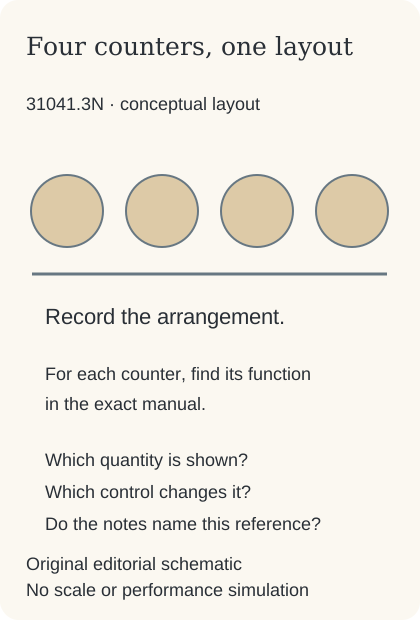
Diagram: Atelier editorial development / Codex. Original SVG created for this edition; no external image or branded artwork reproduced. Conceptual educational schematic; no handling, scale, reconstruction or independent performance test. Factual reading: Chrono 4 Basic 31041.3N.
A chronology connects a place with later design decisions
Eberhard & Co.'s current chronology names Georges-Lucien Eberhard as the founder in La Chaux-de-Fonds in 1887. That is the name used here, with its attribution retained; no independent civil archival record was retrieved to settle every historical naming variant. The chronology gives two later landmarks that make a useful route through the house: 8 Jours in 1997 and Chrono 4 in 2001. One makes stored running time a central subject, while the other reorganises chronograph reading into a line of counters. The same account places the inauguration of its museum at Maison de l'Aigle in 2019. Together, these dated events connect an origin, two distinct design programmes and a place where older objects are presented. They do not prove every promotional claim of priority or uninterrupted ownership. This profile follows the named references and documents rather than granting a founder personal credit for mechanisms introduced generations later.
Evidence: The Maison
The public operator record has a narrower scope than ownership
The website's retained privacy notice names EBERHARD & Co. as controller at its La Chaux-de-Fonds address. The notice carries a 26 June 2018 date. It is a useful public operator record, but its age and purpose matter: it explains who handles the website's stated processing rather than providing a complete, current capital table. The house account's independence language is therefore treated as the maker's description, not as an independently traced shareholding history. This chapter does not assign present ownership percentages or a complete roster of private beneficial owners. Keeping that boundary clear allows the historical narrative to remain useful without pretending that a museum announcement or a privacy page resolves corporate structure. For a reader assembling records, place the dated operator notice in one folder and object-specific technical material in another; either can be updated without silently rewriting the other.
Evidence: Legal notes, privacy and cookies
Chrono 4: read the row before guessing its functions
Chrono 4 Basic reference 31041.3N is described as an automatic steel chronograph with four counters in one line. The maker attributes the arrangement to a patented device. This profile records that claim without performing a patent examination or adopting a universal historical priority. The row is the specific reading proposition: the counters become a sequence across the dial. Their complete role and order are not given in the accessible product body, and its linked image-based manual could not be read adequately here. Consequently, this chapter does not assign four elapsed-time functions or invent a pusher sequence. The useful question is which indication runs continuously and which records an interval. A clear visual arrangement still needs its reference-specific function map.
Evidence: Chrono 4 Basic 31041.3N
8 Jours: a reserve claim and a visible bridge
8 Jours Grande Taille reference 21027.1CP is hand-wound, with a maker-stated eight-day reserve. The product describes two overlapping springs with a combined length exceeding 1.5 metres. That wording is kept intact in meaning; it is not expanded into an undocumented count of barrels. A reserve indicator and small seconds at six o'clock give the wearer two different readings, while the caseback's porthole reveals a skeletonised large-barrel bridge decorated with the number eight. The number becomes both a stated running-time identity and part of the movement's visual presentation. It does not establish the rate throughout an eight-day cycle, which would require a defined test. For an owner, the informative next record is the applicable winding guidance and the movement's observed condition. This article does not invent a number of crown turns from a reserve figure or treat the decoration as a substitute for an operating instruction.
Evidence: 8 Jours Grande Taille 21027.1CP
Scafograf 300: read the case features as a named specification
Scafograf 300 reference 41034.04/SCU is an automatic watch with a 43 mm steel case and a published 300 m rating. The maker specifies a helium-release valve at nine o'clock and a unidirectional ceramic bezel whose first fifteen-minute markings are luminous. Its screwed caseback carries a starfish. These details give the case a recognisable vocabulary, with functional claims and decoration presented together. Keep them attached to this reference: a family name extending through decades does not make every older Scafograf share the same case construction or rating. Nor does a new-product card establish the pressure resistance of an aged specimen today. For owner education, the useful distinction is between the advertised configuration and a current inspection or pressure-test record. The article makes no finding about this watch's suitability for a particular diving activity, and it does not infer a certification absent from the cited specification.
Evidence: Scafograf 300 41034.04/SCU
Extra-fort Retour en Vol: a technical term with a specific meaning
The maker's technical sheet for Extra-fort Retour en Vol reference 31957.05CA99 identifies an automatic chronograph with a column wheel and flyback function in a 41 mm steel case. Its sapphire centre in the caseback provides a movement view. These are the stated features of that reference, not features automatically shared by every watch named Extra-fort. A transparent back also does not establish the full source of the components or a measured timing result. Begin by separating the control mechanism, the function and the opportunity to look inside.
Patek Philippe's generic chronograph explanation describes flyback as resetting and restarting a running chronograph in one press. This definition helps distinguish the function from merely stopping an interval. It supplies no Eberhard pusher assignment or permission to operate an unidentified watch: the applicable owner's instructions remain a separate document.
Evidence: Extra-fort Retour en Vol 31957.05CA99 technical sheet, Chronograph watches
Géant makes scale and visual depth part of the reading problem
The Chrono 4 Géant collection account describes a 46 mm steel case, a rotating bezel with PVD-treated screws and a dial designed through multiple levels. Its maker presents that layered treatment as a way to build visual depth. This description focuses on how the larger object gives its indications a setting. A dimension can be recorded from a specification, while comfort and ease of reading would require experience with an actual watch and wearer. Neither is claimed here. The layers invite a useful visual exercise: describe the spaces around the counters before trying to compare their functions. Consider how a recessed surface and an elevated surface would guide attention differently, leaving actual visibility in use to be assessed separately. That keeps case scale, dial construction and timing behaviour separate enough to assess each with the appropriate evidence, rather than allowing a dramatic presentation to answer every question at once.
Evidence: Chrono 4 Géant
A 1969 Contograf enters a dated museum story
A maker announcement dated 21 July 2026 describes a 1969 Contograf joining the house's museum collections. It places the collection's origin in the early 1960s and links this object to an early period of Palmiro Monti's leadership. This is a valuable distinction between a line's beginning and the year assigned to one surviving watch. The article also interprets the object against changes in watchmaking around the quartz transition; that interpretation remains attributed to the maker. The announcement does not supply a complete accession dossier, a chain of previous owners or an independent examination of every component. Those are questions an object history can keep open while still explaining why a museum chose the watch. Read the acquisition as a dated act of collecting and interpretation. It supports a concrete story about the house's presentation of its past, without becoming evidence of its entire present shareholding structure.
The owner’s first record is an identity record
Eberhard's international-warranty page describes a two-year framework for new watches with its stated documentation requirements, including authorised-retailer activation and a warranty card or dated certificate. These terms belong to the sale record. They do not reveal an older watch's present rate or guarantee the availability of every replacement component. An owner can keep eligibility paperwork separate from a later service history, so neither is mistaken for a technical examination of the object.
The house's contact guidance asks for the reference numbers on the caseback or warranty card when seeking after-sale information. That is a practical identification principle: begin with the object and its documents before asking a collection name to do all the work. For a personal reading record, note the reference and which document it came from; keep unverified dates or changed components explicitly unresolved. This exercise requires no public posting of serial numbers or private paperwork, and no message is sent as part of this chapter.
Evidence: International warranty, Contacts: after-sale reference identification
Reader exercise: separate four kinds of evidence
Create four headings: arrangement, mechanism, condition and history. Under arrangement, write a question about a dial's counter layout. Under mechanism, write a question that needs a named technical sheet or manual. Under condition, leave room for a specimen-specific observation or test. Under history, distinguish the date of a collection from the date assigned to a museum object. Choose one reference in this chapter and place each available statement under the heading it actually answers. Where a document cannot answer your question, leave a blank. Finish by identifying the next source needed to fill one blank, without inventing the missing information.
Original editorial observation or reading prompt.
Sources & reading
- The MaisonEberhard & Co. · 2026-10-06
Current maker names Georges-Lucien Eberhard. No civil archival identity record or complete ownership chain was retrieved; universal priority language is not adopted.
- Legal notes, privacy and cookiesEberhard & Co. · 2026-10-06
Privacy notice is dated 26 June 2018. Controller name and address are a public operator record, not a current full corporate register or complete shareholder list.
- Chrono 4 Basic 31041.3NEberhard & Co. · 2026-10-06
Public body documents four counters in line but does not specify their full role/order. Linked image-based manual was not readable here; no order or pusher procedure inferred.
- 8 Jours Grande Taille 21027.1CPEberhard & Co. · 2026-10-06
Maker specification for the named reference; no specimen measurement, independent performance test or patent examination.
- Scafograf 300 41034.04/SCUEberhard & Co. · 2026-10-06
Published 300 m rating for named reference; no current specimen pressure test, certified diving scope or ISO compliance finding.
- Extra-fort Retour en Vol 31957.05CA99 technical sheetEberhard & Co. · 2026-10-06
One-page technical sheet read. Its generated date is not treated as the original model release date; no watch-specific operating procedure inferred.
- Chronograph watchesPatek Philippe · 2026-10-06
Generic flyback explanation only. Patek pusher assignments are not imported into Eberhard owner instructions.
- Chrono 4 GéantEberhard & Co. · 2026-10-06
Maker specification for the named reference; no specimen measurement, independent performance test or patent examination.
- The 1969 Contograf joins the museum collectionsEberhard & Co. · 2026-10-06
Dated maker announcement, not an independently retrieved accession dossier, complete object provenance or present equity ownership record.
- International warrantyEberhard & Co. · 2026-10-06
Published warranty documentation framework; no account activated and no eligibility finding for an individual watch.
- Contacts: after-sale reference identificationEberhard & Co. · 2026-10-06
Public guidance read; no form submitted, message sent or owner data processed.