
63Watch housesProfile details
Selected museum, signed collection research and manufacturer technical sources, with dated Chopard/Scheufele connection. No universal invention attribution, uninterrupted corporate continuity or independent modern performance claim.
- Historical master-watchmaker recognition
- 1753-12-04
- Historical King/Navy appointment
- 1770-04-01
- Historical name acquisition
- 2006
- Modern official inauguration
- 2015-11-25
- FB-T.FC published reserve
- 53 hours
- FB-RE.FC published reserve
- 50 hours
- FB-SPC published reserve
- 72 hours
- FB-RE.FC remontoir recharge interval
- 1 second
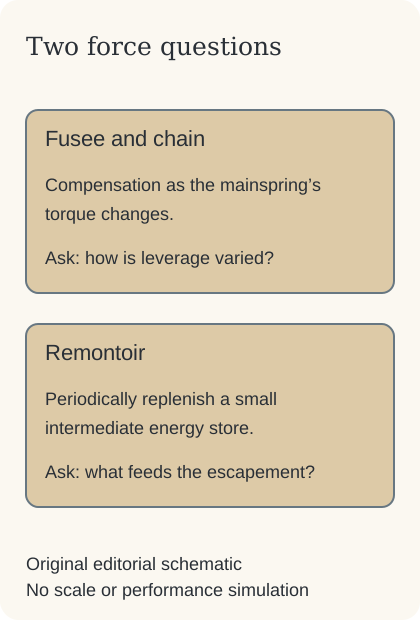
Diagram: Atelier editorial development / Codex. Original SVG created for this edition; no external image or branded artwork reproduced. Conceptual educational schematic; no handling, scale, reconstruction or independent performance test. Factual reading: Chronomètre FB 2RE: an unprecedented mechanical feat, Chronomètre FB 2RE.2.
The date beneath the name needs a verb
The historical Ferdinand Berthoud lived from 1727 to 1807, as the Science Museum Group’s authority record confirms. The modern house’s chronology dates his recognition as a master watchmaker in Paris to 4 December 1753 and his appointment to the French King and Navy to 1 April 1770. Those events describe a career: professional recognition and a later public responsibility. Neither is the incorporation date of today’s watch company. Giving each date its own verb prevents the familiar 1753 from doing more historical work than the evidence supports.
The chronology records marine instruments and publications, including a 1773 treatise on marine clocks. This makes Berthoud interesting as a maker who explained construction and testing, rather than as the sole inventor of marine timekeeping.
Evidence: Ferdinand Berthoud, History
A damaged pocket watch broadens the picture
The Science Museum Group’s No. 976 is a useful interruption to a story told only through grand sea clocks. The museum attributes this silver pocket watch to Ferdinand Berthoud in Paris and dates it to 1775–1790. It describes a quarter repeater with a French verge escapement; the dial is missing, and the catalogue notes missing cock screws and damage. The record identifies an actual object, with a date range and present recorded losses, rather than an ideal historical specimen assembled from promotional descriptions.
This watch also cautions against assigning a single mechanism to an entire historical workshop. Its recorded verge and repeating function belong to this object. They do not turn every Berthoud instrument into a repeater, and the modern wristwatch calibres discussed below should not be read as direct copies of No. 976. The surviving gaps are part of what a careful account can tell.
Evidence: Pocket watch with dial missing, in silver case: No. 976, 1916-234
A reference time worth carrying
A 2021 essay by clockmaker-restorer Dominique Mouret and researcher Ariane Maradan, hosted by the modern house, discusses longitude clock No. XXX, dated around 1780 in the L.U.C.EUM collection. Its context is the comparison between time at an agreed reference meridian and local time aboard a ship. One hour of difference corresponds to fifteen degrees of longitude. The instrument’s importance was therefore connected to preserving a useful reference during a journey, rather than merely producing an attractive seconds indication.
The collection essay remains an attributed source: this profile did not inspect No. XXX or independently establish claims about unique survival. Its object number matters too. A numbered marine clock and a later numbered marine watch can be distinct creations. Keeping the full designation and date beside the story makes a comparison with modern watches more precise and leaves room for differences in power source, construction and purpose.
Evidence: Longitude clocks
Buying a name and opening a manufacture
The Fondation Haute Horlogerie dates Karl-Friedrich Scheufele’s acquisition of the Ferdinand Berthoud name to 2006 and the Chopard group’s modern brand launch to 2015. The house’s tenth-anniversary account, published in March 2025, places the start of research and development in 2011 and the first FB 1 presentation in 2015. These describe a deliberate revival; they do not make the modern manufacture an unchanged legal continuation of the eighteenth-century workshop.
A contemporaneous house announcement provides another distinct event: the official inauguration on 25 November 2015, at Scheufele’s initiative. Its current values page places the dedicated workshops in Fleurier and names him as president. These records document the modern project and its stated leadership. They leave the exact present legal share table unverified, so the Chopard connection should retain its dated, published scope rather than become an unsupported claim of complete current ownership.
Evidence: Ferdinand Berthoud: marque, A decade of modern Chronométrie Ferdinand Berthoud, Chronométrie inauguration announcement (body text), Values
FB 1: compensation and a rotating regulator
The FB 1.1 page names the manually wound FB-T.FC, combining a tourbillon with suspended fusee-and-chain transmission. Published specifications give 3 Hz, a 53-hour reserve and COSC certification. The maker’s 2025 retrospective connects the modern project with its collected astronomical pocket watch No. 3, made in 1806. That historical inspiration is the house’s account of its own collection; it was not independently verified by examining the older watch.
The transmission has a specific task. In its 2020 explanation, the maker describes the chain and cone as compensating for changes in the barrel’s delivered torque, with a reversed, suspended construction in FB 1 and FB 1R. This is an energy-delivery idea. The tourbillon belongs to the regulating assembly, so simply seeing both in the same calibre does not make them the same solution. Neither the explanation nor a beautiful visible mechanism supplies an independent accuracy measurement.
Evidence: Chronomètre FB 1.1, A decade of modern Chronométrie Ferdinand Berthoud, Episode 2: The art of fusee-and-chain transmission
FB 2RE: two interventions along the energy path
For FB 2RE.2, the manufacturer names FB-RE.FC and specifies manual winding, 2.5 Hz and a 50-hour reserve. Its 2020 technical essay separates two functions. The changing fusee diameter compensates for changing barrel torque before the gear train; a secondary spring near the escapement stores a small quantity of energy and is recharged at one-second intervals. The remontoir complements the transmission at another point in the path. That distinction explains why both can appear in one watch.
The model page also links the stop wheel to the central true-seconds display. A second that jumps on the dial and a spring recharged every second have connected roles here, but they are not interchangeable names for every mechanism. The maker presents the arrangement as torque regulation; this profile makes no claim that the output is mathematically perfect or that every worn example achieves an identical daily rate.
Evidence: Chronomètre FB 2RE.2, Chronomètre FB 2RE: an unprecedented mechanical feat
FB 3SPC changes the question again
The FB 3SPC.1 page identifies FB-SPC: manually wound, with a cylindrical balance-spring, 3 Hz and a 72-hour reserve. The maker attributes its inspiration to Louis Berthoud’s decimal watch No. 26 of 1793. Louis and Ferdinand must remain distinguishable historical makers; a present design reference does not transfer authorship of that watch to the name on the modern dial.
The September 2023 development essay explains the work on terminal curves and collet mass needed to address positional behaviour in the cylindrical spring. This is a regulating-organ problem, approached through development and adjustment. It differs from the preceding transmission and remontoir examples. The maker describes COSC certification for FB-SPC; its broader first-or-only language was not checked through an independent survey and is not adopted as a universal historical claim.
Evidence: Chronomètre FB 3SPC.1, Chronomètre FB 3SPC: cylindrical balance-spring, History, Episode 2: The art of fusee-and-chain transmission, Chronomètre FB 2RE: an unprecedented mechanical feat
Let the mechanism keep its own evidence
Read the three named calibres as a comparison: FB-T.FC, FB-RE.FC and FB-SPC have different published reserves and different arrangements. The manufacturer’s certification claims attach to those movements. No individual certificate, temperature trial or owner timing log was inspected here, and the historical objects supply context rather than proof of modern performance. Nour’s escapement and chronometer-standards guides help place each claim at the right point in the movement and the right level of testing.
Evidence: Chronomètre FB 1.1, Chronomètre FB 2RE.2, Chronomètre FB 3SPC.1
Reader exercise: draw the questions before the wheels
On a sheet of paper, write three headings: stored energy, regulation and displayed time. Place the fusee-and-chain transmission, FB-RE.FC’s secondary spring, a balance-spring and the seconds indication where the sources explain their roles. Use arrows to show a functional relationship; leave tooth counts and exact geometry out of the sketch. Beside each arrow, note the named calibre and source that justifies it.
Then compare the published reserves of the three examples. Ask what was specified and what would still need measurement. Finally, write 1753, 1770, 2006 and 2015 with an event beside each date. A correct answer should preserve mastery, appointment, name acquisition and modern launch or inauguration as separate events. The exercise is a reading task and requires no watch adjustment.
Evidence: Chronomètre FB 2RE: an unprecedented mechanical feat, Chronomètre FB 3SPC.1, History, Ferdinand Berthoud: marque, Chronométrie inauguration announcement (body text), Chronomètre FB 1.1, Chronomètre FB 2RE.2
Sources & reading
- Ferdinand BerthoudScience Museum Group · 2026-10-05
Documents historical person and 1727–1807 lifetime; does not establish modern brand incorporation or ownership.
- HistoryChronométrie Ferdinand Berthoud · 2026-10-05
Master-watchmaker recognition 4 December 1753 differs from royal/naval appointment 1 April 1770. Early marine-clock completion year varies across maker-hosted essays; no unsupported first-ever invention claim or uninterrupted modern-company continuity adopted.
- Pocket watch with dial missing, in silver case: No. 976, 1916-234Science Museum Group · 2026-10-05
Museum dates quarter-repeating French-verge silver pocket watch 1775–1790, attributes Ferdinand Berthoud, and notes missing dial/cock screws and damage. Physical condition is catalogue evidence, not a new inspection or service recommendation. No photo used.
- Longitude clocksDominique Mouret and Ariane Maradan / Chronométrie Ferdinand Berthoud · 2026-10-05
30 September 2021 signed essay describes L.U.C.EUM longitude clock No. XXX circa 1780. Collection-hosted account; unique-survival and early completion superlatives not independently established. No.6 1777 marine watch is distinct from earlier marine clock No.6.
- Ferdinand Berthoud: marqueFondation Haute Horlogerie · 2026-10-05
Used for 2006 purchase of historical name by Karl-Friedrich Scheufele and 2015 group launch only. Its 1753 royal-role wording conflicts with maker chronology that separates mastery in 1753 from King/Navy appointment in 1770. Does not establish current complete share table.
- A decade of modern Chronométrie Ferdinand BerthoudChronométrie Ferdinand Berthoud · 2026-10-05
21 March 2025 account identifies Karl-Friedrich Scheufele initiative, 2011 research start and 2015 FB 1 presentation. Historical No.3 1806 pocket-watch design inspiration is maker/collection account, not independently inspected object. Anniversary chronology used over conflicting FB 1 award wording.
- Chronométrie inauguration announcement (body text)Chronométrie Ferdinand Berthoud · 2026-10-05
Body dated 30 November 2015 says official inauguration 25 November 2015, at Karl-Friedrich Scheufele initiative. Current page headline appears to belong to a different distinction story; rely on body event, not that headline. This dates inauguration, not legal incorporation.
- ValuesChronométrie Ferdinand Berthoud · 2026-10-05
Names Karl-Friedrich Scheufele as president and dedicated Fleurier workshops/team. Does not supply company registration, present legal share structure or independently establish every internal manufacturing step.
- Chronomètre FB 1.1Chronométrie Ferdinand Berthoud · 2026-10-05
FB-T.FC manually wound tourbillon/fusee-chain calibre, 3 Hz and 53-hour reserve are published maker data. Page wording conflates launch year with 2016 award; use 2025 retrospective for 2015 launch. No individual COSC certificate or rate test inspected.
- Episode 2: The art of fusee-and-chain transmissionChronométrie Ferdinand Berthoud · 2026-10-05
12 February 2020 account concerns FB 1/FB 1R suspended reversed transmission. Historic first/only, strength, precision and patent superlatives not independently established and not adopted; no video or physical test inspected.
- Chronomètre FB 2RE.2Chronométrie Ferdinand Berthoud · 2026-10-05
FB-RE.FC fusee/chain plus one-second remontoir and true-seconds connection, 2.5 Hz/18,000 vph/50-hour reserve/COSC are model-specific maker data. No perfect-force or wear-rate guarantee inferred; proposed educational block diagram does not reproduce exact geometry.
- Chronomètre FB 2RE: an unprecedented mechanical featChronométrie Ferdinand Berthoud · 2026-10-05
18 August 2020 text separately explains fusee compensation of barrel torque and secondary remontoir spring near escapement with one-second recharge. Claims of constant force and accuracy remain manufacturer descriptions, not independent measurements. Abstract diagram should not reproduce geometry or imply perfectly flat torque.
- Chronomètre FB 3SPC.1Chronométrie Ferdinand Berthoud · 2026-10-05
FB-SPC manual-wind cylindrical balance-spring, 3 Hz/21,600 vph/72-hour reserve/COSC concern FB 3SPC.1 page. Manufacturer unique-COSC language is not an independently verified universal first. No handling or individual certification documents inspected.
- Chronomètre FB 3SPC: cylindrical balance-springChronométrie Ferdinand Berthoud · 2026-10-05
Body date 11 September 2023 (index date differs). October 2022 introduction, Louis Berthoud No.26 1793 inspiration and terminal/collet-development account are attributed. Maker first/only claim and aggregated COSC rate figures are not an independent census or individual owner forecast.