
61Watch housesProfile details
Felix A11B, Erwin A11S, Doppel38 A11R_H1 and archived Doppel-Felix A11R/A11RD remain separate. Own-name products began in 2004; A11 development in 2011 and its introduction in 2014 are distinct. Leibnitz is the current linked contact; Völkermarkt is scoped to the 2024 workshop interview. Maker assurances are not certificates.
- Own-name series beginning
- 2004 — Home-page product account, not exact legal incorporation
- A11 development origins
- 2011 — House-published 2024 movement article
- A11 introduction with Felix
- 2014 — House-published 2024 movement article; not founder date
- Felix A11B stated reserve
- 48 hours — Named manual model specification only
- Erwin A11S frequency
- 4 Hz — Mechanical balance frequency; central seconds display jumps once a second
- Erwin A11S stated reserve
- 48 hours — Named manual jumping-seconds model only
- Doppel38 water rating
- 3 bar — Current Doppel38/A11R_H1 page, not archived Doppel-Felix; present condition untested
- A11 production-direction organisation
- Habring Uhrentechnik OG — Maker FAQ production drawings label; no corporate-register extract
- Contact location observed
- Leibnitz, Austria — Current linked maker contact; relocation and manufacturing locations not established
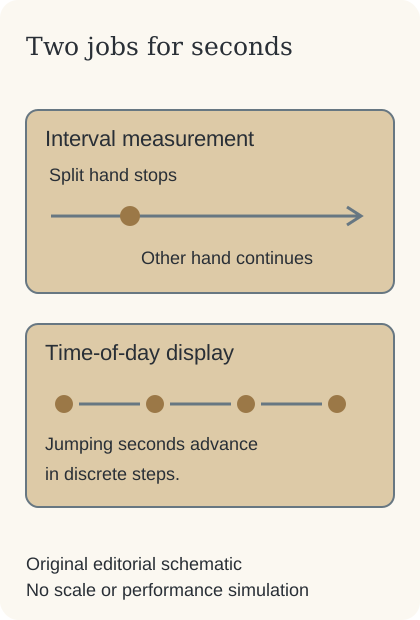
Diagram: Atelier editorial development / Codex. Original SVG created for this edition; no external image or branded artwork reproduced. Conceptual educational schematic; no handling, scale, reconstruction or independent performance test. Factual reading: Felix + jumping second = Erwin, The jumping second, Chronographe à rattrapante, Doppel38.
Two people and an own-name beginning
The superscript in Habring² points to Maria Kristina and Richard Habring. The home page dates the beginning of watches produced under that name to 2004. This is a useful starting date for the product story; it is not an independently verified incorporation date for every enterprise associated with the couple. Their 2024 customer magazine places the workshop story in Völkermarkt, while the current linked maker contact lists Leibnitz.
Keep those places attached to their source dates and functions. The contact listing is evidence for where the maker tells readers to make contact on 5 October 2026, not a documented relocation timeline or proof that every production operation moved there. A small workshop’s personal identity is engaging enough without filling gaps in its legal or geographical history.
Evidence: Welcome to HABRING², HABRING Uhrentechnik contact, Uhrkraft 2024 — independent movement makers and anniversary interview
A11 addresses a supply problem
The maker explains A11 through a practical problem: the withdrawal of ETA supply led it to develop a replacement while preserving interfaces for complications already in its watches. The 2024 movement article places development origins in 2011 and the A11’s introduction in 2014 with Felix. It describes continuity of design as a way to support older watches, rather than a reason to erase the role of their earlier base movements.
The A11 account also names specialist production in Austria, Germany and Switzerland under drawings issued by Habring Uhrentechnik OG. A raw balance spring from Carl Haas is counted and prepared within the workshop. This is a collaborative production story with internal direction and assembly; independence from a complete-movement supplier does not require pretending that every raw component begins under the same roof.
Evidence: What’s the story behind the A11?, Uhrkraft 2024 — independent movement makers and anniversary interview
Felix establishes a useful baseline
Felix uses the manually wound A11B, with small seconds at nine o’clock, a frequency of 4 Hz and a published reserve of forty-eight hours. Its calibre page lists eighteen jewels and a 4.2-millimetre movement height. These details describe an uncomplicated point of departure within the house: winding supplies energy, a regulating assembly sets the rhythm, and the dial separates the running seconds from hours and minutes.
The same page specifically distinguishes Felix from the house’s extensible module system. The owner should therefore not infer that any model can be converted later simply because several share an A11 family label. A base movement can be related to its complicated siblings without every finished case and product being an interchangeable platform. The exact model’s construction decides that practical boundary.
Evidence: Felix the fortunate
Erwin changes the display without becoming quartz
Erwin’s A11S is manually wound and also specified at 4 Hz with forty-eight hours of reserve, but its central seconds hand jumps from marker to marker. Habring’s mechanism explanation describes a small spring charged through the gear train and released at intervals corresponding to a full second. For a 4 Hz balance, that interval contains eight beats. The display can therefore advance once a second while the regulating mechanism continues at its faster mechanical rhythm.
The comparison is a good antidote to identifying a movement merely by its seconds hand. A one-second jump can be a mechanical display choice. The maker’s older explanation includes a broad invention claim and a proposed doctors’-watch story; neither is adopted here as established world history. What this evidence supports is the operating idea and the named Habring implementation, with measured accuracy kept as a separate question.
Evidence: Felix + jumping second = Erwin, The jumping second
Split seconds answers a different timing question
A split-seconds chronograph is concerned with elapsed intervals, rather than Erwin's time-of-day seconds display. Erwin's A11S remains a 4 Hz mechanical timekeeper; its charged spring releases the visible seconds display once a second. FHH's glossary explains the split-hand relationship: two timing hands begin together; one can be held while the other continues, then released to catch up. In an original desk example, those hands preserve an intermediate finish and a later finish. That catch-up relationship is the idea behind the additional split-seconds hand listed for Doppel38's A11R_H1.
The current Doppel38 page lists manual winding, a running-seconds display, chronograph seconds, a thirty-minute counter and the split hand. Chrono-Felix, by comparison, lists a monopusher chronograph and thirty-minute counter without that split-hand specification. The archived Doppel-Felix record names A11R and its pointer-date variant A11RD. Keeping these records apart makes the function easier to understand than simply grouping every watch containing “Chrono” or “Doppel” into one mechanism.
Evidence: Chronographe à rattrapante, Doppel38, Doppel-Felix, Chrono-Felix, Felix + jumping second = Erwin, The jumping second
A family resemblance does not fix the case specification
Doppel38 is listed with forty-eight hours of reserve and 3 bar water resistance, while the archived forty-two-millimetre Doppel-Felix record gives forty-eight hours and 5 bar. Erwin’s page gives a rating equivalent to thirty metres. Similar endurance therefore coexists with different case specifications and different uses of the seconds display. Read the exact record before bringing an instruction or rating across from a sibling.
A pressure rating is also separate from a particular watch’s present condition. These pages supply published specifications; they do not constitute a pressure test of an owner’s watch. Nor does the presence of a chronograph establish whether its controls can be operated in water. That operational question requires the relevant instructions and the maker’s advice, rather than a conclusion drawn from the movement name.
Evidence: Doppel38, Doppel-Felix, Felix + jumping second = Erwin
Service is part of the independence story
The FAQ recommends an annual water-tightness check and describes a general inspection as usually due at about five years, allowing condition and wearing habits to affect the decision. Its three-year manufacturing-defect guarantee is stated as conditional on annual water inspection. These are the maker’s published terms as read for this edition, and an owner should confirm the applicable documents for the actual purchase.
A11’s supply account makes a further assurance: compatible replacement work should keep the earlier A07, A08 and A09 watches maintainable. That is a documented service intention, rather than proof of an unlimited stock of every part or a promised turnaround. Ask the workshop which components can be supported for the exact calibre and which changes a repair would require. Preserving that conversation with the service record is more useful than a general claim that mechanical watches last forever.
Evidence: FAQs, What’s the story behind the A11?
The workshop label does not supply a share register
The technical account names Habring Uhrentechnik OG as the organisation directing A11 production drawings. The linked contact identifies HABRING Uhrentechnik in Leibnitz. Those records establish a documented workshop and contact identity, while the home page names the two people behind the product. No corporate-register extract or complete present ownership distribution was retrieved.
This profile consequently leaves ownership percentages and the exact legal incorporation day unknown. The Felix specification’s description of chronometer quality does not certify an individual watch. The most useful next readings are Chronograph and Chronometer for the distinction between function and tested status, Movements Explained for energy and display, and Servicing and Restoration for the decisions a repair can involve.
Evidence: What’s the story behind the A11?, HABRING Uhrentechnik contact, Welcome to HABRING², Felix the fortunate
Reader exercise: three seconds hands, three questions
Draw a simple card for Felix, Erwin and Doppel38. Under “running time”, place Felix’s small seconds and Erwin’s jumping central seconds. Under “elapsed timing”, place Doppel38’s chronograph and split hands. Imagine two runners starting together and finishing after twenty and twenty-four seconds: the split display can preserve the first result while the other hand continues to the second. Erwin’s ordinary running-seconds display has a different job. Add a fourth card for Chrono-Felix and mark its thirty-minute counter without inventing a split hand. The drawings are conceptual; they are a reading check, not instructions to press controls or test a watch in water.
Evidence: Felix the fortunate, Felix + jumping second = Erwin, Doppel38, Chrono-Felix, Chronographe à rattrapante
Sources & reading
- Welcome to HABRING²Habring² · 2026-10-05
Names Maria Kristina and Richard Habring and dates own-name series beginning to 2004. Product/brand date is not automatically earlier workshop formation or present legal incorporation.
- What’s the story behind the A11?Habring² · 2026-10-05
Maker explains 2011 response to ETA withdrawal, specialists in Austria, Germany and Switzerland, Habring Uhrentechnik OG drawings and raw Carl Haas hairspring. Maintainability is an attributed maker assurance, not a guaranteed independent repair outcome.
- Uhrkraft 2024 — independent movement makers and anniversary interviewHabring² · 2026-10-05
The PDF internal masthead reads №11/2024; its download label says 10/2024. Development in 2011, A11 debut in 2014 and the 2024 maker interview were read. This house-published magazine is not laboratory or corporate-register evidence. Völkermarkt workshop location is scoped to that interview.
- Felix the fortunateHabring² · 2026-10-05
Named A11B: manual winding, 4 Hz, 48 hours and non-extensible Felix architecture. The ambiguous first-anniversary phrase is not used as dating evidence. Chronometer-quality wording is not a retrieved certificate.
- Felix + jumping second = ErwinHabring² · 2026-10-05
Named Erwin A11S: manual winding, 4 Hz, 48 hours, central jumping seconds, Carl Haas spring and a thirty-metre equivalent rating. No independent rate, water-use or current-stock claim.
- The jumping secondHabring² · 2026-10-05
Spring and gear-train release explanation personally read. Broad invention and world-first assertions are not adopted as established history. Named operating explanation does not prove a watch’s measured accuracy.
- Doppel38Habring² · 2026-10-05
Readable page heading is Doppel38; A11R_H1 lists manual winding, 48 hours, running seconds, chronograph and split seconds, and 3 bar. The pagination URL may change. Archived Doppel-Felix specifications are kept separate.
- Doppel-FelixHabring² · 2026-10-05
Archived A11R/A11RD and pointer-date variant: 42 mm, 48 hours and 5 bar. An archive listing does not establish present availability or the newer Doppel38 case rating.
- FAQsHabring² · 2026-10-05
Annual water check, general inspection usually around five years, and a three-year manufacturing-defect guarantee conditional on annual water inspection. Owner tailoring and production counts are first-party statements; no verified capacity or permanent warranty promise inferred.
- HABRING Uhrentechnik contactHabring² · 2026-10-05
Current linked contact lists Konrad-Weg 1, 8430 Leibnitz, Austria. No relocation date, manufacturing-address scope, incorporation day or shareholder record established. German-language body read; no form submitted.
- Chrono-FelixHabring² · 2026-10-05
A11C manual 4 Hz, 48 hours, monopusher chronograph with thirty-minute counter. Photos may show additional functions; only technical text used.
- Chronographe à rattrapanteFondation Haute Horlogerie · 2026-10-05
French glossary explains two elapsed-time hands, stopping one while the other continues, then catch-up and synchronisation. General functional explanation, not a Habring-specific control manual, invention attribution or performance certificate.