
09Watch housesProfile details
Historical and educational profile. Model families developed over time; technical details refer to the stated generation or example.
- Reading time
- 5 minutes
- Profile reviewed
- 2026-10-04
1905–1919: making the wristwatch credible
Rolex began with a commercial proposition rather than a diving watch. In London in 1905, Hans Wilsdorf established a timepiece-distribution business and pursued the idea that a small wristwatch could be a reliable everyday instrument. He used Swiss movements from Bienne; the Rolex name followed in 1908. That sequence matters: the organisation and its ambition preceded the familiar name on the dial.
Precision was an early means of demonstrating the proposition. Rolex records a Bienne chronometric certificate in 1910 and a Kew class A certificate in 1914. Wilsdorf moved the business to Geneva in 1919, with Montres Rolex S.A. registered there the following year. These milestones concern measured timekeeping and corporate development, setting the stage for a second challenge: protecting that performance outside the testing room.
Evidence: Rolex: History 1905–1919
1926–1931: a protected movement, then automatic winding
The Oyster of 1926 approached protection as a system. Its original bezel, back and winding crown screwed against the middle case, closing routes through which moisture and dirt could enter. Rolex’s earlier Submarine of 1922 had enclosed a watch within an additional case, which had to be opened for winding and setting. Comparing the two makes the improvement tangible: sealing needed to coexist with convenient access to the controls.
In 1931 Rolex patented its Perpetual rotor mechanism. Wrist motion could now help replenish the mainspring through a rotating weight. Oyster and Perpetual therefore describe different engineering ideas: one concerns the case, the other the energy supply. Their combination explains much of the brand’s subsequent vocabulary. Automatic winding still depends on motion and a finite reserve; the word “Perpetual” here does not describe a calendar or an inexhaustible power source.
Evidence: Rolex: Behind the crown — Mastering waterproofness, Rolex: History 1926–1945
1945–1956: everyday information becomes a design signature
The Datejust arrived in 1945 with a date window and the Jubilee bracelet created for it. Its significance is easy to overlook beside more dramatic professional watches: a calendar could be integrated into an automatic wrist chronometer without making the dial difficult to read. Date indication became part of the everyday visual language of the watch.
The Day-Date followed in 1956, adding the weekday written in full and appearing in gold or platinum with the President bracelet. The distinction is functional as well as stylistic. Neither name means that the watch calculates the changing lengths of all months. They illustrate how information, case treatment and bracelet design can establish separate identities within a recognisable family.
Evidence: Rolex: History 1926–1945, Rolex: History 1953–1967
1953 onward: the professional watch is a specific answer
Rolex dates both the Explorer and Submariner to 1953. The Explorer grew from the company’s expedition associations; the Submariner addressed underwater use with a rotating elapsed-time bezel. The Sea-Dweller of 1967 added a helium escape valve for a different problem: releasing helium during decompression after saturation-diving exposure. Its valve is not a general-purpose upgrade needed for every encounter with water.
The modern Submariner’s 60-minute bezel demonstrates how an exterior component can perform a calculation. Align its zero marker with the minute hand and subsequent hand positions show elapsed minutes. Counterclockwise-only rotation makes an accidental displacement increase the indicated elapsed time. A GMT bezel, despite a similar circular appearance, has a different scale and purpose. Reading the markings reveals more than recognising the silhouette.
Evidence: Rolex: History 1953–1967, Rolex: Submariner user guide
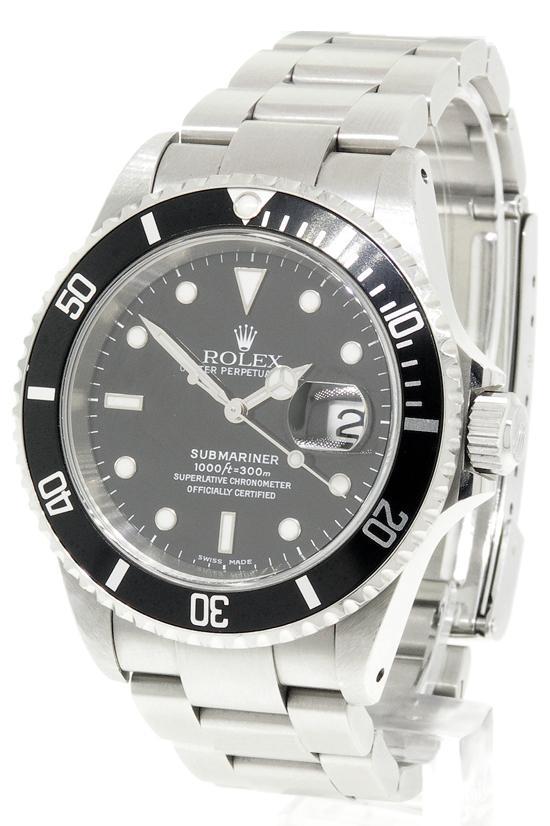
Rolex Submariner-Date, identified on the source page as reference 16610.
Compare the bezel scale and the date aperture as different kinds of information. This later family example does not establish specifications for the 1953 launch watch.
Photo: Rolex-Submariner.jpg by FrankWilliams / Wikimedia Commons. Public-domain dedication by the photographer. Original image; no local edits.
All watch-photo credits1955 and 1982: two generations of travel time
The GMT-Master appeared in 1955 as long-distance flying made simultaneous time-zone awareness increasingly useful. Its association with Pan American World Airways placed the watch in a concrete working environment. A hand completing one revolution in 24 hours could be read against a matching bezel scale, while conventional hands supplied the familiar twelve-hour display. The divided bezel colours also gave the scale a day-and-night structure.
Rolex’s chronology dates the GMT-Master II to 1982. Its important change was an independently adjustable local hour hand, which could move in hour steps without disturbing the minute and 24-hour hands. This made arrival in another time zone less disruptive to the reference time. The extra “II” consequently identifies a meaningful operating difference, not simply a new bezel colour. A travel watch should be understood through what changes when its owner moves.
Evidence: Rolex: GMT-Master II — Time zone to time zone, Rolex: GMT-Master II — In connection with the world
1963–2000: the Daytona’s separate stopwatch
The Cosmograph launched in 1963 and acquired the Daytona name through its motor-racing associations. A chronograph adds an elapsed-time mechanism to ordinary timekeeping. On this watch the outer tachymetric scale can turn the duration of travel over a known distance into an average speed; it does not sense speed directly. The pushers and counters should therefore be read as a separate measuring instrument sharing the case.
The movement history changes the meaning of an apparently continuous design. Automatic calibre 4030 arrived in 1988; Rolex’s own calibre 4130 followed in 2000. Those dates prevent a modern Daytona from standing in for every earlier example. Winding arrangements and movement architecture evolved even while the three-counter racing-watch identity remained recognisable.
Evidence: Rolex: Cosmograph Daytona — Born to race, Rolex Newsroom: The Cosmograph Daytona models
Refinement beneath the familiar exterior
The present Submariner family offers a useful technical comparison. Calibre 3230 powers the time-only model and 3235 the date version; both use the Chronergy escapement and have an approximately 70-hour reserve. Studying these named movements is more informative than assigning one specification to every historical Submariner. The bracelet’s Glidelock adjustment also shows that wearability is an engineering concern alongside the movement.
Precision claims require the same attention to scope. Rolex explains its modern Superlative Chronometer process as two stages: movement chronometer testing, followed by testing of the cased watch under its own protocol. Its stated finished-watch rate tolerance is −2/+2 seconds per day. This is a defined testing claim, distinct from the chronograph function and from a depth rating. Follow those distinctions and the familiar Rolex dial becomes a compact account of construction, function and verification.
Evidence: Rolex Newsroom: The Submariner models, Rolex: Oyster Story — Precision
Selected chronology
Dates describe the stated event or generation, rather than every watch in a family.
- 1905 / 1908Wilsdorf’s London business begins; the Rolex name follows.
Evidence: Rolex: History 1905–1919
- 1926 / 1931Oyster case and Perpetual rotor mark separate construction and winding developments.
Evidence: Rolex: Behind the crown — Mastering waterproofness, Rolex: History 1926–1945
- 1945 / 1956Datejust and Day-Date establish two calendar-led families.
Evidence: Rolex: History 1926–1945, Rolex: History 1953–1967
- 1953 / 1967Explorer and Submariner precede the saturation-diving Sea-Dweller.
Evidence: Rolex: History 1953–1967, Rolex: Submariner user guide
- 1955 / 1982GMT-Master and GMT-Master II mark different travel-time architectures.
Evidence: Rolex: GMT-Master II — Time zone to time zone, Rolex: GMT-Master II — In connection with the world
- 1963 / 1988 / 2000Cosmograph launch; automatic calibre 4030; Rolex calibre 4130.
Evidence: Rolex: Cosmograph Daytona — Born to race, Rolex Newsroom: The Cosmograph Daytona models
Sources & reading
Manufacturer histories describe the house’s own account. Source review dates are inherited from the supplied research packet; the review export does not claim fresh verification.
- Rolex: History 1905–1919primary · 2026-10-04
Section-level source links support dates, model histories and technical descriptions. These are primary manufacturer accounts; the explanations and comparisons are original editorial interpretation.
- Rolex: Behind the crown — Mastering waterproofnessprimary · 2026-10-04
Section-level source links support dates, model histories and technical descriptions. These are primary manufacturer accounts; the explanations and comparisons are original editorial interpretation.
- Rolex: History 1926–1945primary · 2026-10-04
Section-level source links support dates, model histories and technical descriptions. These are primary manufacturer accounts; the explanations and comparisons are original editorial interpretation.
- Rolex: History 1953–1967primary · 2026-10-04
Section-level source links support dates, model histories and technical descriptions. These are primary manufacturer accounts; the explanations and comparisons are original editorial interpretation.
- Rolex: Submariner user guideprimary · 2026-10-04
Section-level source links support dates, model histories and technical descriptions. These are primary manufacturer accounts; the explanations and comparisons are original editorial interpretation.
- Rolex: GMT-Master II — Time zone to time zoneprimary · 2026-10-04
Section-level source links support dates, model histories and technical descriptions. These are primary manufacturer accounts; the explanations and comparisons are original editorial interpretation.
- Rolex: GMT-Master II — In connection with the worldprimary · 2026-10-04
Section-level source links support dates, model histories and technical descriptions. These are primary manufacturer accounts; the explanations and comparisons are original editorial interpretation.
- Rolex: Cosmograph Daytona — Born to raceprimary · 2026-10-04
Section-level source links support dates, model histories and technical descriptions. These are primary manufacturer accounts; the explanations and comparisons are original editorial interpretation.
- Rolex Newsroom: The Cosmograph Daytona modelsprimary · 2026-10-04
Section-level source links support dates, model histories and technical descriptions. These are primary manufacturer accounts; the explanations and comparisons are original editorial interpretation.
- Rolex Newsroom: The Submariner modelsprimary · 2026-10-04
Section-level source links support dates, model histories and technical descriptions. These are primary manufacturer accounts; the explanations and comparisons are original editorial interpretation.
- Rolex: Oyster Story — Precisionprimary · 2026-10-04
Section-level source links support dates, model histories and technical descriptions. These are primary manufacturer accounts; the explanations and comparisons are original editorial interpretation.
- Rolex: History 1905–1919primary · 2026-10-03 · Earlier edition source retained
Primary sources linked below support the historical and technical account. Observational questions and explanatory comparisons are original editorial interpretation.
- Rolex: History 1926–1945primary · 2026-10-03 · Earlier edition source retained
Primary sources linked below support the historical and technical account. Observational questions and explanatory comparisons are original editorial interpretation.
- Rolex: History 1953–1967primary · 2026-10-03 · Earlier edition source retained
Primary sources linked below support the historical and technical account. Observational questions and explanatory comparisons are original editorial interpretation.
- Rolex: GMT-Master II and time zonesprimary · 2026-10-03 · Earlier edition source retained
Primary sources linked below support the historical and technical account. Observational questions and explanatory comparisons are original editorial interpretation.