
15Watch housesProfile details
Educational overview. Specifications and operating instructions vary by exact reference and production period.
- Reading time
- 5 minutes
- Profile reviewed
- 2026-10-04
Read the shape before the specifications
Cartier’s watch history is especially rewarding when approached through design. The shape of the case determines the space available for the dial, the relationship between numerals and hands, and the way a strap or bracelet meets the wrist. A watch can communicate a strong identity before the viewer knows what powers it.
The house records timepieces in its registers from 1853, including pocket watches and wearable jewellery forms. That variety gives useful context for the wristwatches that followed. Cartier’s interest in telling the time developed alongside an interest in how an object is worn, seen and incorporated into everyday life.
For a first comparison, place a square Santos beside a rectangular Tank. Ask where the case begins and the attachment ends. Notice the balance between straight lines and softened corners. These observations are original ways of reading the objects; they do not require treating every example as mechanically identical.
Evidence: Cartier: Our style
Santos and the practical appeal of the wrist
Cartier connects the Santos design to Louis Cartier and the aviator Alberto Santos-Dumont in 1904. The practical story is straightforward: a wrist-mounted display made time easier to consult during flight than a pocket watch. This is an important early wristwatch history, without needing the broader and misleading claim that wristwatches did not exist beforehand.
The square outline, exposed bezel screws and curved transition towards the attachment make the design recognisable. Screws do more than secure parts visually: they give the surrounding frame a repeated rhythm. The rounded corners prevent the square from reading as a simple rigid box.
Cartier’s historical collection includes a Santos-Dumont wristwatch dated 1912. It also records the later Santos de Cartier design created in 1978, represented by a 1981 steel-and-gold automatic example. These are different chapters. The original aviation connection should not be used to suggest that every later Santos has the same case, bracelet or mechanism.
Evidence: Cartier: Santos de Cartier watch and its origin, Cartier Collection: Watchmaking
The Tank and the relationship between case and strap
Louis Cartier created the Tank in 1917. Its two long side elements, known as brancards, frame the dial and make the transition towards the strap central to the composition. Looking at the whole outline is more informative than describing it only as a rectangular watch. The edges, dial and attachment work together.
The house’s collection includes an early Tank dated 1920. That museum object is a useful reminder to distinguish the creation of a design from the date of a particular surviving watch. An archive photograph may illustrate a later example even when it accompanies a story about the family’s origin.
To compare Tank variants, start with width and length, then consider thickness, curvature and dial proportions. A narrow elongated case occupies the wrist differently from a shorter, broader one. Roman numerals, a railway-style minute track and a cabochon crown can provide continuity, while the overall balance changes. “Small” and “large” are collection labels, not universal measurements across every generation.
Evidence: Cartier: Tank watches, Cartier Collection: Watchmaking
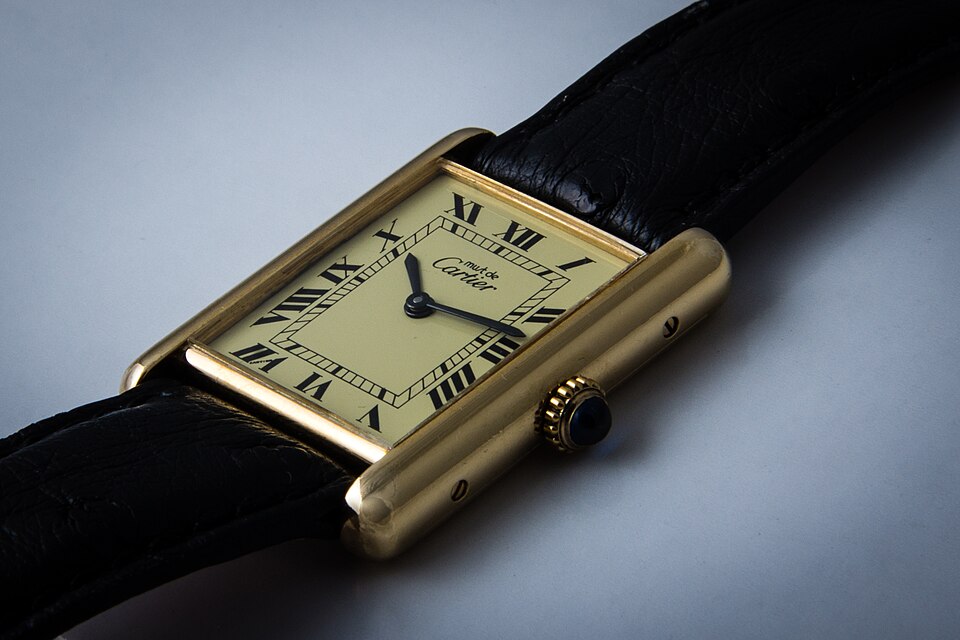
A Les Must de Cartier Tank photographed by Guy Sie. This family example is not a 1917 original or a Tank Louis Cartier.
Notice the vertical case sides, Roman numerals and strap continuity. Production date, exact reference and metal fineness are not established by this photograph.
Photo: Cartier Tank.jpg by Guy Sie / Wikimedia Commons. CC BY-SA 2.0. Wikimedia Commons 960px web rendition; no local edits. ShareAlike applies to adapted images.
All watch-photo creditsBeyond the familiar rectangle
Cartier’s collection also documents a tonneau wristwatch from 1915 and a London Crash from 1967. The first offers a rounded barrel-like alternative; the second distorts the expected outline far more dramatically. Both help explain why shaped watches deserve their own vocabulary, rather than being treated as departures from a supposedly normal round watch.
The Crash’s origin is often wrapped in an accident story. Cartier’s collection page presents that account as a tradition, so it should remain qualified. The surviving object and its 1967 date provide firmer ground for discussion than an embellished narrative about the precise circumstances of inspiration.
Compare how numerals respond to each case. A designer may preserve a regular central dial, stretch the arrangement or let markings echo the outer boundary. The result affects both expression and legibility. This is one of the pleasures of studying shaped watches: familiar time indications become an exercise in spatial organisation.
Evidence: Cartier Collection: Watchmaking
Mechanisms that respond to the design
A shaped case does not automatically imply a shaped movement. Cartier’s hand-wound 1917 MC is an instructive example because its tonneau form was developed for narrower cases, including Tank Louis Cartier and Crash models. The relationship between a movement’s outline and the space surrounding it is an engineering question as well as a visual one.
Skeleton work offers another connection. Cartier’s account traces the modern Santos skeleton vocabulary to the 2009 Santos 100 Skeleton. In Calibre 9611 MC, bridges take the form of Roman numerals, bringing structural support and the reading of time into the same composition. Removing material therefore becomes part of the design of the display.
The 2021 Tank Must SolarBeat illustrates a different response. Perforations in the Roman numerals allow light to reach photovoltaic cells beneath the dial. The interest lies in how the charging system is accommodated within an established appearance. It should be described as a particular technical implementation, not as a feature of every Tank or every quartz Cartier.
Evidence: Cartier: Movements
Clocks extend the same questions
Cartier’s Model A mystery clocks first appeared in 1912. Their hands seem visually detached from a conventional movement, turning the reading of time into a small puzzle. The historical collection includes a 1918 example combining rock crystal and ornamental materials with the apparently floating display.
This offers a useful comparison with skeleton watches. One invites attention to visible supports and mechanical structure; the other makes the transmission of motion difficult to see. In each case, the display is carefully staged. A technical object can invite curiosity through what it reveals and through what it conceals.
Evidence: Cartier Collection: Watchmaking
A practical method for looking
When studying a Cartier watch, record the collection, exact reference, dimensions and movement type separately. Then describe the case outline, numeral arrangement and attachment. This keeps an observation about style from turning into an unsupported claim about technical specification.
Try the comparison with photographs at the same scale, and include a side view when available. Front views alone cannot show curvature or thickness. A quartz version, a hand-wound version and a skeleton interpretation may each serve the design differently. Understanding those decisions makes Cartier a useful starting point for watch appreciation, even before the discussion reaches a list of complications.
Evidence: Cartier: Our style, Cartier: Movements
Selected chronology
Dates describe the stated event or generation, rather than every watch in a family.
- 1904Cartier dates the Santos design for Santos-Dumont to this year.
- 1912The first Model A mystery clocks appear.
Evidence: Cartier Collection: Watchmaking
- 1917Tank design created.
Evidence: Cartier: Tank watches
- 1967London Crash represented in the Cartier Collection.
Evidence: Cartier Collection: Watchmaking
- 1978Santos de Cartier design later represented by the collection’s steel-and-gold automatic example.
Evidence: Cartier Collection: Watchmaking
- 2009Santos 100 Skeleton establishes the modern numeral-bridge vocabulary.
Evidence: Cartier: Movements
- 2021Tank Must introduces the SolarBeat implementation.
Evidence: Cartier: Movements
Sources & reading
Manufacturer histories describe the house’s own account. Source review dates are inherited from the supplied research packet; the review export does not claim fresh verification.
- Cartier: Our styleprimary · 2026-10-04
House archives and technical explanations support the dated history. The comparisons and looking exercises are original editorial interpretation. Brand-supplied images are not licensed by these source citations.
- Cartier: Santos de Cartier watch and its originprimary · 2026-10-04
House archives and technical explanations support the dated history. The comparisons and looking exercises are original editorial interpretation. Brand-supplied images are not licensed by these source citations.
- Cartier Collection: Watchmakingprimary · 2026-10-04
House archives and technical explanations support the dated history. The comparisons and looking exercises are original editorial interpretation. Brand-supplied images are not licensed by these source citations.
- Cartier: Tank watchesprimary · 2026-10-04
House archives and technical explanations support the dated history. The comparisons and looking exercises are original editorial interpretation. Brand-supplied images are not licensed by these source citations.
- Cartier: Movementsprimary · 2026-10-04
House archives and technical explanations support the dated history. The comparisons and looking exercises are original editorial interpretation. Brand-supplied images are not licensed by these source citations.
- Cartier: Our styleprimary · 2026-10-03 · Earlier edition source retained
Primary sources linked below support the historical and technical account. Observational questions and explanatory comparisons are original editorial interpretation.
- Cartier: Santos de Cartierprimary · 2026-10-03 · Earlier edition source retained
Primary sources linked below support the historical and technical account. Observational questions and explanatory comparisons are original editorial interpretation.