
69Watch housesProfile details
- Credor label launch
- 1974 — Seiko luxury label
- 7R14 reserve
- 60 hours — Named calibre; approximately
- CR01 reserve
- 45 hours — GCCR997
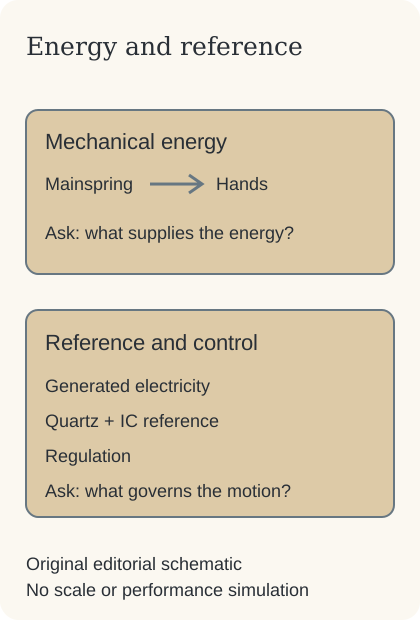
Diagram: Atelier editorial development / Codex. Original SVG created for this edition; no external image or branded artwork reproduced. Conceptual educational schematic; no handling, scale, reconstruction or independent performance test. Factual reading: 7R14 characteristics, Eichi II GBLT999, Movement.
Three dates, three different subjects
Credor’s history dates the Seiko luxury label to 1974. Seiko Group traces Kintaro Hattori’s earlier watch-and-clock retail and repair enterprise to 1881. Seiko Watch Corporation’s profile dates its start of operations to July 2001. Write those statements on separate lines before trying to tell a continuous story. A label’s launch, an enterprise’s lineage and an operating company’s beginning are distinct events. They can coexist without being compressed into a single founding date. That distinction matters when a reader asks who made a particular watch: the answer may involve a brand, a studio and a company, each with a different role. Start the investigation with the object’s reference and calibre, then look for the named responsibilities. A grand anniversary is a useful prompt for history, but it should not erase the boundaries between those dates.
Evidence: Our history, Seiko Group history, Corporate profile
An operating name and a working place
The privacy policy updated on 28 January 2026 names Seiko Watch Corporation. Credor locates the Micro Artist Studio, established in 2000, inside Seiko Epson’s Shiojiri facility; its account also identifies Shizukuishi Watch Studio, established in 2004, for mechanical watchmaking. These names help the reader replace an abstract idea of luxury with a set of responsibilities. A website operator is one answer to a company question; a workshop location is an answer to a making question. Do not force one to stand in for the other. When a craft story follows a person through several operations, ask where the work occurs and which watch it concerns. That gives the narrative a tangible setting without inventing a separate luxury company or a complete supplier map. The next sections follow two named calibres rather than assigning one technical personality to the entire label.
Evidence: Privacy policy, The Creativity of Artisans
Eichi II: a quiet front, a second reading on the back
Eichi II GBLT999 uses manually wound Spring Drive calibre 7R14. Its maker places the reserve indicator on the back and describes a white porcelain dial with hand-painted markers and lettering. Read the front first and write only what the wearer needs at a glance. Then turn to the back and list the questions it answers. The two lists make a useful design conversation: which information should remain constantly visible, and which can wait for a deliberate look? A restrained face can invite attention to proportion and spacing instead of a catalogue of extra displays. Describe those choices in your own words before reaching for a superlative. Make the reference explicit in your notes so a personal response to this object does not become a claim about the whole label.
Evidence: Eichi II GBLT999
Spring Drive: energy and a timing reference
The 7R14 manual says the mainspring is the sole power source. The Eichi II specification describes regulation using an IC and crystal oscillator. Credor’s movement explanation describes the gear train turning a glide wheel to generate electrical energy near coil-wrapped stators. Grand Seiko explains Spring Drive’s quartz-referenced electromagnetic braking through 9R examples; their component specifications are not a 7R14 parts list. A useful diagram begins with two questions: what powers the watch, and what provides its timing reference? Put them on separate arrows rather than squeezing the mechanism into a familiar label. For comparison work, ask the same questions of another calibre and leave the answer blank until a technical source supplies it. Familiar categories become more useful as prompts to investigate than as boxes into which every watch must fit.
Evidence: 7R14 characteristics, Eichi II GBLT999, Movement, Spring Drive mechanism
A reserve figure with a named mechanism behind it
Credor explains that 7R14’s Torque Return System uses excess energy to rewind the mainspring for approximately 35 hours after full winding, supporting a reserve of around 60 hours. GBLT999’s stated rate is ±15 seconds per month, expressed also as ±1 second per day. Keep reserve and rate in separate columns. The reserve describes stated running duration from the winding state; the rate is a published timekeeping specification. Neither column is your own test result. The mechanism’s name is useful because it lets you ask how the maker connects the design to the figure. It should not become a promise that every wearing pattern reproduces the same result. A comparison card can say exactly what is specified and still leave space for observed behaviour, service history and the conditions of a later test.
Evidence: Movement, Eichi II GBLT999
Locomotive: compare the actual reference
Locomotive GCCR997 uses automatic mechanical CR01, with a stated 45-hour reserve, titanium case and bracelet, and a hexagonal design vocabulary. The model account contrasts this modern mechanical movement with the original Gérald Genta design’s quartz movement. Put this reference beside the Eichi II card and compare the fields before comparing the mood. Their shared label encompasses distinct movements and winding arrangements. Begin with how each is wound, then write what the dial asks the eye to notice. A reinterpreted design is a particularly good reason to distinguish continuity of appearance from continuity of technology. If a seller uses the collection name as shorthand, ask for the reference that anchors the description. The result should be a comparison of two watches, rather than an argument over which single mechanism represents the brand.
Evidence: Locomotive GCCR997, Eichi II GBLT999
Two luminous surfaces, two material accounts
Credor’s porcelain account describes a ceramic base, glazing and firing, followed by hand-painted markers and lettering. Its Shippo story names Ando Cloisonné and artisan Wataru Totani, describes a pure-silver base and repeated glaze firings, and explains radial colour gradation. These are different material stories. Describe the effect that interests you, then seek the process attached to the actual dial. A smooth surface or a blue colour alone does not identify how it was made. For a close-reading exercise, separate what you can observe in a permitted image from what the workshop account supplies: colour transition belongs in the observation column, while a named material or firing process needs a source. This approach gives the artisan’s work specificity without turning every luminous dial into the same craft or implying that one method explains the whole collection.
Evidence: Dial, Credor Shippo enamel
An owner’s three documents
The 7R14 winding instructions call for slow clockwise winding and say not to force the crown when fully wound. Its service guidance recommends overhaul around every three to four years, depending on use, and warns that substitute parts may change appearance. Credor’s warranty page gives a five-year term for watches sold on or after 1 March 2023, subject to its conditions. Put the instruction manual, service estimate and warranty conditions in three separate folders. They serve different decisions. A warranty term is not a command to postpone maintenance until its last day, and a recommended service interval is not a guarantee that every watch needs identical work. Bring the actual reference and its history to the discussion. Ask which parts are proposed, what appearance may change and what will be checked afterward. These questions make ownership more informed without asking the reader to become a watchmaker.
Evidence: 7R14 winding the mainspring, 7R14 after-sale service, Warranty
Reader exercise: compare without collapsing the categories
Make a three-column worksheet headed energy, regulation and display. Choose two references whose maker documents you can read. Fill each cell with a short sourced answer, or with a question when the evidence is missing. Add a fourth column for the document’s date and scope. Then write two sentences about why each watch appeals to you, avoiding accuracy claims in that personal description. Finally ask what evidence would change one answer: a calibre manual, a condition report or a measured result under stated conditions. This exercise lets technical interest and aesthetic preference inform each other while keeping their evidentiary jobs clear.
Original editorial observation or reading prompt.
Sources & reading
- Our historyCredor / Seiko Watch Corporation · 2026-10-05
Brand milestones; not incorporation or individual-founder evidence.
- Seiko Group historySeiko Group Corporation · 2026-10-05
Earlier enterprise lineage; not Credor founding or a current full share register.
- Corporate profileSeiko Watch Corporation · 2026-10-05
Operating-company description; not a complete group ownership register.
- Privacy policySeiko Watch Corporation · 2026-10-05
Website operator disclosure; not separate Credor incorporation evidence.
- The Creativity of ArtisansCredor / Seiko Watch Corporation · 2026-10-05
Named studios and work; not proof that every component is internally made.
- Eichi II GBLT999Credor / Seiko Watch Corporation · 2026-10-05
7R14 reference specifications and stated rate; no independent timing test.
- 7R14 characteristicsCredor / Seiko Watch Corporation · 2026-10-05
7R14 instructions only; not CR01 or every Spring Drive calibre.
- MovementCredor / Seiko Watch Corporation · 2026-10-05
Separate 7R14 and 7R31 mechanisms; no brand-wide reserve guarantee.
- Spring Drive mechanismGrand Seiko / Seiko Watch Corporation · 2026-10-05
9R explanation; component specifications are not a 7R14 parts list.
- Locomotive GCCR997Credor / Seiko Watch Corporation · 2026-10-05
CR01 reference specifications; not a universal Credor movement description.
- DialCredor / Seiko Watch Corporation · 2026-10-05
Porcelain and enamel examples; not a process shared by every dial.
- Credor Shippo enamelCredor / Seiko Watch Corporation · 2026-10-05
Named collaboration account; not the material of an Eichi II dial.
- 7R14 winding the mainspringCredor / Seiko Watch Corporation · 2026-10-05
Manual 7R14 winding; not instructions for automatic CR01.
- 7R14 after-sale serviceCredor / Seiko Watch Corporation · 2026-10-05
Recommended interval and parts limits; no perpetual service or stock promise.
- WarrantyCredor / Seiko Watch Corporation · 2026-10-05
Eligibility depends on sale date and conditions; warranty is not scheduled maintenance.