
57Watch housesProfile details
Selected primary-source history and named technical examples. Manufacturer claims remain attributed; current legal continuity, complete shareholding and physical performance are unknown unless a dated source explicitly resolves that question.
- Brand beginning
- 2010
- Design and engineering location
- Antwerp, Belgium
- Production and assembly location
- Fleurier, Switzerland
- TYPE 3 display/base combination
- ROCS 3 / customised 2824/2
- TYPE 11 movement
- RW-01
- RW-01 stated minimum reserve
- 60 hours
- TYPE 3 award
- 2013 Horological Revelation Prize
- Published legal-form conflict
- RESSENCE BV / RESSENCE NV
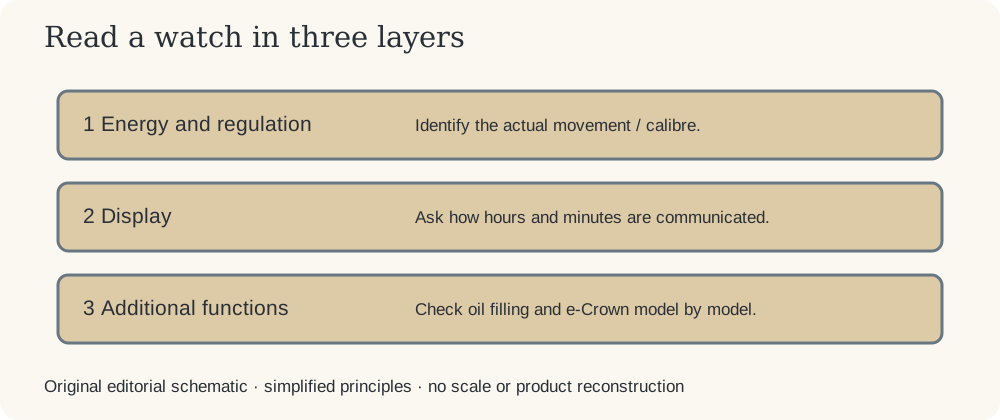
Diagram: Atelier editorial development / Codex. Original SVG created for this edition; no external image or branded artwork reproduced. Conceptual educational schematic; no handling, scale, reconstruction or independent performance test. Factual reading: ROCS — The Ressence Orbital Display, TYPE 3 — Oil-Filled Watch, TYPE 2 — e-Crown, TYPE 11 — The Now Watch.
Industrial design becomes a watchmaking question
Ressence’s official account places its beginning in 2010 with industrial designer Benoît Mintiens. His earlier work included transport interiors and medical equipment. The house describes watches designed and engineered in Antwerp and produced and assembled in a dedicated atelier in Fleurier. That division of places is more informative than assigning every activity to a single national label.
The industrial-design background provides a useful way into the watches: begin with how information reaches the person reading it, then ask how the mechanism makes that arrangement possible. This is an editorial approach to the documented design choices, rather than a claim that a particular training guarantees usability. The products still need to be understood by model and by the mechanisms they actually contain.
The display moves on more than one level
ROCS expands to Ressence Orbital Convex System. In the manufacturer’s explanation, the main display and its satellite indications move relative to one another. Reading it means following an indication while its position within the larger display changes. The system therefore replaces a familiar stationary-dial arrangement with a coordinated set of moving surfaces.
ROCS is a display mechanism, not automatically the entire movement. The published technical account names different versions and the base calibres that drive them. This distinction keeps three jobs visible: storing energy, regulating the movement and presenting information. An unusual display can sit above a recognisable underlying automatic calibre; its visual originality alone does not reveal who made the base movement or what controls its rate.
Evidence: ROCS — The Ressence Orbital Display
TYPE 3 turns depth into an optical problem
TYPE 3 is a documented object through which to explore this approach. Its oil-filled display creates the visual impression of indications close to the glass. The manufacturer explains the effect through the optical relationship between the oil and the crystal: reducing the refractive difference makes the intervening depth less apparent. That is an account of the display’s design, rather than an independently measured guarantee of perfect legibility from every angle.
The oil occupies an upper chamber containing the display system, while the base calibre remains in a separate air-filled chamber. GPHG’s record names TYPE 3 Le Scaphandrier as the 2013 Horological Revelation Prize recipient. The award anchors the model’s public reception in a dated external record without turning that recognition into certification of accuracy or water resistance.
Evidence: TYPE 3 — Oil-Filled Watch, Oil-Filled Watches, Horological Revelation Prize 2013
Moving information across a sealed boundary
Separating oil from the base calibre raises a practical question: how can the movement drive the display across the boundary? Ressence describes a magnetic coupling that transfers the minute information through a separating membrane. The connection avoids requiring a conventional rotating shaft to pass directly between the two environments. That explanation belongs to the identified oil-filled architecture, rather than being a feature to assume in every Ressence watch.
Temperature introduces another problem because the oil’s volume changes. The maker describes seven bellows accommodating that change, and identifies oil-temperature indications in the ROCS 3 and ROCS 5 descriptions. These are ways of managing and communicating conditions within the display system. They should not be confused with a timing test, a depth gauge or a promise that the watch is suitable for every temperature or activity.
Evidence: Magnetic Transmission, The Bellow System
TYPE 2 adds assistance to setting
TYPE 2 demonstrates a different development: e-Crown, an electromechanical setting system working between the mechanical base and the display. The owner establishes a reference time manually; the electronic system can retain that reference and adjust the displayed indications while the mechanical movement is running. Photovoltaic cells support the electronics. The TYPE 2 page describes modes for two time zones, connection to the app and operation with e-Crown switched off.
The distinction is between setting the displayed information and regulating the escapement. Nothing in that description establishes that e-Crown turns the mechanical oscillator into a quartz-regulated one. Oil filling should also stay separate from electronic assistance: the TYPE 2 account is evidence for e-Crown, not permission to attach TYPE 3’s oil chamber to it by association.
Evidence: The Ressence e-Crown, TYPE 2 — e-Crown
A current movement changes the comparison
The consulted TYPE 3 description pairs ROCS 3 with a customised 2824/2 base, using its minute axle to drive the display. The current TYPE 11 record instead identifies RW-01. Ressence presents RW-01 as its first movement designed in-house, with the display system integrated into an architecture sharing components rather than simply being stacked above an existing base.
The RW-01 account describes two barrels and a stated reserve of at least sixty hours; TYPE 11 also lists a sixty-hour reserve and a power indication using small ceramic balls. These are published specifications for that movement and model. They make an undated claim that all Ressence watches use the same externally supplied base untenable. Equally, internal design should not be expanded into an unverified claim that every component is manufactured internally.
Evidence: TYPE 3 — Oil-Filled Watch, The RW-01 Movement, TYPE 11 — The Now Watch
A useful idea does not settle a legal identity
The March 2025 sales terms contain a legal-form inconsistency: their opening names RESSENCE BV, while a later clause names RESSENCE NV. The profile therefore leaves the current legal entity unresolved rather than choosing a form from the same conflicting document. Its current owner and share register also remain unknown from the consulted evidence. The founder’s identity and the house’s language of independent thinking do not establish the absence of other shareholders.
What the evidence does establish is a coherent design enquiry with several technical answers. Orbiting displays, optical oil chambers, electronic setting assistance and the integrated RW-01 should each be attached to their documented scope. Keeping those features separate makes the range easier to understand and prevents a striking technology in one watch from becoming an invented specification for all the others.
Evidence: Terms of Service, Beyond Hands — The Ressence Original Idea
Follow an indication, then make three feature cards
Imagine a small labelled disc moving around the centre of a larger disc while also changing its own orientation. Draw two snapshots and mark the global position separately from the local orientation. Ask which change tells the reader the value, and which changes where that value appears. Treat the sketch as a generic reading exercise, not a drawing of the patented mechanism or its gear ratios.
Next make separate cards for TYPE 3, TYPE 2 and TYPE 11. Copy only the features assigned to each in the cited descriptions: oil-filled display, e-Crown assistance or RW-01 integration. Add a blank for details those pages do not establish. The blanks are useful: they stop a memorable feature from migrating into the wrong model.
Evidence: ROCS — The Ressence Orbital Display, TYPE 3 — Oil-Filled Watch, TYPE 2 — e-Crown, TYPE 11 — The Now Watch
Sources & reading
- Beyond Hands — The Ressence Original IdeaRessence · 2026-10-05
Design background and geography are manufacturer statements; independent thinking is not proof of absence of shareholders.
- ROCS — The Ressence Orbital DisplayRessence · 2026-10-05
Several ROCS variants are specified. A display module is distinct from its base movement; older variant descriptions must not be projected onto RW-01.
- TYPE 3 — Oil-Filled WatchRessence · 2026-10-05
Generic TYPE 3 record checked; not every historical edition, oil volume or later special reference. No physical legibility, rate or water-resistance tests.
- Oil-Filled WatchesRessence · 2026-10-05
Two-chamber optical explanation is the maker’s account. No independent refractive measurement or universal viewing-angle guarantee inferred.
- Magnetic TransmissionRessence · 2026-10-05
Minute information is coupled between separated chambers on identified oil-filled designs. Page language about anti-magnetism is not an independently verified certification.
- The Bellow SystemRessence · 2026-10-05
Thermal-compensation and oil-temperature indication are model-specific descriptions; no general safe-use temperature or accuracy guarantee inferred.
- The Ressence e-CrownRessence · 2026-10-05
Electromechanical setting is distinct from regulating the mechanical escapement. No continuous atomic-time or quartz-rate claim inferred.
- TYPE 2 — e-CrownRessence · 2026-10-05
TYPE 2 modes and e-Crown scope checked; no oil filling or universal use of this system across the range inferred.
- The RW-01 MovementRessence · 2026-10-05
First in-house-designed wording belongs to the maker. Integrated architecture does not establish exclusive internal manufacture of all components.
- TYPE 11 — The Now WatchRessence · 2026-10-05
Current TYPE 11 record with RW-01; sixty-hour specification is not automatically applicable to earlier ROCS/base combinations.
- Terms of ServiceRessence · 2026-10-05
March 2025 text names RESSENCE BV in its opening but RESSENCE NV later. Legal form conflict remains unresolved; no register or beneficial ownership search performed.
- Horological Revelation Prize 2013Fondation du Grand Prix d’Horlogerie de Genève · 2026-10-05
Readable award title and named TYPE 3 Le Scaphandrier record checked; embedded video not played. Award is not an accuracy or water-resistance certificate.