
10Watch housesProfile details
Historical and educational profile. Model families developed over time; technical details refer to the stated generation or example.
- Reading time
- 6 minutes
- Profile reviewed
- 2026-10-04
1839–1851: two partnerships and an everyday invention
The company began in Geneva in 1839 as Patek, Czapek & Co., founded by Antoine Norbert de Patek and watchmaker Franciszek Czapek. Its eventual name records a later partnership. At the Paris Industrial Exposition in 1844, Patek encountered Jean Adrien Philippe’s keyless winding system; Philippe joined him in Geneva in 1845. The firm adopted the Patek, Philippe & Cie name in 1851.
Keyless winding is a useful starting point because its benefit is immediate: the owner need not carry a separate winding key. A seemingly ordinary interaction with the crown contains an important chapter of watchmaking development. This origin also complicates the idea of Patek Philippe as a house concerned only with elaborate displays. Making an essential daily action easier belonged to its programme before many of its celebrated complications.
Evidence: Patek Philippe: The Founders
1932: new custodians, a clear round watch
During the Great Depression, brothers Charles and Jean Stern acquired the company in 1932. Their business, Cadrans Stern Frères, had supplied dials to Patek Philippe. The connection makes the watch face an especially revealing place to study the house: a dial must translate a mechanism into something the wearer can understand, whether it carries two hands or several calendars.
The Calatrava collection also dates to 1932. Patek Philippe associates its round, restrained design with Bauhaus thinking and functional clarity. The name should be distinguished from the Calatrava Cross emblem, formally registered in 1887. A symbol can appear across the manufacture’s work without making every watch a Calatrava. Look at the placement of the hands, the weight of the markers and the space around them before reducing this family to a synonym for simplicity.
Evidence: Patek Philippe: The Stern Family, Patek Philippe: The Calatrava Cross
1968 and 1976: two alternatives to the round dress watch
The Golden Ellipse of 1968 brought a softly shaped case between a circle and a rectangle, with proportions inspired by the golden ratio. Its sparse display makes small decisions unusually visible: slender hands, index lengths and the relationship between dial and case carry much of the design. Modern examples use the thin automatic calibre 240, whose off-centre mini-rotor provides a different architecture from a full-width winding weight above the movement.
The Nautilus, launched in 1976, pursued another direction. A porthole-inspired case, rounded octagonal bezel and horizontally patterned dial gave it a sporting identity. Alternating polished and satin surfaces make its geometry change with the light. Later calendar and chronograph versions show that a model family can retain its outline while changing its mechanical content. The Golden Ellipse and Nautilus are therefore useful companions in study: distinctive form is not confined to one style or level of complication.
Evidence: Patek Philippe: Golden Ellipse collection, Patek Philippe: Nautilus collection
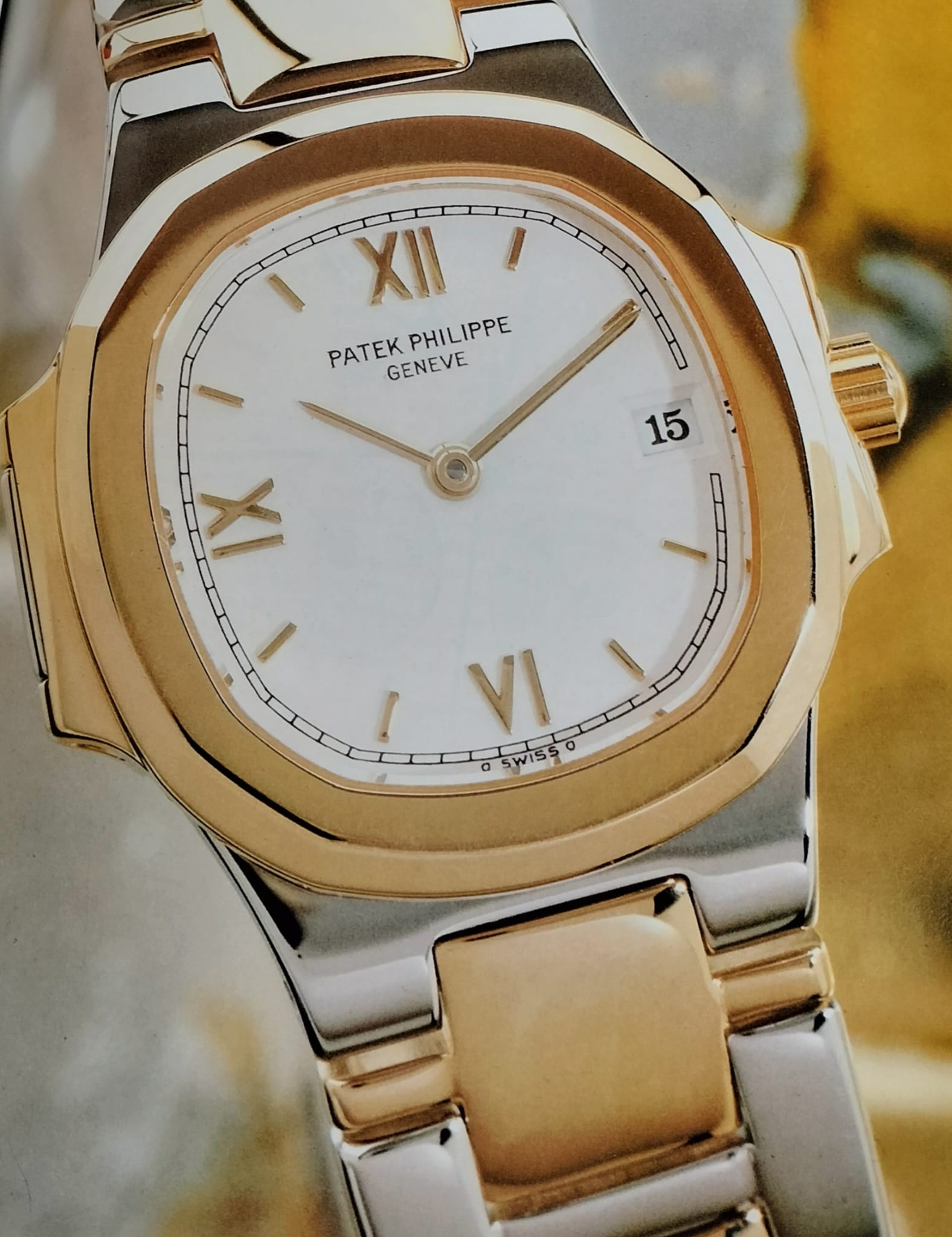
A two-tone Patek Philippe Nautilus; the photographer identifies this example as quartz. This later variant is distinct from the original 1976 mechanical Nautilus.
Notice the continuous case-and-bracelet outline. The movement type is attributed to the photographer, rather than authenticated from this still image.
Photo: Patek Philippe Nautilus, qui in versione femminile in oro e acciaio e con movimento al quarzo, risalente ai primi anni Novanta.jpg by Clyde94 / Wikimedia Commons. CC BY-SA 4.0. Original image; no local edits. ShareAlike applies to adapted images.
All watch-photo creditsCalendars: teaching a mechanism the irregular year
Patek Philippe’s calendar history includes a wristwatch completed in 1925 using a movement made in 1898. That gap is instructive: the date of a movement’s creation and the date of the finished watch can tell different stories. Moving a complicated mechanism to the wrist was its own design problem.
The Annual Calendar introduced in 1996 offers a particularly clear lesson in mechanical logic. An ordinary date display cycles through 31 numbers; an annual calendar also distinguishes 30-day from 31-day months. February still requires a correction. A perpetual calendar goes further by incorporating the usual four-year leap-year cycle. Most such mechanisms nevertheless need intervention at exceptional non-leap century years, including 2100.
Complexity also changes how information is arranged. Compare the arched apertures of Reference 5205 with the single broad day-date-month opening of Reference 5236. Both demand attention to reading order, but the mechanisms do not provide the same calendar programme. Attractive symmetry alone cannot tell the viewer whether a calendar is annual or perpetual.
Evidence: Patek Philippe: Calendar Watches
Chronographs: architecture as well as elapsed seconds
Patek Philippe records a specially commissioned split-seconds wrist chronograph in 1923 and series-produced wrist chronographs from 1927. A split-seconds mechanism supplies two superimposed timing hands: one can pause for an intermediate reading while the other continues. Reuniting them enables another comparison without ending the overall measurement. This is different from a flyback, which rapidly resets and restarts a timing sequence.
A later milestone arrived in 2009 when the manually wound CH 29-535 PS debuted in Reference 7071. The manufacture’s proprietary calibre became a basis for further versions, including the perpetual-calendar chronograph introduced in Reference 5270 in 2011. These relationships make movement names worth learning. They reveal a developing mechanical platform beneath watches whose dial layouts, cases and intended audiences may differ considerably.
Evidence: Patek Philippe: Chronograph Watches
Chiming watches: reading time through the ear
A minute repeater converts the displayed time into an on-demand sequence of sounds. In the conventional Patek Philippe arrangement, low notes count hours, paired notes count completed quarters, and high notes count the remaining minutes. Hammers strike gongs around the movement. The challenge is not merely producing enough components: the sequence must be distinct, paced intelligibly and acoustically convincing inside a small case.
Patek Philippe introduced longer cathedral gongs in 2000 and the double-sided Grandmaster Chime in 2014, whose functions include five chiming modes. A sonnerie adds another distinction by striking automatically at scheduled intervals. Listening therefore exposes differences that a photograph cannot communicate. A complicated dial is only one possible expression of a complicated watch.
Evidence: Patek Philippe: The Patek Philippe Sound
2005 onward: new materials within a traditional craft
The Advanced Research programme began in 2005 and makes technological change explicit. Its early Annual Calendar examples included Reference 5250 in 2005 and Reference 5350 in 2006; the latter introduced the Spiromax balance spring in silicon-based Silinvar. Here the focus is the regulator and its materials rather than an additional indication on the dial. The outwardly traditional watch can contain substantial experimentation.
The Patek Philippe Seal, created in 2009, likewise extends the discussion beyond appearance. Its requirements encompass the complete mechanical watch, including functionality, accuracy, exterior components and finishing. Under this lens, a polished bevel is one part of an overall construction standard. Decoration, reliable operation and legible display deserve separate examination rather than being treated as interchangeable signs of quality.
Evidence: Patek Philippe: Advanced Research, Patek Philippe: The Patek Philippe Seal
Reading a particular watch through its records
The house produces manual, automatic and quartz movements, so its name alone does not specify a power system. Its archival records can identify movement and case numbers, dial details, manufacture date and sale date. Keeping those dates distinct gives an individual watch a more precise history. Compare the record, the actual mechanism and the visible configuration; then return to the basic question shared by Calatrava, Nautilus and complicated watches alike: how clearly does this particular object express what it does?
Evidence: Patek Philippe: The Finest Timepieces in the World — collections, movements and archives
Selected chronology
Dates describe the stated event or generation, rather than every watch in a family.
- 1839 / 1851Original partnership begins; the Patek, Philippe & Cie name follows.
Evidence: Patek Philippe: The Founders
- 1932Stern acquisition and Calatrava collection.
Evidence: Patek Philippe: The Stern Family, Patek Philippe: The Calatrava Cross
- 1968 / 1976Golden Ellipse and Nautilus offer distinctive case architectures.
Evidence: Patek Philippe: Golden Ellipse collection, Patek Philippe: Nautilus collection
- 1996Annual Calendar introduced.
Evidence: Patek Philippe: Calendar Watches
- 2009 / 2011CH 29-535 PS debuts; Reference 5270 adds the perpetual-calendar chronograph chapter.
Evidence: Patek Philippe: Chronograph Watches
- 2005 onwardAdvanced Research develops new regulating materials.
Evidence: Patek Philippe: Advanced Research, Patek Philippe: The Patek Philippe Seal
Sources & reading
Manufacturer histories describe the house’s own account. Source review dates are inherited from the supplied research packet; the review export does not claim fresh verification.
- Patek Philippe: The Foundersprimary · 2026-10-04
Section-level source links support dates, model histories and technical descriptions. These are primary manufacturer accounts; the explanations and comparisons are original editorial interpretation.
- Patek Philippe: The Stern Familyprimary · 2026-10-04
Section-level source links support dates, model histories and technical descriptions. These are primary manufacturer accounts; the explanations and comparisons are original editorial interpretation.
- Patek Philippe: The Calatrava Crossprimary · 2026-10-04
Section-level source links support dates, model histories and technical descriptions. These are primary manufacturer accounts; the explanations and comparisons are original editorial interpretation.
- Patek Philippe: Golden Ellipse collectionprimary · 2026-10-04
Section-level source links support dates, model histories and technical descriptions. These are primary manufacturer accounts; the explanations and comparisons are original editorial interpretation.
- Patek Philippe: Nautilus collectionprimary · 2026-10-04
Section-level source links support dates, model histories and technical descriptions. These are primary manufacturer accounts; the explanations and comparisons are original editorial interpretation.
- Patek Philippe: Calendar Watchesprimary · 2026-10-04
Section-level source links support dates, model histories and technical descriptions. These are primary manufacturer accounts; the explanations and comparisons are original editorial interpretation.
- Patek Philippe: Chronograph Watchesprimary · 2026-10-04
Section-level source links support dates, model histories and technical descriptions. These are primary manufacturer accounts; the explanations and comparisons are original editorial interpretation.
- Patek Philippe: The Patek Philippe Soundprimary · 2026-10-04
Section-level source links support dates, model histories and technical descriptions. These are primary manufacturer accounts; the explanations and comparisons are original editorial interpretation.
- Patek Philippe: Advanced Researchprimary · 2026-10-04
Section-level source links support dates, model histories and technical descriptions. These are primary manufacturer accounts; the explanations and comparisons are original editorial interpretation.
- Patek Philippe: The Patek Philippe Sealprimary · 2026-10-04
Section-level source links support dates, model histories and technical descriptions. These are primary manufacturer accounts; the explanations and comparisons are original editorial interpretation.
- Patek Philippe: The Finest Timepieces in the World — collections, movements and archivesprimary · 2026-10-04
Section-level source links support dates, model histories and technical descriptions. These are primary manufacturer accounts; the explanations and comparisons are original editorial interpretation.
- Patek Philippe: Timepieces and archivesprimary · 2026-10-03 · Earlier edition source retained
Primary sources linked below support the historical and technical account. Observational questions and explanatory comparisons are original editorial interpretation.
- Patek Philippe: Calendar watchesprimary · 2026-10-03 · Earlier edition source retained
Primary sources linked below support the historical and technical account. Observational questions and explanatory comparisons are original editorial interpretation.
- Patek Philippe: Grand complicationsprimary · 2026-10-03 · Earlier edition source retained
Primary sources linked below support the historical and technical account. Observational questions and explanatory comparisons are original editorial interpretation.