
53Watch housesProfile details
Initial meeting, public debut and legal incorporation are distinct. Specifications and mechanisms belong to named models. No universal invention priority, current share register, independent rate test, ancient-history assertion or media licence is supplied.
- Public brand beginning
- 1997 — House public debut and FHH foundation entry; not a verified incorporation day
- Initial meeting
- 1995–1996 — House account includes Felix and Thomas Baumgartner with Martin Frei
- Harry Winston Opus 5
- 2005 — Historical collaboration, not a takeover
- EMC introduction
- 2013 — FHH chronology
- Blue Scorpion calibre
- UR-50.01 — Self-winding movement in the listed Blue variant
- Blue Scorpion stated reserve
- 43 hours — Published specification; not an independent endurance test
- EMC sensor interval
- 3 seconds — Manufacturer-described optical observation when activated
- Website contact entity
- URWERK SA — Geneva contact page; not a share register
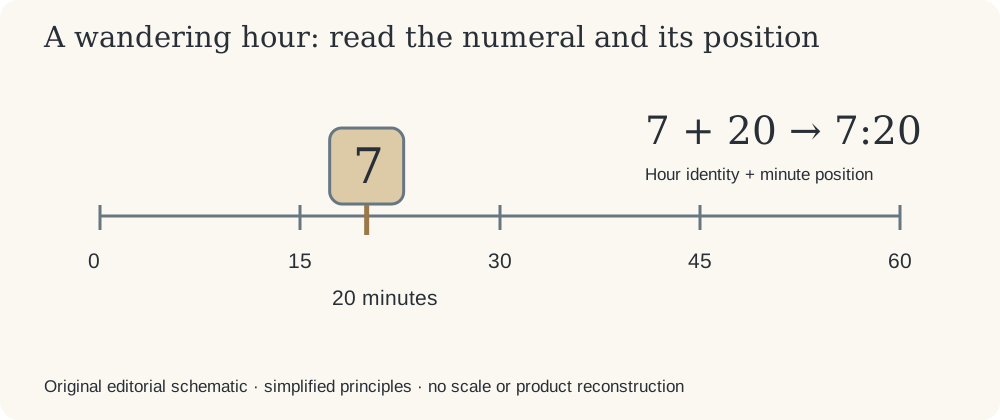
Diagram: Atelier editorial development / Codex. Original SVG created for this edition; no external image or branded artwork reproduced. Conceptual educational schematic; no handling, scale, reconstruction or independent performance test. Factual reading: UR-102 Reloaded.
A watchmaker and a designer, with a third person in the beginning
URWERK begins with a conversation about how time might look. The house places a meeting between Felix Baumgartner, his brother Thomas and designer Martin Frei at the end of 1995, with the idea taking shape at the start of 1996. Its public beginning follows in 1997. The present story identifies Felix as master watchmaker and co-founder, and Martin as chief designer and co-founder; FHH likewise names those two in its foundation entry. Thomas belongs in the documented initial meeting. These accounts should not be compressed into an invented legal founder list or a claim that the three held equal shares.
An hour that travels across its minutes
The UR-102 Reloaded offers a clear entry into this unfamiliar visual language. The manufacturer describes an hour unit moving along an arc, without conventional hands, and labels the display as digital hours with analog minutes. Here digital means an hour shown as a numeral; it does not imply an electronic timekeeper. The number tells you which hour is passing and its position tells you how much of that hour has elapsed. That is an editorial way to read the display, not a new mechanism claim. The Reloaded case is listed at 41 mm, compared with the earlier model's stated 38 mm: a return to an idea can still involve redesign.
Evidence: UR-102 Reloaded
The UR-150 makes the handover visible
The UR-150 Scorpion adds a particularly theatrical transition. According to URWERK, a cam directs a carousel of three hour satellites for sixty minutes. At the end of the scale, a spring returns the retrograde pointer through 240 degrees while the satellites rotate 270 degrees. For the Blue version, the official page lists the self-winding UR-50.01, a 43-hour reserve and a steel case with a titanium back. The reader can distinguish three jobs: presenting an hour, tracing its minutes and preparing the next hour. A dramatic return is a display action, not evidence that time itself jumps or that this mechanism is a chronograph.
Evidence: UR-150 Scorpion
Opus 5: an idea reaches another audience
In 2005, the house presented Opus 5 with Harry Winston. Its historical record describes a satellite hour display, retrograde minutes and a manually wound HW1026 movement with a stated 122-hour reserve. It also records a service indication on the back. This makes a useful connection to Nour's Harry Winston profile: the name on a watch can frame a collaboration rather than tell the whole story of its mechanism. URWERK's account treats the project as a turning point in public recognition. The service display is a documented design feature; calling it the world's first would need wider evidence than one participant's promotional history.
Evidence: OPUS 5
EMC measures the mechanical watch
EMC asks a different question: what if a wearer could inspect the watch's rate rather than only read the time? FHH dates the model to 2013. URWERK describes a mechanical, manually wound movement and an electronic monitoring unit supplied by a hand-powered generator. When activated, an optical sensor observes the four-hertz balance for three seconds; the circuit compares that behaviour with an electronic reference. The resulting indication concerns rate measurement. It does not turn the mechanical movement into a quartz-controlled movement. Nor is one brief reading the same as an independently certified average across positions, temperatures and days. The distinction is more illuminating than repeating the house's artificial-intelligence slogan.
Read the display before judging the silhouette
URWERK's varied displays reward a deliberate first look. Start with the current hour, locate the minute scale, then ask what changes at the next hour. The round Reloaded and the Scorpion organise that task differently; a complicated-looking case is not a reliable measure of how many steps a reader must perform. This is an editorial comparison of the cited descriptions, without a comfort or handling test. The official contact page names URWERK SA in Geneva. That website identity is useful, but the founder story and the privacy notice do not disclose complete shareholder control. Current ownership percentages therefore remain unknown rather than being inferred from a reputation for independence.
Evidence: UR-102 Reloaded, UR-150 Scorpion, Contact, Legal notice
A novel interface needs model-specific instructions
The EMC page describes a rear adjustment screw as well as an electrical generator and measurement control. Those features raise practical questions about the intended adjustment procedure, interpretation of a rate result and long-term servicing. An educational description should not substitute for the instructions of the actual model in front of its owner. Likewise, Opus 5's service display does not inspect lubricant condition or guarantee that a particular old watch needs no attention. Identify the calibre and controls, retain the supplied documentation and ask the maker about any uncertain operation. Nour's escapement, servicing and chronometer guides provide the vocabulary for separating a display feature, a maintenance question and a measured performance claim.
Draw a wandering hour without drawing a branded watch
Draw a plain minute arc from zero to sixty. Put the numeral 8 at the position for twenty minutes and write the time as 8:20. Now move it to fifty minutes, then replace it with 9 at the start of a new arc. This schematic tests the reading rule, not the internal gearing of a particular reference. Beside it, draw a second box labelled rate measurement and record what information would be needed before comparing two measurements. The exercise connects two different forms of knowledge: knowing the time and knowing how the timekeeper behaves. Compare that distinction with the EMC account and the movement guide, without reproducing URWERK's case, satellite hardware or artwork.
Evidence: UR-102 Reloaded, EMC
Sources & reading
- Our storyURWERK · 2026-10-05
House account distinguishes the initial 1995–96 meeting, 1997 public beginning and later models. Do not repeat the name-etymology narrative as established ancient history or childhood anecdotes as independently verified.
- UrwerkFondation de la Haute Horlogerie · 2026-10-05
FHH names Martin Frei and Felix Baumgartner at the 1997 foundation and dates EMC to 2013; not a share register.
- UR-102 ReloadedURWERK · 2026-10-05
Supports the Reloaded display and specification, not unchanged 1997 construction or every URWERK mechanism.
- UR-150 ScorpionURWERK · 2026-10-05
Variant-specific case listings and manufacturer account of cam/retrograde mechanism; no independent durability/accuracy testing.
- OPUS 5URWERK · 2026-10-05
2005 Harry Winston collaboration and HW1026 description; the universal first-service-indicator assertion is not independently substantiated.
- EMCURWERK · 2026-10-05
Mechanical timekeeping with electronic rate monitoring; do not interpret promotional artificial-intelligence wording as machine learning or a measurement as an independent accuracy certification.
- ContactURWERK · 2026-10-05
Names URWERK SA in Geneva; no registration extract or current share percentages.
- Legal noticeURWERK · 2026-10-05
Privacy policy body readable but no share register or ownership attribution; consulted as a negative legal-evidence limit.