
16Watch housesProfile details
Educational historical overview. Movement specifications, certification criteria and operating instructions apply to the identified calibre or reference and its production period.
- Reading time
- 5 minutes
- Profile reviewed
- 2026-10-04
1848–1903: a company named after its movement
Omega’s story begins with Louis Brandt’s workshop in 1848, but the name familiar on today’s dials came later. In 1894, his sons Louis-Paul and César introduced the 19-ligne Omega calibre. Its significance lay in bringing an ambitious movement together with production on an industrial scale. In 1903, the company adopted the movement’s name. These are three different milestones: the business’s origin, a technical product launch and the establishment of its enduring identity.
That sequence provides a useful lens for the whole history. Omega was not built around a single case shape or complication. Its identity repeatedly connects precision with reproducible manufacturing. A movement name can therefore be as revealing as a collection name: it points to the machinery, production methods and engineering objectives beneath the dial.
Evidence: Swatch Group: Le nom OMEGA fête ses 125 ans (the Omega name at 125)
1932–1952: timing events and building everyday collections
Omega’s Olympic timekeeping role began in 1932 with 30 stopwatches. That work belonged to a larger measurement system: officials, start signals and finish decisions mattered alongside the instrument. Modern photo-finish equipment makes the same point in a different technological language. Timing a sporting result is a coordinated operation, not simply a watch possessing an impressive rate specification.
The post-war collections gave precision a more personal setting. Seamaster appeared in 1948, before the purpose-built Seamaster 300 diver of 1957. Constellation followed in 1952; Omega’s archive identifies the CK 2648 as an automatic, chronometer-certified watch using calibres 352 or 354. These families show two distinct priorities: protection for active use and formally tested timekeeping. They also explain why an early Seamaster can look much more restrained than the diving watches now associated with the name.
Evidence: Omega: Saluting Omega’s presence in Tokyo, Swatch Group: Omega Seamaster Planet Ocean Ultra Deep Professional, historical lineage, Omega: Constellation CK 2648, 1952 archive record
1957: three professions, three different instruments
The 1957 professional trio brought those practical ambitions into sharper focus. Speedmaster served racing drivers, Seamaster 300 addressed underwater work, and Railmaster was designed for railway personnel and others exposed to magnetic fields. The shared launch year matters because it makes their differences easier to see. Each watch answered a different environmental or measurement problem rather than expressing one generic idea of a sports watch.
The original Railmaster used an inner protective case to shield its movement against fields up to 1,000 gauss. Speedmaster instead made elapsed-time measurement central to its identity, with a tachymeter scale around the dial. Compare the three by asking what the wearer needed to know and what might disturb the watch. The visible design becomes more intelligible when connected to that job.
Evidence: Omega: The return of the Omega Railmaster, Omega: Speedmaster The 1957 Trilogy, reference 311.10.39.30.01.001
1962–1969: personal choice, qualification and lunar use
The route to the Moon was not a single event. On 3 October 1962, Wally Schirra wore a personally purchased Speedmaster CK 2998 during the Mercury programme’s Sigma 7 mission. The model itself had appeared in 1959. Omega dates NASA’s formal flight qualification to 1 March 1965. Personal use came before institutional approval, and neither date is the date of the lunar landing.
During Apollo 11 in July 1969, Buzz Aldrin wore his Speedmaster on the lunar surface. Omega’s account explains that Neil Armstrong left his own watch in the lunar module as a backup for its malfunctioning timer. Armstrong’s flown chronograph subsequently entered the Smithsonian collection through NASA in 1973. The museum object anchors a famous story in a particular instrument with a documented user and transfer history. This is why reference, mission and provenance are more informative than treating every Speedmaster as interchangeable.
Evidence: Omega: The First Omega in Space Makes a Vintage Return, Omega: 60 Years Since NASA Qualification, Swatch Group: The Omega Speedmaster Professional Moonwatch, Apollo 11 anniversary, Smithsonian National Air and Space Museum: Chronograph, Armstrong, Apollo 11
Reading the instrument behind the story
A chronograph keeps ordinary time while allowing a separate elapsed-time measurement. Begin by distinguishing the running-seconds display from the central chronograph hand and its accumulating counters. The tachymeter then translates a measured interval into a rate. For example, covering one kilometre in 30 seconds corresponds to 120 kilometres per hour; covering one mile in the same interval corresponds to 120 miles per hour. The scale needs a known distance and a suitable timing interval.
Historical styling is a separate layer. Omega’s 2017 tribute to the original Broad Arrow Speedmaster uses calibre 1861, while the 2024 First Omega in Space revival uses calibre 3861. Both deliberately refer to earlier watches, but their movement descriptions identify different contemporary constructions. Read the reference and calibre together, then enjoy the visual quotation on its own terms.
Evidence: Omega: Speedmaster The 1957 Trilogy, reference 311.10.39.30.01.001, Omega: The First Omega in Space Makes a Vintage Return
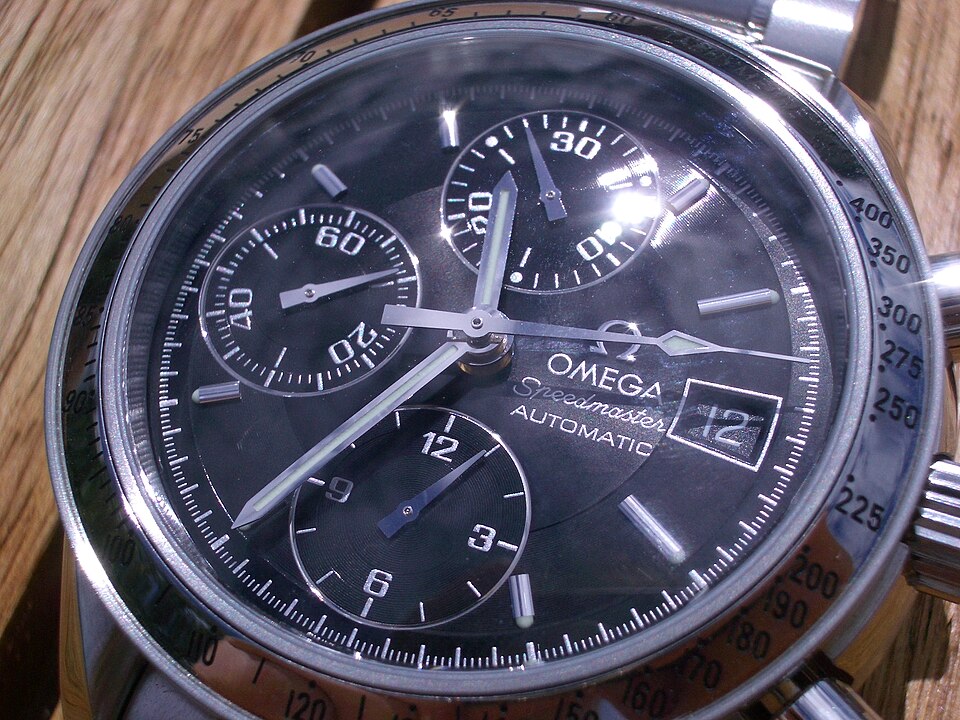
An Omega Speedmaster Automatic with a date window, photographed by Hobo. This image illustrates a different Speedmaster variant from the hand-wound Moonwatch discussed in the history.
Compare the three subdials with the separate date window. The exact reference and movement calibre remain unverified; this is a variant comparison, not a NASA or Apollo illustration.
Photo: OmegaSpeedMaster.JPG by Hobo (source summary; uploader account Richardmilgate) / Wikimedia Commons. Public-domain dedication by the photographer. Wikimedia Commons 960px web rendition; no local edits.
All watch-photo credits1999–2007: Co-Axial changes the internal conversation
In 1999, Omega introduced calibre 2500 with the Co-Axial escapement invented by George Daniels. The escapement controls the release of mainspring energy and supplies impulses that sustain the balance’s oscillation. Co-Axial’s importance concerns how those impulses are delivered and how friction is managed. It is a change to the regulating mechanism, rather than a new dial function like a calendar or chronograph.
The next important step came in 2007 with calibre 8500, designed around the Co-Axial architecture. This progression distinguishes adopting an invention from creating a movement platform around it. It also reconnects the modern house with its nineteenth-century concern for industrial production. The useful achievement to study is how a demanding mechanism becomes repeatable in series manufacture, not merely whether it appears in a rare demonstration piece.
Evidence: Swatch Group: The Omega Co-Axial story (English text on Italian archive page)
2015 onward: from movement architecture to measured performance
The Globemaster introduced Omega’s Master Chronometer era in 2015. Here the question changes again: an escapement describes construction, whereas certification describes tested performance. METAS’s programme considers the complete watch’s chronometric behaviour, water resistance, power reserve and magnetic resistance. Its requirements include exposure to 1.5 tesla, equivalent to 15,000 gauss, and a chronometer-qualified movement.
The testing system also has an institutional structure. The applicant tests movements and watches, while METAS independently monitors the process, analyses results and performs sample checks. The designation is open to qualifying Swiss Made watches from other brands as well. Read an Omega through these separate layers: collection and historical purpose, calibre and mechanical architecture, then certification and its defined tests. That approach makes room for the romance of the Moonwatch while revealing a much broader history of manufacturing and measurement.
Evidence: Omega: Celebrating 10 Years of Master Chronometer Certification, METAS: Master Chronometer certification, METAS: N001 version 1.2, requirements for mechanical-watch certification
Selected chronology
Dates describe the stated event or generation, rather than every watch in a family.
- 1848 / 1894 / 1903Brandt workshop, Omega calibre, and adoption of the Omega company name.
Evidence: Swatch Group: Le nom OMEGA fête ses 125 ans (the Omega name at 125)
- 1932 / 1948 / 1952Olympic timekeeping, Seamaster and Constellation milestones.
Evidence: Omega: Saluting Omega’s presence in Tokyo, Swatch Group: Omega Seamaster Planet Ocean Ultra Deep Professional, historical lineage, Omega: Constellation CK 2648, 1952 archive record
- 1957Speedmaster, Seamaster 300 and Railmaster form the professional trio.
Evidence: Omega: The return of the Omega Railmaster, Omega: Speedmaster The 1957 Trilogy, reference 311.10.39.30.01.001
- 1962 / 1965 / 1969Schirra’s personal watch, NASA qualification and Apollo 11 lunar use.
Evidence: Omega: The First Omega in Space Makes a Vintage Return, Omega: 60 Years Since NASA Qualification, Swatch Group: The Omega Speedmaster Professional Moonwatch, Apollo 11 anniversary, Smithsonian National Air and Space Museum: Chronograph, Armstrong, Apollo 11
- 1999 / 2007Co-Axial calibre 2500 and purpose-designed calibre 8500.
Evidence: Swatch Group: The Omega Co-Axial story (English text on Italian archive page)
- 2015Globemaster introduces Omega’s Master Chronometer era.
Evidence: Omega: Celebrating 10 Years of Master Chronometer Certification, METAS: Master Chronometer certification, METAS: N001 version 1.2, requirements for mechanical-watch certification
Sources & reading
Manufacturer histories describe the house’s own account. Source review dates are inherited from the supplied research packet; the review export does not claim fresh verification.
- Swatch Group: Le nom OMEGA fête ses 125 ans (the Omega name at 125)primary · 2026-10-04
Official manufacturer histories and technical documentation support the dated account; Omega’s spaceflight discussion also uses a Smithsonian collection record, and certification is checked against METAS. Comparisons and reading exercises are original editorial interpretation.
- Omega: Saluting Omega’s presence in Tokyoprimary · 2026-10-04
Official manufacturer histories and technical documentation support the dated account; Omega’s spaceflight discussion also uses a Smithsonian collection record, and certification is checked against METAS. Comparisons and reading exercises are original editorial interpretation.
- Swatch Group: Omega Seamaster Planet Ocean Ultra Deep Professional, historical lineageprimary · 2026-10-04
Official manufacturer histories and technical documentation support the dated account; Omega’s spaceflight discussion also uses a Smithsonian collection record, and certification is checked against METAS. Comparisons and reading exercises are original editorial interpretation.
- Omega: Constellation CK 2648, 1952 archive recordprimary · 2026-10-04
Official manufacturer histories and technical documentation support the dated account; Omega’s spaceflight discussion also uses a Smithsonian collection record, and certification is checked against METAS. Comparisons and reading exercises are original editorial interpretation.
- Omega: The return of the Omega Railmasterprimary · 2026-10-04
Official manufacturer histories and technical documentation support the dated account; Omega’s spaceflight discussion also uses a Smithsonian collection record, and certification is checked against METAS. Comparisons and reading exercises are original editorial interpretation.
- Omega: Speedmaster The 1957 Trilogy, reference 311.10.39.30.01.001primary · 2026-10-04
Official manufacturer histories and technical documentation support the dated account; Omega’s spaceflight discussion also uses a Smithsonian collection record, and certification is checked against METAS. Comparisons and reading exercises are original editorial interpretation.
- Omega: The First Omega in Space Makes a Vintage Returnprimary · 2026-10-04
Official manufacturer histories and technical documentation support the dated account; Omega’s spaceflight discussion also uses a Smithsonian collection record, and certification is checked against METAS. Comparisons and reading exercises are original editorial interpretation.
- Omega: 60 Years Since NASA Qualificationprimary · 2026-10-04
Official manufacturer histories and technical documentation support the dated account; Omega’s spaceflight discussion also uses a Smithsonian collection record, and certification is checked against METAS. Comparisons and reading exercises are original editorial interpretation.
- Swatch Group: The Omega Speedmaster Professional Moonwatch, Apollo 11 anniversaryprimary · 2026-10-04
Official manufacturer histories and technical documentation support the dated account; Omega’s spaceflight discussion also uses a Smithsonian collection record, and certification is checked against METAS. Comparisons and reading exercises are original editorial interpretation.
- Smithsonian National Air and Space Museum: Chronograph, Armstrong, Apollo 11primary · 2026-10-04
Official manufacturer histories and technical documentation support the dated account; Omega’s spaceflight discussion also uses a Smithsonian collection record, and certification is checked against METAS. Comparisons and reading exercises are original editorial interpretation.
- Swatch Group: The Omega Co-Axial story (English text on Italian archive page)primary · 2026-10-04
Official manufacturer histories and technical documentation support the dated account; Omega’s spaceflight discussion also uses a Smithsonian collection record, and certification is checked against METAS. Comparisons and reading exercises are original editorial interpretation.
- Omega: Celebrating 10 Years of Master Chronometer Certificationprimary · 2026-10-04
Official manufacturer histories and technical documentation support the dated account; Omega’s spaceflight discussion also uses a Smithsonian collection record, and certification is checked against METAS. Comparisons and reading exercises are original editorial interpretation.
- METAS: Master Chronometer certificationprimary · 2026-10-04
Official manufacturer histories and technical documentation support the dated account; Omega’s spaceflight discussion also uses a Smithsonian collection record, and certification is checked against METAS. Comparisons and reading exercises are original editorial interpretation.
- METAS: N001 version 1.2, requirements for mechanical-watch certificationprimary · 2026-10-04
Official manufacturer histories and technical documentation support the dated account; Omega’s spaceflight discussion also uses a Smithsonian collection record, and certification is checked against METAS. Comparisons and reading exercises are original editorial interpretation.
- Omega: Sixty years since NASA qualificationprimary · 2026-10-03 · Earlier edition source retained
Primary sources linked below support the historical and technical account. Observational questions and explanatory comparisons are original editorial interpretation.
- Omega: The first Omega in spaceprimary · 2026-10-03 · Earlier edition source retained
Primary sources linked below support the historical and technical account. Observational questions and explanatory comparisons are original editorial interpretation.