
Chapter 9 of 15 / Eighteenth to nineteenth centuries
A clock can carry a place.
On an ocean, a reliable reference time helps answer “Where are we?” On a railway, shared time helps people meet.
At sea, imagine setting a clock to a known meridian and refusing to reset it to local noon. What looks like a disagreement now becomes useful. One reading belongs to the place you occupy; the other preserves a reference somewhere else.
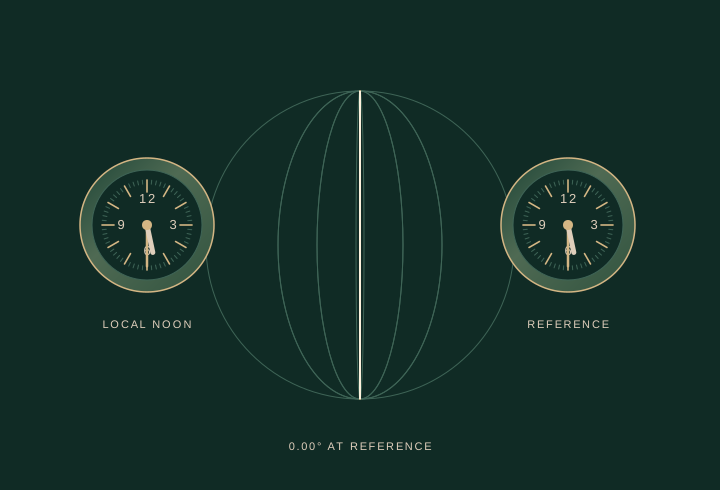
Two times can reveal one position
Earth’s rotation gives a working relation of fifteen degrees of longitude per hour of solar-time difference. A navigator needs a local observation and a dependable time at a known meridian. Neither piece alone supplies the comparison. This is why a good marine timekeeper is useful even when its hands do not show local time.
Try a simplified example using comparable solar times. If your local time is noon while the reference meridian is at two in the afternoon, your noon happens later: you are thirty degrees west of that reference. The arithmetic is only the opening idea. Real observations require corrections, and the Sun’s apparent time is not identical to uniform mean solar time throughout the year.
Sources for this section
- European Southern Observatory — Rotation of the Earth
Astronomy education source explains the 15 degrees per hour relationship. The chapter’s numerical example is a deliberately simplified calculation using comparable solar times, not navigation advice.
The difficult part is carrying the reference
A clock that behaves well ashore may encounter motion and temperature changes on a voyage. Error can accumulate day after day. The challenge is therefore not simply to make a small clock or to put more marks on its dial. It is to preserve a dependable reference away from the conditions under which it was set.
Harrison’s H1 reached London in 1735. Subsequent designs were not effortless improvements: the H3 project occupied many years. H4 took the form of a large watch and was completed in 1759. Royal Museums Greenwich connects this change of direction with a watch made by John Jefferys to Harrison’s design. The smaller solution drew on a continuing experimental network.
Sources for this section
- Royal Museums Greenwich — Harrison’s timekeepers
Marine timekeeping, trials and the longitude problem; includes rival astronomical approaches.
- Royal Museums Greenwich — H4, object ZAA0037
Primary collection record confirms H4’s 1759 completion, its dimensions and the role of John Jefferys’s earlier watch. It is not proof of routine shipboard adoption in 1759.
A successful instrument still needs proof
Read H4 as a surviving artifact with a documented date, then read the trials separately. The 1761 voyage to Jamaica and a later Barbados trial belong to the testing history, not to the date engraved on the watch. The disputes concerned evidence, terms of reward and whether others could reproduce the result. One successful instrument and a widely usable system are different achievements.
That distinction helps explain why navigation did not transform in a single afternoon. Makers still had to produce practical timekeepers, and users had to learn to operate, check and compare them. Harrison’s achievement matters without requiring a story in which one man instantly replaces every astronomical method or places an affordable chronometer on every ship.
Sources for this section
- Royal Museums Greenwich — Harrison’s timekeepers
Marine timekeeping, trials and the longitude problem; includes rival astronomical approaches.
- Royal Museums Greenwich — H4, object ZAA0037
Primary collection record confirms H4’s 1759 completion, its dimensions and the role of John Jefferys’s earlier watch. It is not proof of routine shipboard adoption in 1759.
On land, the problem becomes agreement
Railways exposed another source of disagreement: two accurate clocks could follow different local times. A timetable connecting towns needs an agreed reference. The Science Museum’s William Avison clock, dated 1840–80, bears the words ‘Railway Time’. Its face is evidence of a convention becoming part of an everyday object.
Do not mistake shared time for the invention of accurate timekeeping. One question is how steadily a clock runs; another is what it is set to. An agreed meridian adds a further convention. The Greenwich meridian was selected at the international conference of 1884, but that decision did not make every region’s civil time arrangements change simultaneously. Coordination took institutions and adoption as well as instruments.
Sources for this section
- Science Museum Group — Railway Time clock
A nineteenth-century object for a section on shared time. Verify disputed exact adoption dates before using them.
- Royal Museums Greenwich — What is the Prime Meridian, and why is it in Greenwich?
Supports the distinction between physical timekeeping and agreed reference meridians, and the 1884 conference. Does not imply all countries adopted time zones on the same date.
Carry the reference forward
The Japanese traveling clock in the gallery reminds us to inspect local systems on their own terms. It should not be treated as an obsolete error merely because another network used different hours. Compare what an object was intended to indicate before judging how well it did so.
Next, A Watch Becomes a Bracelet changes the question from a reference carried across an ocean to an object carried on the body. For a technical detour, the GMT reading-room study explores how more than one time can appear on a wristwatch. Keep today’s lesson: displaying a second time, keeping a stable rate and receiving a shared time signal are related but distinct functions.
Sources for this section
- The Met — Traveling Clock
Collection record and public-domain object photographs; object dating and attribution follow the museum, including qualifications.
John Harrison & John Jefferys
H4’s record includes Jefferys’s earlier watch. A named survivor can reveal collaboration and revision rather than a solitary invention appearing fully formed.
Look closer
West, by thirty degrees: two hours multiplied by fifteen degrees per hour. The example assumes comparable solar times and omits the corrections needed for real navigation.
Milestones
- 1735 — Harrison brings H1 to London.
- 1759 / 1761 — H4 is completed, then taken on the Jamaica trial two years later.
- 19th century / 1884 — Railway standardization and the selection of an international reference meridian address coordination as well as precision.
A question to keep
Self-check: in the simplified example, local noon arrives two hours after noon at the reference. East or west?
Interactive model: text alternative
Use the sky here
Imagine local solar noon aboard a ship. A reliable clock still holds the reference time for another meridian.
Read the difference
In the simplified calculation, one hour of solar-time difference corresponds to 15 degrees of longitude: a full turn divided by 24 hours.
From ships to shared schedules
Harrison’s timekeepers addressed the voyage problem. Later railway networks raised a different need: coordinating time between places, not just carrying it reliably.
Hypothetical meridians, local noon and simplified solar times. No GPS, chart, voyage reconstruction or navigation advice.
Archive records and image availability
Museum and archive records
These original image references are retained for review. Follow the collection sources to inspect the objects; the chapter diagram is a conceptual teaching illustration.




Chapter sources and reading notes
- Royal Museums Greenwich — Harrison’s timekeepers
Marine timekeeping, trials and the longitude problem; includes rival astronomical approaches.
- Science Museum Group — Railway Time clock
A nineteenth-century object for a section on shared time. Verify disputed exact adoption dates before using them.
- The Met — Traveling Clock
Collection record and public-domain object photographs; object dating and attribution follow the museum, including qualifications.
- European Southern Observatory — Rotation of the Earth
Astronomy education source explains the 15 degrees per hour relationship. The chapter’s numerical example is a deliberately simplified calculation using comparable solar times, not navigation advice.
- Royal Museums Greenwich — H4, object ZAA0037
Primary collection record confirms H4’s 1759 completion, its dimensions and the role of John Jefferys’s earlier watch. It is not proof of routine shipboard adoption in 1759.
- Royal Museums Greenwich — What is the Prime Meridian, and why is it in Greenwich?
Supports the distinction between physical timekeeping and agreed reference meridians, and the 1884 conference. Does not imply all countries adopted time zones on the same date.