
Chapter 8 of 15 / Seventeenth to eighteenth centuries
The search for a steadier beat.
A clock needs energy. A good clock also needs a rhythm that resists disturbance.
Two watches agree when they are set. By evening their hands have separated. Both received energy, both kept moving, and both counted something. The disagreement reveals the harder task inside a timekeeper: making successive intervals alike while the world keeps disturbing the mechanism.
A clock needs something regular to count
Earlier chapters separated stored power from the display. Now add the oscillator: a system that repeatedly swings or turns back and forth. A pendulum supplies a rhythm that a clock mechanism can sustain and count. Huygens developed his pendulum-clock design in 1656; that milestone belongs to a longer investigation of pendulum motion, including Galileo’s work.
For a simple pendulum making small swings, length is a major control of the period. Increase the length and the beat slows. But a circular swing is not perfectly independent of amplitude. Museo Galileo explains why the ideal of equal periods required careful qualification. The word ‘regular’ describes an engineering aim, not immunity from physics.
Sources for this section
- NIST — A Revolution in Timekeeping
Archived overview of mechanical regulation and quartz; do not adopt its simplified inventor-priority claims without corroboration.
- Museo Galileo — Isochronism of the pendulum
Museum explanation distinguishes the ideal of equal periods from the amplitude dependence of a circular pendulum. The chapter uses a small-swing explanation and makes no claim that real pendulums are perfect.
Keeping the oscillator alive without bullying it
An oscillator would eventually stop if friction and resistance used up its energy. The escapement supplies impulses while releasing the wheel train in increments. Its difficult assignment is to sustain motion without forcing the rhythm to follow every irregularity of the drive. A powerful push is not automatically a helpful push.
Think of keeping a playground swing going. Correctly timed nudges can maintain it; awkward pushes disturb it. That analogy is a guide to the trade-off, not a literal model of a particular historical escapement. A stationary pendulum clock also needs a suitable support. The motion that is tolerable in a room becomes a much greater problem when the room is a ship.
Sources for this section
- NIST — A Revolution in Timekeeping
Archived overview of mechanical regulation and quartz; do not adopt its simplified inventor-priority claims without corroboration.
A portable rhythm and a contested history
For a watch, the balance and balance spring provide another kind of oscillation. The balance turns, the spring resists its displacement, and it returns through its resting position. The mainspring supplies energy elsewhere in the movement; the fine balance spring belongs to the regulating system. Similar names conceal very different tasks.
The year 1675 marks Huygens’s published spiral balance-spring design and patent activity. It does not erase Robert Hooke’s work or the contemporary argument over priority. The Science Museum Group describes independent development by Hooke and Huygens. A useful history identifies the mechanism and the surviving evidence before assigning a single winner to a complicated sequence of experiments, disclosure and practical adoption.
Sources for this section
- Science Museum Group — Pre-balance-spring era watch movement by Thomas Tompion, c. 1671
Museum object record supports independent balance-spring development by Hooke and Huygens and the 1675 Huygens patent. Used to qualify single-inventor shorthand, not to settle every priority argument.
The promise made by a seconds hand
Tompion’s pair-case watch of 1682–83, with a case by Nathanial Delander, turns regulation into something a reader can see. Hours and minutes share the principal display; seconds have a separate ring. The Met also records a stopping mechanism for short intervals. Do not turn this into a claim that it is the first watch with seconds or a modern chronograph.
The object asks a subtler question: why show a finer division? A finer scale is useful only if the movement supports it. Our ability to read a number precisely and the truth of that number are different things. A photograph documents the layout; it cannot certify the rate of the surviving watch today.
Sources for this section
- The Met — Pair-case watch
Collection record and public-domain object photographs; object dating and attribution follow the museum, including qualifications.
One improvement does not finish the whole machine
The companion traveling clock watch offers a revealing counterpoint. The Met describes Tompion’s experiment with using a balance spring while omitting the fusee. The approach was not wholly successful. Improving the oscillator did not make changing mainspring force irrelevant, which is why the distinction from the previous chapter matters.
Continue to Time Connects the World, where a small accumulated error becomes an error in position. For deeper reading, compare the two Tompion records and the Science Museum’s pre-balance-spring movement. Read them as different solutions with different dates, rather than a before-and-after picture in which every old part disappears at once. Precision emerges from the interaction of a whole system.
Sources for this section
- The Met — Traveling clock watch with alarm
Collection record and public-domain object photographs; object dating and attribution follow the museum, including qualifications.
- Science Museum Group — Pre-balance-spring era watch movement by Thomas Tompion, c. 1671
Museum object record supports independent balance-spring development by Hooke and Huygens and the 1675 Huygens patent. Used to qualify single-inventor shorthand, not to settle every priority argument.
- The Met — Seventeenth-Century European Watches
Portable spring-driven clocks, wearable watches, decoration and disputed inventor stories.
Huygens, Hooke, Tompion & Delander
Regulation involved scientific investigation and workshop implementation. The surviving watches also retain a casemaker’s contribution, reminding us that an instrument’s legibility has its own craft history.
Look closer
The mainspring stores the running energy. The balance spring works with the balance to establish the oscillation. A seconds display adds reading detail, but is not itself proof of accuracy.
Milestones
- 1656 — Huygens develops his pendulum-clock design.
- 1675 — The spiral balance spring is disclosed amid competing work and priority arguments.
- 1682–83 — The illustrated Tompion pair-case watch makes hours, minutes and seconds visible.
A question to keep
Self-check: which spring stores the running energy, and which participates in the beat?
Interactive model: text alternative
A rhythm for a stationary clock
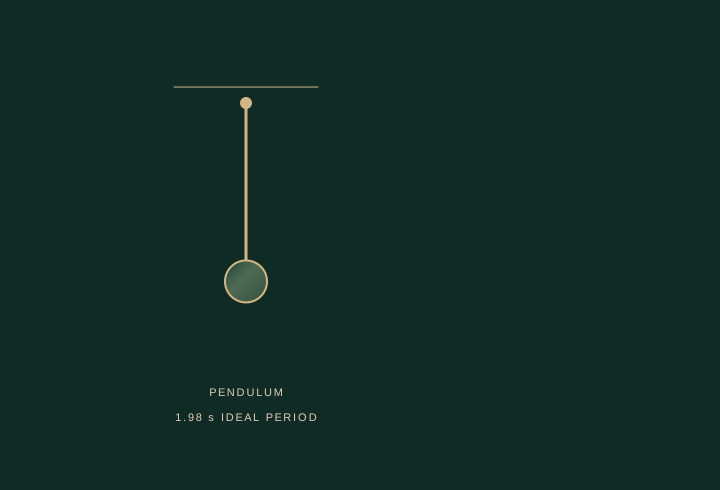
The pendulum became a powerful regulator for clocks. In this ideal small-angle model, a longer pendulum swings more slowly.
A rhythm that can travel
A balance and spring provide an oscillating system suitable for portable watches. This is not a pendulum miniaturised inside a case.
Different oscillators
Compare the two models. Both repeat a motion, but their geometry and use differ. Friction, amplitude and temperature complicate real instruments.
Ideal pendulum uses T = 2π√(L/9.81); the balance motion is illustrative. Not a timing or calibration tool.
Archive records and image availability
Museum and archive records
These original image references are retained for review. Follow the collection sources to inspect the objects; the chapter diagram is a conceptual teaching illustration.




Chapter sources and reading notes
- NIST — A Revolution in Timekeeping
Archived overview of mechanical regulation and quartz; do not adopt its simplified inventor-priority claims without corroboration.
- The Met — Pair-case watch
Collection record and public-domain object photographs; object dating and attribution follow the museum, including qualifications.
- The Met — Traveling clock watch with alarm
Collection record and public-domain object photographs; object dating and attribution follow the museum, including qualifications.
- Museo Galileo — Isochronism of the pendulum
Museum explanation distinguishes the ideal of equal periods from the amplitude dependence of a circular pendulum. The chapter uses a small-swing explanation and makes no claim that real pendulums are perfect.
- Science Museum Group — Pre-balance-spring era watch movement by Thomas Tompion, c. 1671
Museum object record supports independent balance-spring development by Hooke and Huygens and the 1675 Huygens patent. Used to qualify single-inventor shorthand, not to settle every priority argument.
- The Met — Seventeenth-Century European Watches
Portable spring-driven clocks, wearable watches, decoration and disputed inventor stories.