
Chapter 7 of 15 / Approximately 1500–1700 CE
Time becomes something you wear.
A watch can be an instrument, a jewel and a public statement—all while resting close to its owner.
Before the familiar wristwatch, a tiny movement might live inside crystal, painted enamel or precious metal. To carry time was also to choose how it would be seen.
The case has a story of its own
Johann Possdorfer’s small watch at the Met, dated around 1630–40, combines rock crystal and gold. Its size and materials deserve attention independently of its timekeeping performance. The museum notes that the crystal cover is a replacement: even a strikingly coherent object can contain work from more than one moment.
A watch is not always one maker’s complete creation. The movement, case and decoration may reflect different specialties. Reading only a name on a dial can hide the collaboration required to make the whole object.
Sources for this section
- The Met — Watch
Collection record and public-domain object photographs; object dating and attribution follow the museum, including qualifications.
A painting that travels
The watch associated with Jacques Goullons brings painted enamel onto an intimate surface. Enamel is a glassy material fused onto a support through heat. It lets colour become part of an object intended to be handled, worn and repeatedly examined.
Look slowly at the difference between the circular dial and the decorated case. One arranges information for use; the other offers an image to contemplate. The owner can move between those ways of looking. A watch’s meaning cannot be reduced to an accuracy figure, even though accuracy remains a separate question.
Sources for this section
- The Met — Watch
Collection record and public-domain object photographs; object dating and attribution follow the museum, including qualifications.
The intimacy of a portable object
A public clock is encountered in a shared space. A wearable watch can be brought close, opened and consulted privately. That difference changes the gestures around time: reaching into clothing, lifting a pendant, opening a cover, turning a winding key.
None of these gestures tells us exactly how every historical owner behaved. They are invitations to consider the object’s affordances—the actions its form makes possible. When you next see a pocket watch behind glass, imagine its weight and the effort needed to read it. The museum view is still, but the object was designed for a moving life.
Sources for this section
- The Met — Watch
Collection record and public-domain object photographs; object dating and attribution follow the museum, including qualifications.
- The Met — Watch
Collection record and public-domain object photographs; object dating and attribution follow the museum, including qualifications.
The unnamed specialist
A surviving signature may identify a movement maker while leaving other contributors anonymous. Looking at the case separately helps recover the importance of their work without inventing an attribution that the evidence does not support.
Look closer
Compare a transparent case with a painted one. They reveal and conceal in different ways. The replacement crystal is a useful reminder to read the catalogue as closely as the photograph.
Milestones
- c. 1630–40 — Possdorfer’s small rock-crystal watch is made.
- c. 1645–50 — The Goullons watch brings painted enamel and mechanism together.
- Across generations — Repairs and replacements become part of an object’s biography.
A question to keep
Which tells you more about an owner: the movement, the case, or the way the watch is worn?
Interactive model: text alternative
An object to carry
Early wearable watches included pendant forms. Decoration and materials could make them jewels as well as instruments.
A new relationship
Time could be consulted close to the person. Pocket forms developed alongside changes in clothing and watch design.
Beauty meets a mechanism
Seventeenth-century European watches could combine engraved work, enamel and carefully constructed mechanisms. Their appearance and performance are separate things to examine.
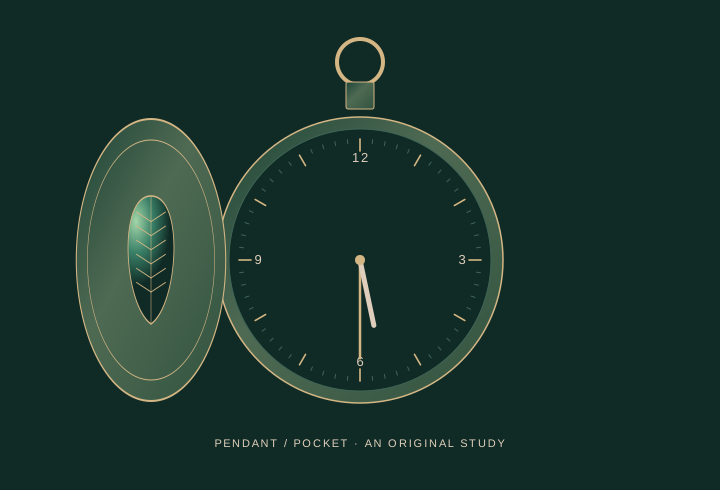
An invented period-inspired watch study, not an attributed historical object. The cutaway is conceptual.
Archive records and image availability
Museum and archive records
Retained source records. The original images are unavailable here; use the linked collection record. The chapter diagram is an original conceptual illustration.




Chapter sources and reading notes
- The Met — Watch
Collection record and public-domain object photographs; object dating and attribution follow the museum, including qualifications.
- The Met — Watch
Collection record and public-domain object photographs; object dating and attribution follow the museum, including qualifications.