
Chapter 10 of 15 / Nineteenth century → early twentieth century
Women put time on the wrist.
Jewellery, patronage and practical use belong at the centre of the wristwatch story.
A watch on a bracelet changes the act of reading time. The owner raises a wrist instead of opening a pocket. That seemingly small gesture has a long and uneven history.
An order survives where an object does not
Breguet’s archives record Caroline Murat’s order of 8 June 1810 for a watch intended for a bracelet. The house identifies it as watch no. 2639 and describes an oval repeating watch on a wristlet of hair and gold thread. The archival record is the evidence shown here.
Breguet states that no exterior sketch survives in its archive and that important details remain unknown. A modern Reine de Naples watch should therefore not be presented as a photograph of the original. A later collection can commemorate a story without reconstructing the lost object.
Sources for this section
- Breguet — Caroline Murat’s 1810 order
Manufacturer archive account; the chapter distinguishes the surviving record from the missing original watch and avoids an uncontested first claim.
A patron is part of the design process
A commission begins with a desire or requirement. The maker translates it into mechanisms, dimensions and materials. Caroline’s role belongs to that exchange: histories of invention can lose their meaning when they remove the person who requested the object.
The portrait and register give us different kinds of evidence. A portrait represents a person; an entry records a transaction or instruction. Neither lets us invent her private thoughts. Together they support a more precise story than a glamorous modern product image alone.
Sources for this section
- Breguet — Caroline Murat’s 1810 order
Manufacturer archive account; the chapter distinguishes the surviving record from the missing original watch and avoids an uncontested first claim.
Practicality is not the opposite of adornment
By the late nineteenth century, women’s wristwatches were part of the setting from which broader wristwatch use developed. The Smithsonian’s discussion of an early Elgin wristwatch places women and outdoor activity within that story, before wartime adoption accelerated it.
A decorative object can still be useful. A useful object can still carry social meaning. The categories overlap, and the wristwatch benefited from that overlap. Ask how a strap, clasp and readable dial let a watch participate in activity while remaining part of dress. The answer involves the body as much as the movement.
Sources for this section
- Smithsonian — Elgin Wristwatch
Women’s early use, wristwatch adoption, design and the uncertainty of precise origins.
Caroline Murat
Her documented order gives the wristwatch story a named customer. It is a strong historical episode; it does not require declaring one uncontested first wristwatch across every possible definition.
Look closer
The register is an archive document, not a design drawing. The earlier crystal watch illustrates another way of carrying time; it is not Caroline’s watch.
Milestones
- 8 June 1810 — Breguet records Caroline Murat’s bracelet-watch commission.
- 1849 — A repair entry records no. 2639 in the next generation of the family.
- Late 19th century — Women’s wristwatches precede their widespread adoption by men.
A question to keep
Who disappears from the history when we remember only the manufacturer?
Interactive model: text alternative
Another way to wear a watch
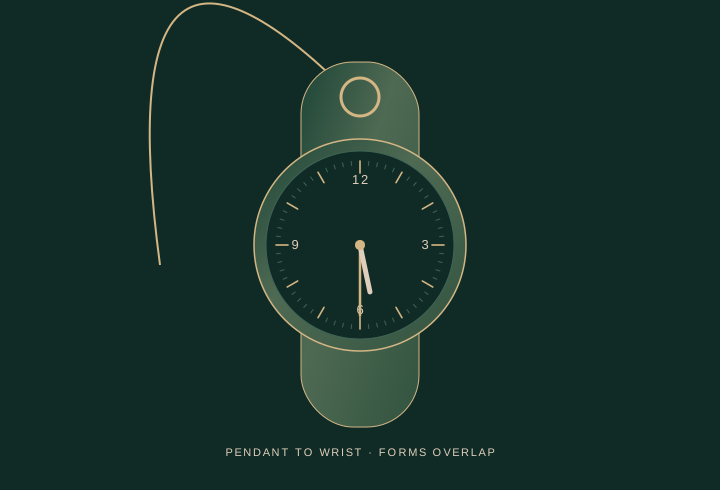
A watch could be worn as a pendant before the familiar wristwatch became established. Different forms overlapped rather than replacing one another overnight.
Women belong in this story
By the late nineteenth century, fashionable women wore small watches at the wrist, including during outdoor activities. Practical use and adornment could coexist.
No simple first
Surviving examples and accounts show a complicated emergence. We do not assign an undisputed “first wristwatch” to one maker here.
Generic wearing-form study. It is not a reconstruction or authentication of an individual watch.
Archive records and image availability
Museum and archive records
Retained source records. The original images are unavailable here; use the linked collection record. The chapter diagram is an original conceptual illustration.




Chapter sources and reading notes
- Breguet — Caroline Murat’s 1810 order
Manufacturer archive account; the chapter distinguishes the surviving record from the missing original watch and avoids an uncontested first claim.
- Smithsonian — Elgin Wristwatch
Women’s early use, wristwatch adoption, design and the uncertainty of precise origins.
- The Met — Watch
Collection record and public-domain object photographs; object dating and attribution follow the museum, including qualifications.