
41Watch housesProfile details
Manufacturer accounts remain attributed. Historical thickness records retain their dates and movement-versus-complete-watch scope. Ownership is limited to the Richemont pages reported checked on 5 October 2026; no image-reuse permission established.
- Workshop established
- 1874 — Family-farm workshop, initially movements and components
- Trademark registered
- 1943 — Trademark registration
- 9P thickness
- 2 mm — Hand-wound movement, introduced 1957; not complete watch
- 12P thickness
- 2.3 mm — Automatic micro-rotor movement, introduced 1960; not complete watch
- Altiplano Ultimate Concept thickness
- 2 mm — Complete watch, including case and crystal; manufacturer account
Workshop, trademark and manufacture
Piaget’s identity joins two disciplines: movement engineering and jewellery design. Georges-Édouard Piaget established his workshop on the family farm in La Côte-aux-Fées in 1874, initially making movements and components. The name became a registered trademark in 1943; a larger manufacture followed in 1945. Those dates describe an evolving business, rather than a modern revival of a dormant historical name.
Evidence: Piaget history
Thin movements
The pivotal technical milestones were the hand-wound 9P movement, introduced in 1957 at 2 mm thick, and the automatic 12P of 1960, measuring 2.3 mm. The latter used a micro-rotor, a compact winding weight that helped keep the mechanism shallow. Piaget describes the 12P as the world’s thinnest automatic movement at its introduction. Keep the historical qualifier: a record achieved in 1960 should not be presented as a current record.
Evidence: Piaget history
Engineering and jewellery design
Thin movements also provided room for expressive watch design. Piaget opened its first Geneva salon in 1959 and developed goldsmithing and gem-setting workshops there. One documented creative encounter came in 1967, when the company acquired rights to use Salvador Dalí’s designs for a limited collection. It is a useful reminder that decorative watchmaking can have a serious mechanical foundation.
Evidence: Piaget history
Movement thickness and complete-watch thickness
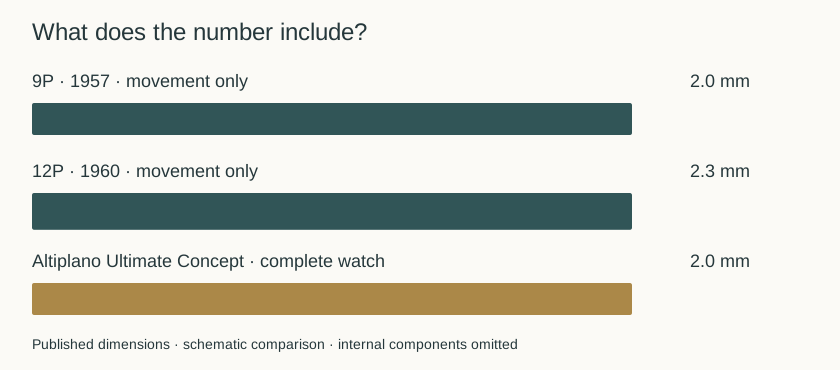
The Altiplano Ultimate Concept makes the thickness question especially clear. Piaget records its prototype’s first running moment as 7 February 2017 at 7:47 p.m., after four years of development. The complete watch, including case and crystal, measured 2 mm: the same headline measurement as the earlier 9P movement alone. Piaget specifies wheels just 0.12 mm thick and a 0.2 mm sapphire crystal. The educational point is the difference between movement thickness and whole-watch thickness; these figures cannot be interchanged when comparing watches.
The Polo 79 reference
For a contrasting signature, study the Polo 79, reference G0A49150. Its yellow-gold case measures 38 mm across and 7.45 mm thick. The visual rhythm continues across dial, case and bracelet, using alternating polished and brushed gold surfaces. The modern Polo 79 family uses the automatic 1200P1, a 2.35 mm micro-rotor movement. Piaget dates the original Polo to 1979 and identifies it as the first watch model the company formally gave a name. The contemporary watch is a reinterpretation of that design, rather than an unchanged vintage specification.
Evidence: Polo 79 reference, Polo 79 collection history
Two jobs within one house
As of the official Richemont pages checked on 5 October 2026, Piaget is included among the group’s maisons. Richemont distinguishes movement production at La Côte-aux-Fées from goldsmithing and jewellery work at Plan-les-Ouates near Geneva. That division helps explain the house: a slim calibre is both a technical achievement and an opportunity for the designer working around it. When studying Piaget, examine the relationship between those two jobs rather than treating the movement and exterior as separate stories.
Evidence: Richemont’s Piaget profile, Richemont’s maisons
Compare dimensions that describe the same thing
Before making a thickness comparison, write the measured object beside the number. Is it a movement, a complete watch, or one component? The three statements in the schematic are deliberately labelled. Two equal numbers can describe very different engineering tasks when one excludes the surrounding case and crystal. For a design study, consider what the slim movement allows the exterior to do, then describe the bracelet, surface rhythm and proportions separately. This comparison is about published dimensions and visual organisation; it does not assign a durability or accuracy ranking.
Evidence: Piaget history, Piaget’s Altiplano Ultimate Concept account, Polo 79 reference, Polo 79 collection history
Sources & reading
- Piaget historyPiaget · 2026-10-05
Supports the adjacent supplied prose only. Consult the article’s explicit scope and qualifications; no image-reuse permission established.
- Piaget’s Altiplano Ultimate Concept accountPiaget · 2026-10-05
Supports the adjacent supplied prose only. Consult the article’s explicit scope and qualifications; no image-reuse permission established.
- Polo 79 referencePiaget · 2026-10-05
Supports the adjacent supplied prose only. Consult the article’s explicit scope and qualifications; no image-reuse permission established.
- Polo 79 collection historyPiaget · 2026-10-05
Supports the adjacent supplied prose only. Consult the article’s explicit scope and qualifications; no image-reuse permission established.
- Richemont’s Piaget profileRichemont · 2026-10-05
Supports the adjacent supplied prose only. Consult the article’s explicit scope and qualifications; no image-reuse permission established.
- Richemont’s maisonsRichemont · 2026-10-05
Supports the adjacent supplied prose only. Consult the article’s explicit scope and qualifications; no image-reuse permission established.