
Chapter 12 of 15 / Approximately 1920–1970
A watch with a job to do.
Protection, self-winding and elapsed-time measurement turn the wristwatch into a family of specialized tools.
The watchmaker’s question changes with the task. Keep water out. Recover energy from movement. Start and stop a separate measurement. Each demand reaches beyond the ordinary time display.
The case becomes part of the engineering
A protective case must address its openings: the glass, back and winding interface are all potential paths into the movement. The historical Oyster studies linked from this chapter examine selected developments in Rolex’s approach.
A photograph cannot establish that an old watch is safe in water today. Seals age, parts change and service history matters. The historical achievement of a design and the present condition of one example are different subjects. Read an archive image as evidence of form and context, not as a current performance test.
Sources for this section
- Rolex — The Perpetual rotor
Manufacturer explanation of automatic winding, not independent proof of every historical priority claim.
Motion helps wind the mainspring
An automatic watch uses motion of a winding mass to help replenish the mainspring. The familiar rotor makes that relationship easy to picture. Energy comes from movement; it is not created inside the watch. If the watch is left still long enough, its stored energy runs down.
The regulator still has its own task. A self-winding system does not replace the balance, and it does not guarantee a particular level of precision. Distinguishing winding from time regulation makes complicated descriptions easier to follow.
Sources for this section
- Rolex — The Perpetual rotor
Manufacturer explanation of automatic winding, not independent proof of every historical priority claim.
Measuring an event inside the day
A chronograph starts, stops and usually resets an elapsed-time indication. It can answer how long an event lasts while the ordinary hands continue to show the time of day. A chronometer is a different term associated with tested precision; the two words are not interchangeable.
Try imagining the dial with each function removed in turn. Which indications remain? Which control affects which hand? This method of looking makes a busy instrument more legible. The linked manufacturer explanation supplies a view of actual chronograph construction; our model stays deliberately unbranded.
Sources for this section
- Patek Philippe — Chronograph watches
The elapsed-time function. A chronograph is not synonymous with a chronometer.
The case designer
A dependable tool is a system: movement, case, display, controls and attachment. Celebrating only the calibre can obscure the engineering that lets the wearer use it in the intended setting.
Look closer
The Rolex and Patek Philippe images are contemporary brand photographs used for comparison. They are explicitly labelled; they are not presented as photographs of the earliest Oyster or chronograph.
Milestones
- Early 20th century — Protection and wrist-based use become increasingly connected design problems.
- 1931 — Rolex dates its Perpetual rotor milestone to this year.
- 20th century — Purpose-specific watches develop through many overlapping traditions.
A question to keep
Which part of a watch actually solves the wearer’s problem?
Interactive model: text alternative
Motion can supply energy
In an automatic mechanical watch, a moving rotor helps wind the mainspring. A battery and a mainspring are different energy stores.
The case has work to do
A protective case is part of the instrument. In the related Rolex journal, examine selected historical developments in the Oyster family.
A separate measurement
A chronograph measures an elapsed interval. It is a function, not a synonym for every watch that keeps accurate time.
Conceptual mechanism and case study. No depth rating, brand priority, or water-resistance claim is made for this illustration.
Archive records and image availability
Museum and archive records
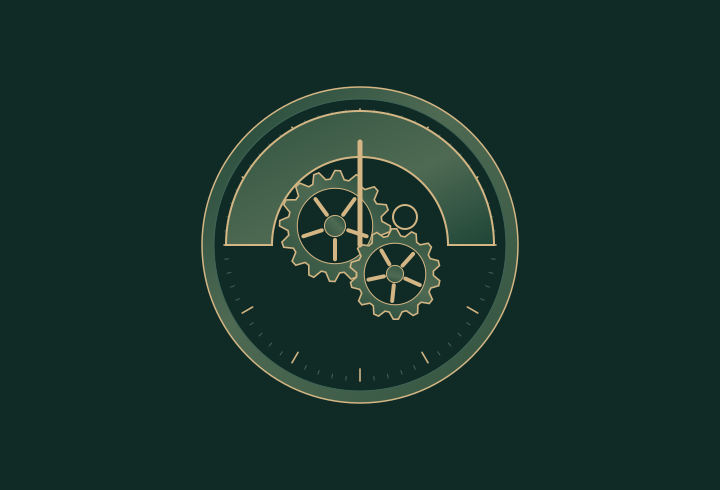
Retained source records. The original images are unavailable here; use the linked collection record. The chapter diagram is an original conceptual illustration.



Chapter sources and reading notes
- Rolex — The Perpetual rotor
Manufacturer explanation of automatic winding, not independent proof of every historical priority claim.
- Patek Philippe — Chronograph watches
The elapsed-time function. A chronograph is not synonymous with a chronometer.
- Royal Museums Greenwich — Harrison’s timekeepers
Marine timekeeping, trials and the longitude problem; includes rival astronomical approaches.