
Chapter 13 of 15 / Approximately 1950–1980
Quartz changes the rhythm.
The decisive change is inside: a vibrating crystal and an electronic circuit can drive the same familiar hands.
The hands still pass familiar hour markers. Beneath them, however, the reference has changed. The Quartz Astron’s quiet-looking dial makes a good place to pause: a revolution in a watch does not have to look revolutionary from across a room.
Electric power is only the first distinction
Calling a watch electric tells us something about its energy supply, but not enough about its oscillator. A battery can power different regulating systems. Quartz refers to the resonator that helps determine the rate, not simply to the presence of a battery or a screen. Keep the earlier chapters’ three questions: where does the energy come from, what sets the rhythm, and how is the answer displayed?
Quartz exhibits piezoelectric behavior, coupling mechanical deformation with electrical effects. In an appropriate circuit, a shaped crystal provides a stable vibrating reference. The vibration is mechanical even though the surrounding system is electronic. ‘Electronic’ does not mean that matter has stopped moving.
Sources for this section
- NIST — A Revolution in Timekeeping
Archived overview of mechanical regulation and quartz; do not adopt its simplified inventor-priority claims without corroboration.
- Seiko — The original Quartz Astron
Manufacturer history; original 8,192 Hz frequency is distinguished from later common quartz frequencies.
Count a fast rhythm, then move a slow hand
The circuit turns many oscillations into useful timing intervals. A stepping motor can then advance gears and hands. In this arrangement, the hands do not establish the reference; they communicate the result of counting it. A numerical display is another possible output, so analog and digital are descriptions of presentation rather than synonyms for mechanical and quartz.
The original Astron 35SQ used an 8,192-hertz resonator. Seiko’s technical history and the IEEE milestone both record that figure. It is not the later common 32,768-hertz value. Keep the actual design in view: remembering a widely used number is less useful than checking whether it belongs to the particular movement in front of you.
Sources for this section
- Seiko — The original Quartz Astron
Manufacturer history; original 8,192 Hz frequency is distinguished from later common quartz frequencies.
- IEEE Milestone — Electronic Quartz Wristwatch, 1969
Supports public sale of the Seiko Quartz-Astron 35SQ on 25 December 1969, and its quartz oscillator, integrated circuit and stepping motor. Commercial introduction is distinguished from prototypes and earlier quartz clocks.
- Seiko — Quartz knowledge
Manufacturer technical explainer distinguishes the original 8,192-hertz Astron from the later frequency four times higher. The text says common, not universal: other quartz frequencies exist.
A milestone has a specific meaning
Quartz timekeeping did not begin with a wristwatch. NIST’s history places quartz clocks and oscillators in an earlier laboratory story. Miniaturizing such a system involved different constraints: a practical case, low power consumption, resistance to disturbance and a way to drive a readable display. A working principle does not automatically become a usable product.
The IEEE records Swiss CEH prototypes at the 1967 Neuchâtel competition. Its separate Seiko milestone identifies the Quartz-Astron 35SQ as a quartz wristwatch sold to the public on 25 December 1969. Those statements describe different achievements. A prototype, a competition entry and a commercial release should not be collapsed into one unqualified claim about the first quartz watch.
Sources for this section
- NIST — A Revolution in Timekeeping
Archived overview of mechanical regulation and quartz; do not adopt its simplified inventor-priority claims without corroboration.
- IEEE Milestone — Pioneering Work on the Quartz Electronic Wristwatch, 1962–1967
The IEEE milestone plaque records CEH’s foundation in 1962 and prototypes at the 1967 observatory competition. Only these milestone facts are used; the page’s surrounding retrospective text has inconsistent prototype naming.
- IEEE Milestone — Electronic Quartz Wristwatch, 1969
Supports public sale of the Seiko Quartz-Astron 35SQ on 25 December 1969, and its quartz oscillator, integrated circuit and stepping motor. Commercial introduction is distinguished from prototypes and earlier quartz clocks.
The artifact keeps the engineering honest
Use the museum’s 1969 Astron as the primary object for this chapter. The Seiko Museum records an advertised monthly accuracy within five seconds. That historical specification is evidence of what the product offered when introduced, not a fresh performance test of an individual surviving watch. Its ordinary hands demonstrate how familiar reading habits could survive a radical change underneath.
Seiko’s development account emphasizes the difficulty of shrinking the motor and reducing its consumption. Precision alone was not enough. If the resonator and circuit worked but the mechanism required an impractical battery, the whole watch would fail as an everyday object. The engineering problem moved across disciplines rather than disappearing when the balance wheel was removed.
Sources for this section
- Seiko Museum — Quartz Astron
1969 commercial quartz wristwatch milestone, described by the manufacturer’s museum.
- Seiko — The original Quartz Astron
Manufacturer history; original 8,192 Hz frequency is distinguished from later common quartz frequencies.
What changes when precision is easier to obtain?
Quartz makes an important interpretive question unavoidable: if keeping a dependable rate becomes more accessible, what else might someone value in a mechanical watch? That is the next chapter’s subject. Craft, construction, repairability and the experience of watching a mechanism can be discussed without claiming that they defeat every electronic instrument on accuracy.
Read Mechanical Watchmaking Reimagined next, then use Timekeeping Today to separate the local oscillator from an external reference. The atomic apparatus in this gallery is a comparison from that wider history. It is not hidden inside the Astron. For further evidence, compare the two IEEE milestones: they make the distinction between experimental achievement and public availability particularly clear.
Sources for this section
- IEEE Milestone — Pioneering Work on the Quartz Electronic Wristwatch, 1962–1967
The IEEE milestone plaque records CEH’s foundation in 1962 and prototypes at the 1967 observatory competition. Only these milestone facts are used; the page’s surrounding retrospective text has inconsistent prototype naming.
- IEEE Milestone — Electronic Quartz Wristwatch, 1969
Supports public sale of the Seiko Quartz-Astron 35SQ on 25 December 1969, and its quartz oscillator, integrated circuit and stepping motor. Commercial introduction is distinguished from prototypes and earlier quartz clocks.
- NIST — A brief history of atomic time
Government scientific history; image credits are retained individually. Laboratory clocks are distinct from wristwatches.
CEH & Suwa Seikosha development teams
The history includes prototypes, observatory testing and commercial engineering. Recognizing those separate tasks gives a fuller account than awarding every form of priority to one product launch.
Look closer
Neither inference is reliable. Hands are a display; a battery is an energy source. Identifying the timekeeping system requires evidence about the oscillator and the mechanism that connects it to the display.
Milestones
- 1920s onward — Quartz oscillators and clocks develop before quartz wristwatches.
- 1967 — CEH and Seiko quartz-wristwatch development reaches observatory competition.
- 25 December 1969 — The Quartz-Astron 35SQ goes on sale with an 8,192-hertz resonator.
A question to keep
Self-check: do ordinary hands prove that a watch is mechanical, and does a battery prove that it is quartz?
Interactive model: text alternative
The electrical connection
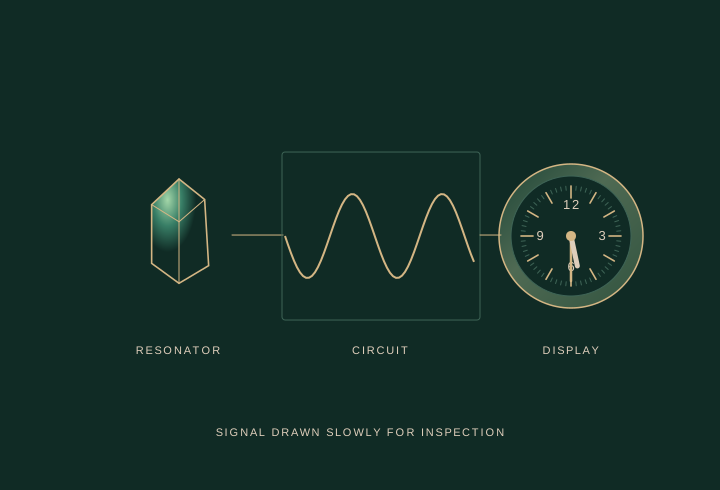
In a suitable circuit, quartz can provide a regular oscillating signal. The schematic separates the resonator from the counting circuit.
Frequency becomes a display
Circuits count cycles to drive a display. Quartz does not mean digital: quartz watches can also move hands.
1969: a wristwatch milestone
Seiko’s museum records the Quartz Astron’s release in 1969. That milestone is different from the earlier development of quartz clocks.
Slow, illustrative wave—not an actual watch frequency or electronic design. The dial is not a branded product.
Archive records and image availability
Museum and archive records
These original image references are retained for review. Follow the collection sources to inspect the objects; the chapter diagram is a conceptual teaching illustration.



Chapter sources and reading notes
- NIST — A Revolution in Timekeeping
Archived overview of mechanical regulation and quartz; do not adopt its simplified inventor-priority claims without corroboration.
- Seiko Museum — Quartz Astron
1969 commercial quartz wristwatch milestone, described by the manufacturer’s museum.
- Seiko — The original Quartz Astron
Manufacturer history; original 8,192 Hz frequency is distinguished from later common quartz frequencies.
- NIST — A brief history of atomic time
Government scientific history; image credits are retained individually. Laboratory clocks are distinct from wristwatches.
- IEEE Milestone — Electronic Quartz Wristwatch, 1969
Supports public sale of the Seiko Quartz-Astron 35SQ on 25 December 1969, and its quartz oscillator, integrated circuit and stepping motor. Commercial introduction is distinguished from prototypes and earlier quartz clocks.
- Seiko — Quartz knowledge
Manufacturer technical explainer distinguishes the original 8,192-hertz Astron from the later frequency four times higher. The text says common, not universal: other quartz frequencies exist.
- IEEE Milestone — Pioneering Work on the Quartz Electronic Wristwatch, 1962–1967
The IEEE milestone plaque records CEH’s foundation in 1962 and prototypes at the 1967 observatory competition. Only these milestone facts are used; the page’s surrounding retrospective text has inconsistent prototype naming.