
Chapter 14 of 15 / Late twentieth century onwards
The mechanical watch finds a new voice.
When electronics can keep time with extraordinary convenience, mechanical watchmaking invites other kinds of attention.
An exposed wheel turns. A polished edge catches the light. A hand advances through a chain of physical contacts. Mechanical watchmaking makes its work available to the eye.
An old invention in a new conversation
Abraham-Louis Breguet patented the tourbillon in 1801. By rotating the regulating assembly, the device addresses certain positional errors in a watch. The patent and historical watch shown here give that idea a documentary and a material presence.
A rotating cage is not a universal guarantee that one watch outperforms another. The original technical problem, the actual execution and the conditions of use all matter. Contemporary interest in the tourbillon includes its visible movement and difficulty of manufacture as well as its historical purpose.
Sources for this section
- Breguet — The tourbillon
Manufacturer account and archive images. Historical purpose is separate from claims about a contemporary watch’s performance.
Finishing asks the eye to slow down
Compare the historical enamel watch with a contemporary Patek Philippe image. Decoration and technical construction have long coexisted. Today, a viewer may linger over the treatment of an edge, a polished surface or the arrangement of bridges rather than merely ask for the hour.
These visual qualities require their own vocabulary, but a photograph has limits. It may reveal a surface without proving how every operation was carried out. Hand finishing, accuracy, originality and authenticity are distinct claims. None should be inferred automatically from a handsome image.
Sources for this section
- The Met — Watch
Collection record and public-domain object photographs; object dating and attribution follow the museum, including qualifications.
- Patek Philippe — Calatrava
Contemporary manufacturer collection, used as a design comparison rather than a history of all mechanical watchmaking.
A tradition can change without disappearing
Mechanical watchmaking today includes industrial production, restoration, independent workshops and highly specialized craft. These activities do not share one purpose or one scale. Some preserve established forms; others alter materials, layouts and ways of displaying information.
The interesting question is what a particular object asks us to value. Is it legibility, tactile interaction, an ingenious complication, a family memory, or the work of a maker we want to understand? Those values can coexist with electronic accuracy rather than compete on a single number. Our contemporary house pages offer starting points for closer study.
Sources for this section
- Patek Philippe — Calatrava
Contemporary manufacturer collection, used as a design comparison rather than a history of all mechanical watchmaking.
- Breguet — The tourbillon
Manufacturer account and archive images. Historical purpose is separate from claims about a contemporary watch’s performance.
Abraham-Louis Breguet
The 1801 patent belongs to a historical problem. Later makers can revisit that idea for new settings and new audiences. Keeping the original purpose visible makes the later reinterpretations easier to assess.
Look closer
The patent is a document; the historic watch is an object; the modern brand image is a contemporary comparison. Each kind of evidence supports a different kind of claim.
Milestones
- 1801 — Breguet patents the tourbillon.
- Late 20th century — Mechanical watchmaking gains new audiences alongside electronic timekeeping.
- Today — Historical mechanisms, new materials and craft traditions coexist.
A question to keep
What do you want a mechanical watch to offer beyond the time?
Interactive model: text alternative
Follow the layers
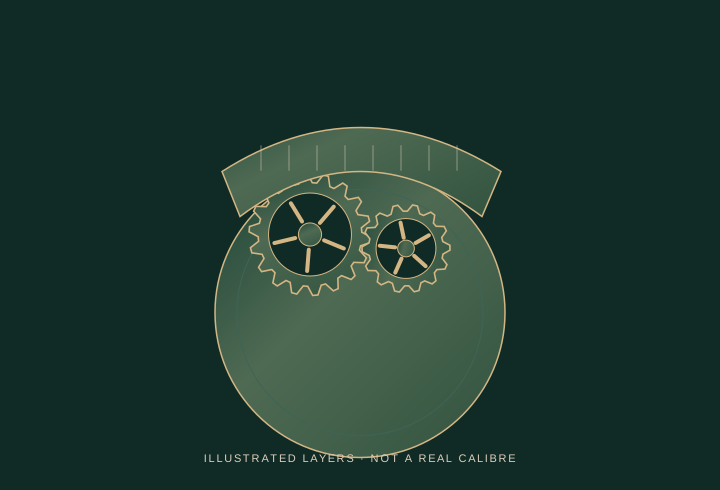
Open the abstract movement study. A layered view helps distinguish the supporting structure, moving train and regulating system.
Look at a surface
Our related Calatrava chapter introduces selected finishing details. A beautiful finish does not, by itself, establish accuracy or authenticity.
A mechanical tradition continues
Contemporary watchmaking can preserve mechanical methods while rethinking design. This study invites observation rather than ranking makers or promising value.
Contemporary design study, not a real calibre or a verification tool. Layers are separated for explanation.
Archive records and image availability
Museum and archive records
Retained source records. The original images are unavailable here; use the linked collection record. The chapter diagram is an original conceptual illustration.





Chapter sources and reading notes
- Breguet — The tourbillon
Manufacturer account and archive images. Historical purpose is separate from claims about a contemporary watch’s performance.
- Patek Philippe — Calatrava
Contemporary manufacturer collection, used as a design comparison rather than a history of all mechanical watchmaking.
- The Met — Watch
Collection record and public-domain object photographs; object dating and attribution follow the museum, including qualifications.