
Chapter 3 of 15 / Ancient through early-modern examples
A shadow. A drop. An interval.
Long before a ticking escapement, people measured time through things that move, flow and burn.
A shadow crosses a mark. Water falls below a line. Sand empties from one chamber into another. In each case, change becomes visible—but the meaning of the reading is different.
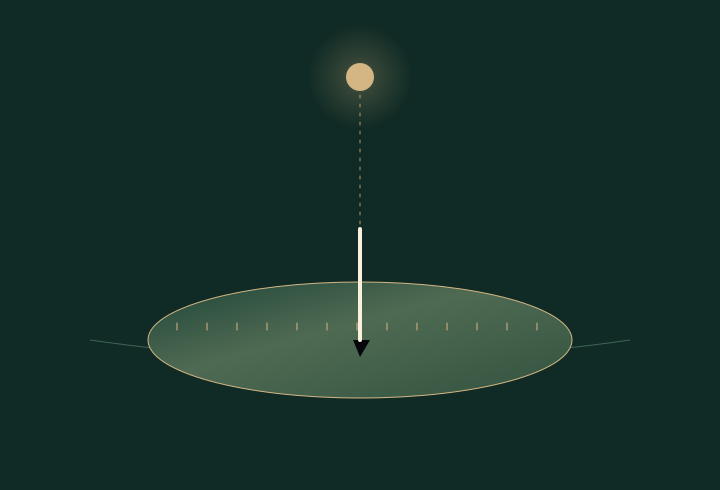
The Sun writes on a surface
A sundial turns the position of the Sun into an indication. The shape of its shadow-casting part, its orientation and its position on Earth all matter. A decorative circle with evenly spaced marks is not automatically a working sundial.
Sunlight offers a powerful reference, but it is not always available. Clouds interrupt the reading, and the night presents an obvious problem. That limitation encourages another question: can an instrument continue measuring when the sky cannot be consulted? The answer does not require a wheel or a spring.
Sources for this section
- NIST — A Walk Through Time: Early Clocks
Archived historical overview of flow and celestial clocks. Exact invention priority needs additional verification.
Making a process behave
A water clock can measure through a changing level or the collection of liquid. But water leaving a vessel does not necessarily flow at a constant rate: the pressure changes as the level falls. Container shape and flow control therefore become part of the design.
A sandglass makes a bounded interval especially easy to see. Turn it over and another interval begins. It does not, by itself, remember how many times it has been turned. This is the difference between measuring a duration and maintaining a continuous time-of-day record. The conceptual model below lets you inspect the distinction.
Sources for this section
- NIST — A Walk Through Time: Early Clocks
Archived historical overview of flow and celestial clocks. Exact invention priority needs additional verification.
Old and new ideas share one object
Jan Jansen Bockeltz’s clock watch, made around 1605–10, combines mechanical and astronomical information with a sundial. It belongs much later in the chronology than the first shadow clocks. Here it shows something more interesting than a clean sequence of replacements: older references could remain useful inside a newer instrument.
The nineteenth-century Japanese traveling clock offers another reason to resist a single straight line of progress. Time could be organized according to local conventions as well as measured by a mechanism. A dial’s divisions tell us about the people using it, not merely the gears behind it.
Sources for this section
- The Met — Clock watch with astronomical dial and sundial
Collection record and public-domain object photographs; object dating and attribution follow the museum, including qualifications.
- The Met — Traveling Clock
Collection record and public-domain object photographs; object dating and attribution follow the museum, including qualifications.
Jan Jansen Bockeltz
The surviving clock watch pairs a portable mechanism with ways of reading the sky. Its complexity asks the owner to compare indications rather than trust a single unexplained number.
Look closer
Open the clock watch’s second view. Notice how different information occupies different surfaces. Do not mistake this early-modern object for an ancient sundial.
Milestones
- Ancient traditions — Shadows and water become timekeeping references.
- c. 1605–10 — Bockeltz combines a clock watch, astronomical dial and sundial.
- 19th century — The illustrated Japanese traveling clock is made.
A question to keep
Does your instrument tell the hour, or only how much time has passed?
Interactive model: text alternative
A moving shadow
Move the light around the gnomon. The shadow changes direction and length. A real sundial depends on its geometry and location; these marks are not calibrated hours.
A changing level
Water can mark an interval without sunlight. But an ordinary hole does not deliver perfectly constant flow as the water level drops. Regulation matters.
An interval, not a date
Sandglasses and candle clocks make change visible. They can help measure duration; on their own they cannot tell you which calendar day it is.
Educational diagrams of different principles, not replicas or a universal order of invention. Flow and burning are simplified.
Archive records and image availability
Museum and archive records
Retained source records. The original images are unavailable here; use the linked collection record. The chapter diagram is an original conceptual illustration.





Chapter sources and reading notes
- NIST — A Walk Through Time: Early Clocks
Archived historical overview of flow and celestial clocks. Exact invention priority needs additional verification.
- The Met — Clock watch with astronomical dial and sundial
Collection record and public-domain object photographs; object dating and attribution follow the museum, including qualifications.
- The Met — Traveling Clock
Collection record and public-domain object photographs; object dating and attribution follow the museum, including qualifications.