
Chapter 2 of 15 / Prehistory and ancient societies
The sky becomes a calendar.
Days, months and years refuse to fit together neatly. Calendars are the ingenious agreements people make around that mismatch.
A crescent returns to the evening sky. It is recognizable, but the season has not returned with it. Keeping a month and keeping a year are not quite the same task.
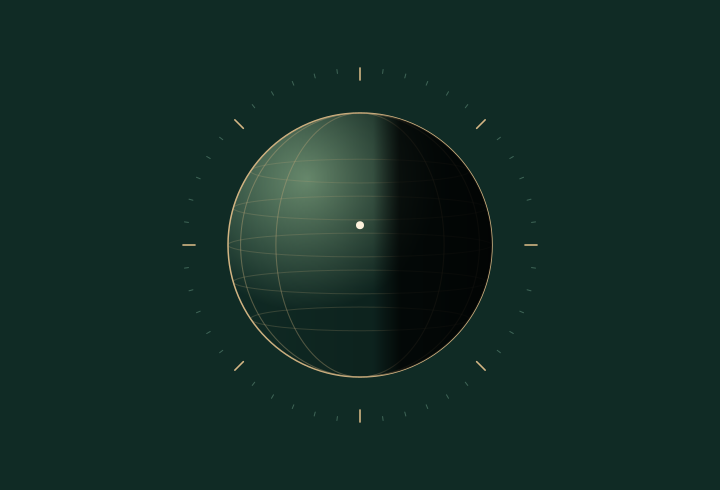
Three cycles, three different measures
The day follows Earth’s rotation, the changing lunar phases offer a month, and Earth’s journey around the Sun gives the year. These cycles are connected, but none is obliged to divide exactly into the next. A calendar must choose how to reconcile them—or choose which rhythm matters most.
A lunar phase cycle takes about 29.5 days. Twelve such cycles are shorter than a solar year. That simple mismatch helps explain why calendars can organize months and seasons differently. A calendar is both an observation of nature and a system of rules.
Sources for this section
- NASA — Moon phases
Illumination changes with viewing geometry; not Earth’s shadow during ordinary phases.
- NIST — Ancient calendars
Archived overview. We avoid treating disputed prehistoric marks as proven calendars.
The Moon is not being covered by Earth
During ordinary phases, we see different portions of the Moon’s illuminated half. Earth’s shadow is involved in a lunar eclipse, not in every crescent. Try the phase model below, then look back at the photograph: the boundary between light and darkness gives relief to craters and mountains.
That visible change can support a calendar without a machine. Yet a sighting also depends on weather, the horizon and the observer. Rules based on observation and rules based on calculation solve related problems in different ways. This chapter does not collapse them into a single universal ancient calendar.
Sources for this section
- NASA — Moon phases
Illumination changes with viewing geometry; not Earth’s shadow during ordinary phases.
An instrument between eye and sky
The brass astrolabe shown here was made in 1654–55, long after the beginnings of calendar-making. It is a later object that reveals how sophisticated the relationship between sky, mathematics and time became. Its moving parts turn the sky into a surface that can be handled.
Look at the density of markings. They suggest a different kind of literacy from reading two hands on a watch. An instrument is useful only when someone knows how to orient it, what a scale means, and which calculation to perform. The history of timekeeping is also the history of learning those skills.
Sources for this section
- The Met — Planispheric Astrolabe
Collection record and public-domain object photographs; object dating and attribution follow the museum, including qualifications.
Muhammad Zaman
The Met attributes this Persian instrument to Muhammad Zaman al-Munajjim al-Asturlabi. Its date, 1065 AH / 1654–55 CE, is itself a reminder that one object can be described through more than one calendar.
Look closer
The astrolabe is a later scientific instrument, not evidence that this exact design existed in prehistory. Its engraved scales invite close inspection in the image viewer.
Milestones
- Recurring days — Rotation supplies a daily reference.
- ≈29.5 days — One complete cycle of lunar phases.
- 1654–55 — The illustrated Persian astrolabe is made.
A question to keep
How would you design a year if months had to follow the Moon?
Interactive model: text alternative
Turn with Earth
Day and night provide a recurring rhythm. The illustration compresses a cycle so that you can inspect it; it does not simulate your location or local sunrise.
Follow the changing Moon
Ordinary lunar phases reveal changing views of the Moon’s sunlit half. They are not made by Earth’s shadow. One cycle of phases takes about 29.5 days.
Return around the Sun
An orbit provides another cycle. Different calendars combine astronomical references in different ways; no single calendar design represents all societies.
Schematic orbits and phase disc, not to scale. The year view demonstrates an orbit, not a model of the seasons.
Archive records and image availability
Museum and archive records
Retained source records. The original images are unavailable here; use the linked collection record. The chapter diagram is an original conceptual illustration.




Chapter sources and reading notes
- NASA — Moon phases
Illumination changes with viewing geometry; not Earth’s shadow during ordinary phases.
- NIST — Ancient calendars
Archived overview. We avoid treating disputed prehistoric marks as proven calendars.
- The Met — Planispheric Astrolabe
Collection record and public-domain object photographs; object dating and attribution follow the museum, including qualifications.