
Chapter 4 of 15 / Selected medieval traditions, approximately 700–1300 CE
The machine becomes a spectacle.
In al-Jazari’s world, a clock could be a performance: water, figures and signals brought into an ordered sequence.
The bird is about to sound, a ball is waiting above the dragon, and the elephant carries the entire scene. This is an imagined viewing of a described machine, not a witnessed medieval performance. The surviving page gives us something more reliable than an invented spectator: evidence we can inspect.
A design and the page that carries it
In 1206, al-Jazari presented his Book of Knowledge of Ingenious Mechanical Devices. Its instructions made mechanisms communicable: a reader could follow more than the appearance of an impressive finished object. The Science Museum Group places clocks alongside other practical and theatrical machines in the work. Timekeeping belonged to a wider craft of controlling movement.
The Elephant Clock folio in this gallery was made later, in 1315. The Met names Farrukh ibn Abd al-Latif as its calligrapher and al-Jazari as the author. Keep those roles separate. The age of a surviving copy, the date of the text and the date of a machine’s construction answer three different questions.
Sources for this section
- Science Museum Group — Ismail ibn al-Razzaz al-Jazari
Museum biographical record supports the treatise’s 1206 date and its written construction instructions. It describes limited knowledge of the author’s life; no invented court scene or universal invention priority is inferred.
- The Met — "The Elephant Clock", Folio from a Book of the Knowledge of Ingenious Mechanical Devices by al-Jazari
Collection record and public-domain object photographs; object dating and attribution follow the museum, including qualifications.
From a changing water level to an event
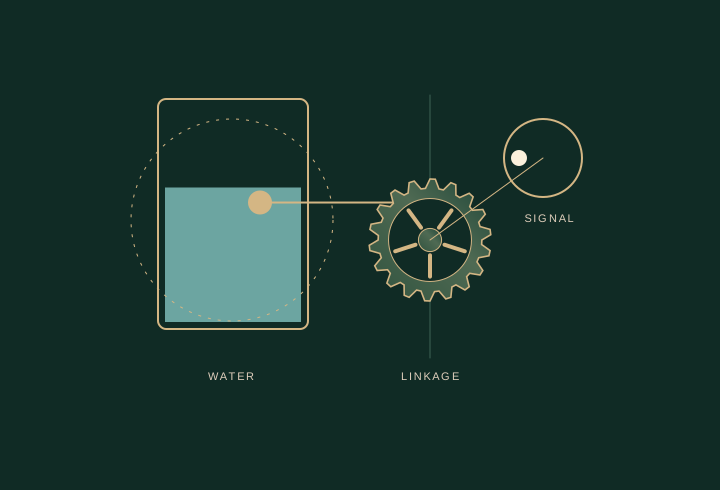
The Met identifies the design as a water clock. At the simplest level, the mechanism turns a controlled process into a signal: water changes a mechanical condition, a release takes place, and linked parts act in sequence. The museum describes half-hour events involving a sounding bird, a falling ball and the elephant’s driver. This summary explains the logic without claiming to reproduce every hidden part.
Separate the timer from the performance. A figure may move dramatically while the important timing action remains concealed. A successful display requires both a dependable interval and a sequence that completes and prepares for repetition. A spectacular motion alone cannot establish that the interval is correct.
Sources for this section
- The Met — Design for a Clock in the Form of an Elephant with an Indian Driver
Collection record identifies a water-clock design and a surviving folio dated 1315. A manuscript representation is not a surviving working medieval mechanism.
- The Met — "The Elephant Clock", Folio from a Book of the Knowledge of Ingenious Mechanical Devices by al-Jazari
Collection record and public-domain object photographs; object dating and attribution follow the museum, including qualifications.
The manuscript is itself an instrument of survival
Look first at what the object actually is: ink, color and gold on paper. It preserves a representation and its place in a technical text. It does not preserve the sound of the original clock, the friction in its joints or a record of its daily error. Those absences are reasons to read carefully, not reasons to dismiss the page.
A modern reconstruction asks a useful experimental question: can an interpretation of the description be made to work? Its success would support that interpretation, while leaving room for differences in materials, dimensions and adjustments. It would not turn modern workmanship into an untouched medieval survivor. For now, the primary artifact is the manuscript leaf itself.
Sources for this section
- The Met — "The Elephant Clock", Folio from a Book of the Knowledge of Ingenious Mechanical Devices by al-Jazari
Collection record and public-domain object photographs; object dating and attribution follow the museum, including qualifications.
- The Met — Design for a Clock in the Form of an Elephant with an Indian Driver
Collection record identifies a water-clock design and a surviving folio dated 1315. A manuscript representation is not a surviving working medieval mechanism.
Another way to ask the sky for time
The neighboring astrolabes offer a comparison rather than a missing piece of the elephant. The Met dates the European example to 1462 and the Persian instrument to 1654–55. Both are later objects. An astrolabe uses marked geometry and a user’s observation to relate the sky to a reading; it need not keep running between observations.
This difference gives the gallery a practical question. Are you looking at an instrument that helps someone calculate, or a machine that carries a process forward and announces its result? Both require knowledge and skilled making. Neither has to be treated as an unfinished attempt at the other, and their dates do not establish a simple line of descent.
Sources for this section
- The Met — Astrolabe
Collection record and public-domain object photographs; object dating and attribution follow the museum, including qualifications.
- The Met — Planispheric Astrolabe
Collection record and public-domain object photographs; object dating and attribution follow the museum, including qualifications.
Continue with the audience, not just the mechanism
The next chapter, The Clock Enters the Town, changes the scale of the audience. A public bell can communicate beyond the people standing beside a machine. Carry this question into it: what must a timekeeper do for its message to be useful to someone else?
For a closer reading here, compare the two Met elephant folios in the source links. One offers the elaborate staged structure; the other isolates the elephant and driver. Comparing records teaches a habit that will matter throughout this atlas: distinguish the object, the explanation and the claim made from them.
Sources for this section
- The Met — Design for a Clock in the Form of an Elephant with an Indian Driver
Collection record identifies a water-clock design and a surviving folio dated 1315. A manuscript representation is not a surviving working medieval mechanism.
Al-Jazari & Farrukh ibn Abd al-Latif
An engineer’s account reaches us through another person’s manuscript work. Both contributions matter: the design needed explanation, and that explanation needed to survive.
Look closer
No. It dates the surviving folio. The treatise belongs to 1206. A copy can preserve an earlier design without becoming contemporary evidence of the original machine’s operation.
Milestones
- 1206 — Al-Jazari presents his treatise on ingenious mechanical devices.
- 1315 — The surviving Elephant Clock folio is dated.
- 1462 / 1654–55 — The two comparison astrolabes belong to later traditions of instrument making.
A question to keep
Self-check: does the date 1315 tell us when al-Jazari wrote the treatise?
Interactive model: text alternative
Energy in a changing level
Some medieval clocks combined water, mechanisms and animated displays. Here a schematic reservoir drives a sequence, rather than reproducing a specific historical machine.
A design on a surviving page
Al-Jazari’s Elephant Clock is described in a surviving manuscript folio dated 1315. That is the date of this copy, not a claim that the device was invented in 1315.
Time becomes an event
The Met describes a sequence of figures and signals recurring at half-hour intervals. A display can announce time through coordinated action, not only a hand on a dial.
Original conceptual flow diagram. It is not an engineering reconstruction of the Elephant Clock.
Archive records and image availability
Museum and archive records
These original image references are retained for review. Follow the collection sources to inspect the objects; the chapter diagram is a conceptual teaching illustration.






Chapter sources and reading notes
- The Met — "The Elephant Clock", Folio from a Book of the Knowledge of Ingenious Mechanical Devices by al-Jazari
Collection record and public-domain object photographs; object dating and attribution follow the museum, including qualifications.
- The Met — Astrolabe
Collection record and public-domain object photographs; object dating and attribution follow the museum, including qualifications.
- The Met — Planispheric Astrolabe
Collection record and public-domain object photographs; object dating and attribution follow the museum, including qualifications.
- Science Museum Group — Ismail ibn al-Razzaz al-Jazari
Museum biographical record supports the treatise’s 1206 date and its written construction instructions. It describes limited knowledge of the author’s life; no invented court scene or universal invention priority is inferred.
- The Met — Design for a Clock in the Form of an Elephant with an Indian Driver
Collection record identifies a water-clock design and a surviving folio dated 1315. A manuscript representation is not a surviving working medieval mechanism.