
Chapter 5 of 15 / Approximately 1250–1500 CE
A town learns to listen.
The public clock changed more than machinery. It gave a community a time that could be heard together.
Stand beneath a tower in imagination. You may not own a watch. You may not even be able to see a dial. A bell still reaches you—and reaches everyone in the surrounding streets.
A clock large enough for a community
During the later Middle Ages, mechanical clocks appeared in European religious and civic settings. The surviving mechanism from Wells Cathedral, usually dated to about 1390, makes that distant change tangible. Its scale belongs to architecture and communal life.
The mechanism is now in the Science Museum in London, while the historic dial remains at Wells. What seems like one clock has a history distributed across places. The museum photographs show a surviving machine in a modern display, not its original installation in a medieval tower.
Sources for this section
- Science Museum — The Wells Cathedral mechanism
Museum account of the surviving mechanism, approximate date and relocation. Not a claim that every part is original.
The weight wants to fall
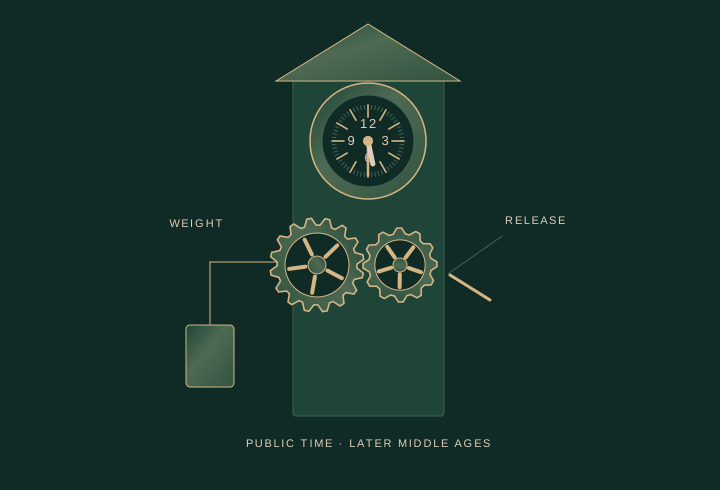
A suspended weight supplies energy through gravity. Left without restraint, it would descend and spend that energy too quickly. Gearing carries the motion; an escapement permits release in successive steps. A regulating system governs the rhythm of those steps.
This separation of jobs is essential. The weight is not the regulator. The hand is not the source of power. The bell is an output that may need its own train and release. Follow the teeth in the close-up photograph, then try the model below. The simplified drawing explains these roles without claiming the exact geometry of the Wells mechanism.
Sources for this section
- NIST — A Revolution in Timekeeping
Archived overview of mechanical regulation and quartz; do not adopt its simplified inventor-priority claims without corroboration.
What a bell can—and cannot—tell us
A public signal allows people to coordinate without owning separate instruments. It can mark work, worship, a meeting or a deadline. But the existence of a tower clock does not mean that everyone suddenly lived by modern minutes, or that every town used the same reference.
There is a social question inside the mechanism: who sets the clock, maintains it and decides what its signal means? A shared indication can be useful and authoritative at the same time. Listen for that question through the later railway and network chapters, where much larger communities try to agree.
Sources for this section
- Science Museum — The Wells Cathedral mechanism
Museum account of the surviving mechanism, approximate date and relocation. Not a claim that every part is original.
Reading a survivor
Old machinery acquires repairs, replacement parts and new settings. Survival is a history of care, not proof that every component is untouched. A museum photograph freezes only one stage in that continuing life.
The Wells frame makes its working relationships unusually visible. Wheels occupy space; shafts have supports; a striking mechanism needs room to act. The future watch will compress comparable jobs into something carried on the body. Miniaturization will change the experience of time, but it will not remove the need to manage energy.
Sources for this section
- Science Museum — The Wells Cathedral mechanism
Museum account of the surviving mechanism, approximate date and relocation. Not a claim that every part is original.
The clock keeper
A weight-driven clock must be wound and attended. The keeper’s work belongs in the story even when the maker’s name is uncertain. The bell heard in the street depends on practical care that most listeners never see.
Look closer
The close-up shows the iron frame, wheels and shafts as physical parts. Open the full-frame view to understand their scale and arrangement. These are photographs of the surviving mechanism.
Milestones
- Late 13th century — Mechanical clocks emerge in European sources.
- c. 1390 — The Wells Cathedral mechanism is generally dated to this period.
- 19th century — The old mechanism moves to South Kensington after replacement at Wells.
A question to keep
Who gets to decide the time that everyone else follows?
Interactive model: text alternative
Gravity does the work
A descending weight supplies energy to a wheel train. Move it down and follow the linked turning wheels.
Energy needs a rhythm
An escapement releases a train in steps. The rotating diagram shows that idea, not the exact geometry of a surviving verge-and-foliot movement.
A public reference
Large mechanical clocks appeared in European town towers during the later Middle Ages. Time could be displayed or announced for a wider community.
Generic weight-driven system; simplified gear ratios and escapement. Not a reconstruction of a named tower.
Archive records and image availability
Museum and archive records
Retained source records. The original images are unavailable here; use the linked collection record. The chapter diagram is an original conceptual illustration.




Chapter sources and reading notes
- Science Museum — The Wells Cathedral mechanism
Museum account of the surviving mechanism, approximate date and relocation. Not a claim that every part is original.
- NIST — A Revolution in Timekeeping
Archived overview of mechanical regulation and quartz; do not adopt its simplified inventor-priority claims without corroboration.
- The Met — Mirror clock
Collection record and public-domain object photographs; object dating and attribution follow the museum, including qualifications.